New music – Guy Johnston’s British cello odyssey

from the press release, edited by Ben Hogwood

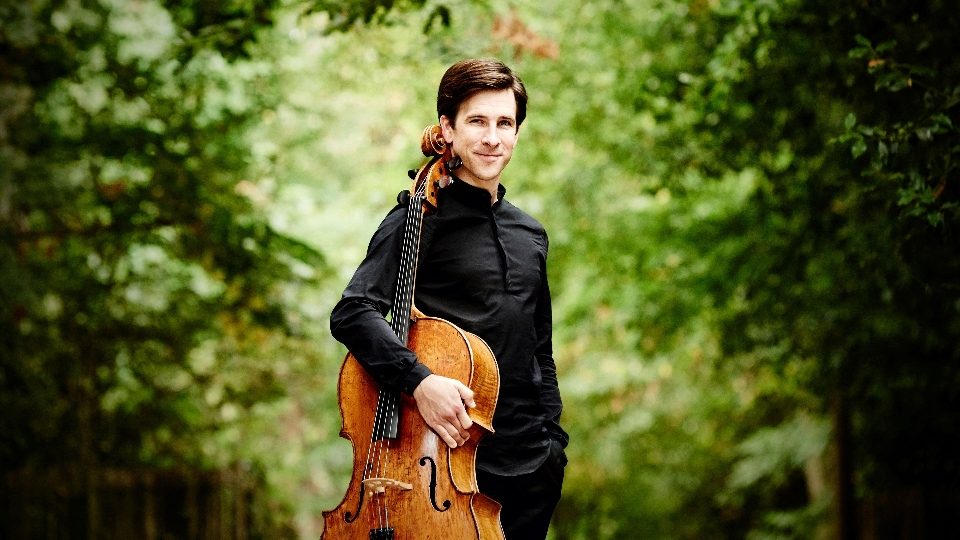
With his 1692 ‘Segelman, ex hart’ Stradivarius Cello, loaned to him from a private sponsor through the Beare’s International Violin Society, Guy Johnston embarks on a British cello odyssey, including the world premiere of a new cello concerto by Joseph Phibbs in January 2026.

To mark Bliss’ 50th anniversary, Johnston’s recording of Arthur BlissCello Concerto with the Royal Liverpool Philharmonic Orchestra conducted by Andrew Manze is released digitally on 25 July, 2025 on Onyx Classics. It will form a later album release with the Britten Cello Symphony.

Following a performance at the 2025 Hatfield Music Festival on 12 October 2025, Johnston will record The Protecting Veil with the Britten Sinfonia directed and led by Thomas Gould in live concerts on 28 and 29 October, 2025 at St. Sophia’s Greek Orthodox Church in London. The album will be released on Signum in the summer of 2026.

Completed in 1988, Tavener’s The Protecting Veil was begun in response to a request from cellist Steven Isserlis for a short piece. It developed into a more substantial work, and was subsequently commissioned by the BBC for the 1989 Proms season. Like many of Tavener’s compositions, this work reflects the composer’s Orthodox religious faith. The inspiration for the piece comes from the Orthodox feast of the Protecting Veil of the Mother of God, which commemorates the apparition of Mary the Theotokos in the early 10th century at the Blachernae Palace church in Constantinople in grave danger from a Saracen invasion.

As Tavener explained, “the cello representers the Mother of God and never stops singing throughout. One can think of the stings as a gigantic extension of her unending song…the first and last sections relate to her cosmic beauty and power over a shattered world.”

Johnston met Tavener on a number of occasions and was touched to be asked by Britten Sinfonia to perform The Protecting Veil last year on the occasion of what would have been the composer’s 80th anniversary. Johnston was keen to record The Protecting Veil at St Sophia’s, where Tavener used to attend mass.

On 16 January 2026, Johnston will give the world premiere of Joseph PhibbsCello Concerto at the Barbican with the BBC Symphony Orchestra conducted by Clemens Schuldt. In 2021, Johnston previously premiered Joseph Phibbs’ Cello Sonata, partly based on an Elizabethan pavane found in the archive of Hatfield House.

Phibbs, who is a huge admirer of Britten, commented,

“The main focus of this concerto is on melody, and how this might be explored in various ways over the uniquely wide range of the cello. The work is symphonic in structure, adopting a multi-movement form as opposed to the traditional three, and ends with a short ‘Vocalise’ (song) for cello and strings which soars to the very top of the cello’s high register. Elsewhere, a dramatic opposition between soloist and orchestra is emphasized. At the forefront of my mind while composing this work has been the wonderfully varied facets of Guy’s playing, which I have admired for many years. It’s been a huge privilege and excitement to write for such a special performer”

In September 2026, Johnston will record Britten’s Cello Symphony with the RLPO conducted by Andrew Manze for Onyx Classics to coincide with the composer’s 50th anniversary (Britten d. on 4 December 1976). The album will include the Bliss Cello Concerto (previously released digitally).

The 2025-2026 season coincides with Johnston’s returns to the Royal Academy of Music as a Professor of Cello. This role will see him offer bespoke tuition to cello students throughout the year. Johnston started out as a professor at the Academy in 2011, later becoming visiting professor. The appointment follows Johnston’s recent relocation back to the UK following his tenure at the Eastman School of Music in Rochester, NY, from 2018 to 2024.

Johnston commented,

“I’m thrilled to have returned last year to the UK with my family for this exciting series of recordings, commissions and performances.”

Published post no.2,600 – Saturday 19 July 2025

In concert – Guy Johnston, Britten Sinfonia / Thomas Gould @ Barbican Hall: The Protecting Veil

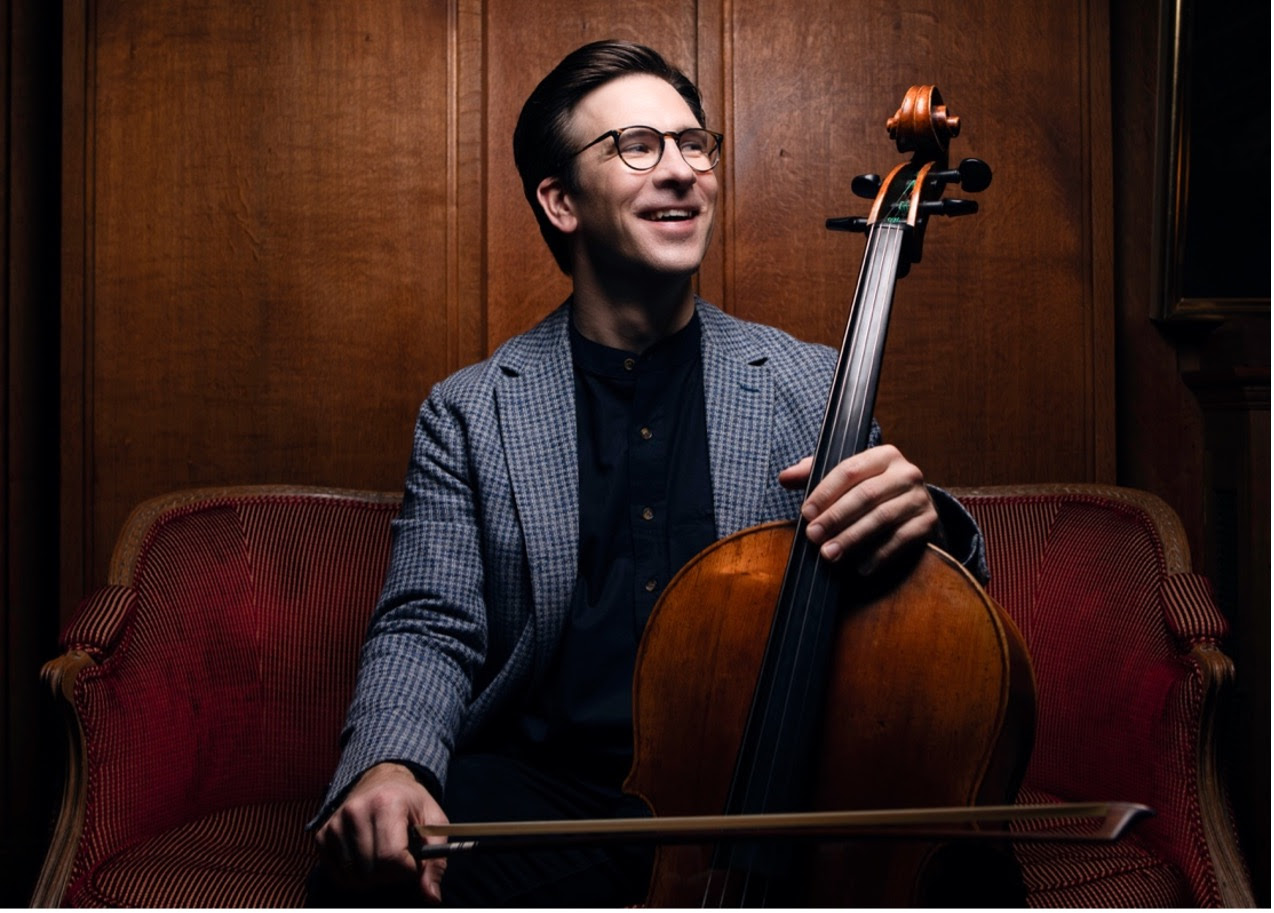
Guy Johnston (cello, above), Britten Sinfonia / Thomas Gould (violin)

Beethoven arr. Weingartner Grosse Fuge Op.133 (1826)
Bartók Divertimento for String Orchestra Sz113 (1939)
Tavener The Protecting Veil (1988)

Barbican Hall, London
Thursday 15 February 2024

Reviewed by Ben Hogwood

The Protecting Veil is a special piece. Written by John Tavener in 1988, this musical meditation for cello and orchestra is based on and inspired by the Greeks resisting Saracen invasion in the early tenth century. They are heartened by a vision of Mary, the Mother of God, surrounded by a host of saints and spreading out her Veil as a protective shelter over the Christians.

In what is effectively a single-movement concerto, the cello represents the Mother of God, leading the string orchestra in eight prayerful chapters that respond to landmark events in which she is present. It may sound elegiac and deeply ambient for much of its duration, but to achieve this elevated state the performers require poise, concentration and inner strength.

It is hard to imagine a better performance than this one experienced at the Barbican. Guy Johnston led us in contemplation, the serenity of his upper register cello line immediately establishing a mood of calm, in complete contrast to the bustling city outside. The Britten Sinfonia responded in kind, conducted where necessary by violinist Thomas Gould but largely following the cello, a congregation responding to his prompting.

In spite of its inner serenity, The Protecting Veil is troubled by the shadows of violence throughout the world. This performance was a stark reminder of how little has changed in eleven centuries, for in the ominous falling motif that recurs for the cello it was impossible not to think of bombs and missiles raining down in the many warzones we see today. The Barbican fell largely silent as those images undoubtedly projected to many listeners, aided by a sympathetic light show that cast the distinctive markings of the back of the stage as a wooden chapel. When Johnston played alone in the central section, The Lament of the Mother of God at the Cross, he could easily have been playing solo Bach, the intimacy of his and Tavener’s thoughts laid bare.

There was, ultimately, consolation and redemption, and the lights burned yellow when the music soared back to the heights with which it began. Feverish anticipation gripped the strings as they responded excitably to the higher cello, and with a surety of tone that never dimmed, Johnston led us to the end. His was a remarkable performance of stamina and poise, those long notes held for what seemed like an eternity, their pure tones never dipping.

The musical contrast with the opening piece, Beethoven’s Grosse Fuge, was notable. Here is a piece that still sounds as new and every bit as challenging as the day it was written, the Everest of fugues. In this arrangement for string orchestra by Felix Weingartner, its angular subject is a touch smoother at the edges, though here the sharp lines were just as clear as in the string quartet original, the fugue subject escaping its restrictions. The Britten Sinfonia found its core in a well-drilled performance.

Bartók’s Divertimento for String Orchestra was lighter in mood to begin with, the ensemble celebrating the great outdoors as the folksy first tune went with a swing. Yet here too there were troubled minds, the slow movement wary of its place in history. Bartók wrote the Divertimento in 1939 in Switzerland, with Europe on the brink of the Second World War. The oppressive approach of the conflict could be felt in a profound slow movement, which began with feathery violas and reached a forbidding climax, emotion wrought from its pages. Those worries were largely banished by the finale, whose powerful unisons were led by Gould as the piece swaggered and bustled to the finish.

Guy Johnston and the Britten Sinfonia continue their tour with The Protecting Veil to Dublin and Manchester – for more details visit the Britten Sinfonia website

Published post no.2,090 – Saturday 17 February 2024

Jennifer Pike and friends – Polish Music Day @ Wigmore Hall

Jennifer Pike (violin), Guy Johnston (cello), Tom Poster (piano)

Wigmore Hall London; Saturday 14 October 2017

Szymanowska Polonaise in F minor / Nocturne in B flat (both c1825)

Knapík Partita (1980)

Górecki Pozegnaie (2009)

Chopin Piano Trio in G minor, Op. 8 (1829)

Reviewed by Richard Whitehouse

This evening’s concert formed the final instalment of an all-day event – as curated by Jennifer Pike (above) – that surveyed Polish chamber music from the Renaissance to the present, so enabling a much wider out-look on this (not least in the UK) little explored area than is usually the case.

Even so, not many such programmes can have opened with pieces by Maria Szymanowski (née Wołowska), whose death in 1831 at only 42 robbed the musical world of an evidently fine pianist and, as evinced by the elegant Polonaise and wistful Nocturne that were played with real poise and feeling by Tom Poster (below), an able composer and the plausible link between Hummel or Field and Chopin, who was surely familiar with her output. No great rediscovery, maybe, but a welcome opportunity to open-out the context of this period within Polish music.

The major discovery came with Partita by Eugeniusz Knapík. Now in his mid-60s, he seems to be among the younger members of a generation as moved away from post-war modernism towards a more traditional, though by no means reactionary discourse. Lasting for almost 30 minutes, this work unfolds from its imposing ‘Entrée’ – far more substantial and emotionally varied than its title might suggest – via a lyrical ‘Air’ in which the influence of Messiaen (this composer’s one-time teacher) was unmistakable; thence on to a central ‘Mouvement’ whose capricious interplay of violin and piano brought with it the most inventive music of the whole work, before a brief while forceful ‘Récitatif’ (mainly for violin) segued into a second though appreciably more sombre ‘Air’ which saw this piece through to a conclusion of tenuous calm.

An uneven though arresting work, then, which Pike gave with unstinting commitment, ably accompanied (an understatement in this instance) by Poster. Hopefully more of his Knapík’s will be heard in due course (his 1971 Violin Sonata just might be a worthwhile place to start).

After the interval, music by Mikołaj Górecki – his brief though undeniably affecting Farewell is not so far removed from some of the later pieces by his father Henryk; albeit with a degree of emotional detachment in keeping with one to has pursued a distinctively classicist idiom.

The main programme concluded with Chopin’s Piano Trio – not a work that tends to receive overmuch praise, but which proved highly enjoyable when rendered with the insight afforded here. A performance such as made light of the awkward tonal follow-through in the opening Allegro, then found due vivacity in the scherzo with its appealingly lilting trio. The Adagio had pathos without undue sentiment, while the finale made much of its folk-inflected themes and underlying krakowiak rhythm as it headed through to a decisive if peremptory close. All three players, not least Guy Johnston (above), made much of their sometimes restricted though never limited roles; suggesting the mature Chopin (his valedictory Cello Sonata uppermost in mind) likely had a masterpiece to contribute to this medium had it not been for his untimely death.

As an encore, Pike introduced a touching piece by Michał Kleofas Ogiński (1765-18330 – his polonaise for piano Farewell to my Homeland (1794) heard in an idiomatic arrangement for piano trio by her father, rounding-off this enjoyable and enlightening evening in fine style.

Photo credits: Jennifer Pike (Eric Richmond); Tom Poster (Toby Poster)

For more concert information on the Wigmore Hall head to their website