
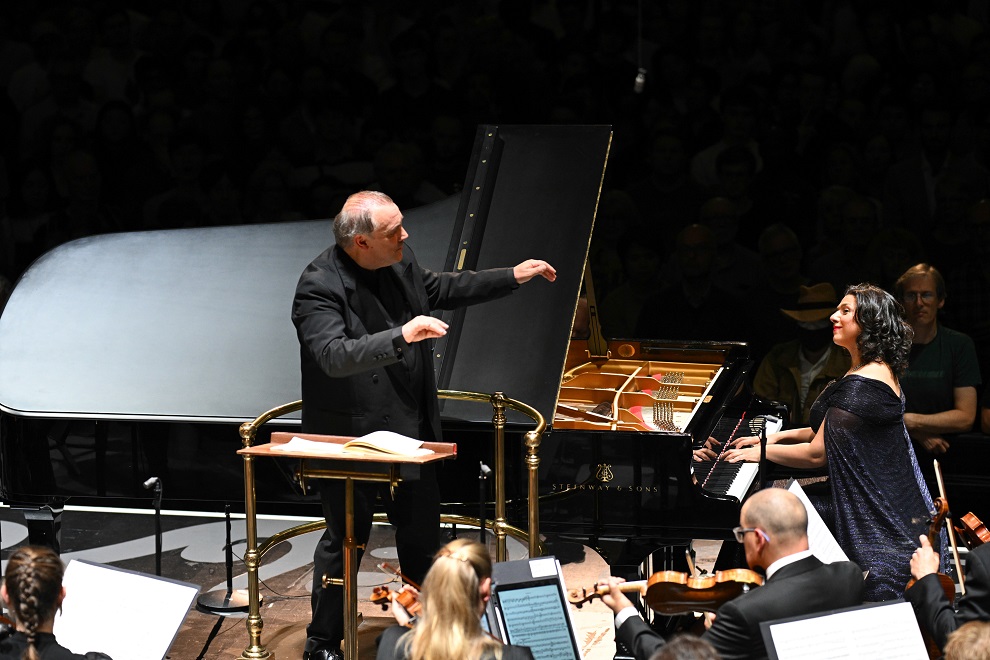
In concert – Khatia Buniatishvili, Melbourne Symphony Orchestra / Jaime Martin @ BBC Proms: Sutherland, Dvořák & Tchaikovsky

Khatia Buniatishvili (piano), Melbourne Symphony Orchestra / Jaime Martin

Sutherland Haunted Hills (1950) [Proms premiere]
Tchaikovsky Piano Concerto no.1 in B flat minor Op.23 (1874-5)
Dvořák Symphony no.6 in D major Op.60 (1880)

Royal Albert Hall, London
Friday 29 August 2025

Reviewed by Richard Whitehouse Photos (c) BBC / Chris Christodoulou

Eleven years after its well-received debut at these concerts under the late Sir Andrew Davis, the Melbourne Symphony Orchestra made its unintentionally eventful return with current chief conductor Jaime Martin and a programme which, for the most part, played to this orchestra’s strengths.

A significant presence in Australian music throughout the mid-twentieth century, Margaret Sutherland has yet to receive her due in live or recorded terms; making this performance of Haunted Hills the more timely. Inspired by the Dandenong Ranges, just outside Melbourne, her symphonic poem evokes the timelessness of its environment as surely as the fate of the Aboriginals who came there. Its starkly dissonant opening then granitic opening paragraph recall that Vaughan Williams’ Sixth Symphony had been unleashed barely two years earlier, and while much of what follows is notable more for its judicious orchestration than formal cohesion, the musical persona that finally emerges is distinctive enough to warrant further hearings of this piece within the context of Sutherland’s not inconsiderable output overall.

Logistical factors necessitated a reordering such that Dvořák’s Sixth Symphony came before the interval. Not a stranger to these concerts (tonight’s being its ninth hearing in 72 years), it responded well to Martin’s interventionist if rarely intrusive approach – not least an opening Allegro (its non tanto duly observed albeit with no exposition repeat) at its most persuasive in a development whose seeming discursiveness was purposefully reined in, and on to a coda whose heightened sense of arrival was mitigated only by those slightly tentative closing bars.
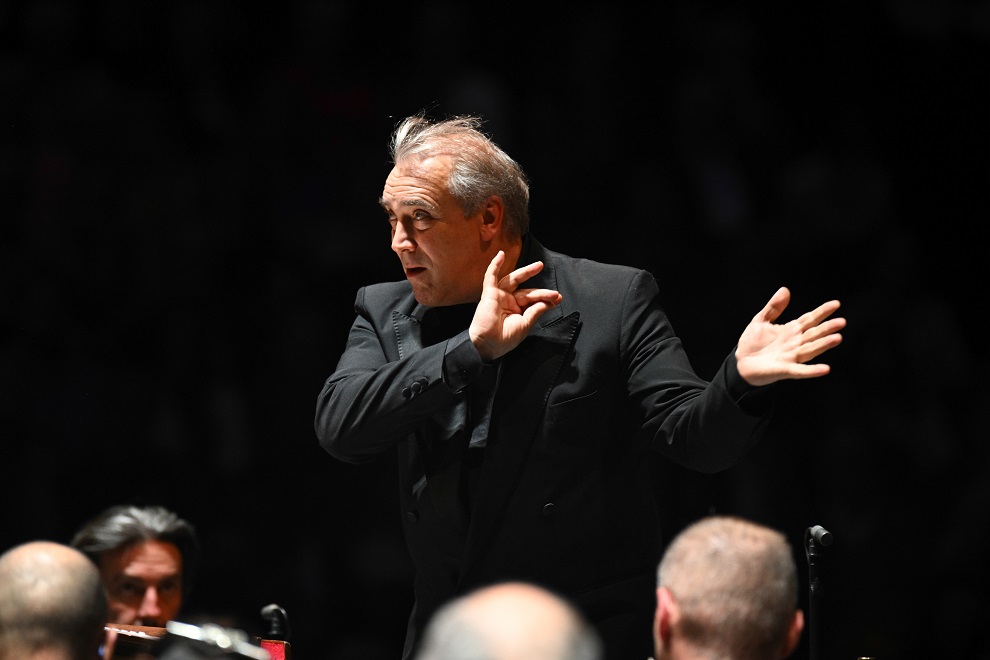
Not the deepest among Dvořák’s symphonic slow movements, the Adagio is surely his most felicitous in its expressive shadings and emotional understatement. Martin made the most of these, as too the contrast between the Scherzo’s impetuous outer sections and its ingratiating trio. The surging acceleration at its close prepared unerringly, moreover, for a Finale as finds Dvořák at his most Brahmsian though, here again, Martin (above), steered a forthright course through its overly rhetorical development before he infused its coda with an exhilarating affirmation.

Tchaikovsky’s First Piano Concerto cannot often have occupied the second half of a concert, though Khatia Buniatishvili made the most of her delayed appearance. Most striking was the amount of hushed playing during a lengthy opening movement whose indelible introduction was kept well within emotional limits. If coordination between soloist and orchestra was not all it might have been, the latter’s entry after a suitably dextrous cadenza was an undoubted highpoint, though not a rather blowsy coda. A melting take on the Andantino was enhanced with poetic contributions from flautist Prudence Davis and cellist David Berlin – while if, in the final Allegro, Buniatishvili’s passagework could seem unnecessarily skittish, she and the Melbourne players came together admirably in a surging but not unduly bathetic peroration.

As to extra-musical occurrences at this concert (for a full BBC account, read here), these artists responded simply by focussing on the music. As an envoi, Buniatishvili’s elegant rendering of the Adagio from Alessandro Marcello’s Oboe Concerto in D minor, arranged by Johann Sebastian Bach, could not have been more fitting.

Click on the artist names to read more about pianist Khatia Buniatishvili, the Melbourne Symphony Orchestra and conductor Jaime Martin. Click also for more on composer Margaret Sutherland, and the BBC Proms

Published post no.2,643 – Sunday 31 August 2025

On Record – Gavin Higgins: The Fairie Bride, Horn Concerto (Lyrita)

Gavin Higgins
Horn Concerto (2023)
Fanfare, Air and Flourishes (2021)
The Fairie Bride (2021)

Marta Fontanals-Simmons (mezzo-soprano), Roderick Williams (baritone), Ben Goldscheider (horn), Three Choirs Festival Chorus; BBC National Orchestra of Wales / Jaime Martin (Horn Concerto), Martyn Brabbins (The Fairie Bride)

Lyrita SRCD440 [84’14”] English/Welsh libretto included
Producer Adrian Farmer Engineer Andrew Smilie

Recorded in Hoddinott Hall, 11 January 2024 (Horn Concerto), Concert Hall, Wyastone Leys, Monmouth, 4 April 2024 (Fanfare, Air and Flourishes), live performance from Gloucester Cathedral on 23 July 2023 (The Fairie Bride)

Reviewed by Richard Whitehouse

What’s the story?

Lyrita adds to the already growing discography of Gavin Higgins (b.1983) with this release featuring two recent major works, both of which are heard in their first performances and thereby confirm this composer’s place among the leading British voices of his generation.

What’s the music like?

Listeners may have come across Higgins’s music via the release Ekstasis (see the link below), a collection of chamber pieces which attests to a distinctive and searching personality. Such is equally true of those here, not least the Horn Concerto that takes its place in a notable lineage of such works ‘in E flat’, while taking in Schumann and Ligeti as part of its range of stylistic or conceptual allusions. Its three movements have as their inspiration the Waldhorn – the first, Understorey, duly outlining an emergence from the (Wagnerian) depths to the forest floor in mounting waves of activity. There follow Overstorey with its airily expressive evocation of the forest canopy as builds considerable fervency over its course, then Myelium Rondo with its overtones of the hunt and energetic fanfares which propel this work to an affirmative close.

No stranger to the horn (being his own instrument), Higgins had indirectly prepared for this concerto with Fanfare, Air and Flourishes, a brief but eventful solo triptych which tries out several gestures or motifs to be developed in the larger work as well as in his second opera.

Commissioned by the Three Choirs Festival, The Faerie Bride takes a legend from the Book of Hergest for its synopsis of the coming together but eventual (its being inevitable) disunion between water spirit and earthly man. This is played out over seven scenes divided into two parts – Francesca Simon’s succinct yet artfully constructed libretto moving from their initial encounters at the lake, via the gradual dissolution of their relationship through events during each of the four seasons, to a climactic juncture when the woman returns with her extended family into the depths. Musically the work encompasses the range of Higgins’s idiom up to this point, its richness and variety of texture complemented by an instrumental clarity which ensures vocal audibility throughout – certain discrepancies between the libretto as published and as sung being immediately evident. That this opera keeps its emotions close to its chest much of the time only makes the closing stages the more powerful, not least in the way the ending reaches back to the beginning for a tangible sense of resolution borne of experience.

Does it all work?

Yes, in that Higgins is able to integrate his influences into a coherent and personal language. It helps that these performers are audibly attuned to this music – not least Marta Fontanels-Simmons as an otherworldly Woman and Roderick Williams as the uncomprehending Man – with Ben Goldscheider a consummate exponent of works for horn. The Three Choirs Festival Chorus characterizes the Villagers with suitable aggression, while Jaime Martin and Martyn Brabbins secure idiomatic playing of real finesse from the BBC National Orchestra of Wales.

Is it recommended?

Very much so. Those yet to do so should certainly acquire the earlier release on Nimbus, but the works featured here round out the potency of Higgins’s music accordingly. Detailed and informative notes by Gillian Moore, though watch out for those discrepancies in the libretto.

Listen & Buy

For purchase options, you can visit the Ulysees Arts website. For information on the performers, click on the names to read more about Ben Goldscheider, Marta Fontanals-Simmons, Roderick Williams, Jaime Martin, Martyn Brabbins and the BBC National Orchestra of Wales. Click to read more about composer Gavin Higgins and about Ekstasis

Published post no.2,465 – Thursday 6 March 2025