Arcana at the Proms – Prom 50: Mao Fujita, Prague Philharmonic Choir, Czech Philharmonic Orchestra / Jakub Hrůša – Dvořák Piano Concerto, Kaprálová & Janáček Glagolitic Mass

Kaprálová Military Sinfonietta Op.11 (1937) [Proms Premiere]
Dvořák (ed. Kurz) Piano Concerto in G minor Op.33 (1876)
Janáček Glagolitic Mass (1926-8)

Mao Fujita (piano); Corinne Winters (soprano), Vella Adamova (mezzo-soprano), David Butt Philip (tenor), Brindley Sharratt (bass), Christian Schmitt (organ), Prague Philharmonic Choir (choir-master Lukáš Vasilek), Czech Philharmonic Orchestra / Jakub Hrůša

Royal Albert Hall, London
Wednesday 28 August 2024

reviewed by Richard Whitehouse Photos (c) Andy Paradise

Their previous Prom having set the bar high as regards playing or interpretation, Jakub Hrůša and the Czech Philharmonic Orchestra equalled and maybe even exceeded it with a programme which once more ranged widely over what might be thought the ‘golden age’ of Czech music.

The career of Vítězslava Kaprálová (1915-40) represents one of those great ‘what ifs’ in 20th century music and works such as Military Sinfonietta confirm her already distinctive idiom. Despite involvement with Martinů, this is redolent more of interwar French music – notably Roussel – in its alternating between the extrovert and the ruminative; relative extremes held in check by ingenious adaptation of the four-movements-in-one design that draws maximum variety from its material while sustaining a cumulative momentum through to a return of the main theme for a powerful but never bombastic apotheosis. The CPO certainly relished these strongly drawn expressive contrasts, and Hrůša kept it on a tight though never inflexible rein with the sizable groups of woodwind and brass duly given their collective head at the close.

Although it has come in from cold over recent decades, Dvořák’s Piano Concerto remains an anomaly – akin to one Mendelssohn or Chopin might have written had they lived into the mid -Romantic era. Numerous pianists have returned to the demanding if unidiomatic solo part as its composer left it, but Mao Fujita (above) opted for that edited by pianist Vilém Kurz which enjoyed favour across much of the last century. Musically the piece remains much the same – opening with an extensive Allegro trenchant and yielding, but with surprisingly little of a Czech tinge to its melodic or rhythmic content. Fujita delivered a confident traversal, then brought limpid poetry to the Andante with Hrůša’s accompaniment of the subtlest. They duly made the most of the final Allegro’s driving impetus and soulful poise, prior to its lively and decisive close.

Despite early advocacy from Henry Wood, Janáček’s Glagolitic Mass only established itself at the Proms half a century after the composer’s death. Recent seasons have brought varying versions of what Janáček (might have) intended, but Hrůša chose the standard edition with a reading of blazing conviction right from the stentorian brass of its ‘Introduction’. Compact in size but forthright in tone, the Prague Philharmonic Choir brought pathos to the ‘Kyrie’ then fervency to the ‘Gloria’ with Corinne Winters and David Butt Philip fearless in their response.

More than usually a fulcrum around which this work revolves, the ‘Credo’ evinced an almost narrative dimension in its journey via speculation and ambiguity to a conclusion – typified by Brindley Sherratt’s eloquence – of radiant certainty. This carried over into the ‘Sanctus’ both sensuous and capricious, Bella Adamova making the most of her ensemble contribution here then in the ‘Agnus Dei’ whose intimation of doubt is brusquely denied by the ‘Postludium’ – a vigorous workout for solo organ in which Christian Schmitt (above) decisively assumed the limelight.

It remained for the ‘Intrada’ to round off proceedings with its pounding timpani and exultant trumpets – so setting the seal on a memorable concert which, as with its predecessor, is likely to prove a highlight of this Proms season: music-making as it can and should be experienced.

You can get details about this year’s season at the BBC Proms website – and you can click on the names to read more about pianist Mao Fujita, the Czech Philharmonic Orchestra and conductor Jakub Hrůša

Published post no.2,285 – Friday 30 August 2024

Arcana at the Proms – Prom 49: Anastasia Kobekina, Czech Philharmonic Orchestra / Jakub Hrůša – Dvořák Cello Concerto & Suk ‘Asrael’ Symphony

Dvořák Cello Concerto in B minor Op.104 (1894-95)
Suk Symphony no.2 in C minor Op.27 ‘Asrael’ (1905-06)

Anastasia Kobekina (cello), Czech Philharmonic Orchestra / Jakub Hrůša

Royal Albert Hall, London
Tuesday 27 August 2024

reviewed by Richard Whitehouse Photos (c) Andy Paradise

First heard at the Proms in those testing times of 1969, the Czech Philharmonic Orchestra has since appeared at these concerts with some frequency during the past quarter-century, and this evening brought the first in a pair of concerts with its principal guest conductor Jakub Hrůša.

Each of these Proms features a Dvořák concerto, with that for cello undertaken by the highly regarded Anastasia Kobekina. The opening Allegro evinced an elegance and understatement abetted by the chamber-like interaction, Kobekina’s line faltering only marginally in its more intensive passagework, though the thrilling ascent up to the reprise of the second theme went for relatively little and its coda rather lacked decisiveness. Much the highlight was an Adagio of ruminative warmth and, after its restless central section, an exquisite poise when the main melody is entrusted to the soloist prior to a melting close. The final Allegro too went well for much of its length, but a tendency to drift came to the fore in its extended coda – Kobekina’s response rather selling short its pathos and, in turn, the inevitability of the orchestral pay-off.

A fine if not overly memorable account, but Kobekina (below) is an artist of style and personality – as she demonstrated in the rendition of Gallardo (Variations on an Ancient Theme) by her father Vladimir Kobekin, Pavel Polívka providing tambourine accompaniment for this lively encore.

Having already made two recordings and given a memorable account with the Philharmonia a decade ago, Hrůša is evidently on a mission to establish Suk’s ‘Asrael’ Symphony in the wider repertoire and tonight’s reading did not disappoint. Especially impressive was his maintaining emotional intensity across those three movements that make up its first part – the introduction to the opening of them starkly drawn so what followed needed only an incremental impetus to sustain itself over a complex yet cohesive sonata design then on to a peroration whose despair was unremitting. The intermezzo found ideal an accord between its ‘otherness’ and that ironic ambiguity where Mahler’s influence is apparent, its teetering on silence a foil for the scherzo whose anxiety was soulfully waylaid by the trio before it exploded in fury towards the close.

What had begun as the commemoration of Dvořák (Suk’s teacher) became a memorial to his daughter Otilie (Suk’s wife) in its second part. Compassionate but never cloying, the opening Adagio was enhanced by some alluring woodwind and an eloquent contribution from leader Jan Mráček as underlined the significance of solo violin for Suk’s output overall. Its subdued close was brusquely denied by timpani at the outset of the finale – a relatively loose but never diffuse structure, the headlong clamour of whose central build-up carried over into a dramatic climax before this subsided unerringly into the lengthy coda. The composer was explicit as to the nature of the latter – its barely fulfilled serenity perfectly captured by Hrůša as this music reaches, if not benediction, at least that repose from where further creativity became possible.

Acknowledging considerable applause, Hrůša explained that no encore would be played given how apposite were the final bars in their countering the ‘‘crazy world’’ around us. Something which could overall be said of what was a highly perceptive and often profound performance.

You can get details about this year’s season at the BBC Proms website – and you can click on the names to read more about cellist Anastasia Kobekina, the Czech Philharmonic Orchestra and conductor Jakub Hrůša

Published post no.2,287 – Wednesday 28 August 2024

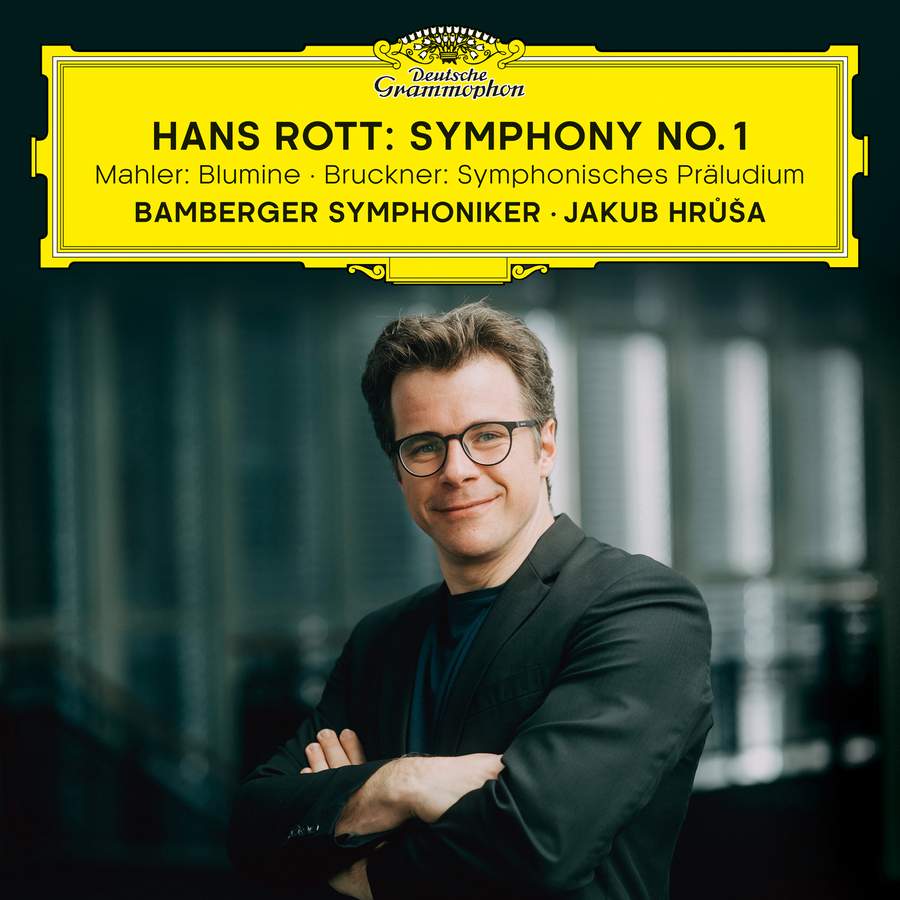
On Record: Bamberger Symphoniker / Jakub Hrúša – Hans Rott: Symphony no.1 (Deutsche Grammophon)

Rott Symphony [no.1] in E major (1878-80)
Mahler Andante allegretto in C major ‘Blumine’ (1884)
Bruckner Symphonic Prelude in C minor WAB297 (1876)

Bamberger Symphoniker / Jakub Hrúša

DG 486 2932 [70’11”]

Producers Sebastian Braun (Rott, Bruckner), Johannes Gleim (Mahler)
Engineers Markus Spatz (Rott), Christian Jaeger (Mahler), Thorsten Kuhn (Bruckner)

Recorded September and October 2021 (Rott), December 2021 (Mahler), March 2022 (Bruckner) at Joseph-Keilberth-Saal, Konzerthalle, Bamberg

reviewed by Richard Whitehouse

What’s the story?

Jakub Hrúša makes its debut on Deutsche Grammophon with a new account of the Symphony by Hans Rott (1858-84), whose belated premiere some 33 years ago prompted a reassessment (still ongoing) as to the evolution of this genre during those final decades of the 19th century.

What’s the music like?

Much time and space has been expended on the indebtedness (or otherwise) of Mahler to this work – elements from which can be found in at least five the younger composer’s symphonies – yet equally fascinating is the audible influence it had upon those who came before and after; hence the first movement from Bruckner’s Seventh and the second movement from Schmidt’s First – both of which are similarly grounded in E major). Without seeking to present it as an unalloyed masterpiece, Hrúša makes a persuasive case for a piece that Rott would doubtless have overhauled had his mental state not deteriorated soon after its completion. He finds the right balance between grandeur and introspection in the preludial Alle breve, as between that raptness which briefly though pointedly erupts into anguish in the Sehr langsam that follows.

The Scherzo is the most convincingly realized movement and Hrúša has the measure of its animated main theme with undertones of polka, broadening into the ländler-derived suavity of its trio before regaining its earlier vigour vis an ostinato-like impetus barely held in check – the accelerando not necessary in this instance. Nor does he disappoint in the finale. Much the longest movement, this is easily criticized for diffuseness but, as Hrúša makes plain, the formal ground-plan – prelude-chorale-fantasia-fugue-stretto-postlude – (such as the organist Rott likely extemporized before committing to paper) is readily perceivable and is invested with cumulative momentum sustained to the beatific concluding bars. That the composer so nearly brought off this ambitious conception is surely more significant than any shortcoming.

Couplings have been judiciously chosen to open-out the context of the main work. Included in early hearings of his First Symphony, Blumine is a remnant from Mahler’s early orchestral projects lost to history and Hrúša brings out those expressive ambiguities as offset the lilting trumpet melody. Once attributed to Mahler, Symphonic Prelude is now believed an exercise from Bruckner’s composition class and Hrúša, adhering to the original orchestration rather than that by Albrecht Gürsching, duly makes the most of its ominous and plaintive musings.

Does it all work?

It does. In his accompanying booklet observation, Hrúša reflects on the musical and historical relevance of Rott’s Symphony and there can be little doubt that, among the dozen or so other recordings of this piece, this is the most convincing in terms of all-round cohesion as also the excellence of the playing by the Bamberg Symphony (whose chief conductor Hrúša has been since 2018). A little too forwardly balanced in tuttis, sound otherwise reflects the excellence of the orchestra’s home-venue – Rott’s extensive use of triangle kept within sensible bounds.

Is it recommended?

It is. Those coming to the main work for the first time should certainly makes its latest release their first port-of-call, and it would be worthwhile DG continuing this association with Hrúša and the Bamberg in other mid-European music from the late Romantic and early Modern era.

Listen

Buy

You can listen to clips and get purchase options from the Deutsche Grammophon website

On Record – Bamberger Symphoniker / Jakub Hrůša – Bruckner 4: The Three Versions (Accentus)

Bruckner (ed. Korstvedt)
Symphony no. 4 in E flat major ‘Romantic’ – 1874, rev. 1875/6; 1878-80, rev, 1881; 1887, rev. 1888. Finales – 1878 ‘Volksfest’; 1881. Earlier drafts and versions

Bamberger Symphoniker / Jakub Hrůša

Accentus Music ACC30533 [four discs, four hours 34 minutes]
Producers: Sebastian Braun, Bernhard Albrecht; Engineers: Markus Spatz, Christian Jaeger
Date: November 2020 at Joseph-Keilberth-Saal, Konzerthalle, Bamberg

Reviewed by Richard Whitehouse

What’s the story?

Jakub Hrůša directs the Bamberg Symphony Orchestra – whose chief conductor he has been since 2016 – in this survey of Bruckner’s Fourth Symphony: three ‘versions’ of the complete work, together with two additional versions of the finale plus over a dozen sundry excerpts.

What’s the music like?

Evidently this project had its basis in a period of lockdown during the Covid pandemic, thus enabling a focus on one specific piece such as would have been unfeasible under more usual working conditions. How one responds to it depends, firstly, on how one sees the legitimacy of the ever-increasing editions of Bruckner symphonies; secondly, on the qualities – whether interpretative or executive – of these performances. Certainly, the identity of this conductor with this composer – whose music he has not previously recorded – can hardly be gainsaid.

Undoubtedly the highlight here is the 1874 version, of which this is the first recording in its 1876 revision – significant in that Bruckner clearly intended for the work to be heard in this guise, rather than its being a ‘first attempt’ shelved on completion. Hrůša might have taken the opening movement at a swifter underlying tempo, but its relatively prolix course is well articulated; as is that of the Andante whose course might seem circuitous compared to later versions, but which eschews discursiveness even so. Its close, moreover, provides a catalyst for the scherzo: too often dismissed as a failure, but recklessly imaginative in its expressive character and benefitting here from the revision’s excision of those pauses between sections. Even finer here is the finale, one whose supposedly lightweight content belies its rhythmic propulsion or a stealthily accumulating momentum unequalled by either revision – certainly not in so viscerally energetic a coda. The Bambergers give their all, while confirming that what Bruckner got wrong here was not necessarily put right in either of those later versions.

The 1878-80 version has become the preferred option in the post-war era, the streamlined trajectories of its initial two movements being more easily absorbed by listeners and more comfortably navigated by the musicians. Without yielding any revelations, Hrůša has their measure – not least a magisterially projected coda in the former or an inexorable approach   to the latter’s climax. The spacious acoustic of Joseph-Keilberth-Saal endows a convincing overall perspective but not the ultimate clarity, such as marginally obscures cross-rhythmic interplay of the brass during the Scherzo’s cumulative passages but ensures an ethereal aura in its trio. The Finale emerges broadly and patiently: maybe too much depending on whether one hears this version as the natural outcome of its music’s thematic potential, or an attempt to make this movement a weightier and more serious culmination that leaves an inevitable self-consciousness in its wake. Hrůša seems to have his doubts, though not in a fervent and headily cumulative account of what is undeniably among the most eloquent Bruckner codas.

The 1888 version is that by which earlier generations came to know this piece, making its latter-day rehabilitation the vindication of Bruckner’s final thoughts or an editorial cash-in according to vantage. Whether or not determined primarily by the composer or by his self-appointed acolytes, the cloyingly enriched harmony or theatrical reorchestrations speak of     a desire to ‘sell’ the ‘Romantic’ as a would-be-Wagnerian equivalent to the symphonies of Brahms. Qualities, moreover, which Hrůša tacitly acknowledges in a dependable but often detached reading – tacitly underlining the myriad textural changes without ever seeking to condone them. Neither does he shirk from following those inane truncations as the Scherzo proceeds into then out of its trio, such as conductors who otherwise adhered to this version were wont to ignore, nor the excisions meted out on the Finale as only serve to fracture an already unwieldy and formally disjunct design. As with the final revisions of his first three symphonies, this is worth hearing in context but not as means to any deeper appreciation.

The fourth disc consists of 14 excerpts, mainly of variants from the second version Bruckner amended during the revision process. Few will need to hear these more than twice, as is also true of an 1881 finale differing only incrementally from that found in the main performance (and which would have been more worthwhile had it featured the coda’s 1886 amendment). More valuable is the inclusion of the Volksfest finale as originally intended for the second version, and which Bruckner rightly recognized as a transitional version towards one that he was never to get quite right. As it stands, though, this alternation between the humorous and portentous makes an engaging piece in its own right; one that could even now find favour as a concert overture or even symphonic poem such as the composer never actually envisaged.

Does it all work?

That depends on whether you regard it as legitimate to release a set as contains three versions of just one piece. Editorial reservations as there are focus on whether Benjamin Korstvedt has exceeded his remit by presenting his editions as being of comparable validity, which is hardly unknown in latter-day academic practice (Simon Rattle’s account of this work, due from LSO Live, takes a similar if less inclusive approach using the editions of Benjamin-Gunnar Cohrs). As to performances, those who already have accounts of the 1874 version by Michael Gielen (SWF Music) or Simone Young (Oehms Classics), the 1887 version by Osmo Vänskä (BIS) and 1878-80 version by upward of a dozen conductors can rest content. Hrůša is evidently a Bruknerian of note, however, and his perspective on this piece is well worth getting to know.

Is it recommended?

Indeed. The presentation, four discs in a slipcase plus a booklet featuring detailed notes from Korstvedt and a thoughtful interview with the conductor, is stylishly economical. Those most redoubtable among the ‘usual suspects’ might dissent, but this project is its own justification. Note too that Hrůša and the Bamberg have a recording of the ‘First’ Symphony by Hans Rott – now regarded as the aesthetic link between Bruckner and Mahler, pertinently coupled here with the former’s Symphonic Prelude and the latter’s Blumine – due out on DG this October.

For further information on this release, you can visit the Accentus website, and you can purchase by clicking on the link from Presto Music. Click on the names for more information on the Bamberg Symphoniker and their chief conductor Jakub Hrůša