Wigmore Mondays – Baiba and Lauma Skride play Nordic works for violin and piano

skride

Baiba Skride (violin) and her sister Lauma (piano, both above)

Wigmore Hall, London, 2 May 2016

written by Ben Hogwood

Audio (open in a new window)

http://www.bbc.co.uk/programmes/b078wy1n

Available until 31 May

What’s the music?

Sibelius Four Pieces Op. 78 (1915-17) (13 minutes)

Vasks Maza vasaras muzika (Little Summer Music) (1985) (10 minutes)

Rautavaara Summer Thoughts (1972/2008) (4 minutes)

Nielsen Violin Sonata No. 2 in G minor Op. 35 (1912) (20 minutes)

Spotify

In case you cannot hear the broadcast, recordings of the music played can be found on the Spotify playlist below. Neither of the Skride sisters have recorded this repertoire before, but there are other versions picked out instead:

About the music

An intriguing program based on the first instrument of composers Sibelius and Nielsen – the violin. While both composers wrote violin concertos that are either extremely well known (Sibelius) or appreciating gradually (Nielsen) their music for violin and piano is almost shrouded in secrecy.

Sibelius wrote a few sonatas but much more in the way of short pieces for violin and piano, many of which were requested as commissions for the salon market. The four here are characteristic examples of a composer who uses economy in his writing, often ending his pieces abruptly but using music of charm and poise – and inventive textures.

Nielsen’s Violin Sonatas are rarely heard, but the second sonata, completed in 1912, is a substantial piece that shows the composer’s ease with dealing in bigger forms of music. The second sonata falls between the third and fourth symphonies in his output.

We also hear shorter pieces for violin and piano by two composers heavily influenced by Sibelius and Nielsen, the Latvian Peteris Vasks and Finnish composer Einojuhani Rautavaara. The warmth felt in both sets of pieces show how Nordic music is not just about the cold!

Performance verdict

Arcana was not at the concert at the Wigmore Hall, but listening to the broadcast it is clear of the involvement both performers have in these works.

The deep-seated passion running through the third of the Sibelius pieces is striking and intense, with the technical mastery of what sounds like a tricky Rigaudon very stylishly achieved.

If anything the Second Violin Sonata of Nielsen carries a greater impact, for this is an impressive piece of work whose stature grows with each hearing. It is unjustly neglected for sure, and the Skride sisters give it an excellent performance here, the violinist’s tone especially impressive in the longer notes used by the composer for many of his themes.

Providing light for the relative shade are the works by Vasks and Rautavaara, full of charm, warmth and melodic invention. They complete a program with an outdoor feel, and both performers give this seldom-heard music the fresh performances it deserves.

What should I listen out for?

Sibelius

1:57 Impromptu The first piece of the four has a dreamy piano and more energetic violin, which feels free spirited over the relatively static harmony.

4:01 Romance The sweet tone of the romance is carried by the violin’s melody over a calm piano accompaniment. There is a childlike quality to the main material reminiscent of Schumann, but the music becomes more passionate.

7:14 Religioso A heavier feel to this, especially in the piano, which uses more of the keyboard in its part, and the lower register of the violin too. A melancholy piece.

12:55 Rigaudon A French dance that starts commandingly in the major key but then has a brief shadow of darkness (13:19) when it shifts into the minor. The rhythm is often syncopated in a way that suggests the tango, and the piece ends abruptly – as so many Sibelius pieces do!

Vasks

16:42 The opening section of this piece (marked Breit, Klangvoll) sounds like bird calls exchanged between the violin and piano.

17:55 A slow episode (marked Nicht Eiland), sweetly sung by the violin.

19:27 A dance, led by the violin, with a rustic, outdoor feel.

21:10 The music takes a serious tone, moving to a minor key, and appears lost in thought.

23:53 –  a glittering descent on the piano (a glissando) introduces another folksy section, with an outdoor feel.

25:21 – once again we hear the first section, with its bird calls.

Rautavaara

27:14 – Rautavaara’s interpretation of summer is a dreamy one, with a wandering line on the piano, but it gradually gathers its intensity for a passionate middle section, falling back and then gathering once again with the violin holding long, lyrical notes. It then fades into the middle distance.

Nielsen

32:25 – initially the mood is calm, starting on the lowest note of the violin, but the music wanders and soon the violinist is taking charge of a passionate section that includes a grand theme in C major around 34:31. By 37:30 the music is a little lighter on its feet but the exchanges continue to brim with passion. The movement ends with reflection at 39:40.

39:55 – the slow movement begins with a broad melody from the violin. The long notes are countered with a restless piano part. That spills over into a fraught statement at 40:48, after which the music calms down. The piano figure can never be fully shaken off however, and even when the movement ends sweetly at 46:48 it does so with the two note progression the piano used almost all the way through.

47:18 – the third and final movement flows with more serenity, and then the piano at 48:44 introduces a jubilant episode, joined in a high register by the violin. By this point the music has reached E major – the same key Nielsen uses as a home base in his exuberant Symphony no.4 (the Inextinguishable). The music gathers greater energy, and at 51:10 the piano hammers out brittle, percussive notes before the music fades to end.

Encore

53:11 – the Mazurka by Sibelius, Op.81/1, the first of five published pieces. This is a piece with plenty of fire in its introduction, but charm when the theme is heard again, softly, at 53:52. The violin has to move between passionate low register tune and a swift upsurge to the high register.

Further listening

Baiba Skride has recorded both the Sibelius and Nielsen Violin Concertos, and these can be heard in company with Sibelius’ 2 Serenades for violin and orchestra. They are on Spotify here:

Wigmore Mondays – Esther Yoo & Zhang Zuo play Mendelssohn & Sibelius

esther-yoo

Esther Yoo (violin), Zhang Zuo (piano)

Wigmore Hall, London, 21 March 2016

written by Ben Hogwood

Audio (open in a new window)

http://www.bbc.co.uk/programmes/b07457qx

Available until 20 April

What’s the music?

Bach – Chaconne from the Solo Violin Partita no.2 in D minor, BWV 1004 (c1720) (15 minutes)

Sibelius – Sonatina for violin and piano in E major, Op.80 (1915) (12 minutes)

Glazunov – Grand Adagio from Raymonda (Act 1) (1898) (4 minutes)

Mendelssohn – Violin Sonata in F major (1838) (21 minutes)

Spotify

In case you are not able to hear the radio broadcast, here is a link to a playlist of the music played. Esther Yoo has not recorded any of it in violin and piano form, so substitute versions have been used:

About the music

Sibelius wrote a great deal of music for the violin but other than the famous Violin Concerto, very little of it is heard regularly these days. It is therefore a refreshing change to see the E major Sonatina listed. A relatively short work, it helped Sibelius through a particularly testing time with his finances.

Mendelssohn has a number of parallels with Sibelius where the violin is concerned, writing a famous Violin Concerto that gets played at the expense of pretty much everything else. Once again in this case there are works for violin and piano, and the Violin Sonata chosen for this concert is the most substantial, completed in 1838. For some unexplained reason it was not published in Mendelssohn’s lifetime, and was resurrected by Yehudi Menuhin in the 1950s.

Esther Yoo begins the concert alone, with Bach’s famous Chaconne – taken from his Solo Violin Partita no.2. It is a landmark in solo instrument writing, a tour de force of 64 different versions of the same sequence of chords that Bach develops with ever greater virtuosity.

She complements the Sibelius, meanwhile, with a short piece – an excerpt of a love scene from Glazunov’s ballet Raymonda.

Performance verdict

A refreshing program from Esther Yoo, who has just recorded a very well-received disc of Sibelius and Glazunov with Vladimir Ashkenazy.

It was particularly good to report a rare outing for the Sibelius Sonatina, a piece with energy and fresh invention that definitely sweeps away the cobwebs! Yoo and her musical partner Zhang Zuo (known as ‘Zee-Zee’) gave a performance full of enthusiasm and energy, giving Sibelius’ melodies a real shot in the arm. Prior to this Yoo had greatly impressed with her account of the Bach Chaconne, a deliberately slow and careful start gathering in pace and intensity, taking the fearsome technical challenges in her stride.

Glazunov’s Grand Adagio made a fitting complement to the Sibelius, invested with suitable passion, but the real discovery was the Mendelssohn, a piece of great craftsmanship and, in the slow movement, a depth of feeling unusual even for him. The two performers had great chemistry here and clearly enjoyed their interactions through the faster music, taking time in the slow movement to let the hymn-like passage sing.

An excellent concert concluded with a Korean folksong arranged for violin and piano, played with delicacy and then great gusto!

What should I listen out for?

Bach

1:28 – the violin begins with a grand statement of a chord sequence which it then proceeds to spin out over 64 variations, reaching great intensity in the string crossing around 7:30. The variations are set mostly in the minor key but move to the major at 9:15. Bach gives an enormous variety of colour, speed, attack, repose and musicality, starting relatively slowly but moving to passages of increasing difficulty and intensity, notably the string-crossing passage mentioned above, but this is also one of his most profound pieces of music when interpreted well. The music turns back to the minor key with impressive dramatic effect.

Bach often asks for the violin to employ ‘multiple stopping’; that is, playing more than one note at a time – which means the music can sound as though it is in many parts, despite still being played on the one instrument.

Sibelius

18:49 – a bold start from Sibelius, with the colour from the piano recognisably his. The grand introduction cuts to a quicker theme at 19:30 which suggests the outdoors. The music trips along at quite a pace – as so often Sibelius suggesting quick movement in his music. It also ends with a typical lack of fuss.

22:25 – the thoughtful second movement starts to spread its wings with the emergence of a rather beautiful melody from the violin.

27:03 – a broad melody on the lower register of the violin restores a grand air to the piece, though soon the violin twists upwards. The music gets faster again, returning us to the spirit of the first movement, with energy and grace in equal measure. Up to the end it becomes increasingly breathless, Sibelius throwing in a surprisingly light finish.

Glazunov

31:05 – as you might expect from a declaration of love in a Russian ballet, this is deeply passionate music, with a melody tailor made for the violin. With long phrases and sweeping gestures the music swoons. The violin reaches for the heights around 34:35, before sinking gracefully into a soft coda.

Mendelssohn

36:47 – it is difficult to understand why Mendelssohn did not publish his Violin Sonata when it starts as brightly as it does in this performance. A distinctive theme leads to close interplay between violin and piano. This being Mendelssohn there is a typically busy piano part, but there is a particularly nice, spring-like passage around 40:00 where the music slows and the composer’s lyrical side comes out.

45:38 – the slow movement is an unexpected treat, one of Mendelssohn’s most searching emotionally. It begins with a solemn statement on the piano, joined by the violin in

52:40 – a typically brisk Mendelssohn finale, the violin scampering off with the piano in hot pursuit. Initially there is barely room for breath, right up until a contrasting slower section.

Further listening

Yoo’s new disc would seem the ideal place to go next, containing Glazunov’s Violin Concerto as well as the one by Sibelius. It has been very well received and can be heard here:

Meanwhile you can watch a preview of the disc here:

Keith Emerson

The sad news today is that Keith Emerson, spearhead of the legendary trio Emerson, Lake and Palmer, has died aged 71.

The group could be regarded as the original pirates of classical music, taking pieces by Sibelius, Prokofiev, Bach, Bartók and – famously – Musorgsky‘s Pictures at an Exhibition, reworking them affectionately for rock band and a new audience.

By way of tribute, here they are in their most famous arrangement of all, Copland‘s Fanfare for the Common Man:

A full appreciation of Emerson’s achievements, especially with regard to his use of classical music, will follow in due course.

New Year Feature – The Sound of Silence

sound-of-silence

First of all, happy new year! I hope 2016 is good for you, and that Arcana can at least play some part in bringing you some musical treats and writing that you will hopefully enjoy.

It may seem an odd thing for a music site to talk about, but I’m going to kick off the New Year by promoting the virtue of silence.

Silence is good on so many levels. It allows the full formation of thoughts, provides a necessary break from the frenetic activity of day-to-day life, and – for me at least – it cleanses the mind over a holiday period such as Christmas, after which the joy of music can be appreciated more than ever. Not that I made an active bid for freedom from music this time around, but stepping away from it for a bit was incredibly useful.

Pop songwriters and classical composers have used silence to their advantage on many occasions. One use of silence I often think of is incredibly minute but works an absolute treat, where King Crimson go for the jugular half way through 21st Century Schizoid Man:

Perhaps the most famous classical example is John Cage in the sound-free 4’33” – which, depending on your view, is a work of genius or flawed publicity stunt. I would definitely tend towards the former, because if you ‘listen’ to 4’33” (after the pretty loud introduction!) each performance is different – because all manner of tiny micro-sounds make themselves known in your environment:

The use of silence goes much further back of course. Can you imagine the works of Beethoven without the use of silence? How on earth would the start of the Fifth Symphony sound without it…

…or the beginning of the second Razumovsky string quartet?

…or, taking a fantastic example from the last century, the very end of SibeliusSymphony no.5?

All show just how powerful silence can be when used strategically. Yet if experienced over longer periods of time it takes on an even more special significance.

A New Year’s Day walk brought this home to me in vivid form. After hearing the radio for the first hour or so of the day – and inevitably U2’s New Year’s Day was included in this! – it was out for a walk where we were staying in Faversham, Kent.

Our walk, designed to cure the hangover from the previous night’s celebrations, took us out beyond the town and heading for the reeds and marshland close to a remote place called Oare, and its haunted pub The Shipright Arms.

Here all that could be heard were calls from what turned out to be little egrets, the wind in the reeds, and something quite astonishing in the whirring of a swan’s wings as it took off on the adjacent lake.

little-egret

Little Egret (c) Ben Hogwood

Yet the wonderful truth was that if you stood and listened, most of what you could hear was…nothing. It was a cleansing experience, and one that has set me up to enjoy what 2016 has to offer musically. We at Arcana hope you choose to enjoy it with us…and share your moments of music and  silence with us…and that you have a Happy New Year!

Ben Hogwood – editor, Arcana.fm

On record: Leif Segerstam conducts Sibelius – Works for the stage (Naxos)

leif_segerstam

Leif Segerstam, conductor of an intriguing series of Sibelius works for the stage on Naxos, where he directs the Turku Philharmonic Orchestra.

In recognition of 150 years since the birth of Finland’s greatest composer, Jean Sibelius, his countryman Leif Segerstam has been illuminating his music for the stage. In a year where the composer’s seven symphonies have been ubiquitous in orchestral concerts, it is really gratifying to have these new versions of relatively rare works made available – even more so since they are given here in complete rather than abridged versions.

What’s the music like?

Sibelius is a fascinating composer in this field, and is able to set a scene with little to no preparation. His economical treatment of melodies can come across as brusque, but he is never less than interesting and writes music that is occasionally puzzling but frequently moving.

segerstam-pelleas

Listeners will more than likely know the first number of Pelléas et Mélisande, At The Castle Gate, for the grand way it has provided the soundtrack to the BBC TV programme The Sky At Night.

Yet there is much else to discover in this music. Segerstam may not be as high powered as some conductors in his interpretation but the music is still deeply felt from the Turku Philharmonic strings, while there is a nice reedy woodwind sound.

The Adagio from Act 1 is notable for the sharp woodwind intervention and coarse strings, providing a chilling outlook, while there are some lovely colours in the opening to Act 3, where the influence of Tchaikovksy still evident.

segerstam-kuolema

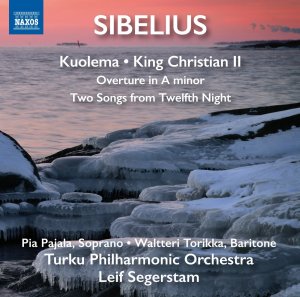
One of the numbers for Kuolema (Death) is one of the composer’s most popular encore pieces. Valse triste, as we know it, begins six scenes of music for a drama by Sibelius’ brother in law Arvid Järnefelt. Segerstam takes it slowly, but is poised and graceful throughout, as he is in the brooding Scene with Cranes, another Sibelius favourite.

Then he is joined by the fulsome baritone of Waltteri Torikka, who gives Paavali’s Song a convincing presence, while Pia Pajala is clear and crisp in Elsa’s Song. The last scene is strangely chilling, with the fateful tolling of bells.

The seven numbers Sibelius composed for the relatively early King Christian II, a Scandinavian historical play by his friend Adolf Paul, begin with a majestic Elegy, conclude with a tempestuous Ballade and include a substantial central Nocturne that proves surprisingly lively for the night time, building to a really impressive climax that reminds us how much sway Tchaikovsky holds over Sibelius’ early output. The whole score is beautifully performed, Segerstam clearly holding great affection for the romantic score.

segerstam-belshazzar

It was satisfying to see Sibelius’s music for Belshazzar’s Feast making a comeback at the BBC Proms this year, and in Segerstam’s hands we enjoy a colourful opening procession and a penetrating flute solo in the NocturnoPia Pajala deserves special credit for a fulsome soprano solo in The Song of the Jewish Girl.

The two discs where the corners of Sibelius’s output are really deeply explored are those devoted to music for Jedermann (Everyman) and Scaramouche.

segerstam-jedermann

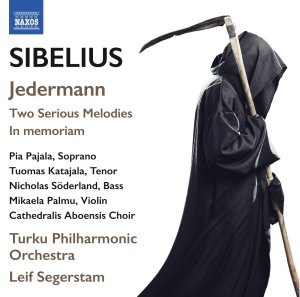
The former carries a chilling picture of a sabre-wielding Death on the cover and it is certainly very dark to start with, with some strikingly beautiful writing for strings that Segerstam is keen to bring out, especially when heard in a solo capacity in the Largo. There is more choral music in this score, sung with commendable spirit by the Cathedralis Aboensis Choir, and there is a memorable main tune that makes regular reappearances throughout. The sonorities become appreciably sweeter when the organ gets mixed in for the second part of the Adagio, but this is music that never really settles, and in the section marked ‘Con grande dolore’ there are some disarming sweeps from the strings.

segerstam-scaramouche

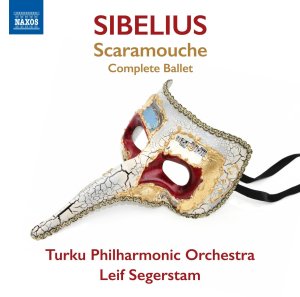
Scaramouche caused Sibelius a lot of problems in its composition, causing him to break a telephone on one occasion, but it still has some striking qualities. The bolero in Act 1 is a very curious stop-start dance where what sounds like a bandoneon is used, while in Scene 6 of Act 2 (again untitled) there is extreme uncertainty, both here and in the start of the successive number in the harmonies and wind colouring. Scene 9 conjures up a favourite Sibelius tactic, the bouncing of bows on the strings. So while a bitty score, Scaramouche still generates a good amount of interest and mystery.

segerstam-swanwhite

 Swanwhite is quite an elusive piece but once again is revealed to have a mixture of charm and mystery. The former quality can be found in the third number of Act 2, where there is a poised and rather lovely dialogue between flute and strings, but by contrast the fifth number wears a stern expression, especially through its clarinet part. There are however some moments of pure serenity in Swanwhite, and while at times its music seems to have a short attention span it nonetheless leaves a lasting impression.

The Lizard, far from a makeweight, is a fascinating piece that shows all the composer’s hallmarks in their early stages – though when hearing the music it sounds a lot later than its publication number, Op.8, might suggest. The sweeping violas, the cold and often eerie unison string lines, and the shivers from tremolo strings around 17 minutes in – all are hallmarks of the mature composer and mark him out as an orchestral colourist of the highest quality.

One of the appealing qualities of Segerstam’s discs is the programming, as alongside the stage works he takes the opportunity to include rarely-heard items such as two songs from Twelfth Night, the Overture in A minor, and many more. These help put the Sibelius output in context, and while they might not be classed as masterpieces the works do still contain moments of inspiration and originality. While the Overture in E major may be an obvious early work, Scene de Ballet gets out the castanets to good effect, before finishing in typically abrupt manner. There is a glint in the eye of the waltz Musik zu einer Szene, and a graceful Valse lyrique. The Overture in A minor could only be by Sibelius, and offsets its stern brass with increasingly active strings before suddenly cutting to a brighter, energetic outlook. The Cortège is a piece of grand ceremony though still has its subtleties, while the Processional is a solemn piece. Meanwhile the short Menuetto has Sibelius’ own stamp on it, richly coloured and quite grounded, before once again stopping suddenly.

These are then extremely valuable additions to the Sibelius discography, and are highly recommended to those looking to progress beyond the ubiquitous symphonies. Though the symphonies make one of the twentieth century’s finest collections in the form, Sibelius was a much deeper composer than that – and in these recordings Segerstam proves that beyond doubt.

Does it all work?

Frequently. These are fascinating pieces, though listeners are advised to read the booklet notes either during or before hearing so that Sibelius’ acute scene setting can be fully appreciated.

Is it recommended?

Yes – especially to those who have gotten to know Sibelius through his symphonies. The stage works reveal the composer in a different light, and provide a substantial complement. They also show his remarkable powers of musical concentration and orchestral colouring.

Listen on Spotify

Pelleas https://open.spotify.com/album/2Hd0S5a6jiOzDziBVJ3uNR
Kuolema https://open.spotify.com/album/5NfQh1uva2xxerW8yNbqlr