In concert – Alina Ibragimova, CBSO / Dinis Sousa: Sibelius, Dvořák & Arvo Pärt

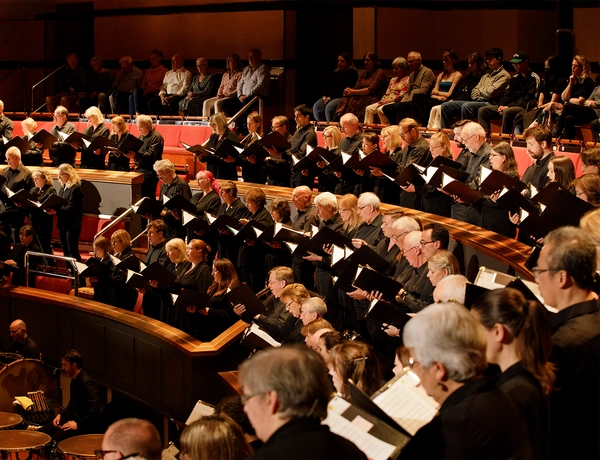
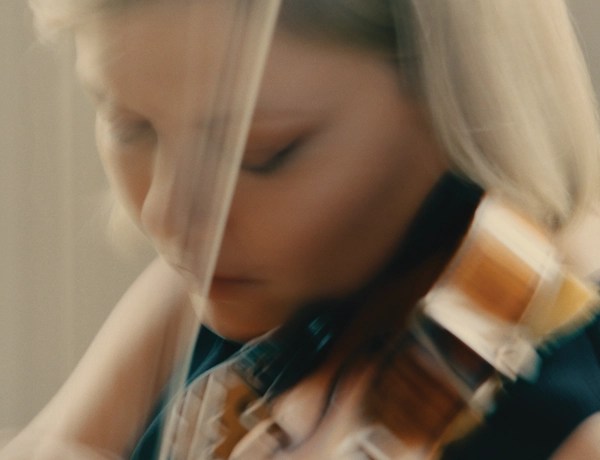
Alina Ibragimova (violin, above), City of Birmingham Symphony Orchestra / Dinis Sousa (below)

Pärt Our Garden (1959, rev. 2003)
Sibelius Violin Concerto in D minor Op.47 (1903-04, rev. 1905)
Dvořák Symphony no.8 in G major Op.88/B163 (1889)

Symphony Hall, Birmingham
Thursday 3 April 2025

Reviewed by Richard Whitehouse Picture of Alina Ibragimova (c) Joss McKinley; Dinis Sousa (c)

In what was an auspicious first appearance with the City of Birmingham Symphony Orchestra, Dinis Sousa presided over an appealing programme that featured repertoire staples by Sibelius and Dvořák alongside welcome revival of an uncharacteristic early choral piece by Arvo Pärt.

Uncharacteristic but highly enjoyable, Our Garden seems relatively untypical of the Estonian composer even in his mid-twenties – its winning an award at a Soviet-sponsored competition in 1962 bringing plaudits at a time when Pärt’s was very much an ‘unofficial’ presence on the new-music scene. Six decades on this can be enjoyed simply for what it is – an unpretentious celebration of youthful endeavour whose unaffected setting of four not overly polemical texts is as cohesive as it is sincere. Certainly, the CBSO Youth Chorus did justice to writing whose rhythmic unison was offset with some deft harmonic twists and enhanced by the resourceful contribution of a sizable orchestra. An obvious candidate for inclusion in music quizzes, Our Garden is never less than effective on its own terms and made for an attractive curtain-raiser.

Geographical proximity aside, there was little connection between Pärt’s cantata or Sibelius’s Violin Concerto, and while a performance of the latter rarely fails to impress it rarely catches fire as it did here. Alina Ibragimova has given some memorable performances in Birmingham over recent seasons, but this account got to the heart of a piece that, for all its indebtedness to Romantic-era virtuosity, is no less original in form or content than its composer’s symphonies and tone poems of this period. Most notable were Ibragimova’s fusing of the first movement’s central cadenza with developmental impetus, her building of cumulative momentum over the course of the Adagio or a final Allegro which, though this may all but have eschewed the ‘ma non tanto’ marking, exuded a drive and panache maintained through to the scintillating close.

A first-rate accompanist, Sousa (above) brought out much of interest from the orchestral texture – not least its writing for low woodwind and horns which frequently underpins the soloist in a way that could only be Sibelius. Such attention to detail was equally evident in his performance of Dvořák’s Eighth Symphony – music easy to take for granted in its warmth and affability, yet whose opening Allegro is a masterclass in formal innovation as benefitted from the incisive if never overdriven energy Sousa brought to this movement as a whole and its coda in particular.

Even finer was the Adagio, its pathos shot through with an ominous import which came to the surface at its brief if forceful climaxes and so confirmed this as music of rare eloquence. The intermezzo’s twin themes unfolded with an ideal lilt that made its boisterous pay-off the more fitting, while the finale made the most of Dvořák’s putting his trenchant folk-dance through a set of variations whose rapidly growing excitement could always be sensed even as the music subsided towards virtual stasis, from where the peroration made for a truly uproarious QED.

Those expecting Finlandia at the start of the second half (as indicated in this season’s guide) were disappointed, but Sousa did offer the second (in G) of Dvořák’s Legends as an apposite encore – its fluid interplay of poise and humour the ideal way to end this memorable concert.

For details on the 2024-25 season A Season of Joy, head to the City of Birmingham Symphony Orchestra website. Click on the names to read more about conductor Dinis Sousa, violinist Alina Ibragimova and the CBSO Youth Chorus

Published post no.2,496 – Sunday 6 April 2025

Storms in music – Sibelius: Tapiola

by Ben Hogwood

With the UK braced for the arrival of Storm Éowyn today, it got me thinking of successful portrayals of storms in music.

The first piece that came to mind was Sibelius’s masterpiece Tapiola, a remarkable and vivid orchestral poem written late in his compositional career about Tapio, the spirit of the forest. Its depiction of a storm is like no other.

Listen here, in a particularly incendiary account from the Berliner Philharmoniker and Herbert von Karajan, keeping an ear out for the storm as it begins around the 16:50 mark:

Published post no.2,421 – Friday 24 January 2025

On Record – Early Stereo Recordings Vol. 6: Sibelius – Finlandia, Pohjola’s Daughter, String Quartet etc (First Hand Records)

Sibelius
Finlandia Op.26 (1899)(a)
Finlandia – Hymn (1938)(b)
Song of My Heart Op.18/6 (1900)(b)
The Origin of Fire Op.32 (1902, rev, 1910)(c)
Pohjola’s Daughter Op.49 (1906)(d)
Valse triste Op.44/1 (1904)(a)
String Quartet in D minor Op. 56 ‘Voces intimae’(e)
Finlandia Op.26 (1899)(f)

cSulo Saarits (baritone); eQuatuor Pascal [Jacques Dumond, Maurice Crut (violins), Léon Pascal (viola), Robert Salles (cello)]; bcHelsinki University Chorus / Martti Turunen; cdCincinnati Symphony Orchestra / Thor Johnson; aOrchestra del Maggio Musicale Fiorentino / Vittorio Gui; fPhilharmonia Orchestra / George Weldon

First Hand Records FHR85 [82’37”]
Producer and Engineer Raphaël Mouterde

Recorded aOctober 9th and b10th 1953, November bd20th and c21st 1953, fMarch 12th 1956, ebefore July 1957. Transfers and Remastering Paul Baily
Detailed production credits at the First Hand Records website

Reviewed by Richard Whitehouse

What’s the story?

First Hand Records continues its valuable Early Stereo Recordings series with this volume devoted to Sibelius, mostly featuring performances that had little wider availability on their initial release and which have seldom, if at all, been reissued in their original stereo format.

What are the recordings like?

First issued on two Livingston Audiosphere binaural tapes, Vittorio Gui’s Sibelius confirms this conductor’s wide-ranging sympathies as to repertoire. Finlandia is accorded a forthright and impulsive reading which is brooding and even ominous in its earlier stages, then with its hymnic melody elegantly while unaffectedly rendered. Valse triste feels arguably even more persuasive as Gui secures playing of poise and finesse from the strings of Maggio Musicale Fiorentino, building up to a culmination of sustained intensity prior to its elegiac conclusion.

George Weldon’s Finlandia affords instructive comparison. First issued on an EMI Columbia stereosonic tape, it exudes no mean spontaneity and panache with the Philharmonia sounding as idiomatic as on the Sibelius recordings made with Herbert von Karajan during this period.

Most valuable are those remaining items. What was initially issued as an A-V Tape Libraries binaural tape is a fascinating collection, not least for this first studio recording of the cantata The Origin of Fire which is overall the best of Sibelius’s Kalevala-derived choral works, and combatively rendered here by Sulo Saarits with the Helsinki University Chorus – which latter contributes respectively stirring then evocative accounts of the indelible Finlandia Hymn and delectable Song of My Heart under Martti Turunen. The Cincinnati Symphony Orchestra comes into its own with Pohjola’s Daughter, the symphonic fantasia that straddles its composer’s nationalist and more classical phases – duly endowed with often irresistible momentum by Thor Johnson (1913-1975), the American conductor who made numerous important recordings at this time.

Surely the highlight, though, is Quatuor Pascal’s reading of Voces intimae. First issued as a Concert Hall Society stereophonic tape, this was only the work’s fourth recording (after those (two) by the Budapest and Griller quartets) and demonstrates acute appreciation of Sibelius’s idiom as shared by few French musicians at this time. From the powerfully wrought opening Allegro with its pulsing Vivace continuation, via the inwardly eloquent Adagio then trenchant Allegretto, to the impetuous final Allegro – this is an interpretation to rank with the very best.

Does it all work?

Yes it does, remembering these recordings were made in Sibelius’s lifetime (just two months before his death in the case of the String Quartet) and can lay claim to pioneering status. The transfers have been expertly managed, conveying the dynamic range and tonal range of those original masters without unwarranted intervention. Tully Potter pens informative annotations, and Peter Bromley invaluable context, though the timing for Weldon’s Finlandia should read 9’17” rather than 8’31” hence is faster than Gui by mere seconds rather than almost a minute.

Is it recommended?

Indeed it is, and it could well be regarded as the most significant release in this FHR series so far. Coming in the wake of groundbreaking inter-war projects from the Sibelius Society, these issues are a vital chapter in the history of Sibelius recording and an indispensable acquisition.

Listen & Buy

For further information and purchase information visit the First Hand Records website. Additional details on (most of) these recordings can be found on the Discogs website

Published post no.2,381 – Tuesday 3 December 2024

In concert – Yeol Eum Son, CBSO / Jonathon Heyward: Still, Prokofiev & Sibelius

Yeol Eum Son (piano, below), City of Birmingham Symphony Orchestra / Jonathon Heyward (above)

Still Threnody: In Memory of Jean Sibelius (1965)
Prokofiev Piano Concerto no.2 in G minor Op.16 (1912-13, rev. 1923)
Sibelius Symphony no.5 in E flat major Op.82 (1914-19)

Symphony Hall, Birmingham
Thursday 24 October 2024

Reviewed by Richard Whitehouse Pictures (c) Laura Tiesbrummel (Jonathon Heyward), Marco Borggreve (Yeol Eum Son)

American by nationality, and currently music director of the Baltimore Symphony Orchestra, Jonathon Heyward is no stranger to orchestras in the UK and this afternoon’s appearance with the City of Birmingham Symphony Orchestra confirmed a rapport that will hopefully continue in future seasons.

His symphonic output may now be well covered by recordings, but performances of William Grant Still remain infrequent such that his Threnody came as a welcome novelty. Dedicated to Sibelius in the anniversary year of his birth, this finds its composer in understandably sombre mood (akin to that of his masterly concertante piece Dismal Swamp from two decades earlier) and, while there is little about its content that recalls the Finnish master, the interplay between elegy and processional is effectively handled through to its subdued yet highly affecting close.

It might not have enjoyed the popularity of its successor, but the CBSO has given memorable accounts of Prokofiev’s Second Piano Concerto over the decades and the present reading with Yeol Eum Son (above) was as good as it gets in a piece that does not make things easy technically or interpretatively. Starting reticently, the opening movement duly hit its stride in the capricious second theme before the orchestra made way for Son’s electrifying take on a cadenza which encompasses development and reprise; the orchestra’s climactic return being no less visceral.

Wresting coherence out of the unlikely formal design of this work is hardly an easier task but, here again, there was no doubting Son’s insight as she fairly tore through its Scherzo without loss of clarity; she and Heyward then drawing abrasive irony out of an intermezzo which can easily descend into caricature. Nor was there any lack of focus with a Finale whose headlong outer sections frame one of folk-tinged pathos – afforded a cumulative intensity only outdone by the propulsive closing stage where soloist, orchestra and conductor were thrillingly as one.

If the reading of Sibelius’s Fifth Symphony after the interval did not quite maintain this level of excellence, it was no also-ran as a performance. Heyward might have observed the Tempo molto moderato of its initial movement more literally, as his swift underlying pace made for too precipitate a climax into its scherzo-like second half. The accelerating transition between them was adeptly managed, but there was little room left for manoeuvre during the approach to a coda where not even the CBSO’s unfazed commitment could gain the necessary velocity.

Neither did the second movement lack forward motion, though here Heyward found a viable balance between the andante and allegretto elements – its (mostly) ingratiating poise abetted by felicitous playing from CBSO woodwind. Setting off impulsively, the finale rather lacked eloquence in its ‘swan theme’ but the resourceful evolution of its material was never in doubt. Other performances have conveyed greater emotional breadth thereafter yet, as those indelible six closing chords unfolded, there could be no doubting their decisiveness as parting gestures. Overall, then, this was impressive music-making with Heyward evidently a conductor on a mission. Next Wednesday brings a programme of Spanish evergreens conducted by Kazuki Yamada, with Miloš Karadaglić taking centre-stage in a certain guitar concerto by Rodrigo.

For details on the 2024-25 season A Season of Joy, head to the City of Birmingham Symphony Orchestra website. Click on the names to read more about pianist Yeol Eum Son and conductor Jonathon Heyward – and for a special website devoted to composer William Grant Still

Published post no.2,345 – Monday 28 October 2024

In concert – Katie Trethewey, University of Birmingham Voices, CBSO Chorus & Orchestra / Ludovic Morlot: John Luther Adams – Vespers of the Blessed Earth; Sibelius

Katie Tretheway (soprano), CBSO Chorus, University of Birmingham Voices, City of Birmingham Symphony Orchestra / Ludovic Morlot

John Luther Adams Vespers of the Blessed Earth (2021) [CBSO co-commission: UK premiere]
Sibelius Symphony no.2 in D major Op.43 (1901-02)

Symphony Hall, Birmingham
Thursday 9 May 2024

Reviewed by Richard Whitehouse

Almost eight years ago, the City of Birmingham Symphony Orchestra and Ludovic Morlot gave the UK premiere of John Luther AdamsBecome Ocean. Tonight they, with the CBSO Chorus and University of Birmingham Voices, gave that of his most recent large-scale work.

It may have been obliquely inspired by Monteverdi, but Vespers of the Blessed Earth is very much a humanist response to those ecological challenges of the present and, to this end, its texts have a concreteness and functionality which is wholly at the service of the music. Thus A Brief Descent into Deep Time sets words as depict the (reverse) geological evolution of the Grand Canyon, its emotional matter-of-factness in contrast to A Weeping of Doves with its unaccompanied setting of the call of the Papuan fruit dove in what is one of Adams’ most ravishing inspirations. Hardly less affecting is Night-Shining Clouds – an interlude, in the form of a chaconne, for strings that follows what the composer calls a ‘sub-harmonic’ series with its slowly spiralling descent to the depths for a graphic evocation of cloudly pollutants.

The fourth and climactic section, Litanies of the Sixth Extinction divides the choruses into four parts which between them chant the names of species in the process of or likely to face extinction – closing ominously with Homo Sapiens. It was here that an antiphonal placing of strings and percussion, along with choirs of woodwind and brass placed along either side of the upper circle, came into its own but, typically for Adams, the effect was one of cumulative if not intensifying emotion. Aria of the Ghost Bird followed with its transcribed rendering of the call from the now-extinct Kaua’i O’ō, tonight taken by Katie Tretheway (above) in what was a finale of the gentlest eloquence. It duly remained for offstage flute and chimes, here placed up in the grand tier, to see this inconsistent while always absorbing work to its wistful close.

In his thoughtful introductory remarks, Morlot spoke of the appositeness when juxtaposing Adams with Sibelius and the latter’s Second Symphony, which followed the interval, made his point admirably. Once the most popular such piece by Sibelius (and, indeed, of the last century), latter-day performances too often fight shy of its innate rhetoric or overt emotion. Without being disengaged, this account succeeded because of its methodical trajectory, not least a first movement whose restraint was never at the expense of its overall incisiveness.

With its stark contrast between conflict and consolation, the slow movement can easily fall into overkill but not here – Morlot evincing a keen sense of cohesion through to its baleful ending. The scherzo likewise secured keen cohesion from its alternate energy and raptness, then its surging transition into the finale brought an emotional frisson maintained through to an apotheosis whose grandeur never felt self-conscious or overbearing. Whether the triumph expressed is cultural or personal, the underlying essence of its affirmation was not in doubt.

It certainly set the seal on a memorable evening – one that confirmed the undoubted rapport between orchestra and conductor, while bridging the conceptual divide and almost 120 years between these pieces. Hopefully the CBSO and Morlot will be working together again soon.

Click on the link to read more on the current CBSO concert season, and on the names for more on soprano Katie Trethewey, conductor Ludovic Morlot, the University of Birmingham Voices and the CBSO Chorus. Meanwhile you can click on the name for more on composer John Luther Adams

Published post no.2,203 – Saturday 8 June 2024