
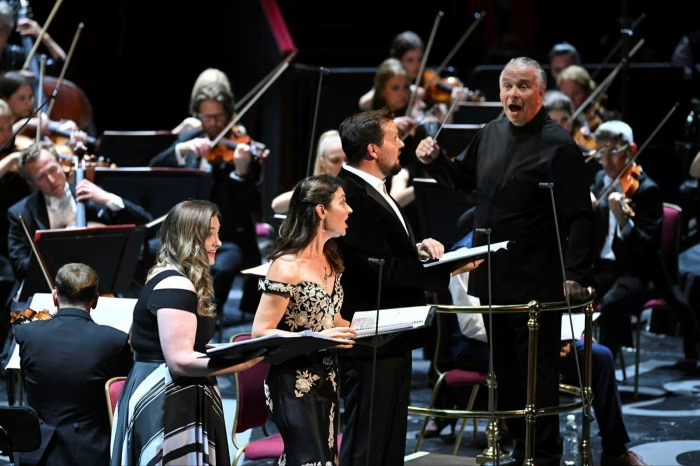
Jennifer Davis (soprano), Claudia Huckle (mezzo-soprano), David Butt Philip (tenor), Roderick Williams (baritone), BBC Symphony Chorus, London Philharmonic Choir, BBC Symphony Orchestra / Sir Mark Elder
Delius Eine Messe des Lebens (A Mass of Life) (1898; 1904-05)
Royal Albert Hall, London
Monday 18 August 2025
Reviewed by Richard Whitehouse Photos (c) BBC / Chris Christodoulou
There could be few venues better suited to Delius’s A Mass of Life, in its conceptual ambition and emotional opulence, than the Royal Albert Hall and this evening’s performance, only the third at these concerts and the first in 37 years, undoubtedly made the most of these qualities.
Despite the tragedy of his ultimate breakdown and ensuing incapacitation, Friedrich Nietzsche was considered a liberator in terms of a guiding philosophy with its emphasis on free will and rejection of conventional mores. Such appeal could hardly have been greater than on Frederick Delius, his largest concert work setting substantial extracts from Also sprach Zarathustra in a way that feels never judgemental and is only rarely overreaching. Much of the time its music has a detached and meditative aura whose inward intensity needs to be sustained accordingly.
That this account did so was owing to Sir Mark Elder, his advocacy already manifest in the finest modern recording (LAWO) as came across just as strongly and often more so here. Certainly, the longest sections were effortlessly paced – whether that beguiling interplay of longing and anticipation in In dein Auge which becomes the still (while never static) centre of Part One, or that extended sequence of Part Two taking in the scenic evocation as is Lasst vom Tanzen ab then the pantheist contemplation of Heisser Mittag schläft which is surely the expressive highpoint. Not that the dramatic openings of each part were under-characterized – the driving energy of O du mein Wille! setting the course for one as vividly as did the rousing Herauf! Nun herauf, with its orchestral prelude Auf den Bergen meltingly rendered, for the other.
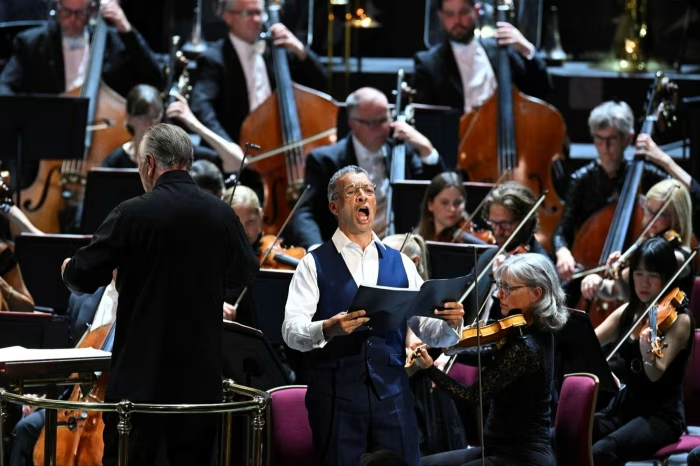
This may be regarded mainly as a choral work, but the importance of its vocal parts is never to be gainsaid. Above all, that of the baritone who assumes the role of Zarathustra in his gradual incline to enlightenment and in which Roderick Williams (above) was consistently at his best – hence the infectious Erhebt eure Herzen and assertive Wehe mir! then, subsequently, the alluring eloquence of Süsse Leier! and will to action of Gottes Weh ist tiefer. If this is the solo role as brings focus or unity to the whole, the others afford textural and expressive enhancements aplenty – Jennifer Davis as capricious and Claudia Huckle as confiding as David Butt Philip was assertive in their respective contributions. All three singers brought out the youthfulness or naivety which are crucial to this work’s underlying journey from innocence to experience.
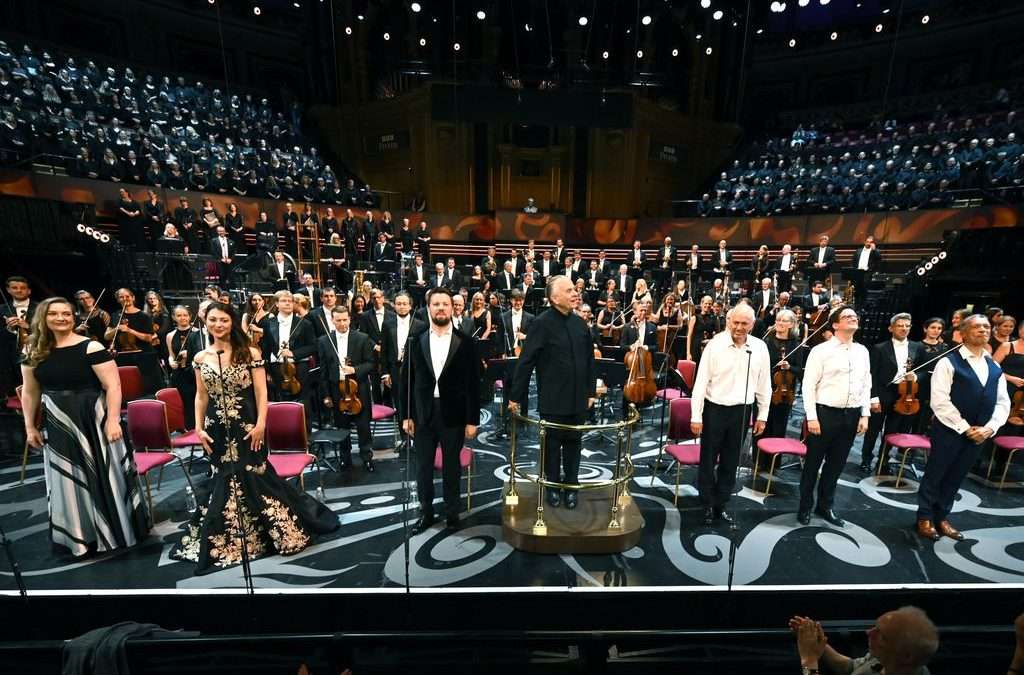
Any doubt a relative disparity in numbers of female and male singers would be detrimental to choral balance was groundless – Elder drawing a vividness but also delicacy of response from those combined BBC Symphony and London Philharmonic forces, while the BBC Symphony Orchestra was rarely less than galvanized whether in complex tuttis or the artless writing for solo woodwind that informs the latter stages. Delius’s orchestration rarely ‘plays itself’ but it conveys a lustre and translucency which could not be mistaken for that of another composer.
A near-capacity audience seemed as attentive to this as it was affected by the final Kommt! Lasst uns jetzt wandeln!, with its build-up to an ecstatic apotheosis then swift dispersal into silence: setting the seal on a memorable interpretation of this all-encompassing masterpiece.
You can listen back to this Prom concert on BBC Sounds until Sunday 12 October – or listen to the recent recording from Sir Mark Elder, with soloists, the Collegium Musicum Choir, Edvard Grieg Kor, Bergen Philharmonic Choir and Orchestra on Tidal below:
Click on the artist names to read more about soloists Jennifer Davis, Claude Huckle, David Butt Philip and Roderick Williams, the London Philharmonic Choir, BBC Symphony Chorus and BBC Symphony Orchestra, and conductor Sir Mark Elder. Click also for more on the Delius Society and the BBC Proms
Published post no.2,632 – Wednesday 20 August 2025
 Arcana.fm