
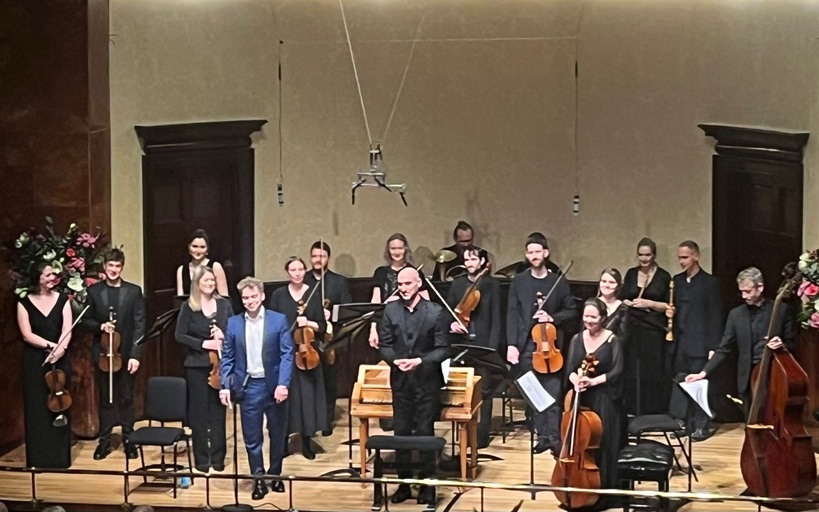
Hugh Cutting (countertenor), Irish Baroque Orchestra (Peter Whelan, director)
Programme including pieces by Mozart, Gluck, Johann Christian Bach, Johann Christian Fischer, Tommaso Giordani and Thomas Arne. Full repertoire list at the bottom of this review
Wigmore Hall, London, 9 March 2026
by John Earls. Photo credits John Earls
Giusto Ferdinando Tenducci (c. 1735-90) may not be a name on many people’s lips but he was something of a superstar in his day (his portrait was painted by Gainsborough twice). The Siena-born soprano castrato (who were the pop stars of their time) was not just a successful singer but his celebrity also featured a colourful life that included spells in a debtors’ prison and a scandal involving him marrying his teenage singing pupil Dorothea (Dora) Maunsell – the couple met in Dublin in Ireland but eloped to Cork, where he was also jailed for a time (the marriage was later annulled).
This concert explored the world and music of Tenducci and his time in Ireland (he spent the early part of his career touring Italian and German cities and came to prominence in London and Ireland in the late 1750s and early 1760s). The Irish Baroque Orchestra released the album The Trials of Tenducci: A Castrato in Ireland (Linn Records) in 2021 and a number of its pieces featured tonight, although there were some compositions too. On the album the singer is Irish mezzo-soprano Tara Erraught. Tonight’s singer was British countertenor Hugh Cutting, a BBC New Generation Artist (2022–24) and the first countertenor to win the Kathleen Ferrier Award. Cutting impressed me as Arsace in English National Opera’s recent surrealist production of Handel’s Partenope, and he made a very strong impact in this performance.
In a nice scene setter, the concert began with Mozart’s Symphony no. 1 which the composer wrote when he was just eight years old, about the time when Tenducci met him in England in 1764. The first set also included two arias from Mozart’s third opera Mitridate: re di Ponto: Già dagli occhi and Venga pur Minacci (which closed the first half) seeing Cutting give rein to his strong stage presence and in the latter, an, at times, literally pointed delivery.
The rest of the first set featured Thomas Arne’s Vengeance, O come inspire me! from Alfred (a forceful opener from Cutting with lively, bright accompaniment from the orchestra) and Water parted from the sea from Artaxerxes (which ran for some 33 performances in Dublin in 1765-66), delivered with clarity by Cutting (not so much the audience member who coughed loudly at the end).
Another first set highlight was the orchestra’s performance of Johann Christian Fischer’s Gramachree Molly with variations from the Oboe Concerto No. 7 which spotlighted some gorgeously expressive and fluent oboe playing by Emma Black.
The young Mozart’s Symphony no. 4 opened the second half followed by three pieces from Gluck’s opera Orfeo ed Euridice. Here the orchestra was in full command for Dance of the Furies with the two horn players holding their instrument’s bells upright for maximum impact. Cutting’s singing on Ahimè! dove trascorsi! and Che farò senza Euridice? was clear and passionate.
There then followed a piece where the orchestra absolutely shined. Tommaso Giordani’s The Celebrated Overture and Irish Medley to The Island of Saints saw Emma Black working oboe magic again, beautifully accompanied by plucked strings, for Shepherds I Have Lost My Love. The Irish Medley was given a joyous performance of its selection of Irish folk melodies featuring some fantastic fiddle playing. It was rewarded with rapturous applause – a perfect early Saint Patrick’s Day celebration. There was more Giordani of a different sort next with Caro mio ben, with Cutting’s vocals hanging confidently and elegantly.
Johann Christian Bach’s Vo solcando un mar crudele from Artaserse W.G 1 was a crisp, rousing finale giving full expression to Cutting’s virtuosity. A repeat of Caro mio ben served as an encore and was even more glorious than the first time round.
This was a mesmerising evening with a wonderful programme that highlighted that baroque music in Ireland goes further than the celebrated premiere of Handel’s Messiah in Dublin in 1742. Hugh Cutting and the Irish Baroque Orchestra are an outstanding combination. I hope there is more to come.
Hugh Cutting and the Irish Baroque Orchestra performed the following repertoire:
Mozart Symphony No. 1 in E flat major K16
Arne Vengeance, O come inspire me! from Alfred
Mozart Già dagli occhi from Mitridate, re di Ponto
Johann Christian Fischer Gramachree Molly with variations from Oboe Concerto No. 7
Arne Water parted from the sea from Artaxerxes
Mozart Venga pur Minacci from Mitridate, re di Ponto; Symphony No. 4 in D major K19
Gluck Dance of the Furies; Ahimè! dove trascorsi!; Che farò senza Euridice? from Orfeo ed Euridice
Giordani The Celebrated Overture and Irish Medley to The Island of Saints; Caro mio ben;
Johann Christian Bach Vo solcando un mar crudele from Artaserse W.G 1
John Earls is Director of Research at Unite the Union and posts at @johnearls.bsky.social on Bluesky and @john_earls on X. You can subscribe (free) to his Hanging Out a Window Substack column here: https://johnearls.substack.com/
Published post no.2,825 – Tuesday 10 March 2026

 Arcana.fm