Alice Boyd (soundscapes, synthesizers, vocals), Belle Chen (piano, synthesizers), Lucinda Chua (cello, vocals), Erland Cooper (electronics, piano, presenter, tape machines), Katherine Tinker (piano, synthesizers), Isobel Waller-Bridge (piano), BBC Symphony Chorus, City of London Sinfonia / Alexandra Wood (violin)
Royal Albert Hall, London Thursday 20 August 2026
Reviewed by Ben Hogwood Photos (c) BBC /
The role of classical music in modern society is changing. With the need to ‘unwind’ greater than ever before, thanks to an age of conflict, hardship and technology – constant visual and audio bombardment from our devices, among many other things – there is a space where calm and undemanding music can make its understated mark.
This can of course happen in operas and substantial Prom concerts, but that Radio 3 should introduce Unwind, their digital counterpart to the main station, says a lot about the mental health of our generation and our short attention span, constantly fraying at the edges as we deal with anxieties, the media and too much attention to social media (I’m speaking for myself here!)
Ultimate Calm is a programme residing on the new channel, beginning on Radio 3 itself under the guidance of the well-qualified Olafur Arnalds before finding its new spiritual home. So how do the BBC Proms achieve ultimate calm, and is it better in person or experienced at home?
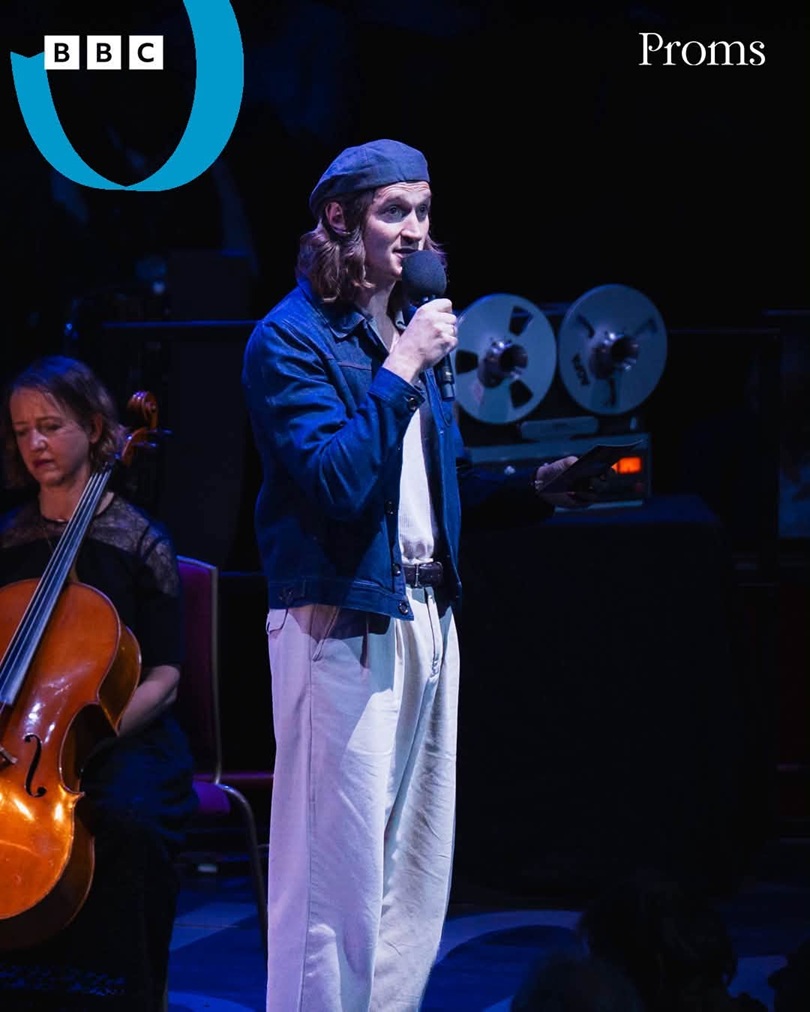
The first sounds on arriving in the arena at the Royal Albert Hall were those of blackbirds, surely the idea of Orcadian composer and multi-instrumentalist Erland Cooper – who, as a regular Unwind contributor, curated this Prom. The music was in the most part enhanced by the birdsong and other field recordings, reminding us of the importance and appreciation of natural beauty.
The published programme proved helpful to a point, listing the pieces but not in the order they were performed. Cooper’s music secured a sonorous and comforting start, his Music for Growing Flowers (Nocturne) presented in a new arrangement blossoming like its subject. The yearning tones of the BBC Symphony Chorus were supplemented by cleverly wrought percussion with the hands imitating rain and wind and complemented by the soft bed of City of London Sinfonia strings.
This curtain raiser / light dimmer was the first work of what became a streaming playlist in live form, with little between the tracks save for field recordings, allowing the listener to picture a natural space. The musical language was largely simple – not a criticism – as it allowed the mind to wander, and – ultimately – to unwind.
Pianist Belle Chen chose well with her pieces, two excerpts from the excellent Ravel In The Forest album that included evocative forest noises from a synthesizer positioned on top of the piano. Moonrise, the first excerpt, leant on Barber’s Adagio for Strings for its inspiration and proved effective in this context.
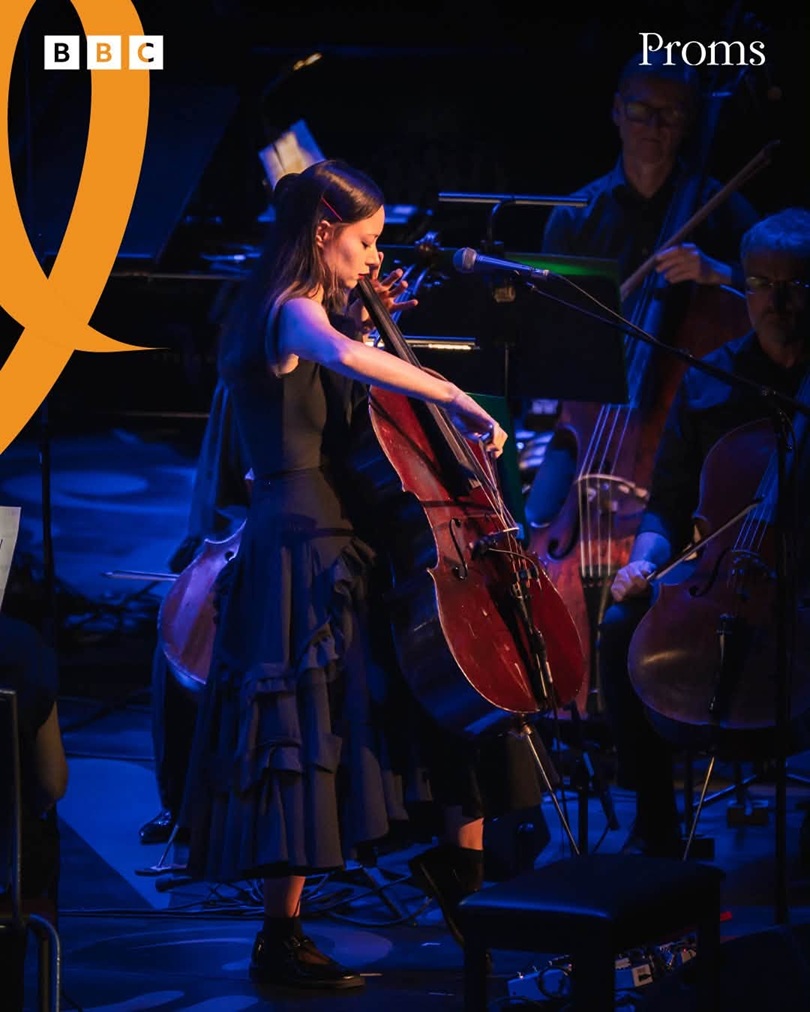
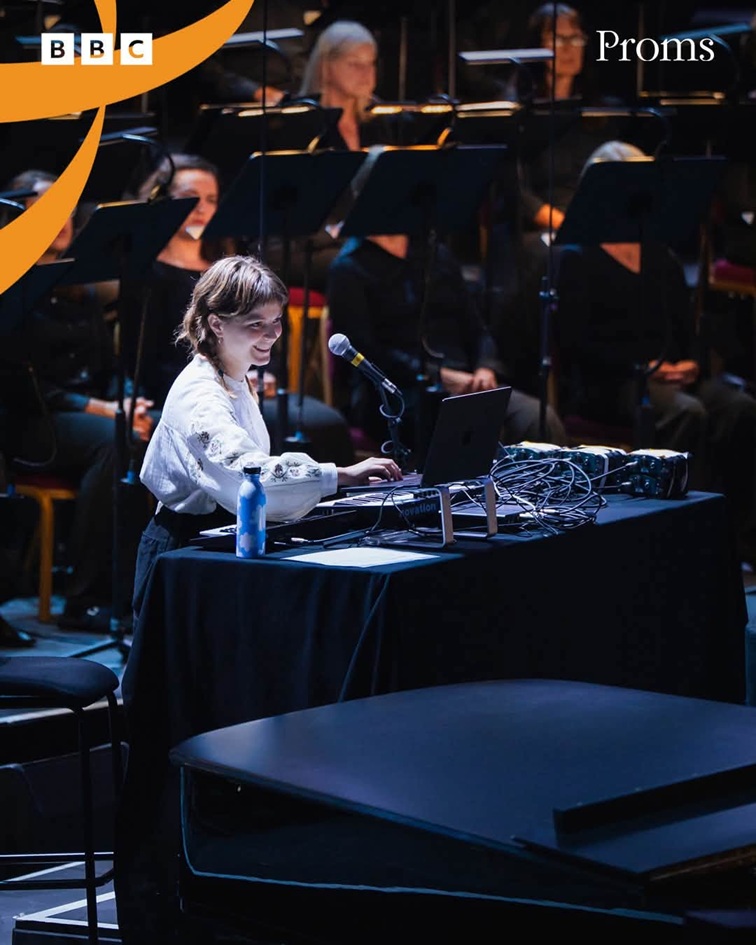
Lucinda Chua’s cello (above) then explored rich, multitracked sonorities on I Left the Earth, while a vocal number, Something Other Than Years, provided a musical affirmation with its catchphrase, “show me how to live this life”. At this point, even allowing for the plaintive Symbiosis from Alice Boyd (below) and the deep resonance of Jóhann Jóhannsson’s A Pile of Dust, we were walking a fine line between background and foreground music, the audience a mixture of calm and fidgeting, as though in the half hour before sleep. Oddly, the unwinding music also drew vivid parallels with coffee shop culture rather than the Royal Albert Hall.
Standing out in the foreground was the craftsmanship of Finzi, Sibelius and Debussy. Finzi’s gorgeous Romance stole the show in a passionate performance from the string orchestra, who also captured the warmth of Sibelius’s Andante Festivo along with its elusive emotions. Meanwhile a sensitive arrangement by Erland Cooper of Debussy’s Clair de Lune also hit the spot, with a special solo from cellist Will Schofield. The City of London Sinfonia strings played dreamily under the direction of Alexandra Wood, the 55-year-old ensemble infrequent Proms visitors but extremely welcome here. The BBC Symphony Chorus, used more sparingly, contributed a brief but moving Abendlied from Josef Rheinberger.
The principal problem with experiencing such a Prom in the flesh was the approach of the midnight hour, and with it the anxiety that the last form of transport home was imminent, making it impossible to unwind completely. With this in mind your correspondent took his leave just as a world premiere was beginning, a new arrangement of Isobel Waller-Bridge’s Solitudes (after Satie) for two pianos, wordless choir and string orchestra. Listening back on BBC Sounds, it proved an affecting piece whose ripples spread out far beyond the hall with waves of wordless singing from the chorus.
As an advert for Radio 3 Unwind, this concert was a strong promotion and will hopefully propel the right audience to its channel. As a way into classical music it is persuasive and low maintenance, especially with the natural link. Yet it is to be hoped such an audience can blossom in the way of Erland Cooper’s flowers, encouraged to explore more substantial works by the composers whose relaxing sounds they have heard. Debussy, Ravel and Sibelius in particular have all written music with great kinetic energy! Yet that is for another day…for this Prom, sensitively staged if somewhat out of place for the live visitor, will leave a lasting legacy online.
Repertoire: Cooper Music for Growing Flowers (Nocturne) Belle Chen Ravel In The Forest: Moonrise; Three Birds Finzi Romance for string orchestra Lucinda Chua I Left the Earth; Something Other Than Years Jóhannsson A Pile of Dust Sibelius Andante festive Rheinberger Abendlied Alice Boyd Symbiosis Debussy arr Cooper Clair de Lune (Suite bergamasque) Isobel Waller-Bridge Solitudes (after Satie)
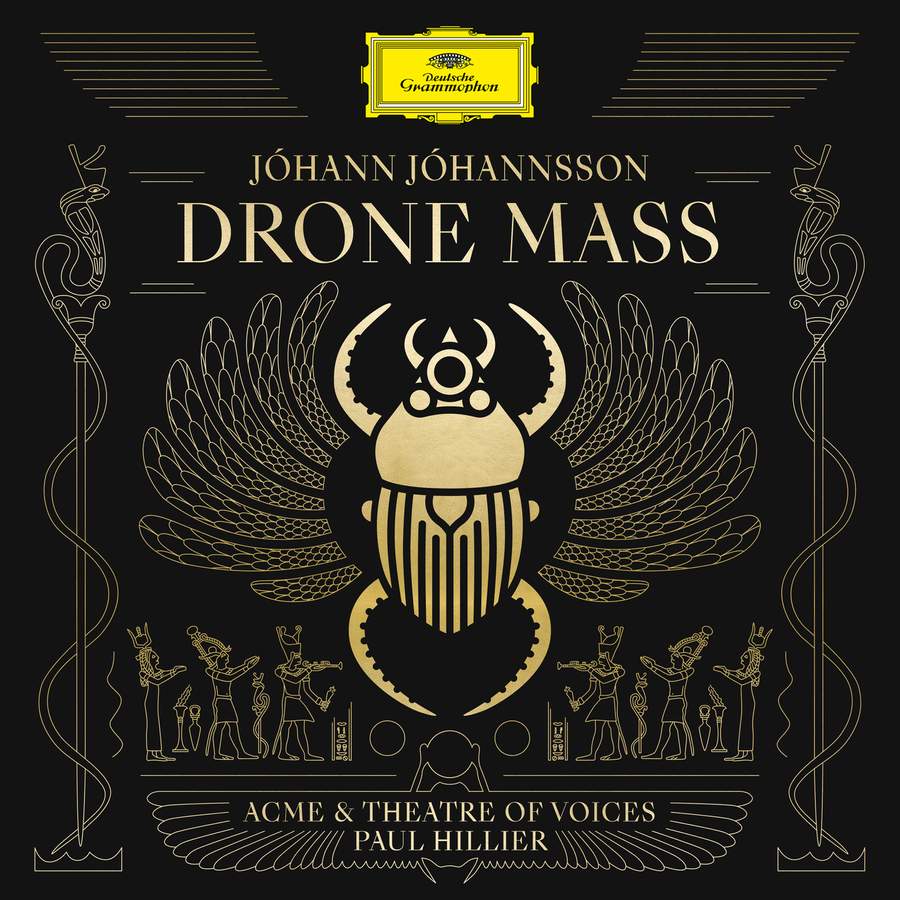
Drone Mass is one of the last completed works from the late and much missed Jóhann Jóhannsson. It was commissioned by the American Contemporary Music Ensemble, and given its first performance in 2015, at the Temple of Dendur in New York’s Metropolitan Music of Art. Jóhannsson took part in early performances of the work, but due to his sudden and sad death in 2018 was not present for this recording, made by ACME and their director Clarice Jensen in 2019. Joining the members of the ensemble were Theatre of Voices, conducted by Paul Hillier, who also took part in the early performances.
As Jensen makes clear in the booklet, Drone Mass is ‘neither a setting of the mass nor a piece that simply drones’ – but it is a sacred piece that has recurring drones throughout the work. It also has new technology as a background theme, Jóhannsson using his mastery of electronic music to write about drones as a force in the world today. The work’s vocals are drawn from the ancient Nag Hammadi scriptures and are written in Coptic, leading to a billing for Drone Mass as ‘an electroacoustic oratorio’.
What’s the music like?
The music takes its lead from the vocals, bringing together elements of ancient polyphony and new, drone-filled electronic textures. Because of this it is possible to approach Jóhannsson’s music from several directions, hearing old, unaccompanied melodies that can switch to electronics with little to no warning. The two work well together, especially as Jóhannsson’s music moves at a relatively slow pace. His language takes its lead from the ‘holy minimalism’ of Arvo Pärt and John Tavener, but is never derivative, searching as it does for a successful fusion of old and new methods of communication.
That search breeds a great deal of tension, which brings depth to the Drone Mass. The work starts with what sounds like an old, ornamented melody on One is True that gradually evolves into a substantial statement from all performing forces. Two Is Apochryphal is a meditative study with high, remarkably pure vocals, then Triptych In Mass contrasts plaintive violin arpeggios with two vocal lines, one drone like and the other much more mannered. The emotional centre of the work, however, lies in the two Divine Objects settings. Part one has a particularly haunting motif which develops into a powerfully wrought statement.
Does it all work?
It does. Although its constituent sections work well out of context, the Drone Mass is at its most effective when heard beginning to end in one sitting, taking shape and growing slowly but surely as it proceeds. The standard of performance is commendably high, too – thanks to outstanding singing from the Theatre of Voices, holding the sustained notes with impressive surety and accuracy. Meanwhile ACME provide the exquisitely shaded instrumental contributions.
Is it recommended?
Yes, without hesitation. Often pieces like this go for too many gestures or try to hit the harmonic sweet spots too often. Jóhann Jóhannsson is different, writing fluently to a larger scale, with music that grows in stature across its hour-long length. It leaves us with much to ponder, the only shame of course being that its composer is no longer around to hear what a fine recording has been made in his honour. In Drone Mass, he leaves a deeply felt and starkly effective representation of our times.
Stream
Buy
You can purchase this compilation at the Deutsche Grammophon website, where you can hear more clips and read more about the project.
It gives us great pleasure to welcome composer and instrumentalist Danielle Schwob – aka DELANILA – to Arcana’s playlist section:
Danielle’s selection is a fascinating Transatlantic exchange, mixing the best of America, Estonia, Iceland and the UK amongst others.
The heady violin of Canadian Angèle Dubeau is the first instrument we hear, leading La Pietà in the first movement of Arvo Pärt‘s Tabula Rasa. This leads to a fascinating exploration of American work from Bryce Dessner, Harry Partch and John Corigliano. Partch’s Two Studies on Ancient Greek Scales, for harp and guitar, are especially fascinating – short but perfectly formed and shimmering attractively.
Later we have a spacious excerpt from Adam Schoenberg‘s Finding Rothko, and a track from Thom Yorke‘s music for Suspiria, led by mottled piano. The music of Justin Dello Joio creates fascinating colours, reinventing the piano trio, while violin pieces by David Lang, Anna Clyne, Giya Kancheli and Jakub Ciupinski are inspiring for their open and ethereal air.
Ben Frost‘s Super Dark Times and a movement from John Adams‘ The Dharma at Big Sur explore expansive viewpoints, while PUBLIQuartet‘s reinterpretation of Hildegard von Bingen‘s O ignee Spiritus is a thoughtful and moving response.
Elsewhere we have two encounters with the music of Jóhann Jóhannsson, with whom Danielle worked – his Krókódíll and then the crowning glory of the mix, the fifth and final part from IBM 1401 A User’s Manual – The Sun’s Gone Dim And The Sky’s Turned Black, which sums up how we still miss the composer and also the current lockdown situation.
That’s not to say this selection is maudlin though – far from it. You will I’m sure discover something new as well as enjoy the chance to revel in some beautiful and powerful music, shifting shapes and perspectives. Take the next 90 minutes out and enjoy it.
DELANILA’s album Overloaded is out now via Zyg Zyg.
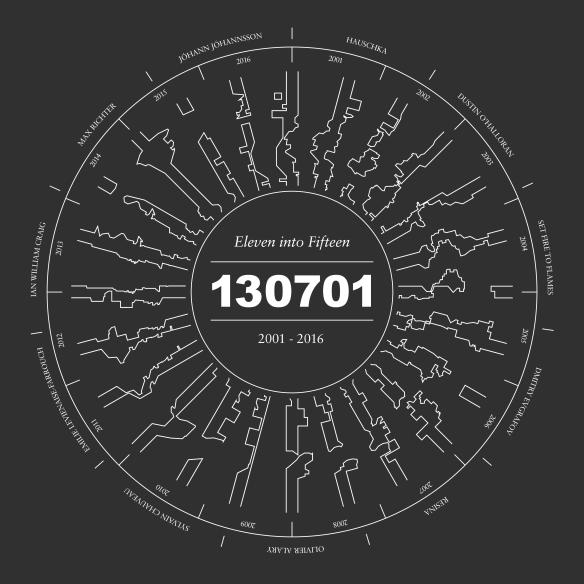
On this day, 15 years ago, a new record label was born. July 13th, 2001 – or, as we should call it for the purposes of this article, 130701 – for that was the new name given to the record company.
It was the brainchild of Dave Howell, and initially existed purely for the release of the new album by Set Fire To Flames, an offshoot of Godspeed! You Black Emperor. Soon the label built into releases from Max Richter and Sylvain Chauveau, adding composers influenced by but not bound to classical music tradition.
These included Hauschka, an adventurous and experimental pianist, Johann Johannsson – now an Oscar-winning soundtrack composer – and Dustin O’Halloran, now half of Mary Anne Hobbs darlings A Winged Victory For The Sullen.
Sadly this enviable pool of musical talent found itself uprooted by a legal dispute for the parent company of 130701, FatCat, and each artist had to subsequently leave the label. Somehow it returned from the ashes, with Howell once again at the helm – and now he can sit with understandable satisfaction, celebrating their fifteenth anniversary with a new compilation, and sharing with Arcana the formation and legacy of his label:
Can you remember your first encounters with classical music?
Ha. I don’t think any of us at FatCat had any background whatsoever in classical music at all prior to setting up 130701. The first encounters I can remember with classical were as a kid, with my father having a handful of classical LPs in the house. I remember one was Holst’s The Planets, and there was probably Vivaldi‘s The Four Seasons there too but he was just a dabbler really, he wasn’t really passionate about music and I never really dug much that he liked, so I don’t have any great memory of it.
I guess there was that thing of reacting against the values of your parents and their music and for me those records were the old order and didn’t speak to me. They came from an age and a class that felt remote and something that I just couldn’t relate to.
I think the first classical stuff I started finding myself getting interested by would probably have come through film – so things like Walter Carlos on ‘Clockwork Orange’ and Michael Nyman’s work for Peter Greenaway’s films.
That was probably the first time I heard contemporary classical stuff that to me sounded really interesting and a little later I read Nyman’s book of his on 20th century experimental music which became a big influence on my thinking and writing and a guide in exploring whole new areas of electronic music, Minimalism and the avant-garde. I think when I started getting more into electronic stuff, then I began to dig things like Satie, Morton Feldman, Arvo Pärt. I never had, and still don’t have, anything remotely approaching a decent understanding of the classical canon and what classical music actually is. But I do know, instinctively, what I like and why I like it, and I do trust my instincts 100%.
Can you remember your first encounters with electronic music?
That’s a little bit easier… growing up through the ’80s electronics was the common currency in pop music. I remember being hugely into Depeche Mode‘s first two or three albums when I was at secondary school. New Order. Kraftwerk. Human League. The Art Of Noise. Soft Cell‘s first couple of records I really loved. Odd bits of electro and hiphop. But if I’m honest, it was all very piecemeal and without any deep engagement or understanding of it in a cohesive sense. When I was at art school at the end of the ’80s I started getting heavily into industrial things – Throbbing Gristle, Cabaret Voltaire, SPK, Clock DVA, Coil.
I went to acid house parties in Portsmouth without really feeling the music, there were bits and pieces I liked but I never totally fell for it. I think I was probably a bit too insular, too much of a loner to really embrace that communal acid vibe. But then, after I moved to Bristol in ’91, I totally started falling into that UK electronica scene – LFO, Black Dog, Aphex Twin, Global Communication, that kind of thing. Also a lot of early drum and bass stuff which seemed really fractured and exciting. I started to consume things much more voraciously, to really start digging deeper and deeper. The first Autechre album In Cuna Bula was a massive find, that opened so many doors for me, and was pretty much the reason I started writing the fanzine Obsessive Eye, which was ultimately what got me working at FatCat.
Do you remember when the two first combined in a meaningful way for you?
Electronics and classical? Well other than that Walter CarlosClockwork Orange stuff, which was amazing but I heard it too early and kind of forgot about it, I would say probably on that first Sylvain Chauveau album, Un Autre Decembre, which was the second 130701 release and something I still really love. That was probably the key release that really helped start to orient 130701 towards the kind of ‘post-classical’ territory we have occupied. It fit really well alongside the Set Fire To Flames stuff (our first release) in that it had this kind of gritty, noisy, electro-acoustic layer locked alongside classical instrumentation – in this case, Sylvain’s really gorgeous, precise but emotive piano.
When Max Richter arrived a year later, that just kind of cemented things and everything seemed clear to me in terms of establishing this progressive, hybrid kind of aesthetic for the label, based on a meshing of traditional classical instrumentation used in on-traditional ways or used alongside newer technologies. There were other things around the same time that were doing similar – people like Kenneth Kirschner and Taylor Deupree; Ryuichi Sakamoto and Alva Noto, people who were taking the piano and re-contextualising it alongside computer processing and electronic noise. I think the prepared piano material on Aphex Twin‘s Drukqs started a lot of balls rolling too.
What do you think is behind the current love for music that touches both classical and electronic aesthetics?
I think it’s a whole range of factors coming together. in general, over the past 10 or 15 years especially, we’ve been on a curve where there’s just much more of an openness about dissolving boundaries as everything has become so much more accessible and maybe the older, more rigid subcultural signifiers and ties have broken down and the way people orient themselves, in terms of music at least, is much more fluid and fractured.
Maybe people don’t discriminate as much as they used to and maybe those kind of musics appeal to a younger generation or people of a certain age who’ve reached a point where they’re looking for things that are a bit calmer or something.. and a generation of musicians who’ve come through the academies or who are self-taught, or coming from non-academic angles, have just looked at ways of utilising those instruments into something that has a more connected modern context.
I also think it’s partly the result of a cumulative effect of things that have been percolating over the same period. this sort of area that we’ve been pushing for the past 15 years, alongside others like Type, Bedroom Community, Erased Tapes, etc – that’s been dripping away for a long time now and slowly drawing more and more people (both creators and consumers) into its orbit.
The music’s also been especially prevalent at sync level – on TV, radio, film, adverts. I can clearly remember back when we first started working with Max in 2004-2005, how fairly quickly his music just seemed to be taken up everywhere as sound-beds on radio, TV, to the level where almost every evening I’d be watching TV and would hear his music somewhere, so it starts to increasingly become part of the cultural soundscape. You can feel that now with Olafur Arnalds, Nils Frahm and others. And also I think when you have a handful of artists like that who are really forceful personalities and who play the game very cleverly and who are great live performers, then that creates a really strong momentum and it provokes further interest and opportunities in the media.
Do you think classical music has become more accessible as a result of that?
Possibly. I think also probably those big classical labels like Deutsche Grammophon have twigged what’s been going on at ground-level and have become a lot smarter about how to market classical music. They are starting to get a bit smarter with the way a release is packaged, and are looking at ways of appealing to a younger, hipper crowd.
Do you think it is important for a record label to innovate in the music it releases?
Not necessarily, no. There’s plenty of amazing music out there which is great without necessarily being innovative, and labels that function really well putting out such music. I think it’s important to have a vision and a strong sense of identity, integrity and quality control about what you do. That’s more important than being innovative.
Having said that, for me personally, that idea of pushing new angles and shaking things up, working with music that does feel innovative, has always been a really strong belief, almost a guiding principle for the past 20 years. I grew up reading melody Maker through the 1980s, with people like Simon Reynolds writing brilliantly about whole swathes of new music, and seeing stuff like Public Enemy, Young Gods, Buttonhole Surfers, My Bloody Valentine etc. on the cover of what were then huge publications, that was pretty amazing. That kind of modernist notion of renewal felt really important and utterly vibrant, and it marked my attitude indelibly and shaped how I thought about music and kind of helped confirm where my interests were.
I sort of luckily fell into A&R-ing and helping to run a label and when I started working here at FatCat I was full of idealism about what a label ought to be – aiming at the kind of adventurous creativity and quality control of labels which for me were defining beacons of brilliance – Factory; Rough Trade between ‘77 – ‘81; 4AD and Blast First in the late eighties; Warp through the ‘nineties; Basic Channel; those kind of labels that were setting agendas, nurturing and working with artists who were chasing a very clear sense of their own vision, who had integrity and who were mostly pushing boundaries.. Whether we’ve got anywhere close to those standards with 130701 is for others to judge, but that was always my own hope / intent.
How would you say 130701 played a part in that?
In being innovative? I think we’ve just been really selective in what we’ve put out on 130701, and there’s been very little compromising.
Are you still in contact with the artists you nurtured on 130701?
Absolutely. I stay in touch with every one of them, meet up whenever they’re passing this way, and I’m really proud we’ve played some part, however small, in each of their careers, and I follow what each of them do pretty closely.
It must have needed a great strength of character to get the label going again. What were the driving forces behind that decision?
It was a massive blow to have lost the roster we had, and it took a while to recover from. I think starting to receive some great music from people like Dmitry and Emilie helped give a bit of impetus, and also the fact that we were coming up towards the fifteenth anniversary, which felt like it needed to be marked properly. Once you start to get things moving then it sort of started to take on a bit of its own momentum. There’s also been a bit of a will to prove to people that we know what we’re doing, that we could get back on our feet and re-establish ourselves as a vital label.
Are you actively looking for the ‘next thing’, rather than looking for the same kind of artist you had before the hiatus?
I guess we are also looking to search out people at the start of their careers a bit more. We’re not looking to repeat ourselves, but we are trying to retain that high sense of quality that we always had, and to be really selective in who we sign. In general I’ve always just tried to find artists in whom I can see some strong sense of purpose and integrity, people who are working their own angles and whose music is really stamped by a strong sense of their own identity, and who hopefully are strong and interesting live performers.
I think “same kind of artists you had before” is a bit of a difficult one also, as those artists weren’t really definable as being that similar. They each had their own thing going on and they were all at a really high level. And it’s not so easy to find people who come up to that level. I’m also very aware of how saturated this little scene is at the moment and I hear quite a lot of stuff that sounds just a bit derivative to my ears, or that lacks that extra something that sets it apart or that resonates strongly enough. It would be kind of easy to just shore things up and just sign a whole bunch of those artists making recognisable piano and string works, like some kind of spread-betting. So in part I feel we’re reacting a bit against that and trying to find things that can expand and reposition the label a bit so it doesn’t just sit in this comfortable little easily-defined space.
Who are you working with now, and what can we expect from the label over the rest of the year?
Well, the roster is basically being re-grown from scratch. Last year we signed pianist/ composers Dmitry Evgrafov and Emilie Levienaise-Farrouch, whose albums came out just before Christmas, and we’ll definitely keep working with them.
This year we reissued Hauschka‘s first album for us in an expanded form, and we signed Ian William Craig, Resina, and most recently Olivier Alary. There’s one or two others I’m keeping tabs on. Ian’s album is just dropping and he’ll be touring in August and I’m so happy to be working with him as I think he’s exactly that artist I mentioned above – someone who has completely his own thing going on and who is just the complete deal.
Resina‘s album will be out in September / October and again, she’s really exciting, doing her own thing, navigating us into slightly different territory. She’s an amazing live performer and someone who could have a really bright future.
I’m looking at trying to bring in a couple of others over the next year or so and just really focus on working with and helping enable those artists to realise their visions and grow their careers as much as possible.
Do you think there is a danger the majors will take some of the spirit of discovery and originality out of the artists you worked with?
You mean Max and Johann signing to Deutsche Gramophon changing their adventurousness away? No, knowing them both really well, I really don’t think that will happen at all. I think DG / Universal are wise enough to understand the way both artists work and I’m sure they’ll just let them continue. They’re both culturally voracious artists and both similarly driven by finding really interesting narratives and concepts and in shaping and framing those within their own aesthetics. I think that spirit of discovery is hard-wired and I just think they’ll continue doing what they’ve been doing. They just have increasingly better resources to realise those ideas.
If you could recommend some new listening for Arcana readers, what would it be? (preferably a mix of 130701 and a few others if you’ve got time!)
Here’s some recent / new stuff I’ve been enjoying that’s all more or less in the 130701 ballpark:

 It gives us great pleasure to welcome composer and instrumentalist Danielle Schwob – aka DELANILA – to Arcana’s playlist section: