In concert – Christian Tetzlaff, Philharmonia Orchestra / Esa-Pekka Salonen: Weimar Berlin – Angels and Demons

Christian Tetzlaff, Philharmonia Orchestra / Esa-Pekka Salonen (above)

Royal Festival Hall, Southbank Centre, London
Thursday 26 September 2019

Hindemith Rag Time (well-tempered) (1921)
J.S. Bach arr. Schoenberg Two Chorale Preludes: Schmücke dich, o liebe Seele BWV654; Komm, Gott Schöpfer, heiliger Geist BWV667 (1925)
Berg Violin Concerto (1935)
Hindemith Mathis der Maler Symphony (1934)

reviewed by Ben Hogwood

This year the Philharmonia Orchestra have been exploring the music of Weimar Berlin as it was in the 1920s and 1930s, with fascinating results. Their most recent concert, subtitled Dreams and Demons, may have been relatively short, but it gave plenty of food for thought and the musical rewards were considerable.

A rather older composer who worked in Weimar made himself known throughout the concert, for the music of Johann Sebastian Bach was quoted, refracted and alluded to in each of the four pieces on the programme. Firstly we heard the opening notes of the Prelude in C minor from The Well-Tempered Clavier, part of an affectionate and brilliantly ‘worded’ joke by Hindemith, whose Ragtime started the concert with a swagger. Esa-Pekka Salonen clearly enjoyed its gruff humour, but found the touches of elegance beneath the surface too.

The Ragtime’s surge to the close in E flat minor blossomed with a cleverly executed join into the first of two Bach chorale prelude arrangements by Schoenberg. Here we wondered at his audacious orchestration, taking on what he saw as ‘the first twelve tone music’ and sharing it around the orchestra with typically inventive pointing towards the melodies. Timothy Walden’s cello probed elegantly at the inner melodic lines of Schmücke dich, o liebe Seele, while the exuberant close of Komm, Gott Schöpfer, heiliger Geistdrew heralded the Hindemith work we were about to hear.

Berg’s Violin Concerto quotes from a Bach chorale, Es ist genug (It is enough) at the height of its remembrance of Manon Gropius, daughter of Alma Mahler. Subtitled To the Memory of An Angel, the work traverses a wide range of emotions in its thought processes, from brief oases of calm to fraught periods of activity. The clarinets of the Philharmonia, in all ranges, were superb, whether in the lighter Ländler theme of the first movement or the solemn chorale itself, their imitation of a pipe organ ghostly and – when the solo violinist’s harmonics were in play – ethereal. This was because soloist Christian Tetzlaff (above) also brought a wide range of sounds to the piece, from the fragility of the opening strings of the start to the surging faster music where he took the music by the scruff of the neck. His was a technically brilliant yet musically sensitive performance, closely joined to Salonen’s deft work with the orchestra.

All the while this wonderful piece was heading for the final bars and the ultimate rest, the sort of chord you would want to go on forever as Berg’s orchestral colours mingle with the highest note the violin reaches in the whole piece. Together Teztlaff and Salonen ensured the pacing was ideal, helped considerably by the light and shade of the Philharmonia’s contribution.

After the interval came a regrettably rare chance to hear some Hindemith in the concert hall in the shape of the Mathis der Maler Symphony, a three-movement work drawn from the opera of the same name. This oft-maligned composer exerts a good deal of influence on the tonal music of the second half of the 20th century, more than he is credited for, and his own works are instantly recognisable. Nor, as Salonen and the Philharmonia illustrated, is there a lack of colour or personality in his orchestral writing.

This was a superb performance of a piece Salonen clearly holds close to his heart, having conducted it at the Proms and recorded it for Sony in 2004. The expectant hush from the strings at the start was magical, the effect like walking into a sacred building, and this was reinforced by a solemn intonation of a chorale from the trombones, those Bach influences coming quickly to the surface. Salonen’s slower tempo here worked well.

The silvery strings enjoyed the moments of confluence in Hindemith’s writing, with the added note chords allowed to breathe, but Salonen was not above letting the grittier parts of the music off the leash, pushing forward through the faster phrases. The Philharmonia woodwind and brass were superb, the bell-like clarity of their playing bolstered by deeper shades. With all these qualities noted, Engelkonzert (Angelic Concert) unfolded beautifully, with a grand sense of ceremony at the end, while in response Grablegung (Entombment) was initially thoughtful, its ruminative woodwind then replaced by a brass-dominated climax which Salonen controlled immaculately.

Most dramatic of all was Versuchung des heiligen Antonius (The Temptation of Saint Anthony), with a ravishing tone from the Philharmonia strings at the outset. As it progressed the movement had a terrific cut and thrust, its tension released with impressive stature in the closing pages. Mathis der Maler is a wonderful score, one of Hindemith’s finest achievements – and by no means the only peak of his orchestral output. Here it put the seal on a fascinating and immensely rewarding concert, with superb musicianship throughout.

Further listening

You can hear the music played in this concert on the Spotify playlist below, including Salonen’s account of the Mathis der Maler symphony:

This playlist offers a broader view of Hindemith’s orchestral output, with the ballet suite Nobilissima Visione, the Concert Music for Strings and Brass and the vastly underrated piece for piano and orchestra The Four Temperaments:

Arcana at the Proms – Prom 71: Bach Night – Dunedin Consort & John Butt perform the four Orchestral Suites and commissioned ‘responses’

Prom 71: Dunedin Consort / John Butt (harpsichord)

J.S. Bach Orchestral Suite no.4 in D major BWV1069 (c1730) (from dfgd on the broadcast)
Nico Muhly Tambourin (2019) (22:14 – 25:28)
J.S. Bach Orchestral Suite no.1 in C major BWV1066 (c1725) (28:12)
Stevie Wishart The Last Dance? A Baroque Tango (2019) (49:28 – 52:37)
Ailie Robertson Chaconne (2019) (1:19:50)
J.S. Bach Orchestral Suite no.2 in B minor BWV1067 (c 1738-9) (1:23:38
Stuart MacRae Courante (2019)
J.S. Bach Orchestral Suite no.3 in D major BWV1068 (c1730)

Royal Albert Hall, Wednesday 11 September 2019

Reviewed by Ben Hogwood

You can listen to this Prom on BBC Sounds here

A joyous Prom.

One of Sir Henry Wood’s many inventions at the Proms was to instigate ‘composer nights’, where the programme revolved around the output of a composer such as Wagner, Beethoven, the Strauss family, or Johann Sebastian Bach.

This particular Bach night came with a neat twist – the four orchestral suites, grouped together, but each complemented with a new commission receiving its world premiere. The idea of composers writing new music for a group that plays on the instruments of Bach’s time is not necessarily new but it is an intriguing one, and led to four very varied responses. What these short asides ultimately did, however, was make the audience even more in thrall to the music of Johann Sebastian.

The four Orchestral Suites do not get as much air or auditorium time as the six Brandenburg Concertos, but there is nothing to mark them out as inferior works. They make a very satisfying whole, especially when programmed as here by John Butt and the Dunedin Consort – the fourth suite placed first, so that we went through a satisfying key cycle and heard the most affirmative music at the end.

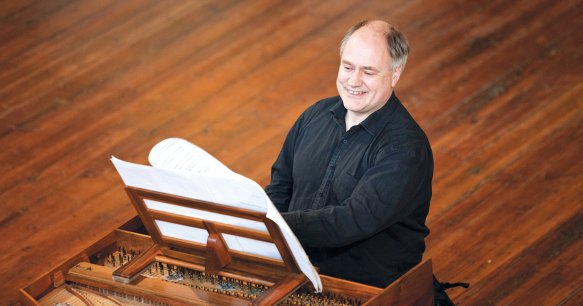
Butt (above) is a Bach specialist, living and breathing the composer’s music. He has scholarly intellect on his side but balances that with enthusiasm in spades. For this concert his energy rubbed off on the audience, and in several faster numbers he literally could not wait to get his hands busy on the harpsichord. Like all bar the cellists and basses he stood to perform, the Dunedin Consort’s freedom of movement translating nicely into their interpretations of Bach’s dance movements, which had a spring in their step.

The last two numbered suites use brass and timpani, so we began with something approaching a fanfare. It took a couple of bars for the Dunedin Consort, numbering nearly 40, to hit their stride, but from then on their playing filled the Royal Albert Hall with the expanse of the fourth suite’s Ouverture, which had a ceremonial air before breaking into a bustling faster tempo. The four dances that followed were fleet of foot, Butt enjoying the humour of the perky Bourrée (10:40), then a stately Gavotte (13:25), Menuet (15:23) and Réjouissance (19:33), at which point brass and drums returned with a flourish.

Nico Muhly’s Tambourin followed without a break, utilising the same grand forces but expanding the harmonic world considerably. As a dance it was syncopated beyond danceable rhythms, starting powerfully but dissolving into D major at the end, dressed by flecks of Stephen Farr’s harpsichord.

The Orchestral Suite no.1 is a rich tapestry of dance movements prefaced by an expansive overture. The most expansive work of the four, its French ‘ouverture’ was elegantly played and dressed with expansive bass notes before moving to a lively fugue, oboes really coming into their own. The dances, again all of French derivation, were light on their feet, propelled by nifty harpsichord accompaniment from Farr and Butt centre stage. They were topped by a bustling Bourrée, its figures flying around the violin section before the complement, a darker, minor key central section for woodwind. With harpsichords silent, this was poignant and beautifully played.

Stevie Wishart complemented the first suite with a striking tribute to the endangered Argentine Hooded Grebe, whose call matched her music and could be heard over the Royal Albert Hall speakers during a witty and rather macabre tango. Once heard the call became ever more poignant, the instruments thrown off course and off pitch. It was effective, haunting and thought provoking.

Ailie Robertson’s Chaconne opened the second half, a reflection on Scottish dance music. A slow and atmospheric piece, it began with eerie held notes in the upper violins which really came into its own when the flutes joined, like Wishart evoking a bird in imagery, though this time a slower, bigger one like an albatross.

For the Orchestral Suite no.2 Butt used reduced string forces and three flutes, headed by the excellent Katy Bircher. The colours of this work are appreciably darker, and the leaner string sound complemented the consoling flutes. After a solemn start to the Ouverture came a lively fast section, then the flutes led us in a sprightly Rondeau, with a quicksilver account of the famous Badinerie to finish. In between there were solemn, more processional numbers – a mournful Sarabande picked up by a quick Bourrée, resolute Polonaise and gallant Menuet.

Stuart MacRae’s Courante was the final commission, an upbeat to the final suite that went off at quite a pace, Stephen Farr’s rattling harpsichord pursued by the orchestra and ultimately caught, before the violins became ‘it’ and took off again, the piece diminishing to a whisper at the end.

The Courante was a cheeky upbeat to a truly joyous performance of Bach’s Orchestral Suite no.3. Trumpets were bright and timpani on point, Stephen Burke tapering his strokes to use angle rather than force to create the sound. The celebrated Air ‘on the G String’ was light on its feet and affectionate without overindulging, while the Gavotte, Bourrée and Gigue had the biggest smile on their faces, Bach’s counterpoint as inevitable and toe tapping as ever. The Gigue was especially upbeat, with rolling timpani and celebratory trumpets.

It is incredible to think that only last year Creative Scotland were proposing to cease funding the Dunedin Consort, a decision that was thankfully overturned. This night at the Royal Albert Hall illustrated beyond doubt the collective, creative bloom the group are experiencing, and it was a privilege to be a part of their Bach night.

Further Listening

John Butt and the Dunedin Consort have not yet recorded the Bach suites, but they did recently release an account of the wonderful violin concertos which you can sample below:

Bach Violin concertos with Cecilia Bernardini from Dunedin Consort on Vimeo.

For a choice recording of the suites, a new disc from the Freiburger Barockorchester is recommended here:

On record – Mahan Esfahani: J.S. Bach – Toccatas (Hyperion)

J.S. Bach
Toccata in F sharp minor BWV910
Toccata in C minor BWV911
Toccata in D major BWV912
Toccata in D minor BWV913
Toccata in E minor BWV914
Toccata in G minor BWV915
Toccata in G major BWV916

Mahan Esfahani (harpsichord)

Hyperion CDA 68244 [76’54”]

Recorded August 2019 at St. John the Baptist, Loughton, Essex

Producer Sébastian Chonion
Engineer David Hinitt

Written by Ben Hogwood

What’s the story?

Mahan Esfahani has been playing a lot of J.S. Bach lately. With a series of the composer’s complete keyboard works ongoing at the Wigmore Hall, and with a well-received account of the Goldberg Variations in the bag from his stint at Deutsche Grammophon, now would seem the ideal time to document his thoughts on some of Bach’s most extrovert and unpredictable works for harpsichord, the Toccatas.

What’s the music like?

Exuberant and even flamboyant. Those are two words you might not readily apply to Bach, certainly in the wrong performance, but this is the sort of recording to remind you that not only was Johann Sebastian a master of the more theoretical processes in music, he could write music of breathtaking originality too.

The Toccatas are the work of a young man looking to experiment and explore, and also to entertain. Esfahani really captures that spirit of freedom from the first to last notes, the Toccata in G major setting us down in a crumpled heap around 76 minutes later.

It helps to have the performer’s accompanying notes on the works, and how difficult it is to arrive at a scholarly direction on how they should be played. What matters as much is the performer’s input, and – as he acknowledges – the producer and engineer, to whom he expresses heartfelt thanks as his own ‘therapists’.

Does it all work?

Emphatically, yes. This feels like just the right stage in Esfahani’s career for him to tackle these works, and his response is stylish and reverent, outgoing too – so that the more overtly display-dominated items are real audience pleasers, and the telling pauses or slow passages are delivered with gravitas and great feeling.

For there is music of great theatre and occasion here. Presented in catalogue order, we begin with the Toccata in F sharp minor BWV910, which begins with a thrilling rush of the right hand, before dance figures take over. A stern central section leads to a rediscovery of its positive stance towards the end.

The Toccata in C minor BWV911 follows, its fugue deliberately paced to start with and then allowed to pick up its natural momentum. Esfahani, so assured in his playing, brings each part in with a firm inevitability as the closing pages approach before signing off emphatically.

The Toccata in D major BWV912 features some really impressive, florid passage work, while the D minor work, BWV813, feels like an answer with its stern, imposing contours. This work really springs forward in Esfahani’s hands around the 3:30 mark, before a superb, authoritative finish, with the pleasure of hearing the keys released at the end.

The instrument’s lower register really sings in the Toccata in E minor BWV914, notable for its bold lines, before an extremely descriptive episode that is so strongly characterised it feels like a scene from a play. When the big rush of counterpoint comes later, Esfahani again exerts close control.

The Toccata in G minor BWV915 starts with a sense of occasion, a cascade in the right hand before a nimble dance and a flourish, before the final Toccata in G major BWV916, a solo concerto in all but name. This has a celebratory air, its descending motif in clumps of chords rather like a peal of bells. Then a slow, thoughtful movement in E minor (the closest relative key of G) provides a reflective episode before a lively return home for an upbeat finale.

Complementing these seven impressive utterances are an ideal harpsichord sound and recording, the church chosen by Hyperion offering just the right amount of depth to the recorded sound, so we hear the clarity of Bach’s writing but also its ambitious scope.

Is it recommended?

Without hesitation. If you tend towards the organ works when listening to Bach played on the keyboard, this is just the disc to show you what you are missing on the harpsichord side of the equation.

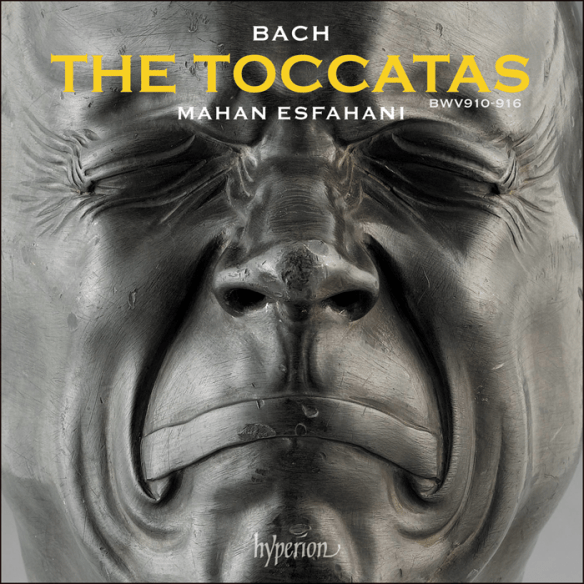
Mahan Esfahani plays these works with formidable technique and with passion too, taking every opportunity to bring Bach’s flourishing works to life. What a cover, too!

Buy

For more information on this release and to purchase in multiple file formats, you can visit the Hyperion website

Wigmore Mondays – Nicolas Altstaedt plays Bach & Dutilleux

Nicolas Altstaedt (cello)

Dutilleux 3 Strophes sur le nom de SACHER (1976) (1:36 on the broadcast link below)
J.S. Bach Cello Suite No 1 in G major BWV1007 (c1717-23) (12:54)
Cello Suite No 5 In C minor BWV1011 (c1717-23) (32:13)

Wigmore Hall, London
Monday 17 June 2019

To hear the BBC broadcast through BBC Sounds, please follow this link

Commentary and Review by Ben Hogwood

The Wigmore Hall is an ideal venue for solo cello, as Nicolas Altstaedt showed in this BBC Radio 3 Lunchtime Concert. Yet before we heard his solo Bach he switched the order of the program slightly, placing the Dutilleux piece first. I must admit I had thought it would be even more effective in between the two Bach suites, but with playing of this insight and quality it soon seemed harsh to quibble.

Along with eleven other composers, Henri Dutilleux wrote a piece to celebrate the 70th birthday of the Swiss conductor and patron Paul Sacher. The brief was to construct a solo cello work using the intials of the conductor’s name (Eb – A – C – B – E – R). Dutilleux was in exalted company – Britten, Boulez, Lutoslawski and Ginastera were some of the other names involved – but he constructed 3 Stophes sur le nom de SACHER, three short but deeply expressive pieces.

Altstaedt played them passionately, immediately enjoying Dutilleux’s ways of exploiting the instrument’s colour through pizzicato, harmonics and a detuned ‘C’ string. The first piece (from 1:36 on the broadcast link) created a heady atmosphere but with plenty of nervous energy, before retreating to a distance. The second piece (4:45) brooded in the cello’s lower register before ascending to a lonely-sounding melody on high. The third (7:20) went at a terrific rate, scurrying figures down the cello punctuated by plucking, then reaching dizzy heights with harmonics that could almost have been from another planet, before swooping down and finishing with aplomb.

Moving to J.S. Bach, the mood eased for a wonderful performance of the Cello Suite no.1. Altstaedt played at a lower ‘baroque pitch’, with very little vibrato and with relatively little flamboyance, happy to let the music do the talking. With an airy Prelude (12:54) followed by a softly voiced Allemande (15:29) and light footed Courante (20:35), notable for its tasteful ornamentation, he was allowing Bach’s dance movements every chance to express their graceful side.

When it came to the slow Sarabande (22:56), he resisted the temptation to do what a lot of cellists do and overplay the double stopped chords, again letting the music speak in quiet, thoughtful tones.

He decided against using the Minuet repeat – a minor shame, as it is such good music! – but the light and shade with the trio section (25:48 and then 26:33) was exquisitely judged, before the Gigue (28:19) danced its way into the distance.

Altstaedt’s choice of suites was very much light and shade, for there is little in Bach with a darker colour than the Solo Cello Suite no.5. The Prelude (32:13) of this suite is austere in the extreme, and again a slightly reserved approach dynamically played to the music’s strengths. The Allemande (37:40) and Courante (43:32) were stern, each dance movement given the appropriate room but very darkly coloured, the rich chords beautifully judged.

The famous Sarabande (45:27), which some have compared to the falling of tears, was suspended in mid-air, time almost stopping as the feather light notes traced their bare outlines. After this a slight pick me up came in the shape of the first Bourrée (49:18), but the second was wispy and elusive (50:48). The concluding Gigue (52:35) gave us more closure but retained the serious air of the suite.

After these performances the lack of an encore was completely understandable, heightening the impact of the music we had heard. It was a very fine concert, and one would hope when he is ready Altstaedt will commit his striking Bach interpretations to disc.

Further reading and listening

You can watch Nicolas Altstaedt play the Dutilleux Strophes here:

The music in this concert can be heard here, in the available versions:

Altstaedt has not yet committed any of the Bach suites to record yet, but he has released a disc of the Sonatas for viola da gamba and harpsichord, with Jonathan Cohen. They can be heard on Spotify here:

The Bach Cello Suites are wide open to interpretation, not just from cellists but from the wider electronic music community. Peter Gregson has a foot in both camps, and last year’s addition to Deutsche Grammophon’s ‘Recomposed’ series was both imaginative and respectful:

On record: Acoustic Alchemy: 33 1/3 (Absolute)


Acoustic Alchemy are Greg Carmichael (nylon guitar), Miles Gilderdale (acoustic and electric guitars), Fred White (keyboards), Gary Grainger (electric bass), Greg Grainger (drums)

OnSide Records CDONSIDE03 [40’39”]

Recorded 28-30 April 2016, Potton Hall, Westleton, Suffolk

Produced by Greg Carmichael and Miles Gilderdale

Reviewed by Richard Whitehouse

What’s the story?

Acoustic Alchemy returns with 33 1/3 – the 17th studio album of its 38-year history and the seventh since Miles Gilderdale joined Greg Carmichael to give this band an electrified edge. All the expected ingredients are in place, though with a few tweaks to their familiar sound.

What’s the music like?

Certainly, there could be no better statement of intent than East of Babylon, a hard-hitting fusion of driving rock with Eastern overtones and a dash of funk that already ranks as an AA classic. If later tracks head into more expected territory, this brings no lessening of purpose – hence the equable interplay of Carmen’s Man, then the poetic evocation of The Swallow’s Tale with its pensive acoustic intro from Carmichael and soulful sax break by Jeff Kashiwa. 33 1/3 itself is replete with deft chord changes and a soaring electric solo from Gilderdale.

There is more than a touch of melancholy to the limpid profile of Winter’s End, while the slow-burning vibe of A Little Closer brings the rhythm section of Greg and Gary Grainger elegantly into focus – not to mention nimble piano work from Fred White. Discreet contrast is provided by Blues for Mr. Mu, its swinging gait and nonchalant guitar interplay abetted by cunning syncopation. The Girl With A Plan is a further highlight in its intricate guitar patterns, against a tensile rhythmic backing that AA has made its own over all these years.

The final tracks make an unlikely though welcome detour into the medium of acoustic guitar. The Allemande (from the Lute Suite in E minor BWV996) is a flowing study in two-part counterpoint, while the Prelude in D minor (transposed from that in C minor, BWV999) is typically Bach in its delicately arpeggiated melody and methodical accompaniment. A solo version of The Wind of Change (originally recorded for the AArt album) then provides a limpid showcase for Carmichael as well as an unexpectedly ruminative close to this album.

Does it all work?

Yes – for all that the album is among the shortest of the band’s career, this is undoubtedly a case of quality winning out over quantity. The only proviso is that the acoustic transcriptions feel as though ‘added on’ to the eight tracks preceding them and might have been even more effective were the Bach placed at the centre (they can, of course, easily be reprogrammed).

Not that these latter tracks are at all redundant: indeed, an album of Bach’s Inventions and sundry two-part pieces from Carmichael and Gilderdale would be an enticing proposition.

Is it recommended?

Very much so. Sound has clarity and punch, while the digipack presentation is economical and stylish as befits the CD’s supposed ‘twilight’ era. 33 1/3 might not be a radical departure for Acoustic Alchemy, yet it does confirm this band’s relevance well into the 21st century.

Further listening

You can listen to this new release on Spotify:

Further reading

You can read more about Acoustic Alchemy on their website