In concert – Piotr Anderszewski @ The Barbican: Beethoven, Brahms, Bartók & J.S. Bach

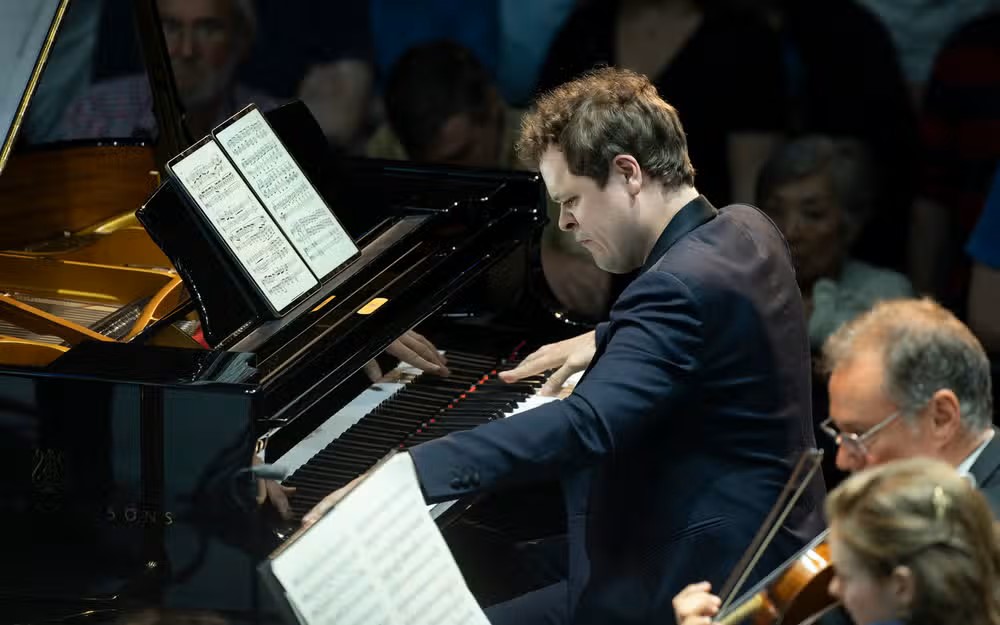
Piotr Anderszewski (piano, above)

Beethoven 6 Bagatelles, Op.126 (1823)
Brahms Intermezzos (1892-93) – Opp.119/1 & 3; Op.118/1 & 2; Op.117/2; 118/6
Bartók 14 Bagatelles BB50 (1908)
J.S. Bach Partita no.1 in B flat major BWV825 (1726)

Barbican Hall, London
Thursday 3 October 2024

Reviewed by Richard Whitehouse. Photo © MG de Saint Venant licenced to Virgin Classics

Expecting the unexpected is the most predictable aspect of a recital from Piotr Anderszewski, tonight’s programme no exception in its juxtaposing collection by Beethoven and Bartók with a selection from Brahms and music by Bach that has long been a cornerstone of his repertoire.

Alive to their iconoclastic flourishes and improvisatory asides, Beethoven’s last bagatelles yet emerged as a cohesive and integrated unity as it ventured through limpid musing and angular playfulness then disarming elegance before arriving at a propulsive take on the B minor Presto muscular or energetic by turns. The final two numbers were of a piece with what went before – the one understated and the other’s ingratiation bookended by outbursts of grating humour. Nothing to be taken for granted in this music, then, as Anderszewski intimated only too well.

Although published as four separate collections, there is no reason why Brahms’s late piano pieces cannot be given separately or in autonomous groupings as here. Starting with Op. 119, Anderszewski brought a confiding touch to the plaintive B minor Intermezzo and rendered the lilting syncopation of that in C with real playfulness. Turning next to Op. 118 and the forlorn quality of its A minor Intermezzo complemented ably that in A, whose new-found popularity need not detract from its harmonic subtlety or soulful poise. From Op. 117, the B flat minor Intermezzo struck note of ingrained fatalism intensified by that in E flat minor from Op. 118 – its ‘mesto’ marking here underlined as the music unfolded toward an endpoint of unforced resignation. Anderszewski looked regretful it should end so before duly leaving the platform.

As his recent recording confirms, Anderszewski has forged unerring identity with the Op. 6 Bagatelles where Bartók gave notice of his fast-emerging individuality. Played with minimal pauses (albeit with a 3-3-2-2-2-2 grouping such as brought these into line with the six pieces in each of those other sets), they offer a conspectus of possibilities over his ensuing creative decade that was to the fore here, alongside a cumulative focus evident less in any increasing technical demands as in a gradual opening-out of their emotional world made explicit in the final two numbers as doubtless stems from Bartók’s unrequited love for violinist Stefi Geyer. Thus, the sombre restlessness of Elle est morte merged directly into the valse Ma mie qui danse – this latter’s vicious irony maintained right through to its almost dismissive pay-off.

Had Bach ever entertained any such feelings, they were certainly far removed from the keen objectivity of his First Partita. A little restive in its Praeludium, Anderszewski hit his stride in its gently eddying Allemande then animated Courante. There was no lack of gravitas in its Sarabande, but this was as deftly inflected as was the elegance of its contrasted Menuet dances, then the Gigue made a dextrous yet assertive conclusion to a sequence where (as in everything heard tonight) what was made possible outweighs what had already been achieved.

It would have been possible to combine these works with other pieces – maybe some or even all of Ligeti’s Musica ricercata that Anderszewski will hopefully play at a future recital. For now, a limpid reading of Chopin’s Mazurka in A flat major (Op.58/2) made for an ideal envoi.

To read more on Piotr Anderszewski, visit his website

Published post no.2,321 – Friday 4 October 2024

In Concert – Sean Shibe @ Wigmore Hall: A Celebration of the Guitar

Sean Shibe (guitar)

J.S. Bach Prelude in C minor, BWV999 (c1727)
Barrios Mangoré La Catedral (1921, rev. 1939)
Villa-Lobos Prelude no. 3 in A minor (1940); Études (1929) – no.1 in E minor, no.5 in C major, no.8 in C sharp minor, no.10 in B minor
Barrios Mangoré Barcarola in D major, ‘Julia Florida’ (1938)
Mompou Suite compostelana (1962) – nos. 1, 2, 5 and 6
Martin Quatre pieces brèves (1933)
Adès Forgotten Dances (2023)

Wigmore Hall, London
Thursday 19 September 2023

Reviewed by Richard Whitehouse

Expecting the unexpected has become synonymous with Sean Shibe, who tonight began his season-long residency at Wigmore Hall with this recital which deftly blurred any perceived demarcation between improvised or notated music in a compulsively absorbing programme.

One of a surviving handful of pieces probably written for lute, Bach’s C minor Prelude began proceedings – its elegantly methodical unfolding here rendered with real liquidity by Shibe. It segued seamlessly into La Catedral as is among a relative few of Agustín Barrios Mangoré’s extended compositions: the subdued fervour of (belatedly added) Preludio saudade heading into the hieratic processional of Andante religioso, before the lively yet disquieting motion of Allegro solenne brought this vividly yet understatedly illustrative sequence to its close.

Here, as across this recital, Segovia was a pervasive presence – not least on the guitar output of Heitor Villa-Lobos. From his Five Preludes, Schiebe opted for the Third – a Homage to Bach whose echoing open strings summon an opulence, even majesty, out of all proportion to its length. Then came four of his 12 Études – the intensive arpeggio workout of the First, the stark contrasts between melody and accompaniment of the Fifth, the playful alternation of registers in the Eighth, then rounded off with the exacting rhythmic fluidity of the 10th.

The first half closed with more Barrios – his Júlia Florida a barcarolle of melting tenderness whose allure carried over a second half that commenced with four of the six movements from Federico Mompou’s Suite compostelana. One of the Catalan’s handful of works for other than piano, the distanced evocation of Preludio complemented the austere spirituality of Coral as surely as did the folk-tinged pathos of Canción the ingratiating allure of Muñeira – this latter bringing the Galician environs which had inspired this music into greatest prominence.

Shibe’s including music by Frank Martin was more than welcome in the 50th anniversary of the Swiss composer’s death as has passed largely unnoticed in the UK. His only work for solo guitar, Quatre pieces brèves has been championed by many guitarists in Segovia’s wake and Shibe duly left his mark with his quizzical take on its Prélude, the chaste witfulness of Air then the barely contained emotional impetus of Plainte, before Comme une gigue provided a pointedly ‘contemporary’ vantage on the Baroque dance by turns quixotic and invigorating.

That both Martin and Thomas Adès have written operas on Shakespeare’s The Tempest seems as good a link as any into Forgotten Dances, the latter composer’s first work for guitar. Its six vignettes traverse the restless Overture and Buñuel-influenced speculation of Berceuse, via the Ligetian propulsion of Courante and tenuous repose of Barcarolle, to the cumulatively effusive homage to Berlioz of Carillon de Ville then rather more equable homage to Purcell of Vesper – its allusions emerging, Dowland-like, over what becomes an affecting farewell.

An intriguingly varied recital duly afforded focus not least by the calmly assured presence of Shibe – his appearance this evening redolent of the long-gone, much-missed Billy Mackenzie. A limpid rendering of an as yet unidentified encore provided a brief if wholly appropriate envoi.

To read more about Sean Shibe’s residency at the hall, visit the Wigmore Hall website – and click here to visit the guitarist’s own website

Arcana at the Proms – Prom 23: Benjamin Grosvenor, Rodolfus Choir, London Philharmonic Chorus & Orchestra / Edward Gardner – Busoni & Rachmaninoff

Rachmaninoff Symphonic Dances Op.45 (1940)
Busoni Piano Concerto in C major Op. XXXIX (1902-4)

Benjamin Grosvenor (piano), The Rodolfus Choir (men’s voices), London Philharmonic Choir (men’s voices), London Philharmonic Orchestra / Edward Gardner

Royal Albert Hall, London
Monday 5 August 2024

reviewed by Richard Whitehouse Photos (c) Andy Paradise

This centenary of Busoni’s death has not thus far seen a great deal of activity in the UK, so it was gratifying to find the Proms scheduling his most (in)famous work – the Piano Concerto tonight receiving its second performance at these concerts, 36 years to the day after its previous outing.

Back then, the first half featured Beethoven’s Fourth Symphony and a more apposite coupling than Rachmaninoff’s Symphonic Dances. Now firmly ensconced in the orchestral repertoire, it remains a stern test the London Philharmonic Orchestra did not quite meet on this occasion – despite such felicities as Martin Robertson’s eloquent alto sax in the first movement and Edward Gardner’s conjuring of a tangible malevolence in its successor. Impulsive but erratic in its outer sections, the finale’s evocative central span had a superficial quality typical of this performance overall.

This was not the case in the Busoni. Benjamin Grosvenor (above) might not the first name who comes to mind for this concerto but, having already given performances in Reykjavik and Berlin, he was audibly attuned to an idiom not as elusive as often supposed in its canny amalgam of the Germanic and Italianate, while his playing was fully equal to its technical demands. That he is not a pianist looking to confront the orchestra head on ensured a more than usually close-knit coordination with players and conductor, which was almost always to the benefit of this piece.

Not least in Prologo e Introito, its orchestral introduction enticingly shaded by Gardner with Grosvenor integrating his unequivocal entry into what are essentially variations on the theme at the outset. Few pianists have weighted Busoni’s complex chords or his intricate harmonies with such translucency, not least the end of this movement where piano and orchestra melded to spellbinding effect. Straight into Pezzo giocoso, its capricious outer sections framing one of stealthy ambivalence as perceptively rendered as was that spectral angularity near its close.

Grosvenor managed the rare trick of making Pezzo serioso simultaneously cumulative and cohesive. He duly channelled the slow-burning momentum of its introduction into the rolled chords of its barcarolle-like first part – Gardner sustaining impetus across its successor to an imperious climax, during which the soloist never risked being obliterated. The lead-in to its third part had a poise equal to that at the end, where subtle rhythmic contrasts between piano and timpani against undulating strings had an enfolding calm to diffuse any lingering tension.

A general pause for retuning, then All’italiana burst forth – the underlying tarantella rhythm a springboard for its motley succession of vernacular elements initially humorous and latterly uproarious, held in check by the scintillating give-and-take of soloist and orchestra. Grosvenor almost topped these shenanigans with his electrifying cadenza – after which, Gardner prepared admirably for Cantico in which male voices (above) hymned Allah’s praises with mounting fervour; Grosvenor a largely passive observer until he belatedly returned for the headlong signing-off.

Quite a performance, then, that will hopefully be released commercially. Did Busoni offer an encore at that Berlin premiere? It could not have been more suitable than J.S. Bach’s Prelude in E minor BWV855, transposed and arranged by Alexander Siloti – three minutes of balm bringing us gently down to earth.

For more on this year’s festival, visit the BBC Proms website – and to read more on the artists involved, click on the names: Benjamin Grosvenor, Edward Gardner, The Rodolfus Choir, London Philharmonic Choir and the London Philharmonic Orchestra

Published post no.2,264 – Thursday 5 August 2024

Music for Easter #3 – J.S. Bach: St. John Passion

Published post no.2,134 – Sunday 31 March 2024

Online Concert: Jean-Guihen Queyras @ Wigmore Hall – Bach, Saygun & Britten

Jean-Guihen Queyras (cello)

J.S. Bach Cello Suite no.1 in G major BWV1007 (c1720)
Saygun Partita for solo cello Op.31 (1955)
Britten Cello Suite no.1 Op.72 (1964)

Wigmore Hall, Monday 20 November 2023 1pm

by Ben Hogwood

There is now a wide variety of repertoire from which the unaccompanied cellist can choose, yet this was emphatically not the case in the days of Johann Sebastian Bach. His six suites opened the door for the instrument to become a purveyor of melody and emotion, even if those facets were left largely unexplored until the 20th century.

Writing for solo stringed instruments went out of fashion in the Romantic period, until the rediscovery of Bach’s works by Pablo Casals towards the end of the 19th century – from which this highly original music reached its rightful platform. The First Cello Suite of the six is a delightful work, written at a standard rewarding those of an intermediate ability with music that repays decades of listening and practising.

Jean-Guihen Queyras brought to it a freshness bringing the most from the music. His unaffected manner with the Prelude found serenity amid a relatively relaxed sequence of string crossing, the cellist’s careful thought giving the music space. This set a theme maintained by the nicely voiced Allemande, then a bracing and rustic Courante reminding us of the dance origins of these pieces. The elegant Sarabande was particularly beautiful, with tasteful ornamentation applied on the section repeats, before a spirited first Minuet was offset by the brief but contemplative second in the minor key. A lively Gigue concluded an excellent performance. Bach will always be work in progress for cellists, but it was clear just how enjoyable that process is for Queyras.

From the well-known Bach we travelled to Turkey to experience the relatively unheard Partita of Ahmet Adnon Saygun, a composer regarded as the first exponent of Western classical music in the country, and whose orchestral music has travelled relatively well. Queyras removed the fourth movement of five from this performance, which nonetheless made a powerful impact. Starting with a drone in the lower reaches, the Lento first movement climbed melodically to an expressive outpouring, totally secure in the French cellist’s hands. A restless, edgy Vivo followed before emotive inflections were found in the Adagio, the melodic lines alternately probing or softly turning inwards. The Allegro moderato was deceptive to start with, initially meandering in mid-register before crossing the cello with emphatic lines, before the music relented to the drone of the opening once more. On this evidence, the chamber music of Saygun – a composer with a prolific output – is definitely worth exploring in more detail.

Like Bach, Britten also based his first cello suite in G major – the third of his works dedicated to the great cellist Mstislav Rostropovich, after the Cello Sonata and Cello Symphony. With a mixture of contrasting dances and tempi, the work has a recurring Canto section, on which Britten typically writes a number of varied repeats. This performance began in commanding fashion, before Queyras repeated the melody in a plaintive voice, getting closer to the true heart of the suite.

For although there was music of immense power this is essentially nervy night-time music. In this performance the Fuga often retreated to the shadows, offering some furtive if slightly playful harmonics at the end. The Lamento was lost in thought to begin with while the Serenata, played pizzicato throughout, evoked another world. So too did the Marcia, its ghostly evocations of flute and drum cutting to assertive, red-blooded music. The Bordone was troubled, the pitches of its drone creating great tension in this interpretation – before the scurrying finale found sure-footed ground.

This was a technically flawless recital from Queyras, a captivating trio of pieces atmospherically cast in half light on the Wigmore Hall stage. His encore was music from György Kurtág, a master of solo instrument composition. His typically compressed but intense Az Hit, where a diatonic melody developed outwards before drawing back in, finished with a charming two-note signature.

For more livestreamed concerts from the Wigmore Hall, click here