The Genesis of Minerva: Schumann and the Young Brahms – Minverva Piano Trio

minerva-piano-trio

Minerva Piano Trio (above): Michal Cwizewicz (violin), Richard Birchall (cello), Annie Yim (piano)

St John’s Smith Square, London; Sunday 23rd October, 2016

Schumann Piano Trio No.1 in D minor Op.63 (1847)

Birchall Contours (2014)

Brahms Piano Trio No. 1 in B, Op. 8a (original 1854 version)

A season-long residency as Young Artists at St John’s is enabling the Minerva Piano Trio to schedule several worthwhile recitals. None fitted the bill more than this afternoon’s programme, culminating in a rare revival for the First Piano Trio of Brahms as heard in its original version.

Completed when he was barely into his twenties, this is the only work from the outset of Brahms’s maturity to have survived essentially as it was conceived. That the composer substantially re-wrote it in 1889 (after his temporary ‘retirement’ from composition) but allowed the versions to co-exist suggests that, dissatisfied though he may have become with them, he was unable to suppress those earlier thoughts. One does not look to the 1854 version for formal unity or finesse, but it certainly has the edge in terms of expression and tonal cohesion.

The opening Allegro is as much about charting an emotional course through its constituent themes than fashioning them into a logical argument, yet such is the imaginative resource with which Brahms elaborates his material that the movement as it evolves becomes its own justification. The Minerva audibly appreciated this with playing as perceptive as the music required, then was equally inside the Scherzo with its alternately brusque and elegant ideas – and an intriguingly fugitive ending that the revision streamlines into something less arresting.

With its multiple allusions to the then nascent Lieder tradition, the Adagio casts a magnetic if unsettling spell and the Minerva accordingly brought out its exquisite ambiguity in full measure. No less impressive was a Finale which, irrespective of how convincing – or otherwise – is its reworking (and Clara Schumann’s strictures cannot be lightly dismissed), the audacious homecoming in B minor is here suffused with inevitability such as the older and wiser Brahms was unable to achieve by modulatory means alone: a QED in every sense.

A commanding performance, then, and the Minerva had been hardly less inside the idiom of Schumann’s own First Piano Trio at the start of this recital. Whether or not the emergence of his wife Clara’s masterly work for the medium just a year before was indeed the catalyst, the present piece harnesses those sombre hues often to the fore in Schumann’s later music with a textural translucency which never spills over into opacity. This, at least, was the impression left by a reading that plotted a resolute course through the discursive design of the opening movement then clarified the scherzo’s rhythmic intricacy without sacrificing its poise. The plangent ‘song without words’ that follows was seamlessly dovetailed into the finale, which unfolded with no lack of incident on its way to a decisive while tenuously affirmative close.

Coming between these expansive staples of the repertoire, Contours by the Minerva’s cellist Richard Birchall proved a diverting entity – its four brief movements amounting to a discreet unity that, with its evocative Nocturne and engaging Fast Waltz, confirmed a real grasp of this difficult medium. There was further music at the close – when, in response to generous applause, the Minerva gave an easeful reading of the Andante from Clara Schumann’s Piano Trio in G minor. An eloquent conclusion to an impressive recital by an ensemble which is clearly going places.

Richard Whitehouse

The Minerva Piano Trio returns to St John’s for further concerts on 9th March and 1st June 2017. Further information can be found at the St John’s website. You can hear more of the trio below:

Wigmore Mondays – Nicola Benedetti & Alexei Grynyuk in late sonatas by Beethoven & Brahms

nicola-benedetti
Nicola Benedetti (violin, above), Alexei Grynyuk (piano, below)

Wigmore Hall, London

Monday, 29 February 2016

Audio (open in a new window)

http://www.bbc.co.uk/programmes/b071cl1c

Available until 29 March

alexei-grynyuk

What’s the music?

Beethoven – Violin Sonata in G major, Op.96 (1812) (28 minutes)

Brahms – Violin Sonata no.2 in A major, Op.100 (1886) (23 minutes)

Spotify

Nicola Benedetti and Alexei Grynyuk have not yet recorded this music, but other versions can be accessed via the playlist below, in case you can’t get to the broadcast:

About the music

Beethoven’s tenth and last published violin sonata sits on its own in his output, a decade after than the composer’s previous work in the form. It is dedicated to the same ‘Archduke’ (Rudolph of Austria) for whom Beethoven wrote his famous B flat major piano trio, also published in 1812. Beethoven supposedly wrote it in a slightly easier style, as the violinist Pierre Rode – who was performing the piece with the Archduke playing piano – was not as skilful as he once was. The G major piece makes allowances, then – but not in a way that you would ever know from listening! It is unusually tranquil, and has instances of the timeless music Beethoven was to find in the slower movements of his late works.

There are no such concessions to technical ability from Brahms, who wrote the second of his three violin sonatas while on holiday by Lake Thun, Switzerland. This is however a relatively late work, and although Brahms has found and established his style the piece still carries some of the pressures of writing for Joseph Joachim. Its lyrical and tuneful nature have helped make it one of the composer’s most popular pieces of chamber music – and like the Beethoven it has a largely sunny outlook.

Performance verdict

A nice combination of two violin sonatas that seemed ideally suited to a bright Spring lunchtime – and how refreshing to hear young artists such as Benedetti and Grynyuk take on two later works like this.

The Beethoven was lovely, performed in a spirit of enjoyment where the violin and piano really were equals. Benedetti’s tone, slightly sweet, was ideal, while Grynyuk proved a very sensitive pianist, with some lightly brushed contributions that made sense of Beethoven’s unusual contentment.

The same mood infused the Brahms sonata, though here there was a greater sense of purpose, as the first movement, having begun relatively slowly, surged through to a much more animated development section. The finale was also notable for revealing some of the shadows that became a greater part of Brahms’s late works – but overall the feeling was one of positivity, celebrating the composer’s good spirits and warm lyricism in this work.

What should I listen out for?

Beethoven

1:58 – as the piece begins there is an immediate feeling of contentment, and although the opening idea is quite innocuous it is distinctive, with its use of the trill ornament. The piano introduces an airy second theme at 3:10, which the violin soon takes up. The mood is summery, and even a bit drowsy. The first section is repeated again at 4:40. Beethoven then develops his ideas fluently before we hear the main tune once again at 8:31, shared this time by the violin and piano. The balmy warmth continues until the end.

13:12 – the second movement is slow, marked Adagio espressivo, and has that kind of heavenly timelessness often found in later period Beethoven. It has a spacious introduction from the piano and is if anything even more relaxed than the first movement. It operates at a similar tempo and mood to the slow movement from the Emperor piano concerto. From around 14:35 the violin lines become quiet and bare, Benedetti using little vibrato, but the warmth does not take long to return.

19: 19 – the third movement, a Scherzo, is short, and if you blink you’ll miss it! Its first idea is once again light of touch, and though there is a heavier trio section it is not at all long before the minor key asserts itself again.

21:48 – the final movement also has a light touch, with a Haydn simplicity, and is particularly rich in the lower register and strong in the continuous, lower runs. The slower music is a delight, still airy and relatively carefree. There is then a quicker, invigorating run to the end.

Brahms

32:37 – one of Brahms’s most celebrated tunes opens this piece, a lovely outpouring of good feeling. It is quite slow and quiet to begin with but grows into a full blooded interpretation as the theme is developed further. There is greater affection here than in much of Brahms’s output.

42:07 – this is definitely the lighter side of Brahms, with a tender slow movement that segues into a more jaunty Scherzo section (43:32), marked by tumbling triplets in the piano part. The slow movement music follows again at a safe distance (44:38) – and then once again the scherzo music trips along (46:43), this time with plucking from the violin.

49:28 – in the last movement we get the warmth of the violin’s lower register, taking the ‘grazioso’ marking in to account. There are though some shadows that the listener might sense occasionally, the odd harmonic turn towards the dark side that never lasts too long but is there nonetheless.

Encore

54:35 – a substantial encore from Benedetti and Grynyuk, and a very different mood in the exotic and intense Myth no.3 by Polish composer Szymanowski.

Further listening

At the bottom of the playlist you will find some further suggestions for violin and piano in the form of sonatas by Schumann – Brahms’ friend, of course – with his Violin Sonata no.1 – and César Franck, whose own Violin Sonata shares the same key and mood as Brahms’s Second. Finally some shorter pieces by Schumann for solo instrument and piano – the joyous Adagio and Allegro and the 5 Pieces in Folk Style, arranged here for cello and piano. Each will put you in a good mood!

Meanwhile if the Szymanowski appeals, Nicola Benedetti has recorded his Violin Concerto no.1:

Wigmore Mondays – Denis Kozhukhin – Out of Doors

denis-kozhukhin
Denis Kozhukhin (piano)

Wigmore Hall, London

Monday, 22 February 2016

Audio (open in a new window)

http://www.bbc.co.uk/programmes/b071774c

Available until 24 March

What’s the music?

Haydn – Piano Sonata in D major, HXVI:24 (1773) (10 minutes)

Brahms – Theme and Variations in D minor (1860) (10 minutes)

Liszt – Benediction du Dieu dans la solitude (1847) (16 minutes)

Bartók – Out of Doors (1926) (14 minutes)

Spotify

Denis Kozhukhin has recorded the Haydn sonata but not any of the other works in this repertoire. In case you are unable to hear the radio broadcast the below playlist contains legendary recordings of the Brahms (Radu Lupu), the Liszt (Claudio Arrau) and Andreas Haefliger’s account of the Bartók:

About the music

Haydn is acknowledged as the godfather of so many forms that became the norm in classical music from the late 1700s onwards. As well as the symphony and the string quartet, he left a great body of piano sonatas that are fresh, original and ground breaking. Later examples from Beethoven and Schubert would surely not have been written were it not for works such as the D major example here.

The Brahms Theme and Variations is actually an arrangement of the second movement of his String Sextet no.1 – and transcribes for piano effortlessly, so much so that the listener would think it was a piano original. This was in order for it to be played by Clara Schumann, who received the score as a forty-first birthday present in 1860.

Liszt wrote his Benediction as part of a cycle of ten pieces for piano called Harmonies poétiques et religeuses in 1847. It is a relatively long, single span of contemplation, and in it the composer writes music that could be seen as an early pointer towards the so-called ‘impressionism’ of Debussy and Ravel. So often known for writing barnstorming piano pieces, Liszt takes his foot off that particular pedal for once.

Liszt’s fellow Hungarian Béla Bartók wrote his short set of five pieces, Out of Doors, in 1926. As its name suggests it is a celebration of the Hungarian countryside, by raucous day – pipes, drums and chases – and by atmospheric night, where the sounds of amphibious creatures can be heard in some of his exquisite nocturnal picture painting.

Performance verdict

From this concert it is very clear that Denis Kozhukhin is a special talent. The well-designed hour of music moved almost seamlessly from the simplicity of Haydn to the brazen antics of the Bartók with almost no join.

Kozhukin’s Haydn was lovely, the D major sonata receiving an airy performance with plenty of rubato – which means a stylish way of letting the music breathe – so that the rhythms were not too rigid.

The Brahms was similarly magical in the quieter passages, allowing Kozhukhin to use an imposing tone when the music returned to the minor key. This was a performance flying in the face of the obvious technical difficulties presented by the composer – and the same could be said for the Liszt, reaching moments of hypnotic beauty in its outer sections.

Kozhukhin took his time here, creating and maintaining the mood of contemplation, holding the atmosphere while easily managing the fiendishly difficult writing for the right hand. In the Bartók he found a good balance between percussive power and the primitive, folksy material that the composer brings to the surface. As a result Out of Doors felt like a celebration, entertaining and energetic, but with an added chill to the night pieces.

What should I listen out for?

Haydn

1:10 – the piece starts with a flourish in the right hand, one that recalls the sonatas of Scarlatti – as BBC Radio 3 announcer Fiona Talkington points out. It is a fresh tune that twinkles with the accompaniment that Haydn chooses, with very little bass. As is customary the first section is repeated (2:14) before at 3:20 Haydn starts to develop his main idea, moving it around harmonically. This is brief – as at 4:25 we hear the main idea again.

5:47 – the slow movement, which is immediately quite sombre and preoccupied. It is in the style of an aria, as though an imaginary singer were taking the line Haydn gives to the right hand. It is a brief but poignant movement, lost in thought towards the end. Haydn emerges from the quiet mood, leading straight into…

8:54 – the last movement, a short structure bright in tone and with an amicable tune. The end is rather nicely done.

Brahms

11:44 – Brahms begins with a grand statement. The first statement of the tune is given to the right hand, while the left plays arpeggiated chords. It is a big tune – and the first of six variations starts at 13:09, still in the minor key. By 15:38 the music is worked up and full of darkly coloured passion, but then Brahms slips effortlessly into the major key and a lighter outlook (16:54), from where Kozhukhin leads to a radiant variation. At 20:04 the austere minor key returns, but Brahms still finished in the major key, settling the strife experienced earlier.

Liszt

22:35 – Benediction du Dieu dans la solitude (God’s blessing of solitude) is a radiant performance of a piece that begins with a very long melodic phrase. It is quite unusual for Liszt in having very few moments of fire and brimstone, and instead achieves a kind of ecstasy of contemplation. The key – F sharp major – is key to this, the black keys somehow much more mystical than the white on this occasion! There are two central sections – both calming influences (28:39 and 30:58) before the original material returns (32:28). We hear all three tunes before the piece closes softly.

Bartók

39:03 – With Drums and Pipes – an exuberant if heavy start, low on the piano. This is almost an early precedent of rock music with its pounding rhythms!

40:40 – Barcarolla – a slower dance that flows nicely but which sounds uneasy, as though the direction of the boat on the water is uncertain.

43:10 – Musettes – this is rustic, dance-based material, where a lot of the tunes sound as though they are packed with wrong notes (they aren’t!) It makes them strangely charming.

46:05 – The Night’s Music – a classic example of a Bartók night setting. The music closes in on itself, and in the distance some animal / insect noises can be heard, disturbing the night’s piece when they get closer or make sudden noises, such as when Kozhukhin slams the upper end of the piano. It is an atmospheric and highly descriptive piece of music, and more than a little eerie as the sounds persist, seemingly stopping any chance of sleep.

51:11 – The Chase – a bruising encounter with the hands seemingly all over the place on the keyboard. The rhythms are deliberately inconsistent as the music hurries along, with great dissonance and surprises in both parts.

Encore

54:35 – the first encore is a sonata from Domenico Scarlatti – a relatively slow one that makes much of a trill in the right hand. It was published as Kk247 and lasts four minutes…after which point (at 59:01) we hear another sonata, this time from the Spanish composer Antonio Soler – a brighter example in D major – just the two minutes.

Further listening

At the bottom of the playlist you can hear the original Brahms Theme and Variations, written as the second movement in his String Sextet no.1. You can then hear another set of variations – on a theme of Haydn – as well as trying to second guess where Liszt was heading, in the direction of Ravel’s Jeux d’eau! Finally some more Bartók – his three movement Piano Sonata, just as raucous and unhinged as Out of Doors. Listen below:

Wigmore Mondays – Behzod Abduraimov: Chopin Ballades and Brahms Variations

behzod-abduraimov

Behzod Abduraimov (piano)

Wigmore Hall, London

Monday, 15 February 2016

Audio (open in a new window)

http://www.bbc.co.uk/programmes/b07032zw

Available until 17 March

What’s the music?

Chopin (1810-1849) – Ballades:

No.1 in G minor Op.23 (c1835) (9 minutes)

No.2 in F major Op.38 (1839) (7 minutes)

No.3 in A flat major Op.47 (1841) (7 minutes)

No.4 in F minor Op.52 (1842-43) (10 minutes)

Brahms – Variations on a theme of Paganini, Book 1 Op.35 (1862-63) (12 minutes)

Spotify

Behzod Abduraimov has not recorded this repertoire as yet, so in case you are unable to hear the radio broadcast the below playlist contains recordings of the Ballades by the legendary Artur Rubinstein – and an equally thrilling recording of the Brahms from pianist Julius Katchen:

About the music

As the name implies, the Ballade is a form that has a literary origin. Chopin seemingly opted to use this name in response to the writings of Adam Mickiewicz – and using such a name gave him freedom of expression and form. So it is that the four ballades for piano each tell their own story, sometimes deciding to apply rigorous structure but on other occasions letting their ideas run free.

More recently it has become a popular concert trend for the four to be performed together, as they span a good range of Chopin’s composing career (12 years) and because their key centres and emotional impressions are complementary. The first and fourth are the most substantial pieces and arguably the most difficult to bring off, while the second is rigorously structured and the third described as more of a ‘salon’ piece – which should not demean it in any way.

Brahms wrote two books of Paganini Variations, taking as his inspiration the composer’s very last Caprice for solo violin, which you can view below:

It was the composer’s last large scale work for solo piano, and was perhaps a surprise to those who had gotten to know him as a serious composer. Here he lets himself off the leash, writing music that seems to be for display purposes as it becomes ever more difficult – despite him referring to his writing as modest ‘finger exercises’. Brahms being Brahms, though, there is still that customary attention to detail throughout the fourteen variations.

Performance verdict

An ambitious program for a lunchtime concert, but one the Uzbek pianist Behzod Abduraimov pulled off with aplomb. He clearly knows the Chopin Ballades very well, for the melodic phrases were invested with a natural instinct that gave him a deceptive amount of room. There were some passages of play that took the breath away, such as the end of the fourth ballade, while in contrast the quieter moments, such as the very private beginning to the third ballade, were equally involving.

The first ballade flowed beautifully, a stream of consciousness that felt instinctive and gained a lot of momentum in its tempestuous central pages.

On occasion the Paganini Variations were too loud, the really fast and firm bits given out with just a bit too much force. Yet that is perhaps the best criticism, for it shows the extent to which Abduraimov was really going for his shots, as it were – nailing most of the really tricky runs and dazzling especially in the right hand of the thirteenth variation.

What should I listen out for?

Chopin

2:54 – the first Ballade begins with a call to arms that soon dims down – where we hear the main theme at 3:25. For much of the first section the pianist appears deep in thought, but soon these thoughts come to the surface, and from 5:00 onwards we hear music of great feeling, rising to a tempestuous climax and a thoroughly convincing finish.

11:45 – the second Ballade has none of the brooding expression of its predecessor, and could almost be mistaken for a Christmas piece at the start, with its blend of grace and nostalgia. Things change dramatically at 13:41 with an outburst from the right hand, a sudden whirlwind of notes that will almost certainly make you jump on headphones! The two contrasting moods alternate through to the end.

18:46 – the third Ballade starts with a beautiful theme and then turns into a graceful, almost balletic triple time dance. A second section at 20:27 is also in the mood for a dance, turning gracefully but then becoming deeper and much firmer. This starts to dominate the ballade as Chopin moves it through increasingly distant key centres, before the main theme returns joyously at 24:40.

25:47 – the fourth and final Ballade does not begin in its ‘home’ key, approaching it by way of an introduction – before arriving at 26:19 with a new theme. The final flurry to the end begins at 34:49 and is brilliantly played.

Brahms

38:16 – Paganini’s theme is heard in some distinctive voicing – and it is not long until the first variation at 38:43, with what sounds like an incredibly difficult piece of writing to play! Other notable variations are the flighty third (39:37), a much quieter and sombre fifth (40:58), and a sixth (41:48) where Brahms’ characteristic rhythms of two against three take hold. There are then some inward looking, quieter moments where the music takes time for thought.

Then at 47:58 we hear the thirteenth variation, and there are some frankly outrageous showboating with glissandi (very fast runs) in the right hand. Who said Brahms isn’t fun?! The end is pretty explosive stuff, and if you listen closely you might be able to hear Abduraimov stamping towards the finish.

Encore

51:49 – very much the calm after the storm, the encore is the pianist Alfred Cortot’s arrangement of the Sicilienne – originally composed by Vivaldi and arranged by Bach (3 minutes)

Further listening

The last Paganini caprice has sparked the imagination of a number of composers, each of whom have written variations on its melody – so at the bottom of the concert playlist you will find the Rhapsody on a theme of Paganini from Rachmaninov, along with Variations from Lutoslawski and Andrew Lloyd Webber. Which one is best?

Meanwhile you can compare Chopin’s approach to the Ballade with that of Brahms, who published his set of four in 1854. The items are on the bottom of the playlist containing the music used in the concert:

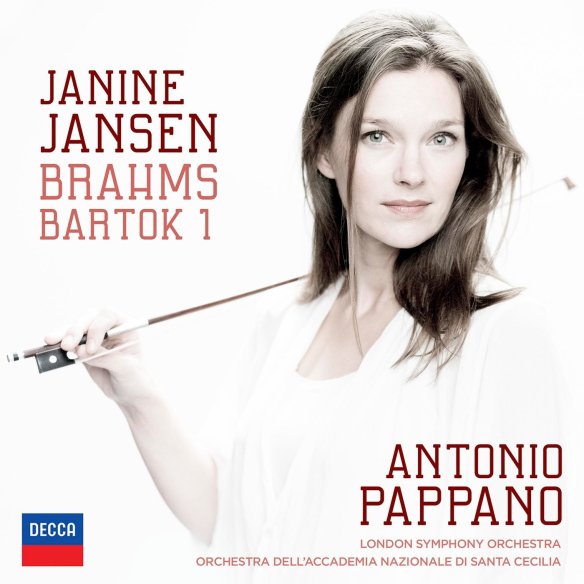
On record: Janine Jansen plays Brahms and Bartók Violin Concertos

Featured recording: Janine Jansen pairs the Brahms Violin Concerto with Bartók’s First
brahms-bartok-jansen

Leading violinist Janine Jansen explores violin concertos by Brahms and Bartók, bringing out the Hungarian connections between them. The accompaniment is from Antonio Pappano and orchestras from the Santa Cecilia Academy and London.

What’s the music like?

This is an unusual pairing that has not been tried on disc before, but it makes perfect sense. Brahms’ Violin Concerto has a finale that makes much of Hungarian gypsy music, so the leap from that to the thoughts of the young Bartók is not as big as you might think.

The Brahms is a big piece, heavily weighted towards its first movement, which at 21 minutes is more than half the length of the work. In this recording Janine Jansen uses cadenzas (the display parts for violin alone) written by Joseph Joachim, Brahms’s friend and the dedicatee of the concerto. Joachim was a long-fingered virtuoso, and because of that the violin part is technically very demanding.

Bartók’s Violin Concerto no.1 is the first of two such published works, and was completed when the composer was in his mid-20s. It also includes traditional Hungarian music but now the language is noticeably more modern, with crunchy harmonies, swaggering cross rhythms and a solo part that sounds more like a duel with the orchestra. In the Brahms the two forces are very much ‘on side’.

Does it all work?

This is an inspired pairing. Jansen plays with a beautiful tone in the Brahms but just as much credit should be levelled at conductor Antonio Pappano and the Santa Cecilia orchestra, for their singing accompaniment that makes the listener want to hum along with the tunes. The Brahms has been recorded a lot of late but in this recording there is a fresh approach, as though the melodies have just been written. The oboe solo in the slow movement is gorgeously played, while the rustic finale is joyous and uninhibited.

The Bartók is similarly fresh, and again the orchestra – this time the London Symphony – cut through all the different textures and crossrhythms to make sense of this occasionally complex music. The rhythmic profile is strong once again, while technically Jansen is right at the top of her game, graceful in the first movement and gritty in the second but without losing any poise.

Is it recommended?

Yes. The two works complement each other in a highly original and brilliantly played pairing.

Listen on Spotify

You can judge for yourself by hearing the album on Spotify here: