This week the Dutch conductor Edo de Waart announced his retirement, after six decades at the top of his game. On inspection of his discography, de Waart has conducted a number of important recordings – either in San Francisco, Minnesota or the Netherlands – and a selection of these are included in the playlist below, which begins with a classic recording of Steve Reich‘s Variations for winds, strings and keyboards and ends with the landmark Harmonium, by John Adams:
With the release of Christopher Nolan’s film Oppenheimer last Friday, it is worth noting that opera also has its own high quality biopic of the scientist.
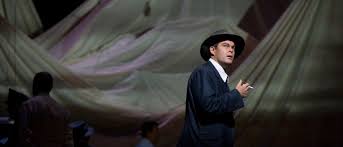
John Adams wrote Doctor Atomic in 2005 to a libretto by Peter Sellars. It is a compelling tale, bolstered by some of the composer’s best music.
The Metropolitan Opera have made their Penny Woolcock production available online, and you can view it here… it is highly recommended!
Adams The Chairman Dances (1985) Mozart Clarinet Concerto in A major K622 (1791) Rachmaninoff Symphonic Dances Op.45 (1940)
Oliver Janes (clarinet), City of Birmingham Symphony Orchestra / Ryan Bancroft
Symphony Hall, Birmingham Wednesday 2 November 2022 [2.15pm]
Reviewed by Richard Whitehouse
Back from its successful US tour (the first such in almost a quarter of a century), the City of Birmingham Symphony Orchestra this afternoon returned to Symphony Hall for what was a programme of contrasts in which an element of dance seldom lurked far beneath the surface.
Although it is often considered emblematic of his opera Nixon in China, John Adams wrote The Chairman Dances well before completing the larger work – this ‘Foxtrot for Orchestra’ encapsulating much of its atmosphere without being intrinsic to its content. Capricious while shot through with a tellingly distanced nostalgia, this remains among Adams’s most effective concert pieces and Ryan Bancroft secured a fine account whose meticulous attention to detail was not without corresponding panache – down to its percussive ‘winding down’ at the close.
It is (nearly) always welcome when an orchestra’s section leader takes the platform as soloist, as was proven with Oliver Janes in Mozart’s Clarinet Concerto – easily the most popular such piece in its repertoire yet one that can easily seem bland or even characterless in performance. There was little chance of that here – not least with a swift and purposeful take on the opening Allegro that left relatively little room for lingering over incidental detail, even if something of its underlying elegance was sacrificed with Janes’s powers of articulation pressed to the limit.
This approach paid dividends in the remaining movements, not least an Adagio whose limpid eloquence was conveyed without trace of indulgence or wanton sentiment. The final Allegro, too, had a winning buoyancy – Janes evincing a deftness and spontaneity to which the CBSO responded in kind, and with a surge of energy towards the closing chords. It set the seal on an appealing rendition which, perhaps surprisingly, Janes will not repeat at tomorrow evening’s concert from Warwick Arts Centre – when that by Gerald Finzi will be the concerto on offer.
Soon to take the reins at the Royal Stockholm Philharmonic, Bancroft is evidently a conductor on a roll as was confirmed by his take on Rachmaninoff’s Symphonic Dances. A triptych that abounds in felicitous detail (as is often belied, if not actually concealed, by the score’s lack of expression markings), it needs flexible direction for each movement to cohere, and Bancroft had their measure. The first exuded a suspenseful energy that, in its central section, took on a winsome pathos embodied by its alto saxophone melody (affectingly played by Kyle Horch).
Even more persuasive was the sardonic central dance, its waltz motion underpinning some of the composer’s most astringent harmonies as were pointedly emphasized here. If the charged outer sections of the final dance lacked the ultimate in exhilaration, the quality of the CBSO’s response was never in doubt. In the slower middle episode, moreover, Bancroft’s deliberation ideally clarified those frequently dense textures whose expressive poise is achieved, uniquely for Rachmaninoff, without recourse to an actual melody. A sign of things to come, perhaps?
Bancroft will hopefully be returning next season, but the present one continues with events to mark the 150th anniversary of Vaughan Williams’s birth – including two of his symphonies and the film Scott of the Antarctic, for which the CBSO is contributing live accompaniment.
You can read all about the 2022/23 season and book tickets at the CBSO website. For more information on the artists, click on the names of Ryan Bancroft and Oliver Janes
NEXT [Joe Howson & Mikaela Livadiotis (pianos), Gavin Stewart (bass flute), Olivia Jago (violin)
Adams Hallelujah Junction (1996) Saunders Bite (2016) Mason When Joy Became Mixed with Grief (2007)
Patricia Auchterlonie (soprano), Ulrich Heinen (cello), Birmingham Contemporary Music Group / Geoffrey Paterson
Birtwistle Cantus Iambeus (2004) Vir Wheeling Past the Stars (2007) – Songs 3 and 4; Hayagriva (2005) [UK premiere]
Town Hall, Birmingham Sunday 20 June 2021
Written by Richard Whitehouse
It might have taken 15 months plus a couple of false alarms, but Birmingham Contemporary Music Group (above) finally resumed live performances en masse this afternoon and with this wide-raging concert typical of its programming across more than three decades of music-making.
Not least with its throwing the spotlight onto players of the next generation, the opening half featuring NEXT musicians as mentored by their senior colleagues. Things got underway with Hallelujah Junction, John Adams’ alternately incisive and soulful evoking of a truck-stop on the California-Nevada border; along with a tribute to orchestra manager Ernest Fleischmann, which doubtless explains its heightened peroration. Nor, despite some occasional vagaries of coordination, was there any doubting the conviction of Joe Howson and Mikaela Livadiotis.
From two pianists situated amid tables in the stalls to a bass flautist just in front of the organ console: Gavin Stewart made the most of this unlikely context with a committed reading of Rebecca Saunders‘ Bite, less a setting than paraphrase of the thirteenth from Samuel Beckett’s Texts for Nothing in which words or syllables are variously sounded in anticipation, or as consequence of the flute’s contribution. It certainly left a fragmented, even rebarbative impression compared to the seamlessness of When Joy Became Mixed with Grief – Christian Mason’s contemplation of a sixth-century Jainist account over several ages of declining natural and human wonder; in which violinist Olivia Jago rendered the music’s gently enveloping pathos with unfailing poise, as well as a sure sense of where this deceptively understated music might be headed.
BCMG accordingly took to the stage for Cantus Iambeus, among the more recent of Harrison Birtwistle’s curtain-raisers for ensemble and arguably his most approachable in the unfolding of expressive contours and its frequently diaphanous textures; all underpinned by the role of iambic rhythm in promoting continuity through to an almost inviting final cadence. Nor was there a lack of that intensive interplay as has been a hallmark of this composer’s music from the outset, and to which these musicians responded with their customary precision and verve.
The other pieces (both included on a new NMC release) were by Param Vir, whose music has been a welcome if undervalued presence over four decades. Firstly, the latter two items from his song-cycle Wheeling Past the Stars after Rabindranath Tagore – the charm and vivacity of Grandfather’s Holiday then musing inwardness of New Birth, both eloquently rendered by Patricia Auchterlonie with Ulrich Heinen. Finally, to Hayagriva – the horse-headed being and mythological archetype behind a work whose headlong rhythmic energy suddenly moves, via an intricately detailed transition, to a final section whose subdued manner does not preclude music of fastidious textural variety emerging. The analogous sequence ‘red-green-blue’ was reinforced by overhead lighting, even if Vir’s musical trajectory is appreciably more subtle.
BCMG responded to Geoffrey Paterson’s direction with alacrity, not unreasonably pleased to be back performing for a live audience in an impressive indication of what can be expected from this ensemble during the 2021-22 season and barring, one hopes, no more false alarms!
You can find information on further BCMG activities here, while further information on Wheeling Past the Stars by Param Vir can be found at the NMC website
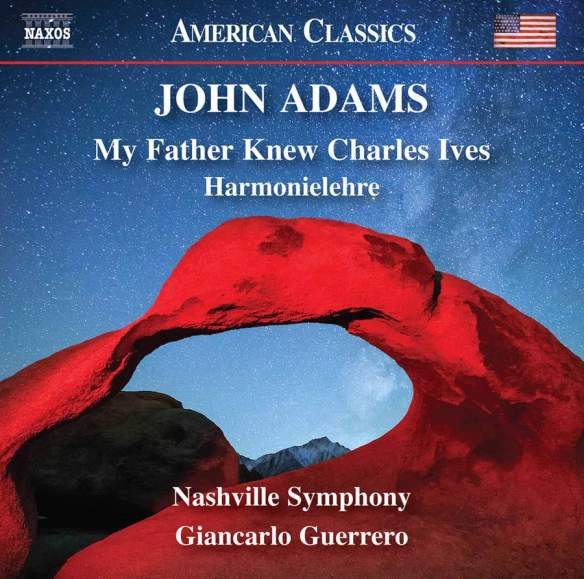
John Adams
My Father Knew Charles Ives (2003)
Harmonielehre (1985)
Naxos American Classics 8.559854 [69’03”]
Producer Tim Handley
Engineer Trevor Wilkinson
Recorded 5-7 October 2018 (Harmonielehre), 25-27 October 2019 (My Father Knew Charles Ives), Laura Turner Concert Hall, Nashville
Reviewed by Richard Whitehouse
What’s the story?
Naxos adds to its coverage of John Adams with this release featuring two major orchestral works – the one among the most enticing of his latter-day output, the other among the most characteristic (and recorded) of the pieces that first accorded him international prominence.
What’s the music like?
Adams has long expressed a penchant for the music of America’s great visionary of the late-Romantic era, and My Father Knew Charles Ives is his oblique while affectionate homage to the composer who gave American classical music its aesthetic basis. Not that the title should be taken literally – rather, the work’s three movements add up to an inclusive portrait of Ives in a way not dissimilar to that of the composer’s orchestral sets. Thus, the opening Concord deftly identifies the cultural environment behind Ives’s thinking besides alluding to some of his most inimitable music, while The Lake builds upon this with evocative and atmospheric writing whose concertante role for piano also finds resonance in the senior composer’s music. The final and longest movement, The Mountain returns to those transcendental strivings as infused Ives’s creative maturity, though its finely sustained initial pages are not followed up by the falling back on well-rehearsed minimalist routines that ensue. Conversely, the closing pages inhabit an ethereal introspection as makes for an understated and affecting apotheosis.
Hard to believe it is now 36 years since Harmonielehre first blazed a trail over the Western musical landscape, or that what once provoked extreme reactions (causing a near riot at the 1987 Huddersfield Contemporary Music Festival) should have come to represent a musical lingua franca imitated many times in the interim. That this earliest of Adams’s ‘symphonic’ works remains among his most representative is fully reaffirmed here. Giancarlo Guerrero finds a viable balance between drama and lyricism in the lengthy opening movement, then builds the mingled Wagnerian and Mahlerian resonances of The Amfortas Wound toward a climax of potent anguish (if such is the music’s intent). The luminous opening of Meister Eckhardt and Quackie demonstrates the best in the Nashville Symphony – as with its superb release of Christopher Rouse (Naxos 8.559852) – and while even astute pacing cannot make the closing peroration sound other than manufactured, the approach yields a methodical and eventful sense of purpose as makes its ‘travelling in hope’ more compelling than any arrival.
Does it all work?
It does, from the perspective that Adams often makes his larger-scale works cohere through sheer force of impact more than formal ingenuity – his trademark post-minimalism proving renewable at almost every turn. Guerrero’s take on My Father Knew Charles Ives is certainly preferable to the composer’s rather calculated account with the BBC Symphony Orchestra (Nonesuch), while his Harmonielehre can rank high among the seven available recordings of this piece – among which, Kent Nagano with the Montréal Symphony Orchestra (Decca) currently leads the field.
Is it recommended?
Yes, not least when recording and annotations are first rate. Hopefully, future Naxos releases of Adams will explore further his extensive back catalogue and revive such as the impressive ‘symphony’ El Dorado, which still awaits its second recording after virtually three decades.
For further information on this release, and to purchase, visit the Naxoswebsite. For more on John Adams, the composer’s website is a great resource. Meanwhile the Nashville Symphony website is here, and you can visit conductor Giancarlo Guerrero’s website here




 Arcana.fm