
In concert – Birmingham Contemporary Music Group: Blossoming In Birmingham

Oliver Janes (clarinet), Philip Brett, Stefano Mengoli (violins), David BaMaung (viola), Arthur Boutillier (cello), Birmingham Contemporary Music Group / Otis Lineham, Kazuki Yamada (conductors)

Illean Januaries (2017)
Fujikura Perpetual Spring (2017)
Ligeti String Quartet no.2 (1968)
Hosokawa Blossoming (2007)
Fujikura Secret Forest (2008)

BCMG NEXT [George Blakesley (clarinet), Anna Vaughan (violin), Alma Orr-Ewing (viola), Finley Spathaky (cello), Rob Hao (piano)

Fujikura Scion Stems (2010)
Illean Février (2019)
Fujikura Halcyon (2011)

CBSO Centre, Birmingham
Saturday 29 April 2023 (7pm and 9pm)

Reviewed by Richard Whitehouse

Spring may have arrived tardily this year, but Birmingham Contemporary Music Group was certainly in full bloom with this judiciously balanced and absorbing programme that featured one post-war classic and two pieces by one of the leading composers from the present time.

First, though, the welcome opportunity to hear a work by Lisa Illean, whose understated and fastidiously realized music conceals more than is evident on initial hearing. Such is true of Januaries, inspired by memories of holidays in Queensland together with descriptions of the Australian landscape. Its innate subtlety finding a direct parallel in this composer’s drawing of often ethereal yet always evocative timbres and textures from her 12-strong ensemble; and throughout which BCMG responded with due commitment to the direction of Otis Lineham.

The first of two pieces this evening by Dai Fujikura, Perpetual Spring drew inspiration from the Japanese Garden in Portland (US), notably the idea of growth as a process both ongoing and inexorable. Heard from this vantage, the clarinet represented a conceptual and expressive focal point; around which the string quartet weaved its dense if never claustrophobic texture with audible dexterity. Here, too, the music implied considerably more than was ever stated – no doubt in accord with the ‘‘power of ‘quiet’ nature’’ its composer took as his starting-point.

Although it now tends to be overshadowed by its predecessor, Ligeti’s Second String Quartet remains one of his most significant works – its five movements a compendium of his musical practice during the late 1960s, but with a formal and expressive focus that amply sustains the 20-minute whole. It was a measure of this account that a cumulative impetus carried through not merely to the explosive fourth movement, but also a finale whose textural mirage took in allusions to what went before: the music not so much ceasing as dispersing beyond earshot.

The string quartet was also Toshio Hosokawa’s chosen medium for Blossoming. Taking the image (and most probably its mythical association) of a lotus as its starting-point, the piece opened out in music typical of this composer for its unforced elegance and felicitous aura.

Considerably more engrossing an all-round experience, Fujikura’s Secret Forest is among the most impressive of his ensemble works and not least for its visceral conception. Placed centre-stage, the string nonet was balanced with groups of woodwind and brass either side, and above the auditorium. It was the ensuing interplay between the spatially arrayed sound-sources, strings intense in their eloquence and winds hieratic in their intangibility, that the conductor shaped over its course – not forgetting the solo bassoon, seated in the auditorium, who became a human figure plotting a course through this sonic landscape. The piece was directed with conviction by Kazuki Yamada and promises much for the Fujikura commission Wavering World, which he will premiere with the CBSO in Symphony Hall on January 17th.

A pity not more punters remained for the post-concert performance by musicians of BCMG NEXT, which featured two more works by Fujikura. Scion Stems took string trio as the basis for a wide-ranging discussion of textures made even more immediate by its brevity, whereas Halcyon pursued a more circumspect yet never disengaged interplay between clarinet and string trio. In between, Février found Illean’s writing at its most sensuous in its sequence of exchanges between clarinet, cello and piano to which these players likewise did full justice. The current NEXT line-up performs its final concert on June 11th, while BCMG itself returns to Birmingham Town Hall on May 12th for its TREE Concert featuring a new commission by Christian Mason alongside one of the most impressive compositions by Helmut Lachenmann

For more on future BCMG events, click on the link to visit their website. For more information on the composers featured, click on the names to read about Dai Fujikura, Lisa Illean and Toshio Hosokawa, while you can read about the conductors by clicking on Kazuki Yamada and Otis Lineham

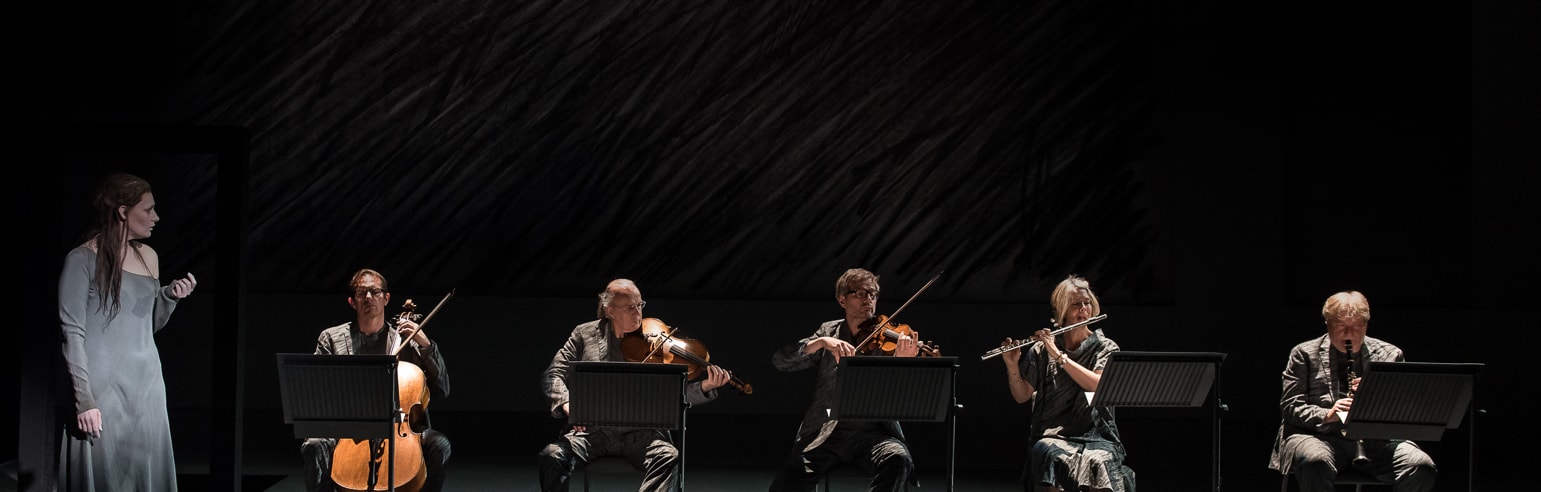
In concert – London Sinfonietta / Edmon Colomer: A Catalan Celebration

london-sinfonietta-catalan

Gerhard Libra (1968)
Figuera
Faula (2017)
García-Tomás
Aequae (2012)
Illean
Januaries (2017)
Gerhard
Leo (1969)

London Sinfonietta / Edmon Colomer

Queen Elizabeth Hall, London
Wednesday 1 December 2021

Written by Richard Whitehouse

A celebration of Catalan music, this concert by the London Sinfonietta also commemorated the fiftieth anniversary of the death of Roberto Gerhard – which, falling in January last year, had augured a number of events substantially curtailed by the COVID-19 pandemic and its attendant lockdowns. At least it had been possible to reschedule this programme – Gerhard’s work framing three recent pieces by contemporary composers whose music, if by no means beholden to that of their predecessor, was demonstrably influenced and even enhanced by it.

Of these three composers, Joan Magrané Figuera (b1988) was most audibly in the modernist lineage. Faula (Fable) unfolds continuously, its four strands of material being akin to levels of activity – exuding a nervous anticipation, ferocious interaction, static intoning, and a deft animation – present in varying combinations for a process which did not so much evolve as play out across its allotted time-span. More arresting was Aequae (Equal) by Raquel García-Tomás (b1984) – its ‘equality’ embodied in six parts, each of two-minute duration, that drew variety as well as ingenuity of response from its ensemble – with a subtle emphasis on those similarities arising unbidden from the emergence of identical motifs in differing contexts. By comparison, Januaries by Lisa Illean (b1983) felt relatively moribund with its concentration on a continuity that, if not static in its timbre or texture, evoked an atmosphere which started then ceased as though a photographic image not susceptible to real change or intensification. The phrase ‘monotonously beautiful or beautifully monotonous’ inescapably came to mind.

Qualities that could never be applied to Gerhard’s output in general or that of his final decade in particular. Works for ensemble are numerous from this time, yet it made sense to focus on those Astrological pieces which, written in the wake of his masterly Fourth Symphony, were also the last he completed. Both are structured as continuous entities alternating between the extreme of stillness and movement common to the music from his maturity. In the case of the ‘chamber concerto’ that is Libra, the concept of balance feels everywhere apparent – not least its six players interlocking in a range of sub-groups that attain equilibrium on both formal and expressive levels. While it pursues a similar trajectory, the ‘chamber symphony’ that is Leo is intentionally less cohesive in design – the confrontation within its larger forces pushing such constraints to, but never beyond their limits. Both works, moreover, feature an epilogue that, with their gently undulating motion and focus on a folk-inflected melody of exquisite poise, bring into accord their musical concerns as surely as those star-signs of Gerhard and his wife.

Music which has lost none of its affective capacity during the more than half-century since it appeared, and how apposite they should be played by the ensemble that gave their world and European premieres respectively. The London Sinfonietta sounded no less committed than its forebears on pioneering accounts with David Atherton – for which Edmon Colomer, his long-time advocacy heard in numerous performances and recordings, can take due credit. One can only hope it does not take another 50 years for this music’s intrinsic worth to be recognized.

For further information on the concert, click here For more information on the composers, click respectively for Roberto Gerhard, Joan Magrané Figuera, Raquel García-Tomás and Lisa Ilean. For more on Edmon Colomer, click here

BBC Proms: Dame Sarah Connolly & Joseph Middleton – English Songs

Proms at the Cadogan Hall: Dame Sarah Connolly (mezzo-soprano, above), Joseph Middleton (piano, below)

Stanford A Soft Day Op.140/3 (from A Sheaf of Songs from Leinster) (1913) (from 7:15 on the broadcast)
Parry Weep you no more, sad fountains (from English Lyrics Set 4) (1896) (9:58)
Vaughan Williams Love-Sight (from The House of Life) (1903) (12:18)
Gurney Thou didst delight my eyes (1921) (16:53)
Somervell A Shropshire Lad – ‘Into my heart an air that kills’ (1904) (20:19)
Bridge Come to me in my dreams (1906) (22:45)
Howells Goddess of Night (1920)
Bridge Journey’s End (1925) (28:19)
Britten A Sweet Lullaby (36:34); Somnus (40:31) (both 1947, world premieres)
Holst Journey’s End (1929) (42:50)
Britten A Charm of Lullabies Op.41 (1947) (45:09, 47:22, 49:08, 51:06, 52:48)
Lisa Illean Sleeplessness … Sails (2018, world premiere) (57:31)
Mark-Anthony Turnage Farewell (2016, world premiere)

Cadogan Hall, Monday 6 August 2018

You can listen this Prom by clicking here The times given on this page refer to the starting times on the broadcast itself

Reviewed by Ben Hogwood. Photo of Sarah Connolly (c) Jan Capinski

11 composers and four world premieres in an hour. Not a recipe for sleep and respite, you might think, but Dame Sarah Connolly and Joseph Middleton constructed between them an enchanting tour of English song, ending up at some far-flung outposts.

For anyone new to the form this would have been the ideal introduction, especially as Dame Sarah was singing with wonderful clarity and diction. I hardly needed to glance at the texts, for her words and expressions, added to those of Middleton’s carefully and beautifully crafted piano parts, did the job perfectly. The structure of the recital was very satisfying too, with natural pauses at the end of a short group of songs for applause and the intake of breath – and, as the subject matter was sleep and dreams, it ensured nobody had fallen foul of the listening criteria in the hot conditions!

The two began in Ireland, presenting the beatific calm of Winifred LettsA Soft Day, as set by Stanford, with the ‘wind from the south’ that some of us in the hot Cadogan Hall would have been longing for! So too for the subject of Parry’s Weep you no more, sad fountains, with its flowing piano lines. This pair from the fathers of English song led to one of the ‘sons’ – Vaughan Williams, and a deeply felt Love-Sight from his song-cycle The House of Life – and Ivor Gurney, his moving Thou didst delight my eyes.

We moved on to Arthur Somervell, the brief but tenderly devastating Into my heart an air that kills (from A Shropshire Lad) and then Come to me in my dreams, an expressive, earlier example of Frank Bridge’s chromatic credentials. Bridge appeared later with the lovelorn Journey’s End, following Herbert Howells’ magical Goddess Of Night – where Connolly allowed the text plenty of room.

Britten’s interpretations of sleep and dreams range from the calm to the nightmarish, aspects that surfaced throughout his song-cycle A Charm of Lullabies, which was given with two extra songs intended for the cycle but left unused. Recently ‘repaired’ by Colin Matthews, A Sweet Lullaby and Somnus were receiving their world premieres and were interesting finds if not quite reaching the level of intensity in the cycle itself.

Britten starts his night with A Cradle Song, before Connolly’s Scots accent (she was born relatively close by in County Durham!) brought an extremely authentic voice to The Highland Balou. The fifth number, The Nurse’s Song, is structured like the Dirge from Britten’s earlier Serenade for tenor, horn and strings. It focused everyone in the hall on the vivid storytelling of Connolly’s voice, from which she moved through humour, intense scolding (scary, too!) and soft slumber. The music ranged wildly, Britten’s wandering piano writing recalling Shostakovich in A Cradle Song, while the clustered chords of the refrain in Sephestia’s Lullaby spoke vividly in a language Janáček would understand. Connolly’s characterisations were brilliant, the audience impatient to clap between numbers initially but held in rapt concentration at the end.

In between the Britten discoveries, Gustav Holst contributed a sparse but telling interpretation of Journey’s End, which Connolly again sang with deep expression, while Australian composer Lisa Illean gave us another world premiere, a farewell of her own in Sleeplessness … Sails. This was a very slow-moving piece where Connolly held admirable control, despite the music’s seeming reluctance to move on. Arguably more effective was Turnage’s Farewell, a profound statement which ended with the composer bounding on the platform, delighted at the interpretation. It would be lovely to hear more from him in song – and from this pair, too, who delivered a wonderful hour’s escapism to the land of nod!

You can hear Dame Sarah Connolly and Joseph Middleton’s new recital disc Come To Me In My Dreams, which features much of the music heard in this concert, on the Spotify link below: