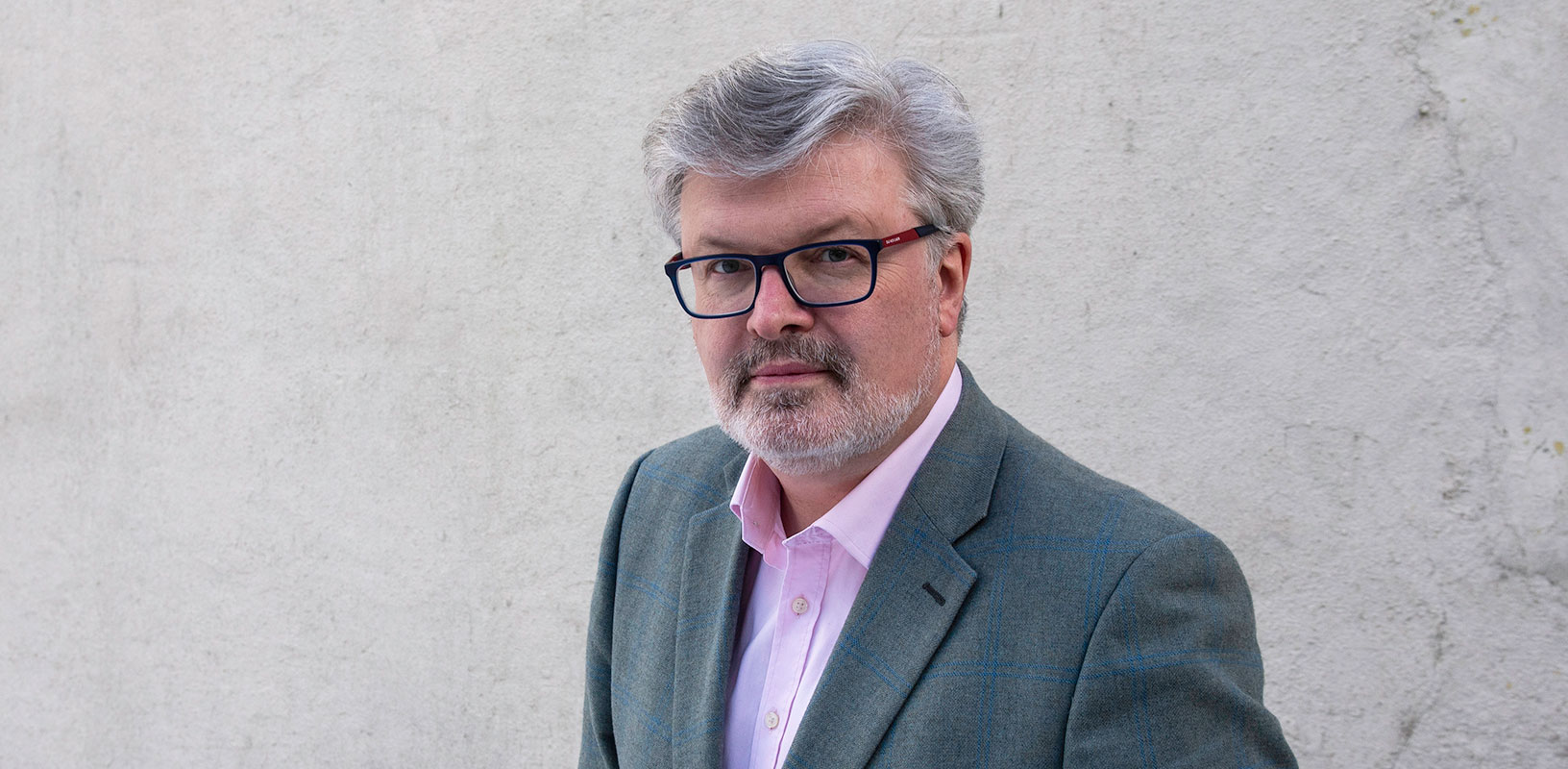
Music has had an important role to play in the celebration of Christmas for as long as we can remember. In spite of the enormous choice of repertoire available, however, new works continue to be created, the inspiration never waning – and the next premiere is less than a week away as we write.
It is a major work, too – Sir James MacMillan filling a whole concert with his Christmas Oratorio. Written in 2019, it had a European premiere in Amsterdam in January 2020, and was due for performance by the London Philharmonic Choir and Orchestra later the same year. For sadly predictable reasons that did not happen, but happily MacMillan is now ready for the UK premiere at the Royal Festival Hall.
Arcana hooked up with the composer via Zoom at his North Ayrshire home, to find out more – and began by asking him for the first experiences of Christmas music he could recall. “The magic of Christmas was the music for me I suppose, going back even to the days before I was involved in music. Hearing the carols at school, and the church, and the home, amongst families, with the piano being played, are all very early memories. I loved it at school especially, and then gradually we were ushered into actually singing and performing the music. I would be pressed into service eventually to accompany some of the carols in the class, and that sort of thing.”
Were there any particular pieces that made a strong impression? “The usual ones or the popular ones, but I always remember it was the Advent carols that got me really excited, as that was the indication that Christmas was coming. It was things like O Come, O Come Emmanuel, and a few other children’s carols. I was at a children’s Catholic school, and there was a lot of that kind of thing covered in the way that the school ran.”
Recalling the first piece of Christmas music he composed proves a little trickier. “I do remember as a teenager being asked to write a setting of one of the Isaiah texts for a singer. It was one of the teachers at the school, who sang it at a local Christmas concert. I would have been around 16 or 17, and I’ve lost the music for that. There isn’t a lot of Christmas music in the catalogue, as most composers get asked to write more music associated with Passiontide If anything. There is an issue perhaps that there isn’t enough Christmas music, as it’s not necessarily the kind of liturgical area that composers get drawn to, which is a pity because there’s a lot to be done! There’s a couple of little things in my catalogue written as a student, and Ex Cathedra asked me to write something a couple of years together which got me going.”
The Christmas Oratorio is a much larger piece – billed, like Bach, as a celebration of Christmas? “I think so. On the basis of what I’ve just said about the lack of Christmas music, my mind turned towards trying to fill the gap in a substantial way. In my discussions with the LPO in the early days, I had flagged up the idea that at some stage I would like to write a big Christmas piece. It had been in my mind for some time. I’ve written two passion settings already, and quite a lot of my music already relates to that point in the liturgical calendar, and it just seemed to be a big, empty space that needed to be filled. The LPO picked up on it and liked the idea, and they gave me carte blanche to produce a very substantial piece. It’s a full evening’s programme, in fact.”
The compositional process, as he recounts it, seems remarkably straightforward. “The next stage was what text do I set, what forces do I use, and it became clear that the chorus should be used quite substantially as well as the orchestra. Then I thought about soloists. Once those practical considerations were made and in place, the next question was what do I give to the different choral groups? The way it worked out was that I decided on a mixture of early English poetry, mostly given to the two soloists, liturgical texts in Latin associated with liturgy and scripture given to the chorus, largely, and then these orchestral interludes. All are inspired by the memories of Bach cantatas, and the sinfonias. A pattern emerged by starting and ending each half with a sinfonia, and using a palindromic structure, with arias for the soprano and baritone, choral items and a central tableau in each part to bring everybody together on a big gospel narrative, a New Testament text.”
At every point the composer had his eye on the bigger structure. “When I began to break it down and look at all the constituent parts, the question was how to build it up into a coherent structure, one that was replicated from part one to part two.” This multi-layered approach would seem to suit audience involvement. “When I did the performance in January, we went over to Amsterdam and did it live on Dutch radio. There was no audience, but I was able to prepare the piece and perform it knowing that there were people listening. I got a sense of how it was stitching together and how the different sections related to each other. I’m pleased with how the different movements complement each other, and how they go from Latin to English, from one aspect of the story to another, in very different ways. The instrumental commentaries stand back from the drama of the storytelling and allow a reflection of either serenity, joy or exultation.”
It might seem odd performing a Christmas work in January, but this proved surprisingly natural for MacMillan. “In essence it’s still part of the season”, he explains. “In Holland and Germany especially, they keep their Christmas trees up until early February. The key thing is to keep the decorations up to the Feast of the Presentation. In European terms there is still something of the Christmas character alive at that time, although we Brits have flat packed our decorations away! It was odd stepping back, but any excuse for live music making was happily received.”
MacMillan took an approach that was aware of what other composers have written for Christmastime, but one presence especially loomed large. “When I’m writing these big pieces, I’m certainly aware of antecedents and models established by great employers in the past. As far as the Passions were concerned when I was writing them it was very much the Bach passions that stuck in my mind, but sometimes it’s more of a hindrance than a help, and it’s trying to put all of that out of one’s mind. Nevertheless, the pattern was there, and the model was set in the Bach Christmas Oratorio, which was very much in my mind. Bach is an inescapable ghost, he hovers over all our shoulders. It certainly has been the case with me as I’ve written these big liturgical pieces.”
The composer has been writing more for choir of late, part of a general resurgence for choral music in the last few years. “That’s true. My background as a young musician was in instrumental music. I was a brass player, I played in brass bands as well as school and university orchestras. I did have some choral involvement as a teenager at high school, and that was that was a very important experience for me. I sang and conducted a lot of choral music as an undergraduate. There was something about a general thrust in modernism especially at that time – the 1970s and 1980s – which emphasised instrumental music over choral music, and certainly over vocal music. It’s probably because modernism valued that kind of extreme virtuosity that instrumentalists were able to achieve. When you look at the great modernists, composers of that time, even their vocal music looks and sounds instrumental, for instance the Berio Sequenza for voice.”
He continues. “Even the choral music of Webern and Schoenberg, going back into the early part of the 20th century, it’s very instrumentally crafted. I was exposed to early polyphony, and the Bach cantatas, and then more modern music that I regard as really important by British composers like Benjamin Britten. You see that there is a different way of imagining the choir and the kind of muscle memory of choral singing that has been kept alive in the British tradition. I grafted myself on to that. Britten was a great composer and there are these other great British composers that keep the choral tradition alive. It’s partly through the church experience and experience of the great English cathedrals in particular, but it’s also the local choral unions and choral societies.”
The tradition reaches well beyond professional singers. “The whole amateur way of working has kept the choral flame alive, and it is a very important part of the musical ecology of these islands. There is that love of choral music which is very deeply embedded into the amateur experience as. As that grew in me, I decided to start writing more and more choral music. And the other thing that has to be said, is that as a young composer in the 1970s in particular, I and many others didn’t see the rise of those fabulous English choral ensembles that have become much more prominent in recent years.”
He name-checks a few examples. “Those are The Sixteen, Tenebrae and Polyphony, The Marian Ensemble and other new groups that are making music of a very, very high standard, and increasingly, incrementally higher standards. This is a very exciting time, not just for British choral singing, but for those of us who value choral music. You’re beginning to see that these groups are commissioning and getting living composers to write for them, and they’re being programmed alongside early music, which makes sense. A brand new piece of 21st century music sits alongside music from the past, and all audiences seem to be at ease with that and seem to see it as a natural complement.”
It is an approach which, to your interviewer at least, makes the early music feel current while the new music gains a historical perspective, the two meeting in the middle. Talking of new music, and MacMillan’s work nurturing new composers, does he have any pointers for the next generation? “Yes. Very recently I’ve been involved in a mentoring process along with The Sixteen and Genesis Sixteen, set up by the Genesis Foundation and directed by Harry Christophers. I’ve worked with them the last seven or eight years now. The last tranche of three composers I met and worked with just a few weeks ago, and Genesis Sixteen brought the course up to Scotland for the first time. There was a Scottish composer, Lisa Robertson, who I have mentored before in choral music at the University of St. Andrews, and also in orchestral music. She’s an all-rounder in that sense, a very gifted young composer. There was an Irish composer, Eoghan Desmond, a very gifted composer, and Anna Semple was the third, a very fine composer too. We workshopped their music – three works in progress, but close to completion. Eventually The Sixteen will take on board the completed works, perform and record them.”
In the wake of the pandemic – be it ending or ongoing – has MacMillan’s approach to composition altered at all? “The only difference I’ve noticed is that I’ve got on with more music writing. Some of our projects were brought forward, because a lot of the other things I do were just obliterated, and I had no contact with universities or students. In a sense I was able to get back to the day job. I wouldn’t say I was more focused on inspired than usual, but I suppose I was given more space to think about the music in more detail. I have written a lot – some choral, some orchestral, some chamber music, which I’m writing just now.”
He continued working with ensembles to. “I did a couple of things with orchestras, because as you know, choirs were shut down. I got to work with the LPO on a mentoring course, but not to a live audience. We recorded the process of rehearsal and performance with several young composers, and I did a Radio 3 recording with the BBC Concert Orchestra. I did filmed concerts with the Scottish Chamber Orchestra, too, and I eventually got to conduct them with a live audience, which was wonderful. It’s just a great thrill to get back to the live concert.”
Does he get nervous before a premiere such as the Christmas Oratorio? “I can never tell before just how nervous I’ll be. Sometimes I’m placidly calm, other times, I’m really on edge, and there’s no single factor determining how I’m going to be.”
Turning back to the music, I ask if it is important with composition to express the importance of being Scottish, and MacMillan’s Catholic faith? “It’s part of my DNA in different ways, part of the given circumstances of who I am. When I was younger, I got involved with Scottish traditional music. I played and sung with folk bands, and I did feel at the time as if it was a kind of absorption process, deliberately trying to absorb the experience of what it was to perform Scottish traditional music with an eye on how it might transform itself into the music I was writing. I was aware that that was an ongoing process, but performing Scottish folk music was a very important experience that had a knock-on effect on some of the music that I made. I don’t do that anymore. Perhaps the experience of Scottish traditional music is much more kind of underground, subconscious rather than conscious.”
He takes more time to consider. “There is perhaps an analogy there with the religious thing. There were times in the past where I thought more consciously and more anxiously about what it meant to engage with religion in modern music, and now I don’t think about it as it’s become much more part of the natural pattern. It’s what I do, it’s who I am. I will write lots of pieces with settings of sacred text, but then I will turn my hand to something else that has nothing to do with text or directly theological considerations.”
Does that make for a stronger connection with the audience, music that is part of MacMillan himself rather than consciously signposted? “That would be good if it was the case! I feel I have a lot in common with my audiences regardless of whether they are Scottish or English, Brazilian or Russian!” You do tend to meet people who love music as much as I do, who will use almost quasi spiritual language to account for the impact of music on their lives. Those are sometimes deeply sceptical people when it comes to religious matters, but it’s an acknowledgement that there’s something about music which is bigger than who we are, and perhaps it does point to a spiritual dimension in the art form.”
Finally, a completely different subject – craft beer! James has been sampling some during lockdown, so does he have any tips to pass on to a likeminded enthusiast? “I wouldn’t say I’m an expert, I’m very much a dilettante, finding things as I go. I keep meeting people who know much more about it than I do. I did manage to get to the States during the summer and ended up in Vermont, where the local craft beers are just wonderful, if a whole lot stronger! After a few of them you’ve had an experience, put it that way!”
James MacMillan’s Christmas Oratorio will be performed at the Royal Festival Hall on Saturday 4 December at the Royal Festival Hall, and then again on Sunday 5 December at Saffron Hall. Sir Mark Elder will conduct the London Philharmonic Choir and Orchestra, with soloists Lucy Crowe (soprano) and Roderick Williams (baritone)
For ticket information, click here for the Royal Festival Hall and here for Saffron Hall. Meanwhile you can find a web guide to MacMillan’s choral music from his publisher, Boosey & Hawkes, here