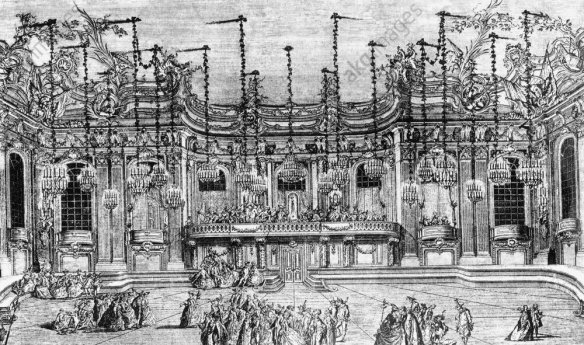
Masked Ball in the Großen Redouten-saal, Hofburg (by Markus Weinmann, 1748)
12 German Dances, WoO 8 for piano (1795, Beethoven aged 24)
no.1 in C major no.2 in A major no.3 in F major no.4 in B flat major no.5 in E flat major no.6 in G major no.7 in G major no.8 in C major no.9 in A major no.10 in F major no.11 in G major no.12 and Coda in C major
Dedication Vienna Artists’ Pension Society Duration 20′
Listen
Background and Critical Reception
This is the piano version of the German Dances Beethoven wrote for the Redoutensaal ball of November 1795 in Vienna.
Thoughts
The dances work really well for piano, ad while they may not be as colourful as the orchestral version the keyboard brings out the crisp nature of the composer’s dance rhythms.
Recordings used and Spotify links
Jenő Jandó (Naxos)
Jandó plays with a nice lilt to the rhythms, showing how the dances are clearly for communal use. Having one follow the other so immediately works well in an energetic account. The final dance tails off rather movingly at the end.
You can chart the Arcana Beethoven playlist as it grows, with one recommended version of each piece we listen to. Catch up here!
Also written in 1795 Gyrowetz– Three Flute Quartets Op.11
Next up12 Variations on ‘Menuet a la Vigano’ WoO 68
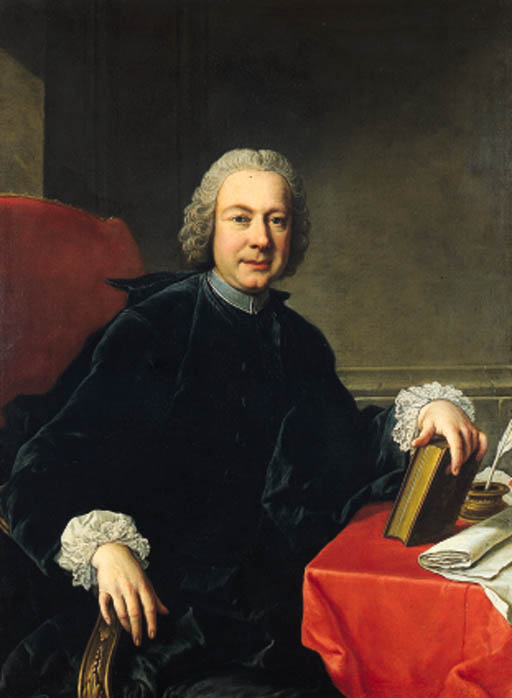
Portrait of Italian poet Pietro Metastasio (1698-1782) Image used courtesy of Wikipedia
La partenza WoO 124 for voice and piano (1795, Beethoven aged 24)
Dedication not known Text Pietro Metastasio Duration 1’10”
Listen
Background and Critical Reception
Beethoven joined a prestigious list of composers in setting Pietro Metastasio’s canzonetta from 1749. Paisiello and Mozart had already taken the text as inspiration, but now Beethoven – setting Italian again – took the plunge. This would appear to be a result of his continuing training with Salieri, who was encouraging the setting of songs in his native language.
Thoughts
Beethoven shifts from the G major of previous song Zärtliche Liebe to A flat major, a tonal centre that would inspire some of his best and most contemplative music over the years. It is a shift in mood, too – the previous song a declaration of love, this one (translating as The Departure) sat in the cloud of departure and loss.
It is a relatively simple setting, and a short one too at just over a minute. A flowing piano is the bedrock for a smooth, mid-range melody, but the overriding mood is sombre and relatively downcast.
Recordings used and Spotify links
Dietrich Fischer-Dieskau, Hartmut Höll (Warner Classics)
Hermann Prey, Leonard Hokanson (Capriccio)
Cecilia Bartoli, Andras Schiff (Decca)
Both Fischer-Dieskau and Prey give this song a good deal of gravitas, their pianists providing solid support. However the bright tones of Cecilia Bartoli and the light-fingered accompaniment of András Schiff give the song a new lease of life.
Also written in 1795 Salieri“Armonia per un tempio della notte” in E flat major for 2 oboes, 2 clarinets, 2 bassoons and 2 horns
Peanuts comic strip, drawn by Charles M. Schulz (c)PNTS
Zärtliche Liebe WoO 123 for voice and piano (1795, Beethoven aged 24)
Dedication not known
Text Karl Friedrich Herrosee
Duration 2’20”
Listen
Background and Critical Reception
The seemingly uncredited booklet-writer for Beethoven’s complete songs as released on the Capriccio label is unequivocal in their praise for this song for higher voice and piano. They describe it in the company of two others as “masterpieces in the restrained use of musical means, a particular feature applicable to more than merely a few of Beethoven’s songs for voice and piano. This characteristic is not easily incorporated in the prevalent image of Beethoven, but it is nonetheless indispensable if the full scope of Beethoven’s art is to be appreciated.”
Leslie Orrey, writing in The Beethoven Companion, sits firmly on the other side of the fence. “There could hardly be…a much less ardent protestation of love than Ich liebe dich…” which he describes with a number of other songs as “looking over their shoulders to another age, to the artificial Arcadian poetry of nymphs and shepherdesses”.
Thoughts
Less is indeed more where this song is concerned. The singer has the first note, an upbeat to a graceful song that proceeds smoothly and largely without incident. There is room to accommodate both the views above, though my thoughts fall with the ‘restraint saying more’ than the Orrey view that Beethoven’s version of love is completely removed.
The gently undulating piano as the singer grows more ardent helps the restrained approach, but does enhance the emphasis on the words and stepwise melody.
Recordings used and Spotify links
Dietrich Fischer-Dieskau, Jörg Demus (Warner Classics)
Ian Bostridge, Julius Drake (Warner Classics)
Fritz Wunderlich, Hubert Giesen (Deutsche Grammophon)
Fritz Wunderlich is the tenderest of the three male singers chosen here, his smooth line beautifully phrased. Dietrich Fischer-Dieskau sings down a tone and with characteristic strength of feeling. Ian Bostridge has a leaner tone but shapes the phrasing affectionately. All three are convincing advocates of a song dividing opinion.
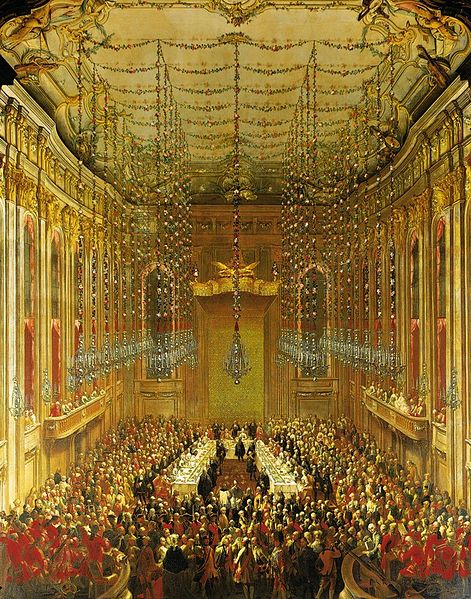
Court banquet in the Redoutensaal on the occasion of the marriage of Joseph II and Isabella of Bourbon-Parma by Martin van Meytens
12 Minuets, WoO 7 for orchestra (1795, Beethoven aged 24
no.1 in D major no.2 in B flat major no.3 in G major no.4 in E flat major no.5 in C major no.6 in A major no.7 in D major no.8 in B flat major no.9 in G major no.10 in E flat major no.11 in C major no.12 in F major
Dedication Vienna Artists’ Pension Society Duration 25′
Listen
Background and Critical Reception
These dances are companions to the 12 German Dances WoO 8, and were written for the masked ball in the Large Redoutensaal, Vienna, on 22 November 1795. It is thought Beethoven had Haydn‘s sponsorship for this event – his teacher had composed for the event three years earlier, a charitable donation. It is also thought Haydn would have attended the 1795 ball.
The minuets last around 2 minutes each, and as with Beethoven’s previous dances they are easy on the ear and light on the feet – despite being composed for a relatively large orchestra, with trumpets and timpani. Daniel Heartz, in a characteristically detailed appraisal of the dances, finds them to be longer than Haydn’s examples, and notes how their choices of key tend to be a third apart.
Thoughts
There is nothing too daring here given the function they were written for, but at the same time there is an embarrassment of good tunes and danceable beats for the guests.
The third minuet, in G major, is especially lively, and has some lovely in its middle section with a pair of horns. The fourth, in E flat major, has a beefy main them which contrasts with the delightful clarinet solo in its middle section. After a while there is a danger that all the different minuets will feel like one long dance, but Beethoven varies the scoring and melodic material enough to avoid that.
Minuet no.9 is brightly scored for the wind, while no.10, returning to E flat major, is like many of these pieces still in thrall to Haydn. The last, as is Beethoven’s wont, features the shrill piccolo in its middle section, the middle of a regal F major sandwich.
Recordings used and Spotify links
The playlist below includes recordings from Philharmonia Hungarica / Hans Ludwig Hirsch (Warner Classics), the Swedish Chamber Orchestra conducted by Thomas Dausgaard on Simax and the Academy of St. Martin-in-the-Fields under Sir Neville Marriner (Philips)
Thomas Dausgaard’s crisp versions are once again a lot of fun, if a touch aggressive at times – the dancers might have a couple of bruised feet afterwards! Sir Neville Marriner and the Academy of St. Martin-in-the-Fields are typically stylish and colourful. Once again the Philharmonia Hungarica and Hans Ludwig Hirsch are more relaxed in their steps.
You can chart the Arcana Beethoven playlist as it grows, with one recommended version of each piece we listen to. Catch up here!
Also written in 1795 Pleyel– Keyboard Trio in D major B461
The panel of Leopold II after the wedding ceremony in the Redoutensaal, 1790 by Hieronymus Löschenkohl (c) Wien Museum
12 German Dances, WoO 8 for orchestra (1795, Beethoven aged 24
no.1 in C major no.2 in A major no.3 in F major no.4 in B flat major no.5 in E flat major no.6 in G major no.7 in G major no.8 in C major no.9 in A major no.10 in F major no.11 in G major no.12 and Coda in C major
Dedication Vienna Artists’ Pension Society Duration 20′
Listen
Background and Critical Reception
Beethoven’s increased standing in Vienna could be comfortably summed up by his commissions for the masked charity ball, held on 22 November 1795 by the Viennese Artists’ Pension Society. There were two balls, one held in the Large Redoutensaal and one in the smaller hall. Both required a set of 12 dances which were commissioned by leading composers of the day, including Haydn and Dittersdorf.
In 1795 the honour fell to Franz Xaver Süssmayr in the big hall, and Beethoven himself for the smaller venue. He delivered a set of 12 German Dances and 12 Minuets WoO7, up next. In the notes to DG’s Complete Beethoven Edition these are praised by Hans-Günter Klein, who notes Beethoven’s ability to ‘avoid any sense of monotony by his varied deployment of brass and woodwind and by his skilful choice of tonality. The use of piccolo and ‘Turkish’ percussion is for special effects, while the extended final dance, roughly twice the length of the other eleven, ‘sounds like a pre-echo of the ‘Pastoral’ symphony’.
Daniel Heartz tells a great story in his book Mozart, Haydn and Early Beethoven of the event and its context – and how composers would respond to the commission with deliberately ‘safe’ keys. He goes into impressive detail of the form Beethoven uses, which is simple but functional, and is topped off by pure melodic invention.
Thoughts
The dances are good fun – and most have a spring in their step, as though Beethoven relished writing for the ball. The second has an urgent demeanour and the fourth has a few witty glances. Each time Beethoven’s scoring is attractive, giving plenty of room for the tune to be heard but using short bass notes to keep the dancers on their toes.
Sometimes the scoring is thicker, such as in the fifth dance, or the seventh, which brings out heavier percussion. These return in the last dance, where Beethoven brings out the artillery, and the coda, which begins gracefully before getting carried away with trumpet fanfares. The tenth dance has a surprise in store too, with a brief minor-key central section. You can sense Beethoven having fun with his audience’s expectations, having successfully persuaded them all onto the dancefloor.
Recordings used and Spotify links
The playlist below includes recordings from Philharmonia Hungarica / Hans Ludwig Hirsch (Warner Classics), the Swedish Chamber Orchestra conducted by Thomas Dausgaard on Simax and the Academy of St. Martin-in-the-Fields under Sir Neville Marriner (Philips)
Thomas Dausgaard’s sprightly versions feel as though they have been plucked from the centre of the Viennese dancefloor, with the crisp bass giving extra lift to each step. Sir Neville Marriner and the Academy of St. Martin-in-the-Fields are more measured, which makes the final coda all the more enjoyable with its added humour. The Philharmonia Hungarica and Hans Ludwig Hirsch are on the slow side tempo-wise.
You can chart the Arcana Beethoven playlist as it grows, with one recommended version of each piece we listen to. Catch up here!
Also written in 1795 Gyrowetz– Three Flute Quartets Op.11



 Arcana.fm