Last week one of the most esteemed British conductors celebrated his 90th birthday. Sir Roger Norrington has been a prominent force in the classical music recording industry over the last 30 years. His interpretations are largely informed by historical performance practice – which is to see he and his forces look to recreate the music of the day.
Norrington’s interpretations have tended to divide critics as to their effectiveness, and his approach has been more provocative with music from the turn of the 19th century. To some extent the ‘marmite’ reception has come about because he has conducted symphonic music from the likes of Bruckner and Mahler. This ‘marmite’ reception has sometimes overshadowed the sheer commitment and enthusiasm he has demonstrated for the British musical cause, whether with the London Classical Players or latterly with the Stuttgart Radio Symphony Orchestra.
His recording achievements with the former include a notable Beethoven symphony cycle for EMI, energetic and brilliantly played, and some standout recordings of symphonies by Mozart and Schubert, together with a thrilling collection of Rossini overtures. In Stuttgart, Norrington reprised some of this work as well as going deeper into the symphonic tradition. Meanwhile with the London Philharmonic Orchestra he recorded an intriguing set of Vaughan Williams symphonies. Some of the highlights of these discs can be heard below:
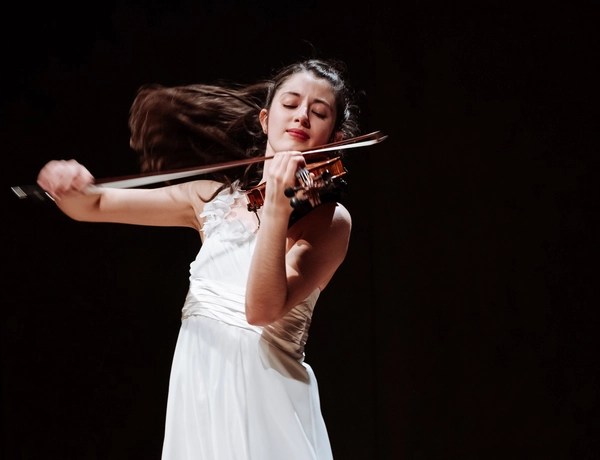
Maria Dueñas (violin, above), City of Birmingham Symphony Orchestra / Kazuki Yamada (below)
Beethoven Violin Concerto in D major Op. 61 (1806) Elgar Variations on an Original Theme, ‘Enigma’, Op. 36 (1898-9)
Symphony Hall, Birmingham Thursday 22 February 2024
Reviewed by Richard Whitehouse Picture (c) Tam Lan Truong
Having given its ‘first part’ yesterday evening, Kazuki Yamada and the City of Birmingham Symphony Orchestra moved on to ‘Elgar & Beethoven: Part 2’ this evening, with an astute coupling of the latter’s Violin Concerto being followed by the former’s ‘Enigma’ Variations.
Anyone having heard Maria Dueñas in Lalo’s Symphonie espagnoleat last year’s Proms will know she is a violinist destined for great things, as was reinforced her take on the Beethoven. Admittedly she and Yamada were not consistently as one in its lengthy first movement – the soloist’s tendency to rhapsodize and to tease out expressive nuance jarring, however slightly, with the conductor’s forthright assertiveness in tuttis. Yet there was no absence of insight on either part, such undeniable eloquence continuing through a central Larghetto that was more adagio as Dueñas conceived it, though which still conveyed a rapt inwardness. The ensuing Rondo lifted this mood appreciably, its impulsive main theme and whimsical episodes deftly eliding into a purposeful traversal of a finale whose conclusion was nothing if not decisive.
As with her recent recording of this concerto, Dueñas played her own cadenzas. That for the first movement had Bach-like deliberation and a harmonic astringency which readily held the attention; if that connecting the latter two movements seemed a little too protracted, and that towards the close of the finale rather offset its overall momentum, there could be no doubting her underlying conviction. She duly acknowledged the considerable applause with a suitably serene, never cloying arrangement for violin and strings of Fauré’s early song Après un rêve.
In his initial remarks, Yamada recalled conducting a Japanese brass band in the First Pomp and Circumstance March as his first experience with Elgar, and this account of the ‘Enigma Variations amply reaffirmed his identity with the composer. Not that this was an integrated or seamless account – Yamada’s halting, even ambivalent take on the Theme intensified in the first variation and, while the swifter variations had no lack of character or impetus, it was in such as the fifth variation’s suffused earnestness with whimsy that this reading left its mark.
On one level the Enigma is a forerunner of the ‘concerto for orchestra’ with its emphasizing various soloists – not least viola in the sixth variation, dextrously negotiated by Adam Römer, or cello in the 12th where Eduardo Vassallo was at his ruminative best. Initially a little stolid, Nimrod built to a culmination of real pathos, and even finer was Yamada’s take on the 10th variation for an intermezzo of unfailing poise and deftness. A tangible atmosphere pervaded the 13th variation – uncertainty as to its dedicatee just part of its fascination, with those veiled allusions to Mendelssohn elegantly rendered by Oliver Janes. From here to the final variation in all its confidence and anticipation was to be recall the impact this music made at the end of the 19th century, Yamada steering it with unforced rightness towards a resounding peroration. Overall, a performance full of insight and one hopes that Yamada will be continuing his Elgar exploration in future seasons. Next week, though, brings two concerts for which former music director Sakari Oramo will be returning to this orchestra for the first time in some 15 years.
Click on the link to read more on the current CBSO concert season, and on the names for more on violinist Maria Dueñas and conductor Kazuki Yamada. Arcana’s Listening to Beethoven series will reach the Violin Concerto soon!
Published post no.2,101 – Tuesday 27 February 2024
Guy Johnston (cello, above), Britten Sinfonia / Thomas Gould (violin)
Beethoven arr. Weingartner Grosse Fuge Op.133 (1826) Bartók Divertimento for String Orchestra Sz113 (1939) Tavener The Protecting Veil (1988)
Barbican Hall, London Thursday 15 February 2024
Reviewed by Ben Hogwood
The Protecting Veil is a special piece. Written by John Tavener in 1988, this musical meditation for cello and orchestra is based on and inspired by the Greeks resisting Saracen invasion in the early tenth century. They are heartened by a vision of Mary, the Mother of God, surrounded by a host of saints and spreading out her Veil as a protective shelter over the Christians.
In what is effectively a single-movement concerto, the cello represents the Mother of God, leading the string orchestra in eight prayerful chapters that respond to landmark events in which she is present. It may sound elegiac and deeply ambient for much of its duration, but to achieve this elevated state the performers require poise, concentration and inner strength.
It is hard to imagine a better performance than this one experienced at the Barbican. Guy Johnston led us in contemplation, the serenity of his upper register cello line immediately establishing a mood of calm, in complete contrast to the bustling city outside. The Britten Sinfonia responded in kind, conducted where necessary by violinist Thomas Gould but largely following the cello, a congregation responding to his prompting.
In spite of its inner serenity, The Protecting Veil is troubled by the shadows of violence throughout the world. This performance was a stark reminder of how little has changed in eleven centuries, for in the ominous falling motif that recurs for the cello it was impossible not to think of bombs and missiles raining down in the many warzones we see today. The Barbican fell largely silent as those images undoubtedly projected to many listeners, aided by a sympathetic light show that cast the distinctive markings of the back of the stage as a wooden chapel. When Johnston played alone in the central section, The Lament of the Mother of God at the Cross, he could easily have been playing solo Bach, the intimacy of his and Tavener’s thoughts laid bare.
There was, ultimately, consolation and redemption, and the lights burned yellow when the music soared back to the heights with which it began. Feverish anticipation gripped the strings as they responded excitably to the higher cello, and with a surety of tone that never dimmed, Johnston led us to the end. His was a remarkable performance of stamina and poise, those long notes held for what seemed like an eternity, their pure tones never dipping.
The musical contrast with the opening piece, Beethoven’s Grosse Fuge, was notable. Here is a piece that still sounds as new and every bit as challenging as the day it was written, the Everest of fugues. In this arrangement for string orchestra by Felix Weingartner, its angular subject is a touch smoother at the edges, though here the sharp lines were just as clear as in the string quartet original, the fugue subject escaping its restrictions. The Britten Sinfonia found its core in a well-drilled performance.
Bartók’s Divertimento for String Orchestra was lighter in mood to begin with, the ensemble celebrating the great outdoors as the folksy first tune went with a swing. Yet here too there were troubled minds, the slow movement wary of its place in history. Bartók wrote the Divertimento in 1939 in Switzerland, with Europe on the brink of the Second World War. The oppressive approach of the conflict could be felt in a profound slow movement, which began with feathery violas and reached a forbidding climax, emotion wrought from its pages. Those worries were largely banished by the finale, whose powerful unisons were led by Gould as the piece swaggered and bustled to the finish.
Guy Johnston and the Britten Sinfonia continue their tour with The Protecting Veil to Dublin and Manchester – for more details visit the Britten Sinfonia website
Published post no.2,090 – Saturday 17 February 2024
Natalya Romaniw (soprano, above), City of Birmingham Symphony Orchestra / Vassily Sinaisky (below)
Tchaikovsky Romeo and Juliet Fantasy Overture (1869, rev. 1872 & 1880) Tchaikovsky Eugene Onegin, Op.24 (1877-78) – Letter Scene Beethoven Ah! Perfido, Op.65 (1796) Beethoven Symphony no.2 in D major Op.36 (1801-2)
Symphony Hall, Birmingham Wednesday 14 February 2024
Reviewed by Richard Whitehouse
It might have been billed as a concert for Valentine’s Day and, though there was little about tonight’s programme to reinforce ‘true love reigns supreme’, it did make for a welcome new collaboration between the City of Birmingham Symphony Orchestra and Vassily Sinaisky.
Whether or not there is any more personal significance in Tchaikovsky’s Romeo and Juliet, it remains a potent encapsulation of Shakespeare’s tragedy. The brooding introduction seemed a little inhibited, but Sinaisky brought suitable incisiveness to the warring families and growing ardour to the love music. Nor was there any lack of drama as this ‘fantasy overture’ unfolded to its fateful denouement – after which, the benedictory chorale as Friar Laurence movingly apostrophises these doomed lovers brought an eloquent response from the CBSO woodwind.
Tchaikovsky’s reputation as an opera composer may have altered markedly over the decades, but Eugene Onegin has held the stage since its premiere; the Letter Scene, in which Tatyana knowingly risks all for love of a cynical anti-hero, its highlight. The Welsh-Ukrainian soprano Natalya Romaniw responded with real impulsiveness and, if her projection was too full-on to convey the emotional ambivalence and fragility of its central stages, the joyous abandon of its beginning and reckless determination at its close were duly rendered with unfailing charisma.
Romaniw sounded even more in her element as the jilted lover of Pietro Metastasio’s lyric Ah! Perfido which Beethoven set in his mid-20s. The latter wrote few such concert arias, but the immediacy of his response can hardly be gainsaid and Romaniw gave it her all – whether in its despairing introduction, the more consoling yet hardly untroubled expression that follows, or the steely resolve of those closing pages where the former ‘loved one’ is denounced in no uncertain terms. As in the Tchaikovsky, it was a pity neither text nor surtitles were provided.
Quite how Beethoven’s Second Symphony fitted into tonight’s conception was unclear, other than with its determination to defy fate and live life to the full, but Sinaisky evidently relished putting the CBSO through its paces – not least a first movement whose imposing introduction prepared for an Allegro of driving impetus and emotional fervour ideally intertwined prior to the blazing coda. Easy to underestimate, the Larghetto impressed with its lilting elegance and, in the central development, its teasing modulations – alongside a pay-off of disarming poise.
If, given its textural weight and unabashed rhetoric, this was ostensibly a performance of the ‘old school’, there was nothing portentous about Sinaisky’s take on the Scherzo – as lithe and quizzical as its trio was capricious, then the final Allegro had the character of an opera buffa ensemble refashioned for the post-Classical symphony toward which Beethoven was striving. Not the least attraction of this reading was its differentiation between soft and loud dynamics – crucial to the impact of a lengthy coda which fairly crackled with energy in its closing bars.
A gripping performance of a symphony which, while hardly unknown, is likely the least often played (albeit in the UK) of Beethoven’s nine. Sinaisky has enjoyed a productive relationship with the CBSO across the years, and it is to be hoped that this will continue in future seasons.
Design for a Beethoven commemorative coin for 5 German marks, 1969 – photograph of an unmarked model
6 Ecossaises WoO83 for piano (c1806, Beethoven aged 35)
Dedication unknown Duration 2″
Listen
by Ben Hogwood
Background and Critical Reception
The general Wikipedia definition for an Ecossaise is ‘an energetic country dance in duple time in which couples form lines facing each other’. Keith Anderson, writing notes for Naxos, states that ‘the so-called Scottish dance was, in fact, a form of contredanse, a product of French imagination’.
Beethoven wrote a small number of these dances for piano, and according to the brief notes for the DG Beethoven Edition, ‘some of these were intended to be used in ballrooms to accompany actual dancing, as seems to have been the case with the ecossaises and waltzes WoO83-86.’
These examples were published in 1807, though there is some doubt over their authenticity.
Thoughts
These lively dances are a lot of fun – and Beethoven shows that even in supposedly minor works like this, he is still capable of writing a tune that will stay in the head. It is the refrain that ends the first dance, and then comes back for a repeat after each of the six little variant dances.
Anyone who had ventured on to the dance floor at the sound of the first dance will surely have stayed for the duration, and hoped for more of the same in successive works!
Recordings used and Spotify playlist
Ronald Brautigam (BIS) Jenó Jandó (Naxos) Olli Mustonen (Decca) Alfred Brendel (Vox) Wilhelm Kempff (DG) Martino Tirimo (Hänssler)
Some lively recordings here, and some notably different approaches. Martino Tirimo is curiously stilted, while Brendel, Kempff and Jenó Jandó are typically elegant. Ronald Brautigam is brisk and lively, his dancers whirling around in circles.