Listening to Beethoven #31 – Flute Sonata in B flat major


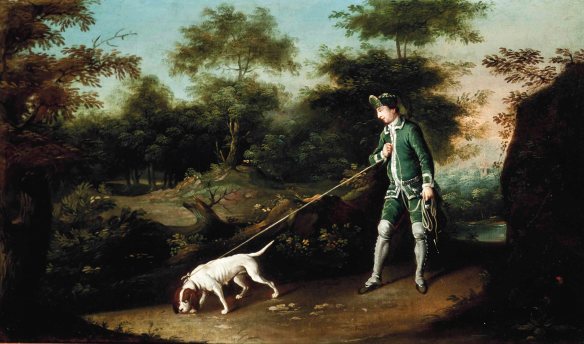
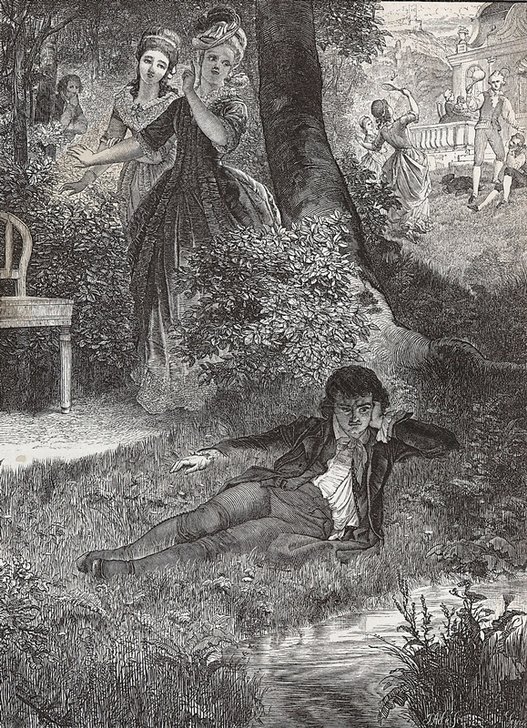
Gentleman walking a hound in a wooded landscape (Unknown, German school, late 18th century

Flute Sonata in B flat major Anh.4 (1790-92, Beethoven aged 21)

Dedication unknown
Duration 25′

Listen

Background and Critical Reception

This substantial four-movement work was found amongst Beethoven’s papers after his death, and was not published until 1906. Despite its location, there are a number of doubts over the authorship of the piece – which appears not to have been in Beethoven’s own handwriting, according to biographer Alexander Thayer.

Barry Cooper, writing in the ‘Rarities’ booklet accompanying DG’s New Complete Edition of Beethoven, makes several useful points. He notes a ‘few awkward moments that could betray inexperience’, and says ‘its authenticity cannot yet be excluded completely, if it is a very early work’. Yet in the other corner there are ‘far fewer articulation markings than in even Beethoven’s earliest known works’, and the scribe ‘was also the composer’, which for Cooper offers the final proof that Beethoven was ultimately not involved.

If it was indeed Beethoven who wrote this work it is thought it would date between 1790 and 1792 – which would plausibly make the dedicatee the flautist son of the Westerholt-Gysenberg family, who Beethoven had included as part of his equally substantial Trio for Flute, Bassoon and Piano a few years earlier.

Thoughts

This substantial piece is quite hyperactive in its first few minutes, when it feels like there are too many notes, but the mood is bright and positive. The music gradually settles, passing through quite an adventurous development section where the dynamic changes, from quite a pastoral mood which then darkens as Beethoven shifts into the minor key.

The second movement, a Polacca, sets out on a strident path, in the same key of B flat major. Both instruments are close together, complementing each other’s melodic movements. The theme is a bit more rustic but the polonaise attributes are not obvious.

The slow movement brings the music to rest, and offers a change of scenery in E flat major. The final movement finds the players close again for a bright theme on which the players then expand with four variations. Even the minor key variation, the third, doesn’t really cloud the sunny exterior too much. By Beethoven’s standards so far it does feel like a relatively standard theme and variations, but they end with a flourish and a relatively restful coda.

Recordings used

Michel Debost (flute), Christian Ivaldi (piano) (Warner Classics)
Emmanuel Pahud (flute), Eric Le Sage (piano) (Auvidis Valois)
Severino Gazzelloni (flute), Bruno Canino (piano) (DG)

A trio of excellent performances here, each of which serves the sonata very well. The top choice by a whisker would be the ever-stylish Emmanuel Pahud and Eric Le Sage, though Severino Gazzelloni and Bruno Canino run them close with their close-knit partnership, which is particularly beautiful in the slow movement.

Spotify links

Michel Debost, Christian Ivaldi

Emmanuel Pahud, Eric Le Sage

Severino Gazzelloni, Bruno Canino

You can chart the Arcana Beethoven playlist as it grows, with one recommended version of each piece we listen to. Catch up here!

Also written in 1792 Haydn Symphony no.98 in B flat major

Next up Primo amore piacer del ciel

Listening to Beethoven #30 – 2 Sonatinas for Piano


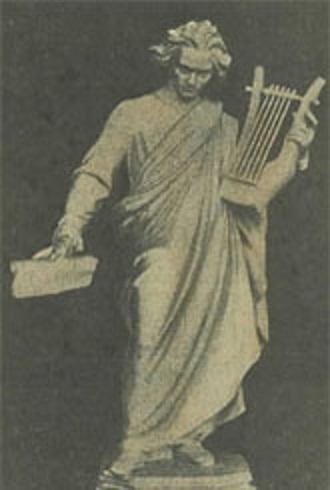
Beethoven with lyre and scroll, alluding to god Apollo (1838-1842)
Reproduction of an old photography of Bläser’s draft, around 1920 (Beethoven-Haus Bonn, photo documentation Stephan Ley, Volume VIII, No. 78)

2 Sonatinas for Piano Anh.5 (1790-92, Beethoven aged 21)

Dedication unknown
Duration 4′ and 5′

Sonatina in G major Anh.5 no.1
1 Moderato
2 Romanze
Sonatina in F major Anh.5 no.2
1 Allegro assai
2 Rondo

Listen

Background and Critical Reception

These two works, of tiny dimensions, are attributed to Beethoven with a suspected year of composition between 1790 and 1792. The unusual numbering of Anh.5 comes from the 1955 catalogue of Beethoven works put together by Georg Kinsky and Hans Halm. ‘Anh’ is an abbreviation for ‘Anhang’, the German word for ‘appendix’, indicating that Beethoven’s authorship remains in doubt.

Were the pieces genuine they would fall towards the end of Beethoven’s time in Bonn. Both works are in two movements, and are mostly suitable for beginners.

Thoughts

Regardless of whether Beethoven wrote these pieces or not, they are a good deal of fun – and one (the F major work) contains a proper earworm.

The G major’s Moderato first movement flows easily on the ear, with a polite theme – and the Romanze, more obviously childlike, is equally easy to listen to.

The F major work appears to be in a bit of a hurry in its first movement, with a few lightly mischievous touches to its phrasing. It is in the second movement, a Rondo, where the earworm appears – and again there are a few mischievous touches round the end. With the emphasis almost entirely on that single tune it is well set in the inner ear by the end!

Recordings used

Tobias Koch (DG)
Ronald Brautigam (BIS)

Brautigam’s fortepiano can sound a little clinical with a harsher edge applied in the Romanze, but he gives charming accounts of both Sonatinas. Tobias Koch is also charming in his versions.

Spotify links

Tobias Koch

Ronald Brautigam

You can chart the Arcana Beethoven playlist as it grows, with one recommended version of each piece we listen to. Catch up here!

Also written in 1792 Haydn 12 Minuets, Hob.IX:11

Next up 2 Sonatinas for Piano Anh.5

Listening to Beethoven #29 – Two movements from a Piano Sonata in F major


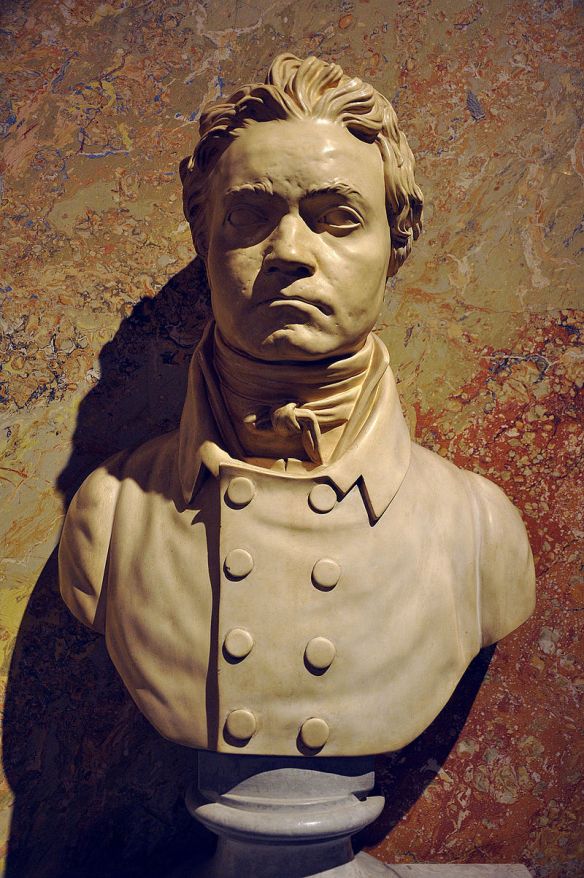
Bust of Beethoven, by Franz Klein (1812)

2 Movements from a Piano Sonatina in F major WoO 50 (1790-92, Beethoven aged 21)

Dedication Franz Gerhard Wegeler
Duration 2′

Listen

Background and Critical Reception

Very little is known of this short pair of fragments, published long after Beethoven’s death in 1950. The apparent dedicatee is Franz Gerhard Wegeler, a German physician and one of the composer’s childhood friends.

The first movement has no tempo marking but its intentions appear to be quite fast, while the fragmented second movement is in triple time.

Thoughts

The first movement fragment flows smoothly over an oscillating left hand line. Beethoven’s theme is simplicity itself, but goes off at a tangent towards the end. The second movement really is gone before you know it – but has quite a crisp theme with a nice lilt to its rhythm.

Ultimately, both fragments are too short to make a lasting impact.

Recordings used

Gianluca Cascioli (DG)
Alessandro Deljaven (OnClassical)

Cascioli’s performances flow beautifully, while Deljaven’s feel rather more deliberate, the left hand accompaniment much more earthbound.

Spotify links

Gianluca Cascioli

Alessandro Deljaven

You can chart the Arcana Beethoven playlist as it grows, with one recommended version of each piece we listen to. Catch up here!

Also written in 1792 Haydn 12 Minuets, Hob.IX:11

Next up 2 Sonatinas for Piano Anh.5

Listening to Beethoven #28 – Violin Concerto movement in C major


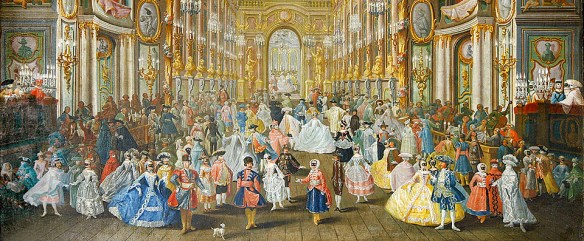
Bönn’sches Ballstück, 1754 by Francois Rousseau © UNESCO-Welterbestätte Schlösser Augustusburg und Falkenlust Brühl

Violin Concerto movement in C major WoO 5(1790-2, Beethoven aged 21)

Dedication not known
Duration 15′

Listen

Background and Critical Reception

This is Beethoven’s first attempt at writing a violin concerto, which went as far as 259 bars. The fragment of a first movement is kept in a museum in Vienna, and debate continues as to whether it is part of a single movement or an entire concerto.

Lewis Lockwood thinks it may date from the early Vienna years, but the narrowest time frame available is between 1790 and 1792 – which may mean it predates Beethoven’s departure from Bonn.

Several scholars have attempted to complete the work – but the only official edition came in 1961 from Willy Hess, the admired Beethoven scholar who also completed the E-flat major Piano Concerto we have already heard. The orchestration is straightforward – the violinist accompanied by a chamber orchestra with the strings augmented by flute and pairs of oboes, bassoons and horns.

Thoughts

The musical language of this fragment is quite polite, starting with a genial theme from the orchestra in unison. Beethoven fleshes this out, before the violin rather sneaks in around the 3’30” mark. Once arrived, though, the soloist takes over, leading the orchestra in an attractive if straightforward discourse. The tunes are nice but ultimately less memorable than others Beethoven was writing at the time.

Recordings used

Gidon Kremer, London Symphony Orchestra / Emil Tchakarov (DG)

Jakub Junek, Czech Chamber Philharmonic Orchestra / Marek Štilec (Naxos)

Gidon Kremer plays a substantial completion by Wilfried Fischer, lasting a quarter of an hour and twice the length of the version from Jakub Junek on Naxos. Despite Kremer’s lovely tone it is a little bit overdone, especially with the dimensions of the cadenza towards the end. Jakub Junek’s version is nicely balanced with the Czech Chamber Philharmonic Orchestra.

Spotify links

Gidon Kremer, London Symphony Orchestra / Emil Tchakarov (DG)

Jakub Junek, Czech Chamber Philharmonic Orchestra / Marek Štilec (Naxos)

You can chart the Arcana Beethoven playlist as it grows, with one recommended version of each piece we listen to. Catch up here!

Also written in 1783 Abel 6 Symphonies Op.17

Next up Piano Concerto in E flat major WoO 4

Listening to Beethoven #27 – Mit Mädeln sich vertragen


Johann Wolfgang von Goethe and Ludwig van Beethoven, walking in Teplitz / Teplice, Czech Republic. Painted by Adolf Karpellus

Mit Mädeln sich vertragen WoO 90 for bass voice and orchestra (1790-2, Beethoven aged 21)

Dedication Joseph Lux
Text Johann Wolfgang von Goethe
Duration 5′

Listen

Background and Critical Reception

“With girls we get along, with men we brawl about”. So runs the first line of Goethe’s Mit Mädeln sich vertragen (With girls we get along), the first of his works to be utilised by Beethoven for musical gain. It is the second of two arias written for the Bonn-based bass (!) Joseph Lux.

Neither of the arias is mentioned much by Beethoven biographers, beyond the date of composition which is thought to be 1791-92. It is not thought the works were performed in Bonn.

In his booklet notes for a new Naxos recording of the aria by Kevin Greenlaw, Keith Anderson writes of how the aria is in fact a setting of a song text from Goethe’s Claudine von Villa Bella, described as ein Schauspiel mit Gesang (‘A play with songs’), and later set by Schubert.

Beethoven revised it in 1795-96, and Anderson talks of how the songs ‘are highly typical of the genre, if not necessarily of Beethoven.’

Thoughts

Beethoven’s melodic inspiration is evident throughout this entertaining piece of music for the stage. It brings out his playful side, which we have now seen on a couple of occasions – and is certainly more lighthearted than you might anticipate for a setting of a Goethe text.

Yet this is a song for men to sing, potentially in a raucous fashion – so it helps that there is a distinctive melody that the strings latch on to, and a refrain that sticks in the head too.

Recordings used

Kevin Greenlaw, Turku Philharmonic Orchestra / Leif Segerstam (Naxos)

Thomas Hampson, Concentus Musicus Wien / Nikolaus Harnoncourt (Warner Classics)

Kevin Greenlaw is ideally suited to this aria, slightly playful and jousting with the strings of the Turku Philharmonic Orchestra, who enjoy their echo of his refrain. Thomas Hampson’s version is a little broader, with Nikolaus Harnoncourt allowing the horns to rasp in the introduction, giving an edge to the music. Hampson is terrific in the refrains, hurling out the words.

A quickfire version for voice and piano also exists, in the capable hands of the masterly Dietrich Fischer-Dieskau and Jörg Demus.

Spotify links

Kevin Greenlaw, Turku Philharmonic Orchestra / Leif Segerstam

Thomas Hampson, Concentus Musicus Wien / Nikolaus Harnoncourt

Dietrich Fischer-Dieskau and Jörg Demus

You can chart the Arcana Beethoven playlist as it grows, with one recommended version of each piece we listen to. Catch up here!

Also written in 1792 Haydn – Symphony no.98 in B flat major

Next up Violin Concerto in C major