Isabelle van Keulen (violin), Ronald Brautigam (piano)
Beethoven Sonata for piano and violin in G major Op.30/3 (1801-2) (from 1:37 on the broadcast) Szymanowski The Fountain of Arethusa from Myths Op.30 (1915) (from 19:51) Fauré Violin Sonata no.1 in A major Op.13 (1875-6) (from 26:34)
Wigmore Hall, London; Monday 8 January 2018
Written by Ben Hogwood
The broadcast can be heard on the BBC iPlayer by clicking here
Full marks to the Wigmore Hall for their choice of established recital partners and an invigorating program to start the 2018 BBC Radio 3 Lunchtime Concert series. Isabelle van Keulen and Ronald Brautigam were clearly brought in to blow away the January blues and dispel any ‘back to school’ feelings among the audience, and they did so with freshly minted interpretations of Beethoven, Szymanowski and Fauré.
Beethoven’s eighth published Sonata for piano and violin, the third of his Op.30 set, began the concert (from 1:37 on the broadcast link). This spring-like work flew off its perch with a flourish, and once a few minor tuning issues at the outset were settled van Keulen and Brautigam enjoyed the close-knit ensemble playing in the first movement.
The second movement, a slow Minuet (from 8:00), was delivered as a passionate song and dance, a little quicker than expected, while the third movement (from 15:00) threw open the doors once again, van Keulen enjoying its folk dance associations.
The first of Polish composer Karel Szymanowski’s 3 Myths, also Op.30, had added electricity. Heralding a new sound world for the composer, The Fountain of Arethusa began with a watery cascade of notes from Brautigam (from 19:51), matched by tensile high register playing from van Keulen, both vividly portraying the fountain but also exploiting the sensual harmonies and rich textures. Hopefully van Keulen will go on to record the composer’s works for violin and piano.
The concert finished with one of the sunniest of works for the combination. Fauré’s Violin Sonata no.1, his first work in the form, surged forwards from the outset (from 26:34), the longer melodic phrases beautifully measured on the violin, while Brautigam’s sensitivity in balancing a busy piano part was a notable achievement.
The second movement (from 35:35) introduced darker, shaded thoughts and grew to a passionate climax of real stature. The third movement Scherzo (from 41:55) was a delight, showing off the qualities that secured an encore at the work’s first performance in Paris in 1877. The finale (45:45), initially elusive, brought all these elements and more together, and finished with an impressive sweep.
There was room at the end for an appropriate encore, giving homage to centenary composer Lili Boulanger. She died in 1918, aged just 24, and her Nocturne (from 52:13 on the broadcast), beautifully shaded here, was an atmospheric example of her unfulfilled potential.
Further listening
You can listen to recorded versions of the repertoire in this concert on this Spotify playlist. Meanwhile if you enjoyed the Fauré and Szymanowski in particular, this lovely disc from Augustin Dumay and Maria João Pires shows the depth of European repertoire from the 20th century for violin and piano.
Ilya Gringolts (violin), Juliet Fraser (soprano), Sound Intermedia (Ian Dearden and David Sheppard, sound design), BBC Scottish Symphony Orchestra / Ilan Volkov (above, picture James Mollison)
Symphony Hall, Birmingham, Friday 17 November 2017
Miller Round (2016)
Sciarrino Allegoria della notte (1985)
Croft Lost Songs (2017) [World premiere]
Beethoven Symphony No. 3 in E flat, Op. 55, ‘Eroica’ (1804)
Reviewed by Richard Whitehouse
Tonight’s Symphony Hall concert was hardly likely to muster a large audience, though those braving inclement weather and the chaos of redevelopment in the Centenary Square environs were rewarded with this strikingly contrasted programme from the BBC Scottish Symphony.
The first half consisted wholly of music by living composers. Canadian-born Cassandra Miller (b1976) may not yet be widely recognized in the UK, but Round demonstrated a sure feeling for orchestral sonority – drawing on a lesser known Tchaikovsky melody (rendered by cellist Gaspar Cassadó) as a ‘cantus firmus’ around which the texture gradually opens-out; taking in antiphonal trumpets and off-stage tubular bells, while maintaining its hushed aura through to the rapturous culmination. Ilan Volkov secured a committed response in this absorbing piece.
Such was no less true in Salvatore Sciarrino’s Allegoria della notte, yet the work itself was a disappointment. Sciarrino (b1947) has a knack for finding the ‘biting point’ between sardonic and ominous, but this homage to and deconstruction of Mendelssohn’s Violin Concerto (near-quotations from which inform the opening and close) was for the most part an exercise in his trademark glassy textures and frozen gestures. Ilya Gringolts handled some stratospheric solo writing with aplomb, but this remained music appreciably longer on technique than substance.
A pity that the orchestra’s absence from the next piece prompted an exodus from the hall in expectation of an interval (though the programme could have been clearer on this), as many failed to return for the highlight of this contemporary triptych. New Zealand-born John Croft (b1971) is a further composer gaining in profile, and Lost Songs should do his reputation no harm at all. These settings of ancient Greek poets (three by Sappho, two by Alcaeus and one anonymous) for solo voice conjured a remote though never arid or uninvolving sound-world, enhanced by the evocation of lyres and reed instruments through the adept manipulation of live electronics – against which Juliet Fraser was a focal-point of eloquent poise. If any ‘note of reconciliation’ rather failed to emerge, this remained an assured and involving experience.
Was a point being made by the introspection of this first half when compared to the combative presence of Beethoven’s Eroica after the interval? Such thoughts came readily to mind during Volkov’s impressive account of a work as wears its two centuries and more lightly, not least in an opening Allegro (exposition repeat excluded) that unfolded intently yet never hectically via a far-reaching development and on to a coda that brought tangible fulfilment. The Adagio then marshalled its funereal essence with equal purpose, building to an anguished fugato and finally subsiding into a numbed acceptance – countered in the scherzo with its incisive energy and its trio’s horn-led jollity. The finale’s initial stages were ideally paced, and if the broader tempo of what ensued risked momentum, the coda duly surged forth with uninhibited resolve.
Overall, a fine showing for Volkov and BBCSSO alike. Were they to give a first UK hearing for Jorge E. López’s seismic Fourth Symphony (as premiered by Volkov in Luxembourg late last year), this would be worth braving the elements and urban redevelopment alike to attend.
For more information on the BBC Scottish Symphony Orchestra, head to their website, and for Ilan Volkov, his artist website
Stories From Far Away is James Heather’s debut album, a set of piano pieces documenting his emotional and musical response to contemporary news stories. It brings out the pianist’s more ‘classical’ side, a complement to the work he does heading up the communications team at Ninja Tune, where for the last 15 years he has supported the label’s output of pioneering electronic and experimental music. In this chat with Arcana he talks about how the two strands unite for powerful musical impact, and his hopes for the future as a performer. But first…
Can you remember your first encounter with classical music?
The most powerful memory is of a subscription we had to a magazine called The Great Composers Of Our Lives. It was a monthly, with 40 or 50 issues in a binder, and they were different colours for different composers. It started off with the big hitters, like Beethoven, Mozart and Schubert, but it was aimed at kids really. It was quite thin and picture-heavy, but it had as much about the academic aspects of the music as it had about their life story. It added a more emotional side, and that seeped in at an early age. It showed me that behind these complicated pieces of work there is a human story. I collected each one in a binder and became obsessed with it!
On top of that my grandparents were very in to classical music. When they came round my dad would like to choose a piece and put it on at just the right level, and sometimes my role was to get the ambience just right with the classical music in the background. My granddad was into classical – personally I am more into the romantic era. My granny was also into Schubert and Schumann, and both of them used to come round and jump on the piano in our house. My granddad was good; he played in the Second World War when he and his colleagues had an off moment – playing in a hotel in Italy. That’s where he met my granny, who I think was a nurse out there. He was playing the piano and she fell in love with him!
My other granny played piano and had a tendency to go off on a mad one, which sounded like Debussy on drugs – quite wayward but had a very distinctive style, quite madcap. I think you can hear that somewhere in my style of piano playing. I used to love listening to them play, and my dad also sent me to blues piano lessons. We had a honky-tonk piano initially, and I learnt the boogie-woogie scales. I can still play them, though they are not what I’ve chosen to put on record so far!
A year or two later I did the classical grades, and got to about Grade Six before going on my own path. That was really good because I learnt some key skills, the scales and theory around it all. What I was most passionate about from 11 or 12 was playing my latest compositions. My teacher was patient with me, and I used to play my new songs for five or ten minutes before the standard lesson.
Even at that age I was composing. I learned to play Beethoven’s Für elise, the Moonlight Sonata, the more simple Rachmaninov stuff, but I wanted to do my own thing. Once a week I would go to my granddad’s house, and he taught me the simple rules of composition – how to change key into another key, the chord sequences – and I was faithful to the rules he taught me but then later on in life I bent them a bit. I always thought he was a stickler for some composition rules. He used to detune his piano so that it was equal temperament; we used to spend hours doing that, and it was really interesting.
How has your style evolved in that time?
Initially I was just improvising, so I would sit down and play for two or three hours, just going off on one, and just play. I loved getting totally immersed, and subconsciously I was training, going off on different tangents of scales and learning what was working. I think I have become more refined, as before I hadn’t worked out introductions and endings. This came later when I started to listen to popular music, and learnt tricks about recurring motifs / hooks, and having a proper end! My early stuff as a young teenager was too repetitive and loop-heavy. The loud bits got loud without a progression to the loud, it wasn’t subtle enough. Now I think I’ve found my style and a way to deliver it in a way that people might appreciate more. I think when playing live it’s good to have a good moment where you improvise, and show that side of you. As you mature as a person your sound evolves of course.
Do you find playing the piano cathartic?
In the early times it was primal; I would just get up and do it. Some people use yoga and meditation but for me if I’m going home and I know I’ve got time to step on to the keyboard I’m excited, because I know I’m going to be relaxed. It calms my centre, and for me that’s what it’s all about. It’s nice to share, and I never assumed that anybody would like it. That’s great, but I’m also sensitive that you should remember the struggle, that for many years nobody seemed to care. Just because people care now, you’ve got to keep it on a level plain.
Given your family history, that must bring an extra personal edge to what you do?
Yes. I do think of my family, and certain chord sequences my grandparents played that seeped into me, and my late Dad’s unparalleled enthusiasm for music. It’s a shame they never saw me have any sort of proper success, but I wanted to protect myself in my teenage years. Everyone heard me play at family gatherings, but I never opened myself up to a wider audience. I didn’t want to be criticised, but you get over that!
Was that partly because your work at Ninja Tune deals with the reception of records and music?
I did become acutely aware of that one, and maybe I was overanalysing what people might think of my stuff – but also I don’t think it was quite ready. I was so busy doing my job that I knew I would get round to it. Who knows why we do things in certain orders?! In the ‘electronic’ and ‘hip hop’ networks I was in a 23-year old classical pianist was slightly odd, but as you get older you find people becoming more responsive to it. I love a rave as much as the next person, but I also have this other side. People knew about it but I do believe in organic stuff, and don’t want to push things down people’s throats. If they want to hear it, then great!
I think it’s good I’ve left it late to let myself ‘out’, because there are intricacies in all composition, and I hope that mine sounds like ‘me’ now. I would hate to just be adding to things. As a solo instrumentalist it’s harder, because if you’re a producer you’re working with hundreds of different sounds. I think I had to find my ‘person’, what made me ‘me’, and sometimes you don’t know that until you’re older.
One angle I would like to potentially go down eventually is that I’d like to do a piano album with a grime MC. I listen to classical music, new classical musicians – maybe 10% – but I listen to all of Wiley and Skepta’s catalogue. Stormzy at Glastonbury was amazing! I don’t just want to put on a bow tie and play a classical gig. I would like to do that as well but it’s all about the flexibility.
There is a certain element of classical music that is very upper class and perhaps more elitist, but then you’ve got all the new people coming through like Nils Frahm, and earlier on artists like Amon Tobin and Cinematic Orchestra opening things up more from the indie world. Now you look at 6Music with the Proms, and people like A Winged Victory for The Sullen, it’s inspiring. There’s not really an obvious place for my current sound as a solo pianist whose brain is more in the electronic world, so I’m going to try and find that. Where I have to add other instruments, why not do more young facing, risky things? I don’t want it to be seen as elevator music!
.
Have the artists you work with at Ninja influence you musically at all?
Before I was at Ninja I had a keyboard in my room at university I was very passionate about what I did, but I had no idea how I could make it successful – a few friends liked some songs. Before that I tried to be in a band, and also make electronic music with friends, but it was hard to get off the ground for various reasons. Then at Ninja I started to get a feel for how the industry worked. I think I’m a very loyal and hard working person, and I was surprised to get the job with no experience – but was in the right place at the right time. For many years I was very focused on not fucking it up, doing well in my position, and became very passionate about promoting the artists and was blown away by their music. Piano remained a hobby, and in London I was in small flats so had a keyboard, which wasn’t the real deal. I kept it going, and what it did for me was realising I had to up my game. Hearing Bonobo and Cinematic Orchestra, and then hearing one of my piano tracks, I was thinking that I need to up it somehow.
That’s how it influenced me, and I guess Ninja has given me a knowledge of how the industry works. I got signed kind of by accident, but had this network of people and could lean on a few for help. I never particularly sent it to the artists, I didn’t want to be the person who had a self-agenda. It made me more ambitious, because I see the ambition in our office. For the foreseeable I think I can put both hats on. Solo piano music is pretty different to what I’m doing at Ninja Tune. I’m going with the flow really, and I don’t pr myself, i got the great Duncan Clark @ 9PR for that – that would be slightly strange and not particularly healthy for me to promote me!
You played at Glastonbury this year – how was that?
It was a random one, because it was a connection through Greenpeace. I know the booker there, and he asked me to play – but there was no piano there, so I had to take my USB keyboard. It’s not my perfect performing situation, but I’m a believer in Greenpeace, so I wanted to help them. It’s also pretty cool to have said that’s my first ever gig! I’ve done Sofar Sounds and random singer-songwriter nights on the piano as a teenager, but it was my first real gig. The scheduling wasn’t perfect for my music, because the act before was a vocal-techno set, and before that there was a very upbeat brass band! Then I was playing my style of piano music, which is on one level very chilled but there are things going on in it. It was a small stage with 30-40 people but then lots on the perimeter. It was Sunday, around 5pm, the sun had just come out – and Shaggy was on the other stage, there was a skateboarding competition – lots of distractions. I had to keep going, and couldn’t hear myself properly, but did a 45-minute set and didn’t bugger it up. Some people zoned into it and contacted me afterwards. It’s not something I would rush into again but it’s an early sign of me not doing what’s expected.
I have a Solidarity of Arts Festival gig coming up in Gdansk, with Johann Johannsson, Kaitlyn Aurelia Smith and Penguin Café. It’s like a Barbican vibe, I’m playing a 400 capacity room on a grand piano. I’m also playing at the National Concert Hall in Dublin, not in the main room but the equivalent of the Elgar Room at the Royal Albert Hall. I’m going to be the first gig in that room, and I’m really looking forward to it. Hopefully that will open up a new world. After 25 years of composing I’ll believe it when I see it, but hopefully those gigs will be the true James Heather experience!
Does the classical music you listened to growing up still resonate now?
Of course, yes. I grew up with Beethoven’s Pathétique Piano Sonata, and the whole grandiosity of it – but then it gets so quiet. Debussy, I have his ‘best of’ – and I just love it. The other day I was listening to the John Cage piece Landscapes, one of the first example of classical music and turntables, and loops. Then I put on a Gangstarr record – which shows how anything goes!
Finally, what does classical music mean to you?
It’s very hard to articulate in words. When classical music hits me in the right way it’s very profound, a transcendent experience. I think it means independence. In indie music you have bands, and in electronic music you often have duos, if you have an orchestra a lot of the time it’s coming from one composer, and it feels like a staunchly independent thing. This is the vision of one composer, and it’s like a big statement, and here are 50 musicians playing it. I think you possibly get less ‘bands’ or ‘duos’ in classical music so for me classical music means Independence. That’s a random on the spot theory!
James Heather’s album Stories From Far Away is out now on Ahead Of Our Time. For more information on James Heather, head to his artist website
The first night of the BBC Proms is a watershed moment in the summer of a classical music lover. Yet increasingly the festival is working on being more inclusive, and some of this year’s BBC Proms Youth Choir (seen above the BBC Symphony Orchestra and conductor Edward Gardner) had not even sung in public before, let alone attended the festival.
Such is the uniting power of one of Britain’s favourite summer institutions, and once again it was off to a flyer with the customary big choral work (John Adams‘ Harmonium) a world premiere (Tom Coult‘s St John’s Dance) and a high profile solo contribution from Igor Levit, whose account of Beethoven‘sPiano Concerto no.3 met and surpassed its heady expectations.
Both Levit and Coult had political undertones to their work. Coult’s new composition depicted the madness of the Middle Ages, people possessed by an all-encompassing dance of death that drove them into dangerous physical and mental situations. A parallel, you might think, for today’s superpowers and the shocking news they bring on a daily basis. Whether these references were intentional or not, it was good to have a new piece that started quietly, with a deliberately fragile violin solo, and built to its bigger moments.
Levit (above, at the piano) also had quiet asides, but his were absolutely spellbinding – the first movement cadenza and slow movement introduction in Beethoven‘s Piano Concerto no.3 both cases in point. Here we could easily have been back at the Wigmore Hall, witnessing a solo sonata performed to a select few, such was the intensity of his communication at a quiet dynamic. When he was with the orchestra the intensity subsided a little, not least because the balance favoured a coarse timpani sound. That said, the playing of the BBC Symphony Orchestra woodwind was particularly beautiful under Edward Gardner’s watchful eye.
Levit had great things to say, his mind clearly at one with Beethoven’s moods and melodic invention. His use of silence was keenly sensitive, the tension evident in a brooding opening movement and deeply thoughtful Largo. The Rondo finale freed itself from the confines, skipping to a more obvious beat – but then Levit delivered a deeply felt encore, Beethoven’s Ode to Joy (from the Choral Symphony finale) reduced to first principles and played to emphasise its role as an anthem of European unity. It was a provocative statement of which Leonard Bernstein – who conducted the Choral symphony in the unification concert when the Berlin wall fell in 1989 – would have been proud.
Finally we went for broke, with the 400-strong throng of the BBC Proms Youth Choir, brilliantly drilled and tirelessly rehearsed to deliver a moving and colourful performance of John Adams‘ Harmonium. Here too there were powerful statements in settings of the poetry of John Donne and Emily Dickinson, and Edward Gardner ensured they were delivered with great clarity and breadth. The thrill of Adams’ colourful music as it generated momentum was as strong as ever, and the percussionists of the BBC Symphony Orchestra in particular deserve great credit for their dexterity, rhythmic power and definition.
As a side note, what a shame to lose the ‘Further Listening and Reading’ section from the Proms programme this time around. It has been my ‘go to’ page ever since I started going to the Proms, and to not have it there feels like an unnecessary omission, even with the introduction of a new Listening Service – Tom, that is. Books are important in classical music, and so are recorded statements. To lose them from the programme is disappointing.
That said – how great it is to have the festival back, confirming the ascent of summer in thrilling style. Eight weeks of great music lie ahead!
Ben Hogwood (photos (c) Chris Christodoulou)
This year Arcana will once again have two different approaches to its coverage of the BBC Proms. There will be a few straight ‘reviewed’ concerts, but the focus of our coverage will be on taking people to the Proms who have not been before.
To that end our reviews will come from first-time punters chosen from a pool of friends and contacts – many of whom will see things that us regulars do not! Most reviews will be from the Arena, which is the ultimate Proms experience – and which to my knowledge is the best part of the Royal Albert Hall for sound quality and atmosphere.
No other source reviews from here as far as I am aware…so stick with Arcana in the weeks ahead, particularly through August. We will look to bring classical music to new audiences on a weekly basis!
Brussels Philharmonic Orchestra (above, picture courtesy of Samsung)
Richard Whitehouse on a visit from the Brussels Philharmonic Orchestra and their chief conductor to the Cadogan Hall, offering a rare chance to hear the music of Guillaume Connesson.
Cadogan Hall, Thursday 29 September 2016
BeethovenSymphony No. 6 ‘Pastoral’ (1808)
Connesson Flammenschrift (Letters of Fire) (2012); E chiaro nella valle il fiume appare (And clear in the valley the river appears) (2015)
Respighi Pini di Roma (1924)
Brussels Philharmonic Orchestra / Stéphane Denève
This evening’s concert brought a welcome visit from the Brussels Philharmonic and current music director Stéphane Denève, his advocacy of new music evident in the inclusion of two recent pieces by Guillaume Connesson which were performed on either side of the interval.
Now in his mid-40s, this French composer conjures a wide range of influences from François Couperin, via Wagner and Strauss, to Dutilleux and the film music of Bernard Herrmann and John Williams (a pity the programme book included no biography either of Connesson or the orchestra – while being dominated by an absorbing if, in context, overly detailed note on the Beethoven).
These pieces are the first two parts of a symphonic trilogy, with Flammenschrift both an evocation of Beethoven and a tribute to the ‘golden age’ of Germanic music. Strauss does indeed make a fleeting appearance during the more lyrical central episode; otherwise, it is the incisive neo-classicism of Honegger that comes most readily to mind, with the relentless rhythmic drive generating an impetus maintained right through to the effervescent final pages.
Taking its title from lines by the early nineteenth-century poet Giacomo Leopardi, E chiaro nelle valle il fiume appare is ostensibly the slow movement of this sequence – its alternately ethereal and passionate manner recalling the later music of Roussel (notably the Adagio from the Third Symphony), with Connesson proving hardly less adept in controlling the expressive momentum of music such as borders on without quite spilling over into overkill. Presumably the questioning tone on which it ends is answered by Maslenitsa, the final part of this trilogy.
Make no mistake, Connesson is a composer in which formal security is allied to an orchestral sense of considerable flamboyance. Interesting that, along with older contemporaries such as Nicolas Bacri, he should draw inspiration from an earlier era of French music – bypassing the serial complexity of Boulez or the harmonic intricacy of Grisey or Murail. Accessible without being facile, his music may yet gain regular hearings here, and there could be no doubting the conviction with which orchestra and conductor presented it to tonight’s appreciative audience.
Nor was the Brussels orchestra found wanting in the familiar works which opened and closed proceedings. A viable first half in itself, Beethoven’s ‘Pastoral’ Symphony did not fit into its present context: Denève secured a fluent if rarely insightful reading, as its best in an animated take on the first movement and appealingly jaunty scherzo, but there was a lack of inwardness and repose elsewhere; while an almost complete absence of vibrato from the strings gave their playing an unyielding quality emphasized by the forward ambience of the Cadogan acoustic.
More successful overall was Respighi’s Pines of Rome, the second and most enduring part of a ‘Roman triptych’ by which he remains best known to posterity. Denève found humour amid the frenzy of the ‘Villa borghese’ then drama in the sombre musings ‘near a Catacomb’. The sensuousness of the ‘Janiculum’ saw an amusing cameo from the percussionist operating the gramophone record of a nightingale, whereas the crescendo of the ‘Appian Way’ brought a frisson of excitement abetted by offstage brass and organ that fairly brought the house down.
The Brussels Philharmonic performs the final part of Connesson’s trilogy on 9 April, 2017. Further details at the Cadogan Hall website
Meanwhile further information on the Brussels Philharmonic Orchestra can be found from their website


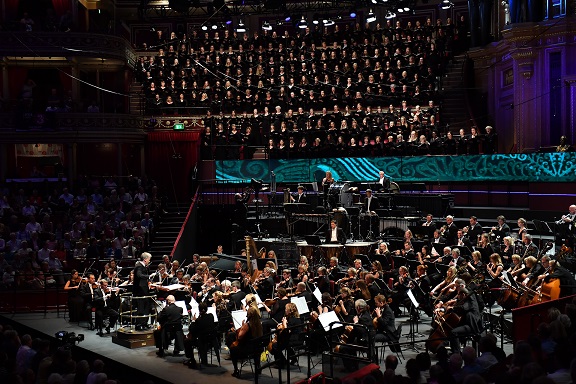 The first night of the BBC Proms is a watershed moment in the summer of a classical music lover. Yet increasingly the festival is working on being more inclusive, and some of this year’s BBC Proms Youth Choir (seen above the BBC Symphony Orchestra and conductor Edward Gardner) had not even sung in public before, let alone attended the festival.
 Levit (above, at the piano) also had quiet asides, but his were absolutely spellbinding – the first movement cadenza and slow movement introduction in Beethoven‘s Piano Concerto no.3 both cases in point. Here we could easily have been back at the Wigmore Hall, witnessing a solo sonata performed to a select few, such was the intensity of his communication at a quiet dynamic. When he was with the orchestra the intensity subsided a little, not least because the balance favoured a coarse timpani sound. That said, the playing of the BBC Symphony Orchestra woodwind was particularly beautiful under Edward Gardner’s watchful eye.
 Brussels Philharmonic Orchestra (above, picture courtesy of Samsung)
 Arcana.fm