Wigmore Mondays – Till Fellner plays fantasies by Beethoven and Schumann

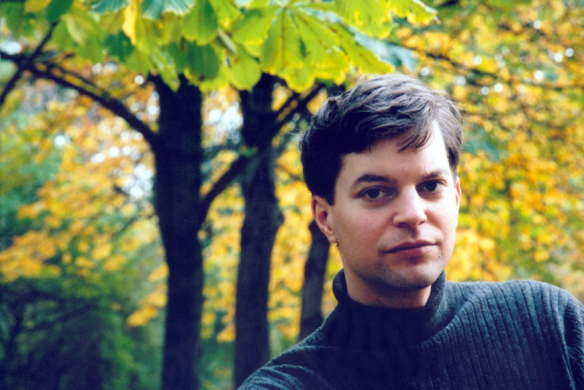
TF_photo_Monika_Groser2

Till Fellner (piano)

Wigmore Hall, London, 30 May 2016

written by Ben Hogwood

Audio (open in a new window)

http://www.bbc.co.uk/programmes/b07cyk0n

Available until 27 June

What’s the music?

Beethoven – Piano Sonata in E flat major Op.27/1 Quasi una fantasia (1800-1801) (16 minutes)

Schumann – Fantasy in C major, Op.17 (1836-1839) (32 minutes)

Spotify

In case you cannot hear the broadcast, recordings of the music played can be found on the Spotify playlist below. Till Fellner has not yet recorded either of the works, so recommended alternative versions have been used:

About the music

The subtitle for Beethoven’s Piano Sonata no.13 gives him permission to stray from the norm. By this time he had twelve piano sonatas already published, and so it would seem to be a reasonable time for experimentation. This is the first of two works bearing the subtitle Quasi una fantasia, the second of which is one of Beethoven’s most famous compositions, the Moonlight sonata. That should not overshadow this piece though, which is – as with all of Beethoven’s 32 sonatas – a very fine work.

Schumann’s Fantasy in C was meant to be dedicated to Beethoven as part of a memorial to the composer in Bonn, but as it turns out is an outpouring of love for his wife to be Clara. It is a kind of reverse of Beethoven’s ‘sonata like a fantasy’, being a ‘fantasy with the form of a sonata’. Despite the outpouring for Clara it is officially dedicated to Liszt, who was tasked with organising the memorial.

Performance verdict

Arcana was not present in the Wigmore Hall for this concert. However even on the radio it is clear that Till Fellner has great empathy with this music. While he is not massively demonstrative he plays with great clarity and a really impressive sense of melodic line, so that even in the most crowded of textures that Beethoven and Schumann employ, the tunes can still clearly be heard.

The link between the two pieces is a fascinating one and makes for a thoroughly rewarding program, whether in Beethoven trying to escape his formal constraints, or Schumann applying them to a loose-limbed fantasy.

What should I listen out for?

Beethoven

1:46 The first movement begins softly, with an Andante tempo marking (at a walking pace). Gradually the intensity grows, but the sudden jump to Allegro in C major at 4:26 still comes as a big surprise. The music returns to the mood of the beginning.

6:37 The second movement is in C minor, a kind of modified Scherzo that actually sounds quite stern.

8:42 A slow third movement in A flat major, which brings back a few memories of Beethoven’s earlier Pathetique sonata, which had a slow movement in the same key. This one is expressive and thoughtful but with more forward movement than in that piece.

11:52 – a transition from the slow movement takes place without a break, moving into a positive and much quicker finale. Beethoven writes this in a ‘rondo’ form – which means we hear the main theme (‘A’) a lot – but we also hear the theme from the slow movement again (‘C’). The form is A-B-A-C-A-B.

Schumann

19:55 – few pieces for piano start with quite the immediate flow of the Schumann, which has a torrent of notes to begin with, a sea of romantic thought. Gradually the ardour cools a little, but around 25:40 it returns, and the continuous, unbroken stream of Schumann’s inspiration is clear. The movement ends softly, seemingly lost in thought.

33:03 – a triumphant march for the second movement, one of Schumann’s most positive musical thoughts – and set in the key of E flat major, home of Beethoven’s Eroica symphony and, later on, Schumann’s own Rhenish symphony – which this movement seems to anticipate. It is a proud, noble piece of music.

41:19 – the third and last movement starts with cool arpeggios, back in the key of C major, before an ardent tune heard from 41:46 in the right hand, one of the staples of the movement. There follows a long and slow build towards 46:15, where Schumann makes a grand statement, before retreating to more reflective music again. The same happens at 49:57, by which time Schumann has worked his way back to C major. Here the music stays in peace and harmony, one of the composer’s most settled states of mind.

Encore

53:24 More Schumann, this time a brief excerpt (1:40) from Carnaval, his short series of postcard portraits of masked revellers for the piano. This one is the fifth of 21, Eusebius – reflecting the composer’s ‘calm, deliberate side’ according to Wikipedia.

Further listening

The obvious next port of call from the Beethoven is his next piano sonata, also with the title Quasi una fantasia – which is of course the Moonlight. Here it is on Spotify played by Emil Gilels, the last three tracks of a superbly played trio of Beethoven sonatas:

From Schumann’s Fantasy there are two hugely enjoyable next steps – the first a set of eight Fantasiestücke published as Op.12, and another set of eight pieces called Kreisleriana, which end on a haunting note. They can both be heard as part of an Alfred Brendel Schumann collection below:

Tasmin Little – in praise of Beethoven and Yehudi Menuhin

tasmin-little1

Violinist Tasmin Little is a cherished English violinist, loved for her interpretations of the classics in the repertoire but also for her pioneering work in ensuring less heard British works for the instrument get their due. More recently she has championed the worth of classical music education, and ensuring classical music is promoted to those who do not often hear it.

Her strong relationship with Chandos Records has yielded a number of high quality recordings, among them a recent release of Beethoven’s complete sonatas for violin and piano with Martin Roscoe. She gave generously of her time in this recent interview, talking with characteristic enthusiasm about Beethoven, Yehudi Menuhin, the importance of musical education – and how to stop those aches and pains violinists so often get!

Can you remember your first encounters with classical music?

The answer is no…because it was probably while I was inside the womb! Neither of my parents is a classical musician, but they love classical music and my father was an actor who sang. There was always music in the house, and they had very broad taste, so I remember Blood, Sweat & Tears and The Beatles in particular. I grew up with the whole range, including the genre of musicals as I grew up. It was the same as talking, listening to music!

How did you develop a love of the violin?

As part of my parents’ record collection they had some violin concertos. I used to listen to them and as I got older, say five or six years old, I began to know what some of the instruments were. I loved the violin especially, and then the piano. My sister began to learn the violin, but it was a disaster and I thought it would be a disaster if I tried too! We begged her to give up, and as a result she is now a visual arts star!

When I was seven I fell ill with chicken pox and I hit on the idea of teaching myself the recorder while I was ill in bed. I did that, and loved it. So when I got better I had piano lessons – and then I thought I would learn the violin.

What experience of playing Beethoven did you have prior to recording the sonatas?

I’ve played Beethoven for years and year, as a student at the Yehudi Menuhin school, where I played it in string quartets and tackled some of the violin sonatas. They are difficult, so I didn’t play them until my early teens – probably the Spring Sonata first. The more complex works such as the C minor sonata I left until later, and then the big mountain, the Kreutzer Sonata, I tackled when I was 21.

tasmin-little-martin-roscoe

Tasmin with her accomplice in the Beethoven sonatas, pianist Martin Roscoe

“Of course when you play these works you need a really good pianist, and it wasn’t until we were at least in our teens that we could cover this music. I’ve been playing some of the sonatas for 30 years, others for 20-25 years, so I’ve known them for a long time. It is really important with works of this nature and complexity, and works that are well recorded to have mature thoughts on them.”

The Violin Concerto I have known since I was 21, and it has been in my repertoire for a long time. More recently I also learned the Triple Concerto, which I recorded with Howard Shelley and Tim Hugh, but it is the Violin Concerto that I completely adore. One of the earliest recordings I had was made by Zino Francescatti, that I have listened to and played into the ground.

Was it daunting recording the sonatas?

I always wanted to record this repertoire, as it is the big mountain of violin and piano repertoire. The violin sonatas by Mozart are a bit more juvenile, whereas with the Beethoven sonatas they are all of such quality you need comparable maturity and sophistication to play them. I took a deep breath before doing the sessions! We did the first five, working fast, in three days – and we felt we were on such a role, Martin and I. Then six months later we finished off the remaining five. It was good to do it like that, otherwise we would have suffered a hit in quality. There was a feeling of momentum.

To begin with in the sonatas they are spring-like, but then that all starts to change. The A minor work, Op.23, is quite a nervy piece but still can’t resist a few jokes. The C minor sonata, Op.30 no.2, is a steely work from start to finish, there is no let up in the drama or intensity. The Kreutzer Sonata is another dimension removed from that, it is an incredibly complex piece. He thinks of it as a concerto for both players, and that’s how it has to be represented. We each represent the orchestra if you like, there are times when he has the fire, and I am in battle against him and his orchestra.

With the ten works covering each period of Beethoven, do you feel like you’re really getting to know him as you progress through each work?

It’s actually misleading, because nine of the sonatas were written in a small space of time, within two years of each other. Then there is a long pause before the last work, Op.96. They are not so representative of the different periods in his output, and that’s why, unlike Mozart, you have this tremendous consistency, within that, he was such a master of so many different styles.

With the equal billing for piano and violin in the Beethoven sonatas, does it help that you have such a good understanding with Martin Roscoe?

Definitely. Beethoven actually puts the piano before the violin in his title pages, it says Sonata Für Pianoforte und Violine – so he considers them piano sonatas with the violin. Because of that I felt strongly that Martin should have lead billing on the cover for this release.

You have got to have someone who is capable of mastering the strength of these pieces, but also the subtlety of colours and the sophistication, mastering the great tunes. You need someone who knows how to play a great tune without being fussy. That’s one of the great strengths of Martin’s playing.

Do you think the sonata recordings are a nice balance to the English music that you’ve recorded?

Absolutely, it is very important to have a balance. I know I’m well known for promoting British music – and there is so much wonderful music that comparatively few people are promoting. I love the standard repertoire too though – Beethoven, Brahms and Tchaikovsky – and I enjoy playing them in concerts.

What is lovely about the relationship I have with Chandos is their support of those aspects of my recording, they don’t try to box me in. The recordings have been varied, with British repertoire but also with the works by Schubert, Richard Strauss and Respighi that I have recorded recently – that’s quite a range. It gives me a much more interesting balance.

You were taught by Yehudi Menuhin as part of your education. What would you say he left as a legacy for violinists?

I would say he left us so much. From a practical point of view he commissioned so many works, to think of just a few those by Bartók, Walton and Panufnik. He also was very much interested in bringing to people’s attention other composers such as Delius. He was very good at communicating, and he used his abilities to bring these to the public.

I also think he was one of the first genuine crossover artists, thinking of his work with Stéphane Grappelli, Ravi Shankar and world music. He made it acceptable to work in different genres, it was fine because he was doing it. He was a great teacher – he founded the school I went to – and he also used his position politically to bring people together. In addition to what he left as a violinist he was trying to use his position to unite conflict – and he did this in the House of Lords, through his work as a conservationist and humanitarian.

You’re also judging the Yehudi Menuhin competition. Given all that you’ve done for music education and youth, is it important for you to be putting something back into this level?

I was at a state primary school in the 1970s, and music had a high position in the curriculum. There was a full time violin teacher, and if there hadn’t have been I would not have started. Because there was, and because music was so high on the governmental agenda, all these things were possible.

That is why it is so important to keep lobbying to make sure that gifted people do not fall through the net. I have given two speeches to the House of Commons and the House of Lords about this, and have written letters about it to them as well.

On another tip entirely, do you suffer from aches and pains as a violinist?

The violin is such an unnatural playing position, horrendously so! You have the full weight on one shoulder, and because of that I do work hard keeping shipshape – I have massages and treatments. I have had a few problems so far but I think generally I have been lucky. You have to take care, as it’s a great physical input as well as emotional and intellectual.

Finally, what violin concertos would you suggest to someone who hasn’t heard any before?

There are two that spring to mind. The first is the Mendelssohn, which is a sparkly, light piece. The second is the Bruch Violin Concerto no.1, the one that I get asked to play the most. It is dark, mysterious and very romantic!

For those who have already heard a few violin concertos I would suggest the one by Glazunov, which I absolutely love!

Wigmore Mondays – Jerusalem Quartet play Beethoven & Bartók

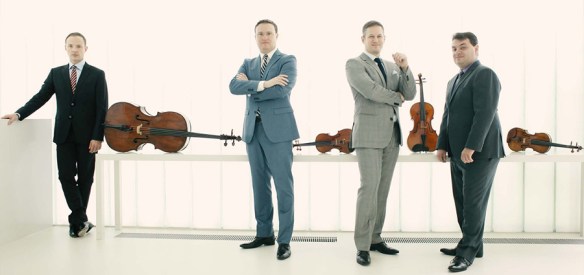
jerusalem-quartet

Jerusalem String Quartet (Alexander Pavlosky and Sergei Bresler (violins), Ori Kam (viola), Kyril Zlotnikov (cello)

Wigmore Hall, London, 16 May 2016

written by Ben Hogwood

Audio (open in a new window)

http://www.bbc.co.uk/programmes/b07b28t8

Available until 14 June

What’s the music?

Beethoven – String Quartet in G major, Op.18/2 (1798-1800) (25 minutes)

Bartók – String Quartet no.6 (1939) (32 minutes)

Spotify

In case you cannot hear the broadcast, recordings of the music played can be found on the Spotify playlist below. The Jerusalem Quartet have recently recorded Beethoven’s first published set of string quartets – of which this concert’s work is the second, while the Bartók appears here in a recording made by his fellow compatriots, the Takács Quartet:

About the music

Beethoven took a little while before letting himself on the string quartet discipline. This was in part due to Haydn’s formidable example, but also because he was writing in other forms of chamber music beforehand, such as the string trio, piano trio and wind quintet. When he did finally arrive at the quartet it was with a set of six pieces that gradually challenged several aspects of Haydn’s string quartet model. Perhaps the most obvious was the use of a scherzo (a more witty movement) over the minuet, an approach Haydn was moving towards but which Beethoven perfected.

The sixth and last of Bartók’s ground-breaking string quartets is viewed as the composer’s response to the onset of war. It is a deeply profound work, especially as the composer begins each of the four movements with a slow and sorrowful introduction. In the second and third movements this gives way to energetic Hungarian dance music, with a considerable strength of feeling that on occasion is tinged with bitterness. Once the final movement arrives the slow music has taken over to such an extent that it runs throughout, providing a profound final statement for a fine if occasionally difficult work.

Performance verdict

The Jerusalem Quartet have been playing the music of Bartók for some time now, culminating in a recording to be released in the Autumn. It showed clearly in this performance, for the Sixth String Quartet made a very strong impact. Their cohesion in the slow introductions was admirable, particularly in the power of the viola and cello solos, while the sardonic dance forms accessed by the composer in the middle movements were crisp in their rhythmic execution.

The Bartók made an ideal contrast with the Beethoven, which was good humour personified – with some nice jokes around the edges and a few more brusque statements that gave clues for the master’s future development. Again the quartet have spent a lot of time with Beethoven’s early work, and they clearly enjoyed the high spirited tunes and the poised dialogue that goes with them.

As an encore we had more Bartók, the pizzicato movement from his String Quartet no.4 – and again ensemble and execution were impeccable.

What should I listen out for?

Beethoven

1:21 –  A fresh, genial start. Very polite and charming – with a first section repeated at 3:14. Beethoven then develops his ideas from 4:59 and a slight shadow appears, the music now in the minor key. This does not last long, mind, for Beethoven returns to his original material in exceptionally good humour.

9:22 – The slow movement, an equally bright and positive piece of work. The tune itself is straightforward but memorable. At 11:35 Beethoven presents a much faster interlude, but just a minute later we return to the safety of the slow movement.

15:34 – even compared to the first two movements this one – the Scherzo – has a big smile on its face, and the quartet are huddled closely together, seemingly in discussion. At 17:27 the music takes a new direction, harking back a little to the slow movement – and then at 19:15 Beethoven cleverly works things back around to the main tune.

20:38 – the last movement is again a genial piece of music, though this time there is more of the characteristic Beethoven cut and thrust.

Bartók

28:33 – a slow and sad elegy from the viola begins the Sixth Quartet, the instrument alone for some time before the others join – and from there on the mood is one of restlessness and anguish. Bartók uses some strikingly dissonant chords, but the ensemble is kept close together – and each of the four instruments has its turn to speak. The harmonic language is complex but not without a key centre.

36:59 – this time the sad melody is assigned to the cello, and takes place over an unsettling rustle of tremolos from the other three instruments. Then at 38:23 a sudden change in mood as Bartók introduces a ‘recruiting dance’ (or Verbunkos in Hungarian) – which is the music played during military recruiting. It has a bitter edge but also touches of humour on the edges. Then around 40:50 a passage of extraordinary intensity, where the piercing higher register of the cello completely takes the lead in a striking tune. The movement continues in a fraught mood.

45:30 – the quartet unite in the sadness that begins the third movement, and each movement finds these periods of reflection getting longer. When the focus changes at 47:15 it is to a ‘Burletta’ – and at 47:26 you can hear the first and second violins playing the same melody – almost – as they are separated by just a quarter tone. There is a plaintive, folksy feel to some of this music, while the louder passages have a much more aggressive stance.

53:27 – a fourth slow introduction, and this one is probably the saddest of all in mood and concentrated in feeling. The quartet is close together throughout, at times speaking with one voice.

Further listening

If the Op.18 set of Beethoven appeals then I strongly recommend the Jerusalem Quartet’s new recording of all six works – fresh and vividly recorded.

Recommending a piece to complement the Bartók is very difficult, but it makes sense to explore another work written in 1939 by the composer for strings – his well-loved Divertimento, part of a disc recorded by Pierre Boulez and the Chicago Symphony Orchestra:

In concert – Bristol University SO / John Pickard – The Vision of Cleopatra

bristol-uso-pickardImage credit: Bhagesh Sachania

Eve Daniell (soprano), Rachael Cox (mezzo-soprano), Angharad Lyddon (contralto), Jeffrey Lloyd-Roberts (tenor), Alexander Learmonth (baritone), Bristol University Choral Society and Symphony Orchestra / John Pickard

Victoria Rooms, Bristol; Saturday 12th March, 2016

Beethoven Mass in C, Op.86 (1807)

Brian The Vision of Cleopatra (1907)

Written by Richard Whitehouse

The regular concerts given by the Bristol University Symphony Orchestra can be relied upon for innovative programming, as was proved this evening with the first performance in 107 years of the most ambitious earlier work by Havergal Brian – his cantata The Vision of Cleopatra.

The work was finished in 1907 and premiered at the Southport Festival two years on, where it enjoyed a succès d’estime but no further performances. Loss of the orchestral score and parts during the 1941 Blitz made any revival impossible until 2014, when John Pickard undertook the new orchestration that received its first hearing tonight. Brian’s orchestral pieces from the 1900s offered a viable point of departure, though Cleopatra is hardly more indebted to these than to Pickard’s own large-scale works. The outcome is highly audacious within the context of British music from this period, notably for its taking on board those possibilities opened-up by Richard Strauss in his controversial opera Salomé – unheard in the UK until 1910, but which Brian had most likely studied from the score and absorbed its innovations accordingly.

Whatever else (and for all that Gerald Cumberland’s rather tepid libretto tries hard to suggest otherwise), Cleopatra is no anodyne Edwardian morality. After the orchestral Slave Dance that functions as a lively overture, the cantata unfolds as a sequence of nominally symphonic movements: a speculative dialogue between two of the queen’s retainers, then an increasingly fervent duet between Cleopatra and Antony followed, in its turn, by an expansive aria for the former; divided by a speculative choral interlude and concluded by a Funeral March of stark immediacy. So systematic yet by no means inflexible a formal trajectory serves to predicate expressive continuity over scenic evocation, a sure pointer to Brian’s future as a leading mid-century symphonist who operated at an intriguing remove from the Modernism of this period.

The Vision of Cleopatra may have fazed its first-night performers, but there was little tentative or underwhelming about tonight’s rendition. Eve Daniell was sympathetic as Iris and Rachael Cox even more so as Charmion, complementing each other effectively as the retainers, while Jeffrey Lloyd-Roberts made an ardent showing as Antony whose tendency to histrionics was understandable. Angharad Lyddon, though, stole the show (as she needed to) as Cleopatra – bringing real eloquence to her climactic aria while evincing palpable depth of tone that made light of Brian’s exacting demands. Bristol University Choral Society sang with evident lustre, and Pickard secured a committed response from his forces – alive to those audacities that the composer doubtless put into his orchestral writing and which were grippingly to the fore here.

The first half had seen a welcome revival of Beethoven’s Mass in C, a work destined to live in the shadow of its ‘solemn’ successor but whose almost cyclical constuction is allied to a generosity of spirit in itself affecting. Some fine choral and solo singing – notably from the baritone Alexander Learmonth – was allied to a perceptive interpretation which (rightly) put emotional emphasis on the Benedictus, most enquiring of this work’s sections whose repose communicated itself to tonight’s listeners as surely as it eluded those hearing it 109 years ago.


Wigmore Mondays – Nicola Benedetti & Alexei Grynyuk in late sonatas by Beethoven & Brahms

nicola-benedetti
Nicola Benedetti (violin, above), Alexei Grynyuk (piano, below)

Wigmore Hall, London

Monday, 29 February 2016

Audio (open in a new window)

http://www.bbc.co.uk/programmes/b071cl1c

Available until 29 March

alexei-grynyuk

What’s the music?

Beethoven – Violin Sonata in G major, Op.96 (1812) (28 minutes)

Brahms – Violin Sonata no.2 in A major, Op.100 (1886) (23 minutes)

Spotify

Nicola Benedetti and Alexei Grynyuk have not yet recorded this music, but other versions can be accessed via the playlist below, in case you can’t get to the broadcast:

About the music

Beethoven’s tenth and last published violin sonata sits on its own in his output, a decade after than the composer’s previous work in the form. It is dedicated to the same ‘Archduke’ (Rudolph of Austria) for whom Beethoven wrote his famous B flat major piano trio, also published in 1812. Beethoven supposedly wrote it in a slightly easier style, as the violinist Pierre Rode – who was performing the piece with the Archduke playing piano – was not as skilful as he once was. The G major piece makes allowances, then – but not in a way that you would ever know from listening! It is unusually tranquil, and has instances of the timeless music Beethoven was to find in the slower movements of his late works.

There are no such concessions to technical ability from Brahms, who wrote the second of his three violin sonatas while on holiday by Lake Thun, Switzerland. This is however a relatively late work, and although Brahms has found and established his style the piece still carries some of the pressures of writing for Joseph Joachim. Its lyrical and tuneful nature have helped make it one of the composer’s most popular pieces of chamber music – and like the Beethoven it has a largely sunny outlook.

Performance verdict

A nice combination of two violin sonatas that seemed ideally suited to a bright Spring lunchtime – and how refreshing to hear young artists such as Benedetti and Grynyuk take on two later works like this.

The Beethoven was lovely, performed in a spirit of enjoyment where the violin and piano really were equals. Benedetti’s tone, slightly sweet, was ideal, while Grynyuk proved a very sensitive pianist, with some lightly brushed contributions that made sense of Beethoven’s unusual contentment.

The same mood infused the Brahms sonata, though here there was a greater sense of purpose, as the first movement, having begun relatively slowly, surged through to a much more animated development section. The finale was also notable for revealing some of the shadows that became a greater part of Brahms’s late works – but overall the feeling was one of positivity, celebrating the composer’s good spirits and warm lyricism in this work.

What should I listen out for?

Beethoven

1:58 – as the piece begins there is an immediate feeling of contentment, and although the opening idea is quite innocuous it is distinctive, with its use of the trill ornament. The piano introduces an airy second theme at 3:10, which the violin soon takes up. The mood is summery, and even a bit drowsy. The first section is repeated again at 4:40. Beethoven then develops his ideas fluently before we hear the main tune once again at 8:31, shared this time by the violin and piano. The balmy warmth continues until the end.

13:12 – the second movement is slow, marked Adagio espressivo, and has that kind of heavenly timelessness often found in later period Beethoven. It has a spacious introduction from the piano and is if anything even more relaxed than the first movement. It operates at a similar tempo and mood to the slow movement from the Emperor piano concerto. From around 14:35 the violin lines become quiet and bare, Benedetti using little vibrato, but the warmth does not take long to return.

19: 19 – the third movement, a Scherzo, is short, and if you blink you’ll miss it! Its first idea is once again light of touch, and though there is a heavier trio section it is not at all long before the minor key asserts itself again.

21:48 – the final movement also has a light touch, with a Haydn simplicity, and is particularly rich in the lower register and strong in the continuous, lower runs. The slower music is a delight, still airy and relatively carefree. There is then a quicker, invigorating run to the end.

Brahms

32:37 – one of Brahms’s most celebrated tunes opens this piece, a lovely outpouring of good feeling. It is quite slow and quiet to begin with but grows into a full blooded interpretation as the theme is developed further. There is greater affection here than in much of Brahms’s output.

42:07 – this is definitely the lighter side of Brahms, with a tender slow movement that segues into a more jaunty Scherzo section (43:32), marked by tumbling triplets in the piano part. The slow movement music follows again at a safe distance (44:38) – and then once again the scherzo music trips along (46:43), this time with plucking from the violin.

49:28 – in the last movement we get the warmth of the violin’s lower register, taking the ‘grazioso’ marking in to account. There are though some shadows that the listener might sense occasionally, the odd harmonic turn towards the dark side that never lasts too long but is there nonetheless.

Encore

54:35 – a substantial encore from Benedetti and Grynyuk, and a very different mood in the exotic and intense Myth no.3 by Polish composer Szymanowski.

Further listening

At the bottom of the playlist you will find some further suggestions for violin and piano in the form of sonatas by Schumann – Brahms’ friend, of course – with his Violin Sonata no.1 – and César Franck, whose own Violin Sonata shares the same key and mood as Brahms’s Second. Finally some shorter pieces by Schumann for solo instrument and piano – the joyous Adagio and Allegro and the 5 Pieces in Folk Style, arranged here for cello and piano. Each will put you in a good mood!

Meanwhile if the Szymanowski appeals, Nicola Benedetti has recorded his Violin Concerto no.1: