We asked her for a blend of her current listening and one piece inspired by the Variations album – and I think you’ll agree she has come up with something rather special in the form of Edmund Rubbra’s rare but strikingly original orchestration of Brahms’ Variations on a theme of Handel. Here it is in the only available current recording, conducted by Neeme Järvi:
As to her current listening, Sarah gives us a trio of very fine chamber works from the 19th century, Beethoven and Schubert to be precise, and the music of Hans Gál, finally emerging into the public consciousness – his very fine Cello Concerto:
We end with peerless jazz, the Oscar Peterson Trio and their wonderful Night Train
Our grateful thanks to Sarah – do have a listen on the Spotify link below:
If you live in London or the south of England and love the piano, then consider this: Did you know there is a fully-fledged, international piano competition right on your doorstep?
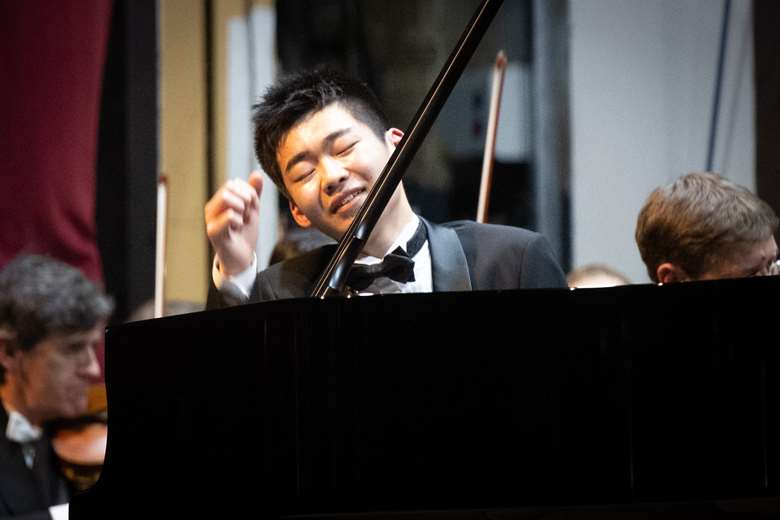
It is, of course, the Hastings International Piano Competition, hosting their Prize Winners’ Gala Concert at the White Rock Theatre in the town this Saturday 4 March. Performing at the concert, and accompanied by the Royal Philharmonic Orchestra under Rory Macdonald, will be two of the stars of last year’s competition. The winner, Japanese pianist Shunta Morimoto (above), will perform Beethoven’s Piano Concerto no.4, while third-placed Mariamna Sherling (below) will close the concert with Rachmaninov’s much-loved Rhapsody On A Theme of Paganini.
“It is a great honour for me to perform again on the historical stage of the White Rock Theatre”, said Sherling. “The Royal Philharmonic Orchestra is absolutely incredible! I was lucky to perform with this outstanding orchestra a year ago in the final of the Hastings International Piano Concerto Competition. I can’t wait to collaborate with them again.”
Shunta, meanwhile, is similarly excited for his performance of the Beethoven. “It will be my greatest delight to bring to my performance with the Royal Philharmonic Orchestra all the beauties I have uncovered studying the 4th concerto of Beethoven. It will be my honour to share this with the public of my most beloved city in England.”
The Hastings International Piano Competition is under the authoritative guidance of Paul Hughes who moved to the role from his previous post as Director of the BBC Symphony Orchestra. The competition itself has its roots in the Hastings Music Festival, which dates all the way back to 1908 – and it evolved from the festival, growing at a startling rate. Last year’s competition, says Hughes, was its best yet. “Yes, very much so. We had a record number of applicants – 360 – and a truly international field.”
Morimoto’s winning concerto in the 2022 competition, says Hughes, “demonstrated his extraordinary musicality and the maturity of his playing, as well as meeting all the technical demands of that particular work. Beethoven’s Piano Concerto no.4 has parallels in that it requires a deep understanding of the music, exceptional phrasing and an appreciation of the architecture of the concerto; all qualities that Shunta has in abundance.”
The concerto will begin with Dvořák‘s effervescent Carnival Overture, while Tchaikovsky’s Romeo and Juliet Fantasy Overture opens the second half – a prelude to Sherling’s Rachmaninov. “Mariamna (above) is the possessor of a fabulous technique, a razor-sharp mind and a sense of fun”, says Hughes. “I am expecting she will employ all of this to demonstrate many facets of Rachmaninov’s set of variations.”
Hastings has a reputation of being ‘The Friendly Competition’, which Hughes attributes to “a combination of the efficient organisation of HIPCC combined with the warmth of the community whose hospitality in looking after and supporting the young pianists at every stage of their progress through the competition makes such a difference. It is also the friendliness and openness of the jury who share insights and give constructive feedback to the competitors.”
Following the contestants after the competition has finished is imperative. “That is an important part of the Hastings International Piano experience”, he stresses. “We follow, support and offer performance opportunities to our pianists, and not just the finalists.” When choosing the winners, he says that “formally we don’t discuss the artists as a group of jurors. The range of experience within the jury means we are all looking for different aspects of a performance, and make our selections individually.”
Hughes (above) considers the future of the competition to be rosy. “Professor Vanessa Latarche was President of the jury in 2022 and fulfilled that role magnificently. She is now Artistic Director of Hastings International Piano and so I am confident we will attract an even wider range of pianists from across the world. One of the elements of the competition that distinguishes it from many others is that it focuses predominantly on the piano concerto; to that end we have conductor Rory Macdonald returning to conduct not just the finals, but also the semi-final round. One further innovation new to the Hastings competition is that we are commissioning a new piano solo work that each competitor will be required to perform in their solo recital round.”
These exciting developments are a natural progression from Paul’s previous role with the BBC Symphony Orchestra. “In my role there I have worked with and presented very many pianists, from early career new generation artists to the most distinguished pianists working today. I have commissioned new work for them, supported and developed long term relationships with these amazing artists and fostered a sense of loyalty that I believe is so important in our profession. I am calling on all those experiences in Hastings to create a platform where we can discover, support and nurture young pianists and engage the Hastings community in the wonderfully exciting journey of a young pianist from competition to the very top of the profession.”
Gedenke mein! WoO130 for voice and piano (1804-5, revised 1819-20. Beethoven aged 33 at time of composition)
Dedication Prince Nikolas Borissovich Galitzin
Text Anonymous Duration 1’30”
Listen
by Ben Hogwood
Background and Critical Reception
Thoughts
This song has quite a gentle, hymn-like profile – especially when the harmonies. The voice and piano move together, step by step, with a nostalgic tone, until what can only be a regretful closing statement.
Spotify playlist and Recordings used
A seldom-recorded song – but when you have versions from the great baritone Dietrich Fischer-Dieskau and tenor Peter Schreier the song is still amply covered.
The below playlist contains those two recordings:
You can chart the Arcana Beethoven playlist as it grows, with one recommended version of each piece we listen to. Catch up here!
Also written in 1805Wölfl Piano Sonata in C minor Op.25
Next upVariations for piano trio on ‘Ich bin der Schneider Kakadu’ Op.121a
Commemorative medal for Ludwig van Beethoven – Bronze medal from the Hungarian Ministry of Culture based on a design by József Reményi (picture courtesy of the Beethovenhaus, Bonn)
Bagatelle in C minor WoO 52 for piano (c1795-7, Beethoven aged 24-6)
Dedication not known Duration 3’45”
Listen
written by Ben Hogwood
Background and Critical Reception
A bagatelle that slipped through the net on Arcana’s Beethoven voyage! This one, which appears to have been finished between 1795 and 1797, is one of a series of such works completed in C minor. It was seemingly on the shortlist to be picked for the set of bagatelles Beethoven published as Op.119 in 1823.
Misha Donat, writing in his notes for the recording by Steven Osborne on Hyperion, suggests the movement was intended for inclusion as part of the Piano Sonata no.5 in C minor Op.10/1, but ‘discarded the scherzo-like piece because its tempo was too similar to that of the finale’. The piece was first published in 1888.
Thoughts
It is easy to see how this piece could be an out-take from the C minor sonata. It has the profile of a scherzo, with a repeated note motif that isn’t too dissimilar to that used in the forthcoming Symphony no.5. Although this ‘riff’ starts in the left hand it transfers to the right as well, and Beethoven enjoys playing with the syncopations it generates.
As a ‘trio’ section Beethoven moves into the major key, with a lighter touch and a warmer outlook to the music. It doesn’t last long, however – and we return to the dogged C minor material for a convincing finish.
Not exactly an easy Bagatelle to play, and much more a sonata fragment – but typically well constructed and memorable in its material.
Recordings used and Spotify playlist
Jenő Jandó (Naxos) Mikhail Pletnev (DG) Ronald Brautigam (BIS) John Lill (Chandos)
Ronald Brautigam provides plenty of energy on his account, and there are tasteful versions from the other three pianists on the list – as well as Steven Osborne on Hyperion.
You can chart the Arcana Beethoven playlist as it grows, with one recommended version of each piece we listen to. Catch up here!
Also written in 1797 Eberl2 Sonatas for Keyboard four hands, Op.7
Wagner Lohengrin – Prelude to Act One (1846) Beethoven Piano Concerto no.5 in E flat major Op. 73 ‘Emperor’ (1809) Prokofiev Symphony no.5 in B flat major Op. 100 (1944)
Cédric Tiberghien (piano), City of Birmingham Symphony Orchestra / Eduardo Strausser
Symphony Hall, Birmingham Wednesday 25 January 2023 2.15pm
Reviewed by Richard Whitehouse Picture of Eduardo Strausser (c) Peter Wallis
Is there a more evocative way to begin a concert than the Prelude to Wagner’s Lohengrin? The opera itself may fail (for the most part) to live up to the precedent set, but the quality of this piece has never been in doubt – with composers as distinct as Berlioz and Verdi having been captivated by its almost tangible atmosphere and counterpoint redolent of Palestrina in its supple inevitability. Under the assured direction of Eduardo Strausser, it made a fitting curtain-raiser to this afternoon’s concert by the City of Birmingham Symphony Orchestra.
It also provided a telling foil to Beethoven’s Fifth Piano Concerto that followed in the first half. Still the most popular of its composer’s such pieces, it is also nowadays the hardest to bring off – particularly the initial Allegro with its unabashed emotional rhetoric and overtly symphonic conception. Playing down the former aspect and rationalizing the latter, Cédric Tiberghien opted for a tensile and unaffected traversal which emphasized cohesion at the expense of grandeur – underlining just why Beethoven never again completed a concerto.
There was little to fault in Tiberghien’s take on the Adagio (save for a few errors to remind one that Beethoven’s slower music is by no means easier to play), and if the transition into the finale was less than spellbinding, that latter movement for the most part brought out the best in the rapport between pianist and conductor. The CBSO responded with the necessary rhythmic agility, and Tiberghien responded to the applause with excerpts from the Eroica Variations he has recently recorded as part of an edition of Beethoven’s works in this genre.
The engaging director of last year’s Viennese New Year concert, Strausser (above) clearly enjoys a rapport with this orchestra as was a hallmark of Prokofiev’s Fifth Symphony following the interval. Itself the most often heard of a diverse and often diffuse cycle (the ‘Classical’ more often encountered on recording than in concert), it presents notable difficulties of balance and pacing – notably the initial Andante, whose accumulating momentum needs careful handling so as not to congeal. Strausser duly had its measure, maintaining focus through to a seismic peroration – the impact from which carried over into a scherzo whose outer sections seemed more than unusually acerbic. Nor did this preclude a more genial response in the trio, its main theme held over from Romeo and Juliet and as captivating a melody as any by this composer.
That the Adagio is the emotional heart of this work only increases the need to prevent it from dragging, and Strausser’s sense of proportion ensured that the sense of dread made explicit at its climax was balanced by the serene eloquence towards its close. Heading (rightly) straight into finale, he steered a secure course through a movement whose poise is constantly being undercut by disruptive elements as take control in the coda – the composer’s perspective on imminent Soviet victory in the ‘Great Patriotic War’ remaining ambivalent even at the close.
A fine reading of a work whose stature is still questioned (and a reminder that Prokofiev’s Second Symphony still awaits its CBSO debut). Chief Conductor-designate Kazuki Yamada returns next week for an unlikely though appealing double-bill of Tchaikovsky and Holst.







 Arcana.fm