On Record – The Definitive Eric Coates (Lyrita)

Various soloists and orchestras / Eric Coates
Lyrita REAM.2146 [seven discs, 8h 53m 13s]
Compilation, Audio Restoration and Remastering Alan Bunting

You can find the full definitive track listing on the Presto website

Reviewed by Richard Whitehouse

What’s the story?

Lyrita reissues the set collating all those extent recordings by Eric Coates of his own music, ranging over the greater part of a career when he was established among the leading British composers of his generation, heard here in consistently excellent transfers by Alan Bunting.

What are the performances like?

Even at the height of his acclaim, Coates was often dismissed as a purveyor of ‘light music’ at a time when such populism was frowned upon by the classical establishment, though the fact no less an eminence than Elgar had Coates’ recordings of his own music on permanent order confirms the latter’s success was by no means restricted to the record-buying layman. As did Billy Mayerl in the piano domain, it was Coates’ ability to pick up on current trends and render them with an ageless ‘middle of the road’ stylishness that ensured his popularity.

Although his earlier reputation came through his numerous songs (comparatively neglected today), Coates gradually achieved recognition for orchestral music – notably his suites that, grouped according to descriptive title, attracted informed musicians for their compositional finesse as much as more casual listeners for their melodic immediacy. Such success was by no means restricted to the inter-war era – Coates finding a ready outlet for his newer pieces through to the advent of a New Elizabethan Age, just four years prior to his death. Nor was this standing necessarily diminished with the rise of a new popular music during the 1960s as, unlike that of his contemporaries, his music continued to be played such that, at the turn of this century, almost all his major works were available on recordings other than his own.

The present set was manifestly a labour of love on the part of Alan Bunting – who not only supervised its remastering from a disparate range of sources, but has also arranged the order of tracks on each volume. As he himself notes, a strictly chronological ordering would have been more suited to the afficionado, but the present sequencing avoids duplication of works recorded more than once and so enables listeners to enjoy a varied cross-section on each of the initial five volumes. The sixth volume collates all those recordings made in the acoustic process (up until 1926) and inevitably of more specialist appeal, then the seventh features a selection of recordings by other musicians that, in itself, constitutes a true roll-call of artists from the ‘golden age’ of light music and is an essential supplement to Coates’s own legacy.

Does it all work?

Indeed. The remastering has been expertly carried out so the sound across almost all of the electrical recordings exudes clarity and perspective without sacrificing that ambience which came with the actual acoustic. The set comes with two booklets: one that gives an inclusive track-listing for each of the seven volumes while the other, even more substantial, consists of an extensive contextual essay Eric Coates and the Gramophone by Michael Payne; his detailed study about the composer’s life and music (Ashgate: 2012) being required reading.

Is it recommended?

Very much so. The only proviso would be this edition having been issued as two separate sets rather than as a more economical card-box – thereby saving space and plastic! Note also that a two-disc compilation Coates Conducts Coates (REAM.2146) is available from this source.

Listen / Buy

You can explore purchase options at the Wyastone website

Published post no.2,633 – Thursday 21 August 2025

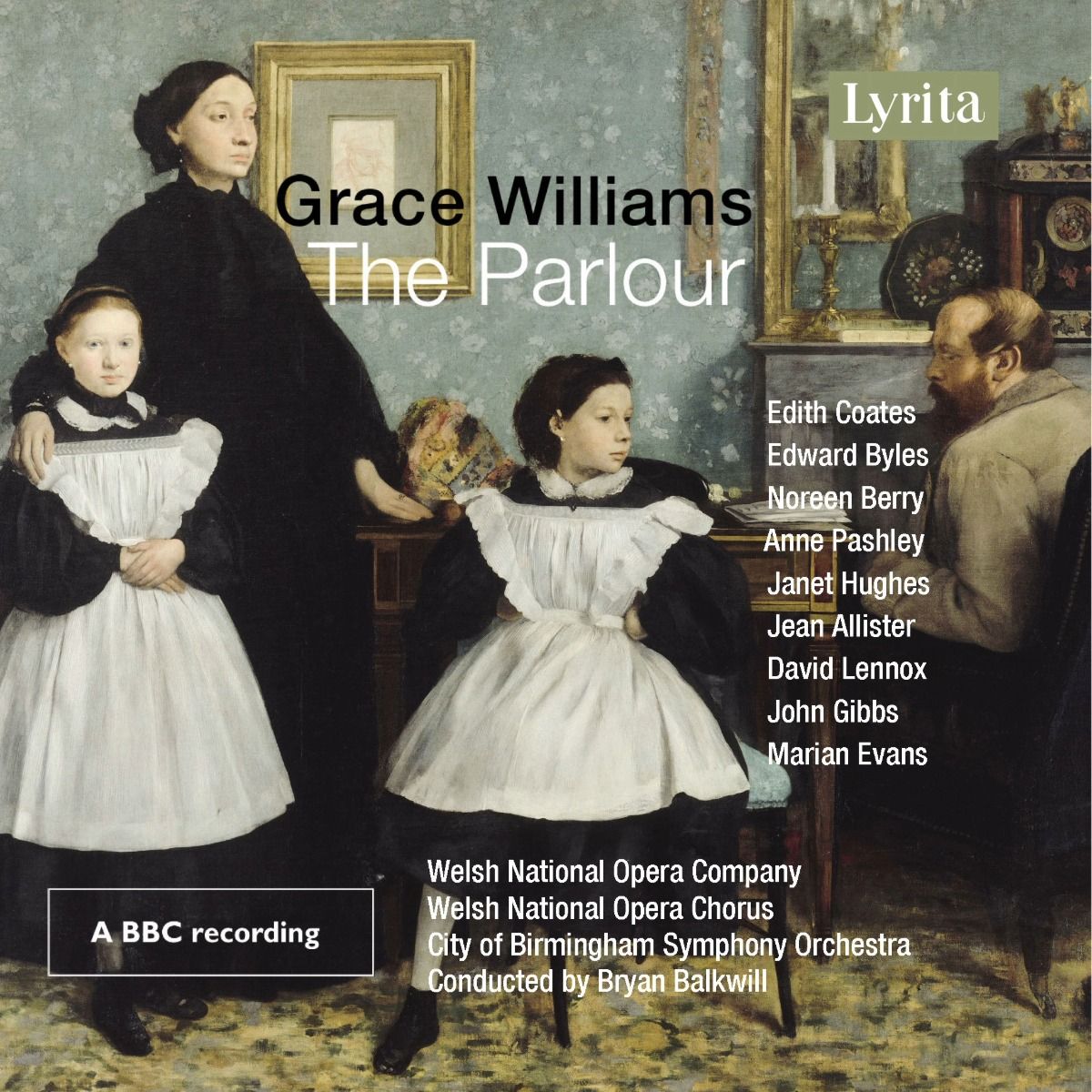
On Record – Grace Williams: The Parlour (Lyrita)

The Parlour (1960-61)

Comic Opera in One Act (two scenes)
Libretto and music by Grace Williams, after En Famille by Guy de Maupassant

Grandmama – Edith Coates (contralto)
Papa – Edward Byles (tenor)
Mama – Noreen Berry (mezzo-soprano)
Louisa – Anne Pashley (soprano)
Augusta – Janet Hughes (soprano)
Aunt Genevieve – Jean Allister (mezzo-soprano)
Uncle Steve – David Lennox (tenor)
Doctor Charlton – John Gibbs (baritone)
Rosalie – Marian Evans (soprano)
Welsh National Opera Company, Welsh National Opera Chorus, City of Birmingham Symphony Orchestra / Bryan Balkwill

Lyrita REAM.1147 [79’32”, Mono/ADD] Producer John Moody
Broadcast performance from Odeon Theatre, Llandudno on 18 August 1966

Reviewed by Richard Whitehouse

What’s the story?

Lyrita continues its coverage of Grace Williams with this first commercial release of her only opera, taken from its first run by Welsh National Opera and so adding another major work to the discography of one who, almost half a century after her death, is finally receiving her due.

What’s the music like?

Although she was, by her own admission, brought up in a ‘singing tradition’ and experienced opera from an early age, it was only in 1959 that Williams was approached with a commission for one. Written to her own libretto, after the short story by Guy de Maupassant, The Parlour was completed two years later but not premiered until May 1966 – a subsequent performance being broadcast and heard here. There have since been semi-professional stagings in London (1974) and Cardiff (1993), but no further production from one of the main British companies.

Relocating this story away from Paris to an unspecified Victorian seaside town, Williams was mindful to maintain the petit-bourgeois conservatism and mendacity from that original setting. As a narrative it makes for pretty dispiriting reading, but the liveliness and wit of her libretto is rarely less than engaging, while her music hardly falters in bringing out the essence of the situation at hand. Eight out of nine singing roles get a turn in the spotlight, and though their profiles might not be sharply drawn, the interplay of characters as of voice-types is astutely managed. Orchestrally the score may lack the intensity of Williams’ other large-scale works, but its dextrousness and intricacy seem ideally suited to a domestic drama; with that pathos which frequently surfaces in her music being no less evident during the opera’s final stages.

Vocally there are strong contributions by Edith Coates as the implacable grandmother, from Edward Byles as her always put-upon son and from Noreen Berry as her perennially hapless (and luckless!) daughter-in-law. Anne Pashley and Janet Hughes become one as her witless grand-daughters, with Jean Allister and David Lennox ideally cast as her favoured daughter and her wheedling son-in-law. John Gibbs makes the most of her doctor in all his contrived bluffness or feigned disinterest, and Marian Evans chips in as the dim-witted family servant. The Welsh National Opera Company and Chorus betray occasional tentativeness, but swift-moving passages for the neighbours lack little of focus or discipline – from a time when this organization was in the process of making its transition from amateur to professional status.

Does it all work?

It does, not least owing to the excellence of this performance. WNO did not then have its own orchestra, but the City of Birmingham Symphony Orchestra is more than equal to the task of projecting Williams’s eventful score with the necessary clarity and verve, while it responds with alacrity to the direction of the company’s then music director Bryan Balkwill. The mono broadcast has come up more than adequately in its remastering, and this set comes with the full libretto and insightful annotations from Paul Conway in what is a typically excellent Lyrita presentation.

Is it recommended?

It is. The Parlour is unlikely to have a professional staging any time soon, making this release of more than archival interest. Could Lyrita acquire the 1963 broadcast of Daniel Jones’s The Knife, intended to be staged with the Williams in what would have been a weighty double-bill.

Listen / Buy

Published post no.2,626 – Thursday 14 August 2025

On Record – Soloists, BBC National Chorus and Orchestra of Wales / Adrian Partington – Grace Williams: Missa Cambrensis (Lyrita)

Grace Williams Missa Cambrensis (1968-71)

April Fredrick (soprano), Angharad Lyddon (mezzo-soprano), Robert Murray (tenor)
Paul Carey Jones (bass), Dr Rowan Williams (narrator); Côr Heol y March, BBC National Chorus and Orchestra of Wales / Adrian Partington

Lyrita SRCD442 [66’41’’] Latin / Welsh text and English translation included
Producer / Engineer Adrian Farmer, Engineer Simon Smith

Recorded 20-21 January 2024 at BBC Hoddinott Hall, Cardiff

Reviewed by Richard Whitehouse

What’s the story?

Lyrita continues its coverage of Grace Williams (1906-1977) with her largest concert work, Missa Cambrensis, in a recent studio recording which confirms it as the defining statement from a composer who, almost half a century since her death, is only now receiving her due.

What’s the music like?

As Paul Conway observes in his typically thorough booklet notes, Missa Cambrensis is one among a number of works by Williams that is Welsh only in a titular sense. Premiered at the Llandaff Festival in 1971, it was well received by fellow composers, critics and public alike but not heard again until 2016 in a performance one recalls as originally intended for release on Lyrita and which can be heard via the composer’s dedicated website. Not that the present account is other than successful in conveying the essence of this powerful yet elusive piece.

Many settings of the Mass since Haydn have unfolded a symphonic trajectory, but Williams goes further with the division into five clearly defined movements. The initial Kyrie Eleison not only introduces most of those salient motifs but also establishes that tone, mystical in its undulating equivocation, such as characterizes this work’s long-term expression: the contrast here between choral and soloistic textures duly accentuated by their hieratic and supplicatory quality. This duly sets up an emotional contrast intensified in the Gloria, outwardly the most straightforward part of the work but with a calmly ecstatic response at Laudamus te then an eloquent Dominus Deus that are nothing if not personal, together with an intensely wrought Cum Sancto Spiritu whose culminating Amen’s convey a distinctly ambivalent affirmation.

As most often, the Credo is the most substantial portion but Williams rings the changes by dividing this into halves, a pertinent division coming at Et homo factus est and Crucifíxus étiam pro nobis. In between are interpolated a setting of Saunders Lewis’s Carol Nadolig (A Christmas Carol) for children’s voices with viola, cello and harp of melting pathos, offset by a starkly narrative treatment of the ‘Beatitudes’ prior to a mostly ruminative resumption of the Credo. Pivoting between contemplation and elation, the Sanctus is rounded off by a joyful Hosánna in excélsis which is not to be heard again after the subdued eloquence of the Benedictus. An anguished response to the Agnus Dei feels the more acute, as also a searching Dona Nobis Pacem which brings the work full circle to its contemplative close.

Does it all work?

Yes, and with an understated while readily identifiable personality that surely makes this the most potent setting of the Mass from a Welsh composer. Subliminal influences might not be hard to discern, among them Britten’s War Requiem, but they never detract from Williams’s own idiom. The soloists cannot be faulted in terms of commitment, with Rowan Williams a notably incisive reciter, while Adrian Partington secures a lustrous response from his choral and orchestral forces. Overall, it is hard to imagine the work given with greater conviction.

Is it recommended?

It is indeed, not least in the hope that further live hearings of Missa Cambrensis may prove forthcoming. Good news, moreover, that Lyrita has now acquired the premiere performance of Williams’s only completed opera, The Parlour, which is scheduled for imminent release.

Listen & Buy

You can read more about this release at the Wyastone website

Published post no.2,516 – Monday 28 April 2025

On Record – George Lloyd: The Works for Violin and Piano (Lyrita)

George Lloyd
Lament, Air and Dance (1975)
Violin Sonata (1978)
Seven Extracts from ‘The Serf’ (1938, arr. 1974)

Tasmin Little (violin), Martin Roscoe (piano); Ruth Rogers (violin), Simon Callaghan (piano) (Extracts from The Serf)

Lyrita SRCD.424 [two discs, 60’33” and 28’16”]
Producers George Lloyd, Adrian Farmer (The Serf) Engineers Tony Faulkner, Adrian Farmer (The Serf)

Recorded 7-8 September 1989 at St Martin’s, East Woodhay; 10 June at Concert Hall, Wyastone Leys, Monmouth (The Serf)

Reviewed by Richard Whitehouse

What’s the story?

Lyrita’s eminently worthwhile Signature Edition devoted to the reissue of Albany recordings of George Lloyd (1913-1998) continues with this volume of his output for violin and piano, here re-released with the addition of music that has been specially recorded for the occasion.

What’s the music like?

Those who have been following this series (or who have those original issues) will know that Lloyd often devoted himself to a specific medium at certain times in his life, and so it proved with this particular duo. Despite having studied the violin with no less than Albert Sammons, he wrote nothing centred on this instrument until his First Violin Concerto of 1970. Between then and its successor (both on SRCD.2421-22) seven years later, he also essayed two major works for violin and piano that reflect the ambition of his symphonies from previous decades.

Although not designated such, Lament, Air and Dance is hardly less of a sonata than the piece which followed. Not least its Lament whose spacious if methodical unfolding on the lines of a chaconne, albeit that in G minor by Vitali rather than the more expected one in D minor by Bach, exhibits formal cohesion to balance its emotional immediacy. The relatively brief Air provides an oasis of lyrical calm, then the Dance makes for a more than viable balance with its bravura writing and a rhythmic verve that fairly dominates those impetuous closing bars.

Seemingly begun the following year but only finished in 1978 (the composer’s website and present booklet note diverge on this), the Violin Sonata is cast on almost the same scale, but its three sections unfold without pause. The notion of a one-movement conception is further reinforced by its initial Largamente’s two main themes – respectively rhythmic and melodic – that evolve through the central Moderato’s brief while delectably whimsical course, to their elaboration and eventual fusion in a Finale which builds to a decisive and impassioned close.

Before either of these works, Lloyd had effectively ‘tried out’ this medium by extracting then arranging seven pieces from his second opera The Serf – which, one senses, he considered his greatest achievement such that the aborted BBC production and recording in 1990 must have been a sore disappointment. Those familiar with the first of his two orchestral suites arranged as late as 1997 (SRCD.2417-18) will recognize some of this music, but the present sequence appeal taken as an overall entity or as individual items which almost all make ideal encores.

Does it all work?

Yes, not least for the fact that Lloyd’s music is idiomatically conceived for whatever medium with which he chose to work. Both main works benefit from the commitment of Tasmin Little and Martin Roscoe in teasing expressive nuances out of music that, not for the first time with this composer, is subtler and more ambivalent than often supposed. Nor are Ruth Rogers and Simon Callaghan found wanting in those extracts from The Serf, recorded just a few months ago and welcome enhancement of what was already a desirable release in the Albany series.

Is it recommended?

Indeed, given the excellence of playing, recording and Paul Conway’s customarily thorough annotations. This series of George Lloyd reissues awaits his operas Iernin and John Socman for completion, though if it could run to a new recording of The Serf then so much the better.

Listen & Buy

For further information visit the dedicated page for the George Lloyd Signature Series. For more on the composer himself, head to the George Lloyd website

Published post no.2,375 – Wednesday 27 November 2024

On Record – George Lloyd: The Piano Works – Solo & Duo (Anthony Goldstone & Caroline Clemmow, Kathryn Stott, Martin Roscoe (Lyrita)

George Lloyd
Aubade (1971)a; Eventide (1989)a; The Road Through Samarkand (1995)a; The Lily-leaf and the Grasshopper (1972)b; The Transformation of that Naked Ape (1972, rev. 1987)c; Lullaby ‘Intercom Baby’ (1975, arr. 1987)c; An African Shrine (1966)c; The Aggressive Fishes (1972)c; St. Antony and the Beggar (1972)c. The Road Through Samarkand (1972)c

Kathryn Stott (b), Martin Roscoe (c) (pianos)
Anthony Goldstone and Caroline Clemmow (a) (piano duo)

Lyrita SRCD.2423 (two discs, 70’16” and 77’55”)
Producers bcHoward Devon, aAnthony Goldstone and Caroline Clemmow with George Lloyd Engineers bcHoward Devon, aAnthony Goldstone and Caroline Clemmow with George Lloyd

Recorded b2 June 1987 at Henry Wood Hall, London; c18 & 19 June 1987 at St. Barnabas, North Finchley, London; a4 & 5 November 1996 at St. John the Baptist, Aldeburgh

Reviewed by Richard Whitehouse

What’s the story?

Lyrita continues its ‘Signature Edition’ of music composed (and conducted) by George Lloyd with his works for one and two pianos, admirably performed here by a line-up of international stature including those pianists who recorded his concertos for this instrument (SRCD.2421).

What’s the music like?

As Lloyd himself recounted, training as a violinist rather prejudiced his writing for the piano, despite his wife’s prompting. It was hearing the young John Ogdon in the early 1960s that led to Scapegoat, this first piano concerto being followed by three others and several other works for piano over the ensuing decade. For all their diversity of inspiration, they have in common a determination to avoid wanton virtuosity in favour of a technical precision as never inhibits their composer’s aim to realize his musical intentions – whether idiomatically or individually.

This is evident in Lloyd’s earliest and arguably finest work for solo piano, An African Shrine. Written for Ogdon, who played it regularly and recorded in his 1970 EMI anthology Pianistic Philosophies, this takes in several sections – the vividness of whose expressive contrasts are balanced by the seamlessness with which they merge into an unbroken formal continuity. As an evocation of mindless violence, it is highly affecting and its cohesion as a one-movement ‘sonata’ makes for an indispensable addition to British piano music during the post-war era.

Lloyd followed this with the even more expansive Aubade, composed for Ogdon and his wife Brenda Lucas. Described as a ‘fantasy’, its eight sections outline a dream-like scenario which takes in charcoal burners, tin soldiers, a song then dance for two lovers, a medley of bells and chants, then moths; framed by an Introduction and Finale as set the scene thematically then sum it up unerringly. Enticingly realized for its medium if too diffuse overall, this would likely enjoy wider exposure if it were shortened and orchestrated as the ballet it cries out to become.

The year 1972 saw Lloyd immersed in the solo piano. Among these shorter pieces, The Road Through Samarkand is the most directly appealing with its amused if never sarcastic send-up of Krishna adherents in central London with many taking the journey from Calais to Calcutta, though whether the outcome is one of utopianism or disillusionment is left unanswered by the peremptory close. St Anthony and the Beggar is a direct corollary to the Biblical parable, here with an outcome of demonstrable catharsis, while The Aggressive Fishes evokes the allure yet danger of certain tropical species in music alternately atmospheric and ominous. Inspired by a citing from the banks of the Avon, The Lily-Leaf and the Grasshopper is a subtler interplay of contrasts – the insect’s quizzical demeanour emerging out of then back into a rapt waterscape.

The most substantial of these later pieces is The Transformation of the Naked Ape. Taking its cue from Lloyd’s consideration of the essential difference between animals and humans, these six movements (each longer than the last) deftly outline a progression from external to internal properties – hence from Her Hair, via those of Tongue, Eyes, Brain and Mind, to Her Soul – though any inference of increasing spirituality is scotched by the capricious final number of this highly diverting sequence, in which pleasure and provocation have been pointedly elided.

Lloyd wrote little more for piano in either medium, though his arrangement of the violin-and-piano Intercom Baby 12 years on as Lullaby turned one of his most ingratiating shorter pieces into this ideal encore – wistful and playful by turns. Drawing on a carol written when he was just ten (then used extensively in his opera John Socman), Eventide emerges as a fantasy on this tune such as adumbrates a journey from innocence to experience of deceptive simplicity and has enjoyed greater exposure in a no less effective arrangement for brass band two years on. Finally, The Road Through Samarkand makes its reappearance arranged for two pianos – the inherent virtuosity of its writing more equably realized in this medium if, as is suggested here, those elements of struggle and assumed repose more potently realized by the original.

Does it all work?

Almost always. There is a sense of this music (rather its composer) fighting against precedent as regards idiomatic piano writing, for all that the outcome feels never less than effective and often much more so. The performances are highly sympathetic and often inspired – particularly Kathryn Stott with her contributions, though Martin Roscoe affords no mean insight and lucid pianism with his larger selection. The duo of Anthony Goldstone (much missed) and Caroline Clemmow is heard to impressive effect, but sound here could do with rather greater definition.

Is it recommended?

It is. Paul Conway’s annotations feature many pertinent observations, while the solo items are recorded with ideal clarity and spaciousness. Not the first port-of-call for those new to George Lloyd, maybe, but a collection where several items warrant inclusion in the modern repertoire.

Listen & Buy

For further information visit the dedicated page for the George Lloyd Signature Series. For more on the composer himself, head to the George Lloyd website, while for more on the artists click on the names to read about Martin Roscoe, Kathryn Stott and the Anthony Goldstone & Caroline Clemmow duo.

Published post no.2,248 – Tuesday 23 July 2024