George Lloyd Lament, Air and Dance (1975) Violin Sonata (1978) Seven Extracts from ‘The Serf’ (1938, arr. 1974)
Tasmin Little (violin), Martin Roscoe (piano); Ruth Rogers (violin), Simon Callaghan (piano) (Extracts from The Serf)
Lyrita SRCD.424 [two discs, 60’33” and 28’16”] Producers George Lloyd, Adrian Farmer (The Serf) Engineers Tony Faulkner, Adrian Farmer (The Serf)
Recorded 7-8 September 1989 at St Martin’s, East Woodhay; 10 June at Concert Hall, Wyastone Leys, Monmouth (The Serf)
Reviewed by Richard Whitehouse
What’s the story?
Lyrita’s eminently worthwhile Signature Edition devoted to the reissue of Albany recordings of George Lloyd (1913-1998) continues with this volume of his output for violin and piano, here re-released with the addition of music that has been specially recorded for the occasion.
What’s the music like?
Those who have been following this series (or who have those original issues) will know that Lloyd often devoted himself to a specific medium at certain times in his life, and so it proved with this particular duo. Despite having studied the violin with no less than Albert Sammons, he wrote nothing centred on this instrument until his First Violin Concerto of 1970. Between then and its successor (both on SRCD.2421-22) seven years later, he also essayed two major works for violin and piano that reflect the ambition of his symphonies from previous decades.
Although not designated such, Lament, Air and Dance is hardly less of a sonata than the piece which followed. Not least its Lament whose spacious if methodical unfolding on the lines of a chaconne, albeit that in G minor by Vitali rather than the more expected one in D minor by Bach, exhibits formal cohesion to balance its emotional immediacy. The relatively brief Air provides an oasis of lyrical calm, then the Dance makes for a more than viable balance with its bravura writing and a rhythmic verve that fairly dominates those impetuous closing bars.
Seemingly begun the following year but only finished in 1978 (the composer’s website and present booklet note diverge on this), the Violin Sonata is cast on almost the same scale, but its three sections unfold without pause. The notion of a one-movement conception is further reinforced by its initial Largamente’s two main themes – respectively rhythmic and melodic – that evolve through the central Moderato’s brief while delectably whimsical course, to their elaboration and eventual fusion in a Finale which builds to a decisive and impassioned close.
Before either of these works, Lloyd had effectively ‘tried out’ this medium by extracting then arranging seven pieces from his second opera The Serf – which, one senses, he considered his greatest achievement such that the aborted BBC production and recording in 1990 must have been a sore disappointment. Those familiar with the first of his two orchestral suites arranged as late as 1997 (SRCD.2417-18) will recognize some of this music, but the present sequence appeal taken as an overall entity or as individual items which almost all make ideal encores.
Does it all work?
Yes, not least for the fact that Lloyd’s music is idiomatically conceived for whatever medium with which he chose to work. Both main works benefit from the commitment of Tasmin Little and Martin Roscoe in teasing expressive nuances out of music that, not for the first time with this composer, is subtler and more ambivalent than often supposed. Nor are Ruth Rogers and Simon Callaghan found wanting in those extracts from The Serf, recorded just a few months ago and welcome enhancement of what was already a desirable release in the Albany series.
Is it recommended?
Indeed, given the excellence of playing, recording and Paul Conway’s customarily thorough annotations. This series of George Lloyd reissues awaits his operas Iernin and John Socman for completion, though if it could run to a new recording of The Serf then so much the better.
George Lloyd Aubade (1971)a; Eventide (1989)a; The Road Through Samarkand (1995)a; The Lily-leaf and the Grasshopper (1972)b; The Transformation of that Naked Ape (1972, rev. 1987)c; Lullaby ‘Intercom Baby’ (1975, arr. 1987)c; An African Shrine (1966)c; The Aggressive Fishes (1972)c; St. Antony and the Beggar (1972)c. The Road Through Samarkand (1972)c
Kathryn Stott (b), Martin Roscoe (c) (pianos) Anthony Goldstone and Caroline Clemmow (a) (piano duo)
Lyrita SRCD.2423 (two discs, 70’16” and 77’55”) Producers bcHoward Devon, aAnthony Goldstone and Caroline Clemmow with George Lloyd Engineers bcHoward Devon, aAnthony Goldstone and Caroline Clemmow with George Lloyd
Recorded b2 June 1987 at Henry Wood Hall, London; c18 & 19 June 1987 at St. Barnabas, North Finchley, London; a4 & 5 November 1996 at St. John the Baptist, Aldeburgh
Reviewed by Richard Whitehouse
What’s the story?
Lyrita continues its ‘Signature Edition’ of music composed (and conducted) by George Lloyd with his works for one and two pianos, admirably performed here by a line-up of international stature including those pianists who recorded his concertos for this instrument (SRCD.2421).
What’s the music like?
As Lloyd himself recounted, training as a violinist rather prejudiced his writing for the piano, despite his wife’s prompting. It was hearing the young John Ogdon in the early 1960s that led to Scapegoat, this first piano concerto being followed by three others and several other works for piano over the ensuing decade. For all their diversity of inspiration, they have in common a determination to avoid wanton virtuosity in favour of a technical precision as never inhibits their composer’s aim to realize his musical intentions – whether idiomatically or individually.
This is evident in Lloyd’s earliest and arguably finest work for solo piano, An African Shrine. Written for Ogdon, who played it regularly and recorded in his 1970 EMI anthology Pianistic Philosophies, this takes in several sections – the vividness of whose expressive contrasts are balanced by the seamlessness with which they merge into an unbroken formal continuity. As an evocation of mindless violence, it is highly affecting and its cohesion as a one-movement ‘sonata’ makes for an indispensable addition to British piano music during the post-war era.
Lloyd followed this with the even more expansive Aubade, composed for Ogdon and his wife Brenda Lucas. Described as a ‘fantasy’, its eight sections outline a dream-like scenario which takes in charcoal burners, tin soldiers, a song then dance for two lovers, a medley of bells and chants, then moths; framed by an Introduction and Finale as set the scene thematically then sum it up unerringly. Enticingly realized for its medium if too diffuse overall, this would likely enjoy wider exposure if it were shortened and orchestrated as the ballet it cries out to become.
The year 1972 saw Lloyd immersed in the solo piano. Among these shorter pieces, The Road Through Samarkand is the most directly appealing with its amused if never sarcastic send-up of Krishna adherents in central London with many taking the journey from Calais to Calcutta, though whether the outcome is one of utopianism or disillusionment is left unanswered by the peremptory close. St Anthony and the Beggar is a direct corollary to the Biblical parable, here with an outcome of demonstrable catharsis, while The Aggressive Fishes evokes the allure yet danger of certain tropical species in music alternately atmospheric and ominous. Inspired by a citing from the banks of the Avon, The Lily-Leaf and the Grasshopper is a subtler interplay of contrasts – the insect’s quizzical demeanour emerging out of then back into a rapt waterscape.
The most substantial of these later pieces is The Transformation of the Naked Ape. Taking its cue from Lloyd’s consideration of the essential difference between animals and humans, these six movements (each longer than the last) deftly outline a progression from external to internal properties – hence from Her Hair, via those of Tongue, Eyes, Brain and Mind, to Her Soul – though any inference of increasing spirituality is scotched by the capricious final number of this highly diverting sequence, in which pleasure and provocation have been pointedly elided.
Lloyd wrote little more for piano in either medium, though his arrangement of the violin-and-piano Intercom Baby 12 years on as Lullaby turned one of his most ingratiating shorter pieces into this ideal encore – wistful and playful by turns. Drawing on a carol written when he was just ten (then used extensively in his opera John Socman), Eventide emerges as a fantasy on this tune such as adumbrates a journey from innocence to experience of deceptive simplicity and has enjoyed greater exposure in a no less effective arrangement for brass band two years on. Finally, The Road Through Samarkand makes its reappearance arranged for two pianos – the inherent virtuosity of its writing more equably realized in this medium if, as is suggested here, those elements of struggle and assumed repose more potently realized by the original.
Does it all work?
Almost always. There is a sense of this music (rather its composer) fighting against precedent as regards idiomatic piano writing, for all that the outcome feels never less than effective and often much more so. The performances are highly sympathetic and often inspired – particularly Kathryn Stott with her contributions, though Martin Roscoe affords no mean insight and lucid pianism with his larger selection. The duo of Anthony Goldstone (much missed) and Caroline Clemmow is heard to impressive effect, but sound here could do with rather greater definition.
Is it recommended?
It is. Paul Conway’s annotations feature many pertinent observations, while the solo items are recorded with ideal clarity and spaciousness. Not the first port-of-call for those new to George Lloyd, maybe, but a collection where several items warrant inclusion in the modern repertoire.
Various venues in Oxford, Saturday 9 October. Artists as listed below
Written by Ben Hogwood from online streams
The Oxford Lieder festival is into its 20th year, a cause for celebration indeed. It has become one of the UK’s finest classical music events, lovingly curated and produced but gathering increasing levels of enthusiasm every year.
The 2021 model is ideally weighted, with live music events streamed and recorded for posterity – an ideally weighted dual approach in these uncertain times. Titled Nature’s Songbook, it has set aside days for anniversary composers Saint-Saëns (100 years since his death) and the lesser-heard Swedish composer Wilhelm Stenhammar (150 years since his birth)
Saint-Saëns had his day on the Saturday, offering audiences a chance to appreciate his under-heard Mélodies in the context of better-known chamber and stage works, not to mention works by pupils and contemporaries. Baritone Victor Sicard & pianist Anna Cardona (above) were on first, the 2011 winners of the festival’s Young Artists Platform giving a recital from the ideal acoustic Saint John the Evangelist.
They began with a pupil and close friend of the featured composer. Gabriel Fauré was to become one of the very finest French composers of the 20th century, his output headed but not restricted to sublime contributions in the world of chamber music, piano and song. We heard his first published song cycle Poème d’un jour Op.21, a brief affair – which is ironic, since the subject of Charles Grandmougin’s verse was exactly that. Sicard found his feet in the slightly sorrowful first song, with an easily flowing piano part from Cardona. There was strength of character in the second, and wistfulness in the third as the day-long love affair fizzled out.
Saint-Saëns melodies followed and – as is often the case with this composer – hit the mark immediately. The attractive La Brise was secured by a rustic drone from Sicard’s left hand, which also gave its urgency to the next song. Emotionally the heart of this selection lay in La splendeur vide Op.26/2, which was followed by the Danse macabre, Saint-Saëns working with inner resolve. Perhaps it lacked a little edginess but a really strong connection between the two was clear.
Fauré’s pupil Ravel was next, and Sicard found the exquisite, timeless quality of Kaddisch, its melodic inflections beautifully expressed and contrasting with the questioning L’Énigme Éternelle. Following this was Histoires Naturelles, the ideal choice given the festival’s theme. Cardona had a strong descriptive role to play, with some lovely detail portraying Crickets, and The Swan too, which had strong characterisation. The Guinea Fowl’s ‘rowdy and shrill’ ending was perfectly judged by the pair – as was an exquisite encore of Chanson française.
Later we further examined the link between teacher and student in the Jacqueline du Pré Music Building, as violinist Fenella Humphreys and pianist Martin Roscoe played sonatas by Saint-Saens and Faure. In an aside to the audience, Humphreys revealed it was the first time the duo had performed the Saint-Saens Violin Sonata no.1 in D minor Op.75 (1885), realising a long-held dream of playing a work in public she had loved since childhood.
The closer acoustics of the hall took a little while to adjust to – certainly on the live stream – but it was easy to admire the duo as they met the challenges of the busy first movement head on, getting beneath the tumultuous phrases to the deeper emotion below. The softer-hearted second theme, a chorale, with rippling arpeggios from the piano, reminded us that the Organ Symphony was not far off – and it was beautifully rendered here. A keenly felt Adagio led to a balletic third movement, initiated by Roscoe’s nicely pointed piano part. There was however a strong sense of everything pointing towards the finale. Its tremendous technical demands were comfortably conquered, but again the music’s feeling won the day, Humphreys playing winsome long phrases. Both players enjoyed the return of the ‘chorale’ theme, but also the peal of bells evoked by Roscoe from the piano.
Fauré’s Violin Sonata no.1 in A major Op.13 is an early work, written nine years earlier, when it was given a glowing review by his teacher. Humphreys spoke affectingly of its significance during lockdown, and it was clearly a tonic for her to be playing it again. The two players dovetailed beautifully, Roscoe’s flowing introduction picked up seamlessly by Humphreys’ lyrical phrases. The slow movement took time for deep thought, its gently undulating piano a foil for the violin’s probing melodies, gradually building to a deeply felt apex. The scherzo was winsome, its syncopations tripping over each other happily. An ardent account of the fourth movement found the players deep in conversation, right up to the end of this richly rewarding piece. It is difficult to write about what makes Fauré such an attractive composer – his gifts are plentiful but elusive – yet this performance had all the qualities that so impressed his teacher.
A strong cast of thirteen musicians assembled for a pair of concerts in the Saint John the Evangelist church. They were led by soprano Elizabeth Watts, and baritone Felix Kemp, with pianists Jâms Coleman, Martin Sturfält joined by principal players of the Echor Chamber Orchestra (Anna Wolstenholme (flute / piccolo), Jernej Albreht (clarinet), Owen Gunnell (percussion), Jonathan Stone and Sara Wolstenholme (violins), William Bender (viola), Nathaniel Boyd (cello), Laurence Ungless (double bass)
It is funny to think Saint-Saëns prohibited performances of Le Carnaval des Animaux in his lifetime, for fear of being dismissed as a frivolous composer. In the event the suite was published a year after his death, and the piece has had an enduring appeal ever since. The Oxford Lieder edition recognised that appeal but interspersed his suite with an array of animal-based songs from contemporaries and countrymen, together with short readings from nonsense verse by Ogden Nash.
The programme was brilliantly conceived but was too big, including a total of 17 songs alongside the Carnival without a break, meaning the flow was difficult to pick up at times. That said, the imaginative set of works largely succeeded thanks to the artistry on stage. Watts’ versatility was evident in the oppressive heat of Chausson’s La Caravane, its powerful vocal line in thrall to Wagner, and also in the amusing tale of La Cigale et la fourmi as set by Offenbach, with some brilliant high notes at the end.
There was a striking duet between Watts and flautist Anna Wolstenholme, portraying Roussel’s Rossignol mon mignon, before the soprano found the nub of Hugo Wolf’s solemn Wie lange schon war immer mein Verlangen. Felix Kemp was an effective foil, capturing the micro portraits of animals as realised by Poulenc from Apollinaire’s poetry, as well as Britten’s elusive Fish in the unruffled lakes.
The Carnival itself was a huge amount of fun. From the boisterous Introduction and Royal March of the Lion onward, it was nice to see the performers enjoying themselves in this irrepressible music. Double bassist Laurence Ungless caught the character of The Elephant, lumbering into view, while The Swan was beautiful and effortless in the hands of Nathaniel Boyd. Pianists evinced some ready laughter, before we returned to Watts for the rather lovely final song, Grieg’s own portrayal of the swan, which found her using a third language of the evening. The Echor soloists wrapped up with a celebratory finale, putting the cap on a concert which may have been too long, but which was ultimately enjoyable.
A packed day ended with a late evening recital from Adèle Charvet & Anne Le Bozec. Subtitled Mélodies on Tour, their program began with three English-language songs – two about sleep from Gounod, by turns perky then lustrous, with a setting of Longfellow’s poem Sleep. Saint-Saëns himself was next, evoking a heady atmosphere with A Voice By The Cedar Tree but then agitated in La mort d’Ophélie, where Charvet held an impressively strong tone.
The recital alternated songs by our chosen composer with a well-chosen selection of eight songs from Pauline Viardot, to whom Saint-Saëns dedicated his opera Samson et Dalila. Her song Lamento was the most directly communicative song, and an indication of why she is finally starting to get the exposure she deserves in a male-dominated field. Noch’Yu, one of two Pushkin settings, was evocative in this setting, but the pick of the eight was Aimez Moi, which brought a rapt stillness to proceedings.
Saint-Saëns‘ two settings of Uhland featured a striking piece of writing in the low register during Antwort, very well handled by Charvet, then the composer exaggerating his feelings rather in Ruhetal. Later we heard Guitares et Mandolines, the composer relishing the chance to depict the instruments in Anne Le Bozec’s deft accompaniment. The agitated Tournoiement spun itself into an eternal whirlpool.
There was time for two songs from Massenet, another underrated songwriter – his Crépuscule and Nuit D’Espagne expertly crafted examples, the latter with a Habanera-like profile – to which we returned in Viardot’s Madrid. The context of these night-time songs helped put the seal on a fascinating and richly rewarding set of concerts, showing the strength of depth French composers have to offer.
For further information on this year’s Oxford Lieder festival, you can visit the event’s website here
Jennifer Pike (violin, above), Martin Roscoe (piano, below)
Wigmore Hall, Monday 27 January 2020 (lunchtime)
You can listen to this concert on the BBC Sounds app here (opens in a new window)
Review and guide by Ben Hogwood
How refreshing to witness a world premiere brighten up an incredibly dull January day. Dualism, by British composer Dani Howard, is a new piece by violin and piano based on the conflict between ambition and relaxation that we experience on an increasing scale in our everyday lives. With the premise in hand it was easy to spot the ambitious bits – the piano’s energy propelling the music forward initially, the violin swept along – and the much-needed relaxation, where the music paused rather beautifully to take in its surroundings.
Because of these moments Dualism (2:39) was easy to relate to, and its tonal language, with wide open textures in the piano part, brought with it thoughts of the space achieved by the music of Copland and John Adams. Howard created some buoyant harmonies to go with the relatively angular melodic writing but the piece had depth too, an ongoing tension between the power for which it strove and the respite it also needed. The ultimate winner was difficult to call over the nine and a half minutes, Jennifer Pike and Martin Roscoe finding a balance between the elements and each other in an attractive performance.
Elgar’s Violin Sonata followed, an important work in his output as it effectively signals the beginning of his late, shadowy style. Here is where the composer’s work takes on an appreciably darker tinge, though each of the four main works in the period – the Sonata, String Quartet, Piano Quintet and Cello Concerto – each contain moments of light despite all being set in a minor key.
The Sonata is an elusive work, but Pike and Roscoe found its essence and its tunefulness. The first movement (2:39) was the strongest, and you can hear on the broadcast the strength of feeling immediately transmitted through the long sweeps of violin melody. The first theme is passionate, but soon the wisps of violin melody (16:28) indicate the dappled light of autumn.
The second movement (23:38) is a Romance, reaching levels of intensity that speak of sadness and bitter personal experience. It begins with a spirit of unrest, and the light humour forces a short-lived smile before Elgar retreats to the shadows once again. Pike and Roscoe apply a lightness of touch that really suits the dance-like figures that ultimately never get off the ground.
The final movement (31:08) is much broader in its dynamic reach and Pike relishes the return to the sweeping style of the first movement, her broad bow strokes bringing beauty to the melody. Meanwhile Roscoe successfully clarifies the busy piano part, again judging its volume ideally. A fine performance – bittersweet but ultimately resolving positively.
The pair finished with a rustic Theme and Variations from Miklos Rózsa, the composer of such epic film scores as Ben-Hur, Spellbound and A Double Life. Rózsa had a firm grounding in classical forms, writing a Violin Concerto for Jascha Heifetz in 1953 among numerous orchestral pieces. The Hungarian Peasant Song in this concert found him inspired by the folk music of his native country, and more specifically the Mátra region – where he wrote 14 variations on a rustic, outdoor theme. Pike had a lot of fun with these but found the emotional centre too, right from the unaccompanied theme itself (42:34).
The piece progressed through long, powerful lines, bold double stopping or short, twanged pizzicato (plucking). Roscoe’s counterpoint to this was a delight, knowing exactly when to hold back or push on, the pair navigating the very different moods of Rózsa’s variations before bringing them all back together at the end.
Repertoire
This concert contained the following music (with timings on the BBC Sounds broadcast in brackets):
Dani Howard Dualism (2019, world premiere) (2:39) Elgar Violin Sonata in E minor Op.82 (1918) (14:28) Rózsa Variations on a Hungarian Peasant Song Op.4 (1929) (42:34)
A well-chosen encore came in the form of Elgar’s Salut d’Amour (54:00), this orchestral favourite working beautifully in reduced form and given the appropriate level of indulgence by Pike.
Further listening & viewing
The Elgar and Rózsa music from this concert can be heard in the recorded versions below, including a classic account from early in Nigel Kennedy’s career, with pianist Peter Pettinger:
Martin Roscoe has recorded the Elgar with Tasmin Little previously, but that version is not available on Spotify. However Jennifer Pike has recorded the orchestral version of the Rózsa Variations, and they form part of a highly rewarding disc devoted to the composer’s orchestral works, including a substantial Cello Concerto:
Jennifer Pike’s most recent album The Polish Violin comes highly recommended, a homage to her Polish roots. Based mainly on the exotic works for violin and piano by Szymanowski, it is brilliantly played and really well programmed, with works by Karłowicz and Wieniawski also included:
Finally a playlist of those four late Elgar works – the Violin Sonata, String Quartet, Piano Quintet and Cello Concerto, in order of publication:
Violinist Tasmin Little is a cherished English violinist, loved for her interpretations of the classics in the repertoire but also for her pioneering work in ensuring less heard British works for the instrument get their due. More recently she has championed the worth of classical music education, and ensuring classical music is promoted to those who do not often hear it.
Her strong relationship with Chandos Records has yielded a number of high quality recordings, among them a recent release of Beethoven’s complete sonatas for violin and piano with Martin Roscoe. She gave generously of her time in this recent interview, talking with characteristic enthusiasm about Beethoven, Yehudi Menuhin, the importance of musical education – and how to stop those aches and pains violinists so often get!
Can you remember your first encounters with classical music?
The answer is no…because it was probably while I was inside the womb! Neither of my parents is a classical musician, but they love classical music and my father was an actor who sang. There was always music in the house, and they had very broad taste, so I remember Blood, Sweat & Tears and The Beatles in particular. I grew up with the whole range, including the genre of musicals as I grew up. It was the same as talking, listening to music!
How did you develop a love of the violin?
As part of my parents’ record collection they had some violin concertos. I used to listen to them and as I got older, say five or six years old, I began to know what some of the instruments were. I loved the violin especially, and then the piano. My sister began to learn the violin, but it was a disaster and I thought it would be a disaster if I tried too! We begged her to give up, and as a result she is now a visual arts star!
When I was seven I fell ill with chicken pox and I hit on the idea of teaching myself the recorder while I was ill in bed. I did that, and loved it. So when I got better I had piano lessons – and then I thought I would learn the violin.
What experience of playing Beethoven did you have prior to recording the sonatas?
I’ve played Beethoven for years and year, as a student at the Yehudi Menuhin school, where I played it in string quartets and tackled some of the violin sonatas. They are difficult, so I didn’t play them until my early teens – probably the Spring Sonata first. The more complex works such as the C minor sonata I left until later, and then the big mountain, the Kreutzer Sonata, I tackled when I was 21.
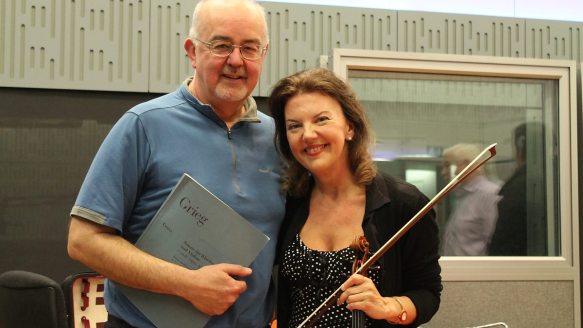
Tasmin with her accomplice in the Beethoven sonatas, pianist Martin Roscoe
“Of course when you play these works you need a really good pianist, and it wasn’t until we were at least in our teens that we could cover this music. I’ve been playing some of the sonatas for 30 years, others for 20-25 years, so I’ve known them for a long time. It is really important with works of this nature and complexity, and works that are well recorded to have mature thoughts on them.”
The Violin Concerto I have known since I was 21, and it has been in my repertoire for a long time. More recently I also learned the Triple Concerto, which I recorded with Howard Shelley and Tim Hugh, but it is the Violin Concerto that I completely adore. One of the earliest recordings I had was made by Zino Francescatti, that I have listened to and played into the ground.
Was it daunting recording the sonatas?
I always wanted to record this repertoire, as it is the big mountain of violin and piano repertoire. The violin sonatas by Mozart are a bit more juvenile, whereas with the Beethoven sonatas they are all of such quality you need comparable maturity and sophistication to play them. I took a deep breath before doing the sessions! We did the first five, working fast, in three days – and we felt we were on such a role, Martin and I. Then six months later we finished off the remaining five. It was good to do it like that, otherwise we would have suffered a hit in quality. There was a feeling of momentum.
To begin with in the sonatas they are spring-like, but then that all starts to change. The A minor work, Op.23, is quite a nervy piece but still can’t resist a few jokes. The C minor sonata, Op.30 no.2, is a steely work from start to finish, there is no let up in the drama or intensity. The Kreutzer Sonata is another dimension removed from that, it is an incredibly complex piece. He thinks of it as a concerto for both players, and that’s how it has to be represented. We each represent the orchestra if you like, there are times when he has the fire, and I am in battle against him and his orchestra.
With the ten works covering each period of Beethoven, do you feel like you’re really getting to know him as you progress through each work?
It’s actually misleading, because nine of the sonatas were written in a small space of time, within two years of each other. Then there is a long pause before the last work, Op.96. They are not so representative of the different periods in his output, and that’s why, unlike Mozart, you have this tremendous consistency, within that, he was such a master of so many different styles.
With the equal billing for piano and violin in the Beethoven sonatas, does it help that you have such a good understanding with Martin Roscoe?
Definitely. Beethoven actually puts the piano before the violin in his title pages, it says Sonata Für Pianoforte und Violine – so he considers them piano sonatas with the violin. Because of that I felt strongly that Martin should have lead billing on the cover for this release.
You have got to have someone who is capable of mastering the strength of these pieces, but also the subtlety of colours and the sophistication, mastering the great tunes. You need someone who knows how to play a great tune without being fussy. That’s one of the great strengths of Martin’s playing.
Do you think the sonata recordings are a nice balance to the English music that you’ve recorded?
Absolutely, it is very important to have a balance. I know I’m well known for promoting British music – and there is so much wonderful music that comparatively few people are promoting. I love the standard repertoire too though – Beethoven, Brahms and Tchaikovsky – and I enjoy playing them in concerts.
What is lovely about the relationship I have with Chandos is their support of those aspects of my recording, they don’t try to box me in. The recordings have been varied, with British repertoire but also with the works by Schubert, Richard Strauss and Respighi that I have recorded recently – that’s quite a range. It gives me a much more interesting balance.
You were taught by Yehudi Menuhin as part of your education. What would you say he left as a legacy for violinists?
I would say he left us so much. From a practical point of view he commissioned so many works, to think of just a few those by Bartók, Walton and Panufnik. He also was very much interested in bringing to people’s attention other composers such as Delius. He was very good at communicating, and he used his abilities to bring these to the public.
I also think he was one of the first genuine crossover artists, thinking of his work with Stéphane Grappelli, Ravi Shankar and world music. He made it acceptable to work in different genres, it was fine because he was doing it. He was a great teacher – he founded the school I went to – and he also used his position politically to bring people together. In addition to what he left as a violinist he was trying to use his position to unite conflict – and he did this in the House of Lords, through his work as a conservationist and humanitarian.
You’re also judging the Yehudi Menuhin competition. Given all that you’ve done for music education and youth, is it important for you to be putting something back into this level?
I was at a state primary school in the 1970s, and music had a high position in the curriculum. There was a full time violin teacher, and if there hadn’t have been I would not have started. Because there was, and because music was so high on the governmental agenda, all these things were possible.
That is why it is so important to keep lobbying to make sure that gifted people do not fall through the net. I have given two speeches to the House of Commons and the House of Lords about this, and have written letters about it to them as well.
On another tip entirely, do you suffer from aches and pains as a violinist?
The violin is such an unnatural playing position, horrendously so! You have the full weight on one shoulder, and because of that I do work hard keeping shipshape – I have massages and treatments. I have had a few problems so far but I think generally I have been lucky. You have to take care, as it’s a great physical input as well as emotional and intellectual.
Finally, what violin concertos would you suggest to someone who hasn’t heard any before?
There are two that spring to mind. The first is the Mendelssohn, which is a sparkly, light piece. The second is the BruchViolin Concerto no.1, the one that I get asked to play the most. It is dark, mysterious and very romantic!
For those who have already heard a few violin concertos I would suggest the one by Glazunov, which I absolutely love!






 Arcana.fm