
In concert – Quatuor Danel: Shostakovich & Weinberg #2 @ Wigmore Hall

Quatuor Danel [Marc Danel & Gilles Millet (violins), Vlad Bogdanas (viola), Yovan Markovitch (cello)]

Weinberg String Quartet no. 2 in G major Op. 3/145 (1939-40, rev. 1986)
Weinberg String Quartet no. 3 in D minor Op. 14 (1944, rev. 1987)
Shostakovich String Quartet no. 3 in F major Op. 73 (1946)

Wigmore Hall, London
Friday 12 January 2024

by Richard Whitehouse Photo (c) Marco Borggreve

Commenced anew last November, after having been abandoned in the wake of the pandemic, the Quatuor Danel’s cycle of string quartets by Shostakovich and Weinberg at Wigmore Hall continued this evening with formative works from the latter and a masterpiece by the former.

Hopefully it will not be long before Weinberg’s Second String Quartet (1940) has entered the repertoire. Written during his two years in Minsk (after having fled a Poland overrun by Nazi forces), its ‘back to basics’ outlook is evident in the initial Allegro’s textural clarity and easy lyricism, but also a compositional flair asserting itself in the movement’s tensile development and combative coda. Revision saw the Andante become a more complex and imposing entity, its fraught central section intensifying the sombre expression either side, along with an extra movement. This taciturn yet wistfully elegant Intermezzo makes for an admirable foil to the Finale, its rondo format energetically traversed through to a curtly decisive close. The Danel was palpably in command of music which transcends any apprenticeship quality with ease.

Shorter and more concentrated, Weinberg’s Third Quartet exudes an overarching emotional intensity. The Danel was mindful to observe those attacca markings such as give the overall design its unity within diversity – the uninhibited energy of the opening Presto by no means offset with the bittersweet poise of the central Andante, its taciturn unease being continued in a final Allegretto as affords only the most tenuous of closes and one which arguably feels too provisional, even in this insightful a reading. One reason, perhaps, the composer overhauled this piece when recasting it more than three decades later as his Second Chamber Symphony, when a completely new and more ‘conclusive’ finale was substituted for the original. Which is not to deny the fascination of this music from a crucial stage in his mastery of the medium.

A mastery as Shostakovich achieved with his own Third Quartet, its five movements drawing on those formal and expressive possibilities of his wartime Eighth and Ninth Symphonies, so the opening movement unfolds almost as a revisiting of that from the latter piece. The Danel undeniably had the measure of its playful capriciousness and brought out the ominous unease of the intermezzo, then headlong aggression of the scherzo which follow. Shostakovich’s first recourse to a passacaglia in his quartets, the slow movement exuded acute eloquence and this ensemble timed to perfection its cumulative approach to the finale’s searing apex. From here, the gradual dissipation of accumulated tension was palpably conveyed through to the numbed fatalism of a conclusion in which Shostakovich seems intent on bowing before the inevitable.

At this stage in the Danel’s traversal one might have expected either or both of Weinberg’s standalone Aria and Capriccio (written 1942-3) to have been given as encores. Instead, the players opted for repeating the finale from his Second Quartet, which at least provided the necessary uplift after the close of the Shostakovich. Hopefully those two pieces will be heard after the next instalment of this cycle, the Fourth Quartets of both composers being followed with the Fifth Quartet of Shostakovich: truly a ‘concert and a half’ as regards string quartets.

You can hear the music from the concert below, in recordings made by Quatuor Danel:

For more information on the next concert in the series, visit the Wigmore Hall website. You can click on the names for more on composer Mieczysław Weinberg and Quatuor Danel themselves.

Published post no.2,057 – Monday 12 January 2024
In concert – CBSO / Mirga Gražinytė-Tyla: From Mirga With Love

Marie-Christine Zupancic (flute), Oliver Janes (clarinet), Eugene Tzikindelean (violin), Adam Römer (viola), Onutė Gražinytė (piano), City of Birmingham Symphony Orchestra / Mirga Gražinytė-Tyla

Traditional (arr. Raminta Šerkšnytė) Anksti rytą kėliau
Čiurlionis (ed. Charalampos Efthymiou) Miške (1901) [UK premiere]
Weinberg Clarinet Concerto Op.104 (1970)
Loboda Requiem for Ukraine (2014)
Weinberg 12 Miniatures for Flute (1945, orch. 1983) [UK premiere]
Kakhidze Bruderschaft (1996) [UK premiere]

Symphony Hall, Birmingham
Wednesday 6 December 2023

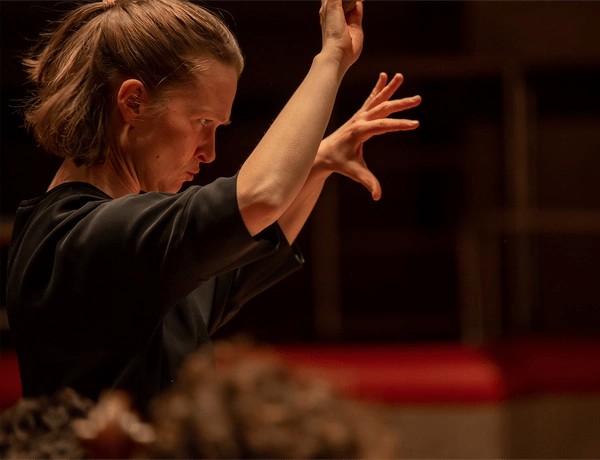
Reviewed by Richard Whitehouse. Picture of Mirga (c) Beki Smith

The sound of a Lithuanian folksong I got up early in the morning, plaintively sung by Mirga Gražinytė-Tyla and accompanied by her sister Onutė, introduced tonight’s concert where the conductor made a welcome reappearance with the City of Birmingham Symphony Orchestra.

MGT gave a memorable performance (not for all the right reasons) of Mikalojus Čiurlionis’s symphonic poem The Sea during her tenure as music director, and the CBSO sounded equally assured with his earlier such piece In the Forest that opened the programme. Here once again the composer’s over-ambition is evident from a rather episodic construction and the textural overload (odd in music this opulently scored to have had no timpani, as might have brought greater definition to emotional highpoints), though had Čiurlionis heard this in performance the outcome might have been otherwise. What remains is a sequence of enticing paragraphs, framed by ones whose formal and expressive aims seemed impressively as one in pointing towards just what might have been possible were it not for his demise at the age of only 35.

The music of Mieczysław Weinberg has been a preoccupation of MGT for over a decade, and it was good to hear this continue through two pieces in which CBSO principals played to their strengths. Oliver Janes sounded enthused by the Clarinet Concerto, its initial Allegro pivoting between incisiveness and inwardness typical of the composer’s maturity. The Andante brought a plangent interplay of soloist and strings, with the sardonic humour of the ensuing Allegretto building toward a cadenza whose entreaties were curtailed by the peremptory closing gestures.

Commissioned after Russia’s occupation of the Crimea, Igor Loboda’s Requiem for Ukraine has only become timelier this decade since – its heady series of variations within a chaconne-like form offering no mean technical challenges that Eugene Tzikindelean met with panache.

As did Marie-Christine Zupancic the more restrained subtleties of Weinberg’s 12 Miniatures for Flute. Composed with piano accompaniment and arranged for strings almost four decades later, these deft and often characterful vignettes follow a methodical tonal progression, while the opting to render them as three groups of four implied a latent fast-slow-fast format akin to that of a concerto. At no time was there any sense of Weinberg being less idiomatic or more impersonal in pieces which are as meticulously realized as any of his larger compositions.

After this, the paucity of content in Vakhtang Kakhidze’s Bruderschaft (Brotherhood) was only too evident. A ‘sinfonia concertante’ for viola, piano and strings, its easeful opening section had a certain charm of which Adam Römer’s playing was nothing if not persuasive, but the livelier music that followed was lounge-jazz at its most cliched and neither the violist’s input nor an almost choreographed response from Onutė Gražinytė raised it above the commonplace. Both these sections were elaborated to little intrinsic purpose, other than to prolong what was already a lengthy concert such that numerous attendees could be seen departing in those final minutes.

A pity in what was otherwise a rewarding programme as reaffirmed MGT’s continued rapport with her former orchestra. Hopefully there will be more such collaborations in future seasons.

You can read all about the 2023/24 season and book tickets at the CBSO website. Click on the artist names for more information on Mirga Gražinytė-Tyla, Marie-Christine Zupancic, Oliver Janes, Eugene Tzikindelean, Adam Römer and finally Onutė Gražinytė

Published post no.2,033 – Friday 8 December 2023

In concert – Quatuor Danel: Shostakovich & Weinberg @ Wigmore Hall

Quatuor Danel [Marc Danel & Gilles Millet (violins), Vlad Bogdanas (viola), Yovan Markovitch (cello)]

Shostakovich String Quartet no.1 in C major Op.49 (1938)
Weinberg String Quartet no.1 in C major Op.2/141 (1937, rev. 1985)
Shostakovich String Quartet no.2 in A major Op.68 (1944)

Wigmore Hall, London
Monday 13 November 2023

Reviewed by Richard Whitehouse. Photo (c) Marco Broggreve

No-one could accuse the Quatuor Danel of bowing to circumstance. Having had to abandon its cycle of the combined Shostakovich and Weinberg string quartets some three-and-a-half years ago owing to the COVID pandemic, the ensemble has commendably started again and from scratch. Tonight accordingly saw the first instalment in this survey of 32 quartets, with an evening such as traced the beginnings of what promises to be an enterprising and, above all, rewarding series of recitals from musicians with a palpable empathy for both composers.

A more unassuming start could scarcely be imagined than with Shostakovich‘s First Quartet. Not only did the composer leave it relatively late until tackling this genre, but the result is as understated a debut as could be imagined. Perhaps in its trying to up the emotional ‘ante’, the Danel sacrificed some of the opening movement’s wistful elegance, but the ensuing variations on a Mussorgskian melody were ideally poised, with the quicksilver scherzo and rumbustious finale reinforcing the infectious charm as well as technical mastery of this ingratiating debut.

The most obvious criticism of Weinberg’s First Quartet is that it bears little resemblance with what was to follow. Yet given its indebtedness to Bartók and Szymanowski, the initial Allegro pursues its doggedly eventful course through some torturous chromatic harmonies and dense textures, while the central Andante evokes a tense and even ominous atmosphere enhanced by its being muted throughout. Only with the final Allegro does the future composer come to the fore, its driving rhythms and folk inflections as Weinbergian as is the teasing evanescence of those closing bars. Now that Daniel Elphick’s reconstruction of the original version has been performed publicly, the revision is more clearly one of ‘less is more’ afforded by hindsight – which does not make this teenage effort, or the Danel’s rendering of it, any less impressive.

As the last in a sequence of large-scale chamber works, Shostakovich’s Second Quartet has tended to be overshadowed by his Piano Quintet and Second Piano Trio, but that it does not want for stature was underlined by the Danel’s reading. The fervent while formally lop-sided Overture responded audibly to this trenchant and forthright approach, its modally inflected plangency carried through to the Recitative and Romance in which Marc Danel‘s impulsive take on those florid first violin solos was ably complemented by the fraught interplay toward its climax. Nor was there any lack of purpose in the Waltz and its ominous revisiting of the composer’s past, before the closing Theme with Variations evinced inexorable momentum on route to an implacable restatement of that theme for a warning pure though hardly simple.

Given such music and music-making it might have been churlish to expect an encore, yet the Danel duly provided an additional few minutes in the guise of an Improvisation and Rondo Weinberg wrote around 1950 but which was only premiered 69 years later. More is the pity, as the former proved as affecting as the latter was appealing in melodic directness. January 12th sees the second instalment, with Shostakovich’s Third preceded by Weinberg’s Second and Third Quartets, of a series which one fervently hopes will now run its intended course.

You can read all about the next concert in the series at the Wigmore Hall website – and click on the name to read more about Quatuor Danel.

Published post no.2,011 – Thursday 16 November 2023

In Concert – Silesian Quartet & Wojciech Świtała: Bacewicz, Weinberg & Zarębski

Wojciech Świtała (piano, below), Silesian Quartet [Szymon Krzeszowiec and Arkadiusz Kubica (violins), Łukasz Syrnicki (viola), Piotr Janosik (cello)]

Bacewicz String Quartet No. 4 (1951)
Weinberg String Quartet No. 3 in D minor, Op. 14 (1944)
Zarębski Piano Quintet in G minor, Op. 34 (1885)

Wigmore Hall, London
Monday 17 October 2022

Reviewed by Richard Whitehouse

In existence now for 44 years and with only a change of leader during that time, the Silesian Quartet has amassed a broad repertoire taking in the extent of the Austro-German tradition along with that of its Polish heritage – as was evident from this latest Wigmore Hall recital.

The rapid upsurge of interest in women composers has been of real benefit to those such as Grażyna Bacewicz, whose sizable output of essentially abstract music went too long under the radar and not least a minor masterpiece as her Fourth Quartet – its first prize at the Liège Competition in 1951 vindicated. Its three movements are dominated by the first of these – a sombre Adagio introduction as variously infiltrates the lively ensuing Allegro, such that the coda essentially becomes a stretto between such contrasted expression. The central Andante finds this composer at her most lyrical, with the ‘giocoso’ marking of the final Allegro not necessarily implying any lessening of formal and emotional focus, as this builds toward an impetuous conclusion that clinches the unorthodox if methodical design of the whole work.

The Silesian gave a superb account of a piece it knows well – having recorded all Bacewicz’s quartets – as it did of Mieczysław Weinberg’s Third Quartet. On a similar scale, this also has a similarly overarching intensity – not least when attacca markings between movements were scrupulously observed as to give the overall design its unity within diversity. The unchecked energy of the initial Presto is by no means offset by the bittersweet poise of the Andante – its taciturn unease continued in an Allegretto affording only the most tenuous, even provisional closure. One reason, surely, why the composer restructured this piece when recasting it more than three decades later as his Second Chamber Symphony, which is hardly to deny the sheer fascination of the music at a crucial stage on the way to Weinberg’s mastery of this medium.

Had he died before writing his last work, Juliusz Zarębski would barely have been a footnote in musical history. His Piano Quintet confirms an acute feeling for Lisztian harmony, allied to a commanding formal sense as should have been the springboard into an eventful maturity and is not so far behind those by Brahms, Dvořák and Franck in being a major contribution to its medium. The Silesian had the measure of the first movement’s quirky take on sonata form – its vividly contrasted ideas merged in a tensile development then varied reprise and dynamic coda. The Adagio frames its lilting central section with a melody of rapt fervency, as is itself framed by music of ‘Forest murmurs’ aura, while the Scherzo likewise frames its wistful trio with music of an intently rhythmic propulsion. The final Presto is essentially a cyclical reprise of earlier ideas as this picks up where its predecessor left off, before pursuing a sonata-rondo trajectory such as culminates in a fervent recollection of the work’s opening theme. That this piece remains the summa of Zarębski’s creativity does not lessen the extent of its attainment.

The Silesian and Wojciech Świtała had prepared no encore, instead reprising the final pages of the Zarębski to close this programme in fine style. It is part-way through a recorded cycle of Weinberg’s quartets, another of which will hopefully feature in a future Wigmore recital.

For more information on the performers, click on the names to visit the websites of the Silesian Quartet and Wojciech Świtała – and for more on the composers, click on the names of Juliusz Zarębski, Mieczysław Weinberg and Grażyna Bacewicz

In concert – Sheku Kanneh-Mason, Marie-Christine Zupancic, CBSO / Mirga Gražinytė-Tyla: Vaughan Williams, Haydn, Elgar, Weinberg & Britten

Vaughan Williams Fantasia on a Theme of Thomas Tallis (1910)
Haydn Cello Concerto no.1 in C major Hob.VIIb/1 (c1761)
Elgar Sospiri Op.70 (1914)
Weinberg Flute Concerto no.1 Op.75 (1961)
Britten The Young Person’s Guide to the Orchestra Op.34 (1945)

Sheku Kanneh-Mason (cello), Marie-Christine Zupancic (flute), City of Birmingham Symphony Orchestra / Mirga Gražinytė-Tyla

Symphony Hall, Birmingham
Wednesday 6 October 2022

Reviewed by Richard Whitehouse

Shortly to embark on its first tour of the United States in almost a quarter-century, the City of Birmingham Symphony Orchestra tonight played some of the pieces to be included there – a diverse selection that amounted to a cohesive and well-balanced programme on its own terms.

Opening the concert was one of those pieces heard on the CBSO’s album The British Project, and while this orchestra has performed Vaughan Williams’s Fantasia on a Theme of Thomas Tallis often, Mirga Gražinyte-Tyla relatively swift traversal compelled attention. The opening stages felt a little detached – the offstage ‘orchestra’, placed offstage-left, more a background presence than active participant – but the string quartet contribution was eloquently rendered while the approach to the main climax was as unerringly judged as that resonant final chord.

Sheku Kanneh-Mason has been playing Haydn’s cello concertos extensively, so there was no doubting the control and insight brought to the C major work – earliest of the pair and poised between the Baroque and Classical eras in its combining formal lucidity with melodic poise. Kanneh-Mason was mindful of the opening movement’s Moderato indication, maintaining a steady and never headlong tempo that allowed his tonal finesse and elegance of phrasing full rein. The Adagio could have had greater inward intensity, but not that stealthy transition into the return of the main theme, and the final Allegro had wit and incisiveness aplenty. A much-reduced CBSO was responsive in support – Kanneh-Mason offering an unlikely yet appealing pizzicato take on Bacharach’s I Say a Little Prayer (found on his new album Song) as encore.

There cannot have been many times when Elgar’s Sospiri began the second half, but it did so this evening to enticing effect. MG-T drew out its pathos without no trace of affectation, and if the organ part was missing, the strings’ burnished eloquence was more than compensation.

After last week’s public premiere of his Jewish Rhapsody, MG-T turned to (relatively) more familiar Weinberg with his First Flute Concerto. It also proved an ideal showcase for Marie-Christine Zupancic, longstanding section-leader of the CBSO, to demonstrate her prowess as soloist – whether in the energetic interplay of the initial Allegro, deftly understated threnody of the Adagio, or whimsical humour of an Allegro that anticipates Weinberg finales to come. The strings responded with alacrity to a piece now taking its place in a still-limited repertoire.

Britten‘s The Young Person’s Guide to the Orchestra has not been out of the repertoire in 77 years and it remains not just the finest educational work of its kind but an impressive showpiece in its own right. With the CBSO heard at full strength for the only time tonight, MG-T directed a performance which only fell short in the rather stolid rendering of the theme at the start. The traversal through the four orchestral sections threw up various distinctive cameos, while the closing fugue duly put the orchestra back together for what was an exhilarating apotheosis.

This was not quite the end, MG-T introducing the encore to feature on tour – Thomas Adès’s O Albion (from his quartet Arcadiana), here suitably evocative even if the irony of playing so -named a piece to a Birmingham audience can hardly have been lost on most of those present.

You can read all about the 2022/23 season and book tickets at the CBSO website. For more information on the artists, click on the names of Mirga Gražinyte-Tyla, Sheku Kanneh-Mason, Marie-Christine Zupancic for more information, and head to the website of Mieczyslaw Weinberg for more information on the composer.