
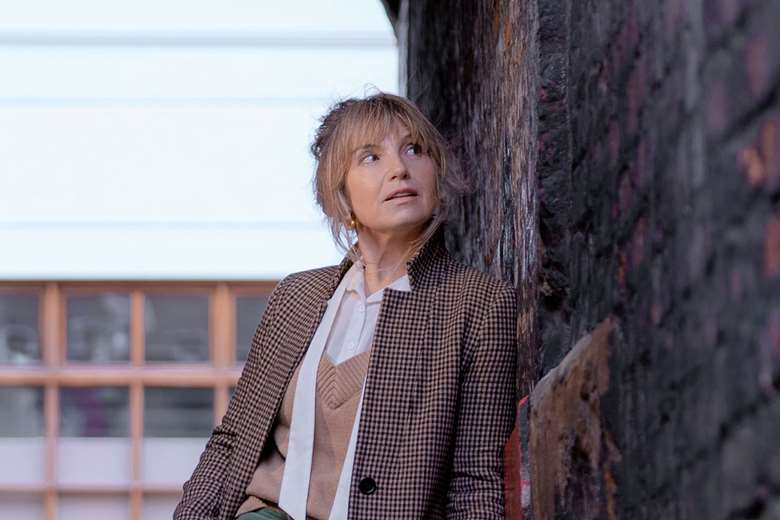
Talking Heads: Claire Booth

The leading British soprano talks to Ben Hogwood about her duo of new albums celebrating the music of Schoenberg, as well as a fascinating career that touches on Mussorgsky and her meaningful friendship with Oliver Knussen. Photos (c) Sven Arnstein (above), Mark Allan (Oliver Knussen)

It is no understatement to state that Claire Booth is a national singing treasure. She would be too gracious to admit this, but the British soprano has played a leading role in classical music on these shores, particularly in league with composer and conductor Oliver Knussen as a leading exponent of new compositions.

Yet Booth’s pioneering spirit extends to music of the classical canon, and after Knussen’s sad death in 2018 her work has continued apace. In 2024 she has included a special emphasis on the music of Arnold Schoenberg, 150 years on from the composer’s birth. His music remains a challenge today – but as Booth revealed in an enjoyably candid chat, it is a challenge well worth accepting for the performer and ultimately the listener.

Before we discuss Booth’s new Pierrot Portraits album on Onyx Classics, where she is joined by Ensemble 360 to put Schoenberg’s melodrama Pierrot Lunaire in the context of composers inspired by the Pierrot, I ask her if she can remember her first encounter with Schoenberg’s music. It turns out to be a milestone she will never forget. “The first time I did Pierrot Lunaire, which was the first piece of Schoenberg that I did, was with Pierre Boulez at the Lucerne Festival. I was a young artist on the inaugural Festival Academy. The first year that they did that was just the Ensemble Intercontemporain and Pierre Boulez. Every instrumentalist had one student, so there was basically a student ensemble, the Ensemble Intercontemporain, Pierre Boulez and Hilary Summers, who was effectively the singing consultant. I was the student singer, so Pierre Boulez basically taught me Pierrot Lunaire! I sort of went, bowed at his feet and said, “Sprechtgesang – how do you do it?”, thinking this is the master of 20th century composition, I’ll get this incredible insight – and he must have been about 70, I suppose, and he just looked at me and said, “You sing a bit, you speak a bit. That’s it.” And actually, he’s so right – because you just learn it like any other piece of music, and you do sing a bit and speak a bit! How you do that is up to you. Like a lot of very, very good musicians, they’re very keen to leave it up to the performer. He wasn’t a micromanager,  and when you’re working with really good people they assume you’re as good as them – I mean, the nice ones do. So he just let me get on with it, and those were the parameters.”

Does the straightforward approach remove a temptation to micromanage Pierrot Lunaire itself? “That’s interesting, because you definitely need to put a lot of time in, and by that, you might think, “Gosh, I’m micromanaging this”. But I can think of any Mozart aria that actually, if you pull it apart, you are micromanaging how you are working. There is a certain sense of micromanagement, but there’s quite a negative connotation with that phrase. With Schoenberg’s music people often get stuck in the realm of thinking very carefully and complexly, but ultimately we do that with all repertoire. After that, we free ourselves up and employ our musicality and our professionalism. Once you get to that stage with Pierrot, then it does feel very innate and characterful, you just have to have done the groundwork.”

Booth has worked with one of Pierrot’s legendary interpreters. “I remember Jane Manning told me, in the way that only Jane could, that she had given the most accurate rendition of the piece ever. She’s absolutely right that there is no excuse not to be accurate pitch-wise, but if you listen to someone like Erwin Schrott do Don Giovanni, when he’s singing the recitatives, he’s not caring about the individual notes – but there’s no way he doesn’t know the notes. He’s inhabiting it completely, and it’s such a wonderful way of listening to the freedom of it. You don’t want to get bogged down in the micromanagement of accuracy. You have to be accurate, but then you get to the next level.”

Schoenberg’s detail of colour in the score reaches descriptive heights with the voice and ensemble, colours that present themselves afresh with each listen. “Absolutely. Obviously there were other vocal pieces before Pierrot Lunaire that employed instruments, but I think Schoenberg really did break up the rule book in how he uses the instrumentalists and voice as one. You’ve got five instrumentalists playing eight instruments, and the singer playing three characters and the narrator in a myriad of different emotional states. The palette is so deft that if the performer understands the text in us, it’s a complete gift. The orchestration is so brilliantly witty, clever, charming and poignant – you know, there are echoes of Bach, Mozart, and elegiac and even aggressive qualities to it. Like all the best music there are no extraneous notes, and his decision to play the note in a certain way is just consummate to me. When people come to this new as an audience member, you might be thinking, “What have I let myself in for?” Within five minutes, though, you are in this sound world, and audiences delight in the sheer virtuosity of the world. As a performer you just have to dive right in, and if you really believe in what is written, it’s just mind blowing!”

Booth has also been recording Schoenberg’s early songs with pianist Christopher Glynn, in a compelling Expressionist Music album released earlier this year on Orchid Classics. It reveals the remarkable breadth to their compositional style. “When you listen to pop music you have the Coldplay sound, the U2 sound, and it’s their thing. But one of the reviews of the Expressionist Music disc said it sounds a bit like Mahler or Brahms. Well, what’s wrong with that? These were people in the musical, historical pedigree that he loved and revered. Why wouldn’t his sound world sound like that? I think one reviewer was almost disappointed that it didn’t all sound like Schoenberg. And you’re like, “What is Schoenberg? Is it a kind of construct that we’ve decided is difficult, atonal?” I think an audience’s appreciation of tonality and atonality now is different than it would have been 40 years ago. We’ve all listened to a lot more music, we don’t hear the jarring qualities that atonality maybe heralded within us. My granny might still think it sounds a little bit risque, but, I think we’re much more open to his world anyway.”

She adds some context. “It’s so important, I think, for everyone to recognize that Schoenberg was a product of his time. He didn’t just parachute in with a pistol aiming to blow a hole in everything. He was absolutely continuing as he felt the tradition, but in the way that the expressionist movement, was going he was continuing a movement by forward motion, taking things on a step. You’ve got folk songs, cabaret songs, love songs – he clearly was a man fascinated by a lot of different aspects of life, you know? He had enormous depth and breadth, and that comes across in his vocal music, in terms of his poetry choices. It also comes through in knowing the man – he was friends with Kandinsky and a tennis partner with Gershwin. The guy was a hoot!”

Booth has been working with the Arnold Schoenberg Center in Vienna – a fascinating resource and museum dedicated to the composer, where it is possible to witness a full scale mock-up of Schonberg’s Hollywood apartment. “I’ve been in touch with them over the last year”, she says, “and we’re going to sing there in December and stay in the apartment. We’re really delighted to have that sort of immersion. Even when you go on the website, with the amount of archival material, you can really geek out on it! I think it’s a shame that he’s been so synonymous with all that is difficult and complex about music when there are composers that have come since Schoenberg that have been far more impenetrable. He’s maintained this aura of unapproachability, which you see in the reticence of festivals and promoters to put on his music, even in this 150th anniversary year, which I just don’t think is justified. So it’s wonderful to get opportunities to be reminded of kind of the breadth of his interests, and how he was a complete part of the kind of wider artistic movement in the 20th century. He’s such a towering figure!”

Booth has explored a vast amount of new music in her performing career to date. Is there the same thrill of discovering new music as there was with Schoenberg? A prime example is Helen Grime’s Folk, a setting of verse by Zoe Gilbert for soprano and orchestra which she is preparing for performance as we talk. “I think that’s what’s so great about music. I am so on the back foot – in my first lesson at college, I heard this piece of music, and I lent to the next person and said, “This is the theme music to Trading Places!” And she said, “No, it’s the Overture to The Marriage of Figaro!” I know so little about music that I am still discovering so much now – the joy of discovering new music that’s in the canon, together with new music that’s being written now.” If what your question is leading to is the same kind of craft in new music as in Schoenberg then Helen (above) is a wonderful affirmation of that.

You can listen to Helen Grime’s Folk, performed by Booth with the BBC Scottish Symphony Orchestra under Ryan Wigglesworth, on BBC Sounds

Booth elaborates on Grime’s qualities. She’s such a craftswoman, and such a great orchestrator. Not for nothing was Oliver Knussen such a big champion of her in her early days, and that’s one of the reasons we got to know each other. It feels special to be kind of continuing Ollie’s work with the composers he loved and rated, because he was such a meaningful figure to me. I wouldn’t want to speak too broadly about compositional trends in general. I think I’m very fortunate that I get to sing an awful lot of music by people that I particularly love. It’s easier to believe in music that you have an immediate connection to, and I’m lucky to have that. As a singer I’ve still got so much to learn, repertoire wise, and I’m still so curious in that.”

She cites her exploration of the songs of Mussorgsky, in league with her regular pianist Christopher Glynn. “I’d heard a couple of songs, but what an absolute deep dive. You wouldn’t think of him as a song composer! We know Songs And Dances of Death, but, that’s a group of five – and he wrote 60-70 songs! There are some absolute beauties in there, and no extraneous notes. His brilliant use of pace and orchestration – with only the piano – and the wonderful opportunities for female protagonists in his songs, which doesn’t come through so clearly in his operas. As a curious artist, that’s just brilliant. Five years ago I didn’t know any of that, and now I’m a bit of a guru. I think my love of music has maintained my curiosity for the repertoire that’s already out there, and hopefully that’s a way of marrying the two.”

Booth is struck by Mussorgsky’s originality. “When you listen to this writing, you think it’s Mahler or Wolf, and this guy was writing these songs in the 1840s-1850s. He really was ahead of his time. Ollie always did the Stokowski orchestration of Pictures at an Exhibition, with lots of bells! I think purists would say it’s less sophisticated than the Ravel, but there’s an earthiness and a gravitas to it, a sort of ridiculous element which he doesn’t shy away from. The piece is such a smorgasbord, and that’s the word I’ve tried to use with a lot of these retrospectives, and with Schoenberg too. It’s wonderful to be able to advocate for a composer’s breadth, because I think people have one or two pieces by somebody that they like, and that’s great, but that can lead to other things.”

With that in mind, the Pierrot Lunaire album places Schoenberg’s work in the context of a number of different and fascinating responses to the central character. “When you look at versions of Pierrot Lunaire, it’s always intriguing as to what people put it with. Usually it’s with another Second Viennese School composer, and I definitely didn’t want that. It did seem the figure of Pierrot himself is such a magnet for creatives. Schoenberg wasn’t even the only one to set the Hartleben translation.”

Joseph Marx went in a completely different musical direction to Schoenberg. Kowalski, another Jewish composer of the early 20th century, was actually a lawyer who advocated for Schoenberg when he was having a problem with one of his publishers. He’s done 12 settings of those heart labor poems, but they’re not the same as the ones Schoenberg did. So even with Pierrot Lunaire, we think of it as this seminal work, and it’s wonderful to see how other people have set it. It’s nice to give people a taste of what other composers thought – and even with the Korngold aria, it is this beautifully elegiac piece and so haunting. It’s the ability of the Pierrot character to be so permeable. It’s called Portraits for a reason I suppose, we wanted to present as many different angles as possible.”

We move on to the demands Schoenberg makes on the voice itself. With such a wide range of dynamics and pitches, does the voice need special preparation? “I’ve always done quite a lot of different repertoire concurrently, and I do remember a performance of Pierrot Lunaire where I performed some Handel arias two days later, and I definitely suffered. I remember thinking I would have to schedule these things a bit better. As I’ve gone on in my career, without blowing my own trumpet, I find increasingly that it doesn’t seem to cost any more than singing anything else. I mean, I did some Mozart concert arias in Prague recently, 20 minutes of singing, and I was bloody knackered! If you can get past the complexity of the score and be quite a seasoned interpreter, there is a freedom that comes with knowing something incredibly well, which then allows you to give just the right amount. I’m doing various ‘Pierrots’ this season, and some of them will be next door to singing Debussy, Marx, these other vocal styles – and obviously you need to be ready for both, otherwise you’re short changing the audience.”

Talk turns again to the much-loved Oliver Knussen. What sort of legacy has he left with Claire, and more widely, with British music? “Happily, I’m part of a large family of people who spent time with Ollie and who he was a massive influence on. When I think about Ollie, and his music making, I think of incredible standards and incredible kindness – which extended to nurturing, sponsorship and facilitating of others’ work. He always put his own compositions second, and he really wanted to facilitate others music. He got to know Harrison Birtwistle, reasonably late in his life, but part of that was because I think he felt really second best to Harry, and he was a bit embarrassed. I heard him say he felt his music wasn’t well crafted enough.”

Humility was one of Knussen’s standout qualities. “He was incredibly modest. I was the recipient of so much of his listening, and I suppose the legacy is that I would like to achieve those same exacting standards in my work, the absolute knowledge about and love of the music, and musicality of a properly high standard. As a professional creative, it matters to me, and it mattered to him hugely. The commission with Helen Grime and also Zoe Martlew, this year, who was also an incredibly close friend of Ollie’s, means a lot. When I am involved I do try to remember kind of that Ollie was so generous in his time to advocate for others work. I like to think that he’d be pretty chuffed that I was working with Helen and Zoe in this way. I think he’ll be having a chuckle when Helen’s piece comes to life!”

She goes into more detail. “Ollie worked with quite a small number of musicians over and over, and the rehearsal process was very positive and open and facilitory. I’ve worked with plenty of eminent musicians where the room is not necessarily positive and quite dictatorial and exacting, and now my job is to deliver when somebody wants to be exacting. I really appreciated Ollie’s understanding that if you have booked the right people, they’re going to be good. Treating people with respect and confidence begets that, and having a positive vibe in the room might sound like an obvious thing, but it’s amazing how often that doesn’t happen. In today’s world there’s a lot of talk about this stuff, but I wouldn’t say that people have nailed how to do it. With Ollie, with his potentially intimidating presence, both physically and musically, he was always incredibly respectful and facilitating off of the artists that he worked with. So I hope that if I could generate half of the vibe that he did, I think I’m going the right direction.”

You can explore purchase options by clicking on the links for Pierrot Portraits and Expressionist Music. Claire will perform Pierrot Lunaire twice in November – click for ticket options for Pierrot in the Moonlight on Saturday 2 November at the Classhouse International Centre for Music, and on Thursday 21 November at the Royal Welsh College of Music and Drama, and also for her multi-composer Wigmore Hall recital with pianist Jâms Coleman on Friday 29 November.

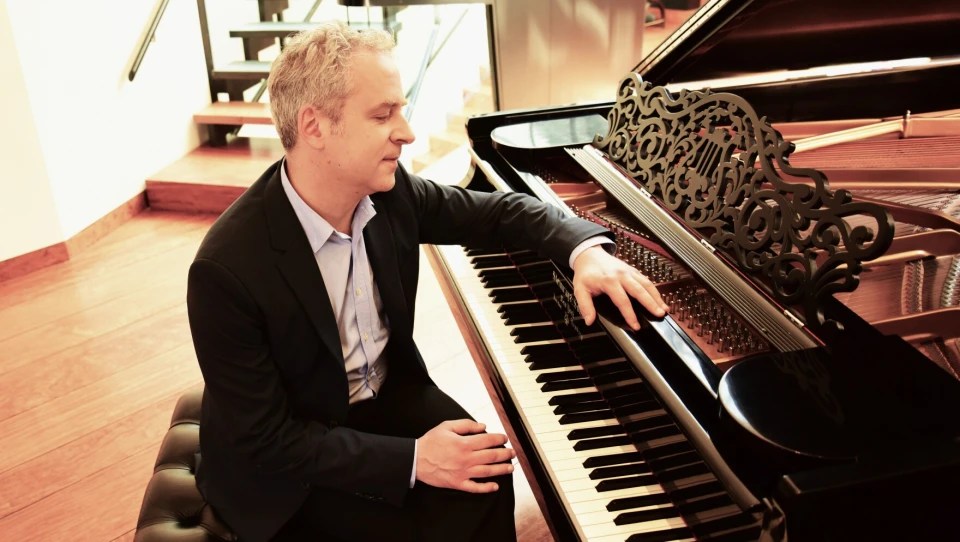
In concert – Paul Lewis, CBSO / Kazuki Yamada: Ravel, Mozart, Holmès & Mussorgsky / Wood

Paul Lewis (piano, above), City of Birmingham Symphony Orchestra / Kazuki Yamada

Ravel Ma mère l’Oye – suite (1910-11)
Mozart Piano Concerto No. 27 in B flat, K595 (1790-91)
Holmès La Nuit et de l’Amour (1888)
Mussorgsky arr. Wood Pictures at an Exhibition (1874, orch. 1915)

Symphony Hall, Birmingham
Wednesday 21 August 2024

Reviewed by Richard Whitehouse

Although the CBSO has not put on its own Proms season for many years, a concert featuring the programme for its annual Proms appearance has been a regular fixture and this evening’s event proved to be much more than merely a ‘dry run’ for tomorrow’s Royal Albert Hall date.

Despite the timing, this was indeed the suite as orchestrated by Ravel from his Mother Goose piano duets before being expanded into a ballet. It took a while to get going – Pavane of the Sleeping Beauty feeling impassive and Little Tom Thumb enervated, yet Laideronette had the requisite playfulness. Conversations of Beauty and the Beast was ideally poised between whimsy and pathos, before The Enchanted Garden concluded this sequence with an inward rapture made more so thanks to its exquisite contribution from leader EugeneTzikindelean.

Paul Lewis must have played Mozart’s 27th Piano Concerto on innumerable occasions (and several times with the CBSO) but his perspective constantly varies. The opening movement had a spaciousness resulting in an unusually moderate Allegro, albeit never at the expense of a subtly incremental intensity unerringly sustained through to a cadenza of limpid eloquence. Even finer was the Larghetto – dependent, as with much of Mozart’s late music, on what the performer brings to it; here yielding a serenity informed by not a little fatalism. After which the finale provided an ideal complement in its buoyancy and unforced humour, leading into a cadenza (how fortunate Mozart’s own have survived) of pensive understatement, then a coda launched with a guileless interplay of soloist and string that set the seal on this performance.

Opening the second half was Augusta Holmès’s La Nuit et l’Amour – actually, an interlude from Ludus pro Patria, her ‘Ode-Symphonie’ which, even if it might not sustain the present piece’s enfolding passion, should certainly be worth at least a one-off hearing in its entirety.

In Henry Wood’s orchestration, Mussorgsky’s Pictures at an Exhibition proved a highlight of last season. Wood retains only the first appearance of the Promenade but is not unfaithful to the original’s essence. Hence the shock-horror of Gnomus, sombre aura of The Old Castle with its baleful euphonium, playful insistence of The Tuileries or fatalistic tread of Bydlo with its evocative percussion. The whimsical Ballet of the Unhatched Chicks contrasts with the grim realism of Samuel Goldberg and Schmuÿle or the frantic bustle of The Market at Limoges.

Respighi surely took note of this glowering Catacombs with its plangent recollection of the promenade refrain hardly less effective than in Ravel, and while Baba Yaga is unnecessarily curtailed here, its sudden dispersal more than prepares for the crescendo of offstage bells that launches The Great Gate[s] of Kiev. This set the tone for a realization which, if its opulence borders on overkill, could not prevent the CBSO from projecting Wood’s cinematic sonics to the maximum. Those present once again erupted during that echoing resonance at its close.

Quite a way, then, to end an impressive performance and memorable concert. Kazuki Yamada and the orchestra will be doing it all over again tomorrow evening at their Prom, at which this orchestration of the Mussorgsky will be heard in the environs as envisaged by its orchestrator.

The playlist below collects the music from this concert, including the only available recording of the arrangement of Pictures At An Exhibition by Sir Henry Wood:

For details on the 2024-25 season A Season of Joy, head to the City of Birmingham Symphony Orchestra website. Click on the names to read more about pianist Paul Lewis and chief conductor Kazuki Yamada

Published post no.2,279 – Friday 23 August 2024

In concert – Jeremy Denk, CBSO / Kazuki Yamada: Gershwin, Clyne, Ravel & Mussorgsky / Wood

Jeremy Denk (piano, above), City of Birmingham Symphony Orchestra / Kazuki Yamada

Gershwin An American in Paris (1928)
Clyne ATLAS (2023) [CBSO Co-Commission: UK Premiere]
Ravel Pavane pour une infante défunte (1899, orch. 1910)
Mussorgsky orch. Wood Pictures at an Exhibition (1874, orch. 1915)

Symphony Hall, Birmingham
Wednesday 1 May 2024

Reviewed by Richard Whitehouse

This evening’s concert by the City of Birmingham Symphony Orchestra may have taken its overall title from the final work, but ‘pictures’ were everywhere in evidence and not merely those ‘at an exhibition’ – not least with Kazuki Yamada as enthusiastic as ever at the helm.

While it loses out to his Rhapsody in Blue in the popularity stakes, Gershwin’s An American in Paris is surely the most successful of his orchestral pieces for matching its immediacy of imagery to a resourceful structure. Encouraging the CBSO to a bracing response in the outer sections, and with Jason Lewis’s nostalgic trumpet initiating that pathos-laden central phase, Yamada secured a response whose full-on expression was offset by too sectional an approach – the music proceeding in a stop-start fashion rather than unfolding organically as it should.

Over recent years, the New York-based Anna Clyne has emerged among the leading British composers of her generation, with this first UK hearing for her piano concerto ATLAS keenly anticipated. Inspired by the eponymous and epic collection of the artist Gerhard Richter, this likewise falls into four ‘volumes’ rather than movements, which also underlines their relative formal freedom. Certainly, the ingenious interplay between soloist and orchestra is a tough challenge which Jeremy Denk met head-on – whether in the coursing energy then yielding eloquence of the opening Fierce, alluring textural overlaps of Freely, intimate, the lilting nonchalance of Driving or cumulative activity of the final Transparent with its surge to an emphatic close that (as with this work overall) was capricious and allusive in equal measure.

Doubtless motivated by Denk’s coruscating virtuosity, the CBSO gave its collective all in a work which (rightly) appealed to those present – the pianist responding with his deft take on the Heliotrope Rag co-written by Scott Joplin and the tragically short-lived Louis Chauvin.

After the interval, a rare moment of calm – Ravel’s Pavane for a Dead Princess given with a studied if never stolid grace, Elspeth Dutch’s horn and Katherine Thomas’ harp enhancing its appeal. As with Fauré’s Pavane, this is ideal music for opening the second half of a concert.

And so, to Mussorgsky’s Pictures at an Exhibition – heard here in the orchestration by Henry Wood which preceded and was duly superseded by Ravel’s. Wood is more interventionist, not least by reducing the recurrent ‘Promenade’ to a stealthy introduction, but not necessarily less faithful to the piano work’s spirit – hence the scabrous immediacy of Gnomus, sombre aura of The Old Castle (Andrew McDade’s tuba balefully intoning on high above stage-right), or fatalistic tread of Bydlo with its evocative percussion. Respighi was probably taken by this glowering depiction of Catacombs with a ghostly recollection of the promenade hardly less effective, and if Baba Yaga gets summarily curtailed here, the crescendo of bells launching The Great Gate[s] of Kiev set the tone for a treatment whose opulence borders on overkill.

Not that this inhibited the CBSO from projecting Wood’s organ-clad texture to the maximum, to the enthusiasm of an audience that erupted in the lingering resonances at its close. Quite a way to end an impressive performance, and a memorable concert, on a day that saw Yamada become this orchestra’s Music Director and the CBSO launch ‘A Season of Joy’ for 2024/25.

Click on the link to read more on the current CBSO concert season, and also to read about the recently announced 2024/25 programme. Click on the names for more on pianist Jeremy Denk, conductor Kazuki Yamada, and composer Anna Clyne

Published post no.2,168 – Saturday 4 May 2024

Talking Heads: Damian Iorio

Interviewed by Ben Hogwood

With the divisiveness surrounding these shores on account of Brexit, here is a tale of cross-European collaboration and unity. London-born and Italian based, conductor Damian Iorio has close links with Russia, France – and Milton Keynes. Arcana hooked up with him for a chat about conducting Russia’s flagship opera, bringing classical music to the UK commuter belt and promoting ‘home’ composers via the Naxos label.

We begin by talking about the flagship opera – Musorgsky’s epic, Boris Godunov, which Iorio has conducted at the Opéra Bastille in Paris this summer. He is wholly enthusiastic about the experience. “It has been very good, and what helps is that the production itself was great, and of course the music is marvellous. The cast have been phenomenal too. This is the first time I’ve conducted Boris, and we have done the first version – which isn’t done very often. It is not so well known, and there has been a lot of hard work to get it free and put it on.”

The opera had a complicated genesis, which he takes up. “The potted history is that the first version wasn’t passed by the imperial theatre committee, because they wanted more female roles. There were large-scale scenes, and it was never staged. Then for the second version he added the last act, and it was staged but not ultimately very much. Musorgsky was not a professional composer and his technical abilities were not so great, so Rimsky-Korsakov completed an orchestration, and this was taken as a new edition. We had to tweak it a bit, restoring some of the chamber-like qualities of the first version, especially because in Bastille we had a 15-year-old singing the address, so we had to be very careful balancing that out.”

Iorio has conducted opera in Paris before. “Ten years ago I was there to conduct Smetana’s The Bartered Bride”, he recalls. “From that I learned they have their own characteristics, and I remember the entrance to the pit and feeling the history behind me. There’s a little door near the pit that goes to a lake, a man-made reservoir. I thought I could disappear forever with all the ghosts of the past! It is a very large pit, and when I conduct there I feel a great sense of occasion. It is a real honour and privilege to have been there.”

Boris has more Parisian connections – and has also reaffirmed Iorio’s love for Russia. “It is a very important musical statement that has influenced both Debussy and Ravel”, he asserts. “The Pushkin libretto is based on fact, and so it is a very important historical statement. We worked with some great Russian singers for this production, and they treated me as Russian. I love the country deeply – my wife is Russian, I speak Russian, and it is an honour to be respected like that. I learnt from them of course, not least because the librettos were incredibly complicated. My wife and I translated it word by word to get behind the double meetings. The published version is complicated, and we had to get behind the text to understand the history of certain phrases and sayings.”

First impressions might imply opera in Paris and concerts in Milton Keynes inhabit very different worlds, but Iorio enjoys the contrast between the two. He has been Music Director of the Milton Keynes City Orchestra since 2014, and enjoys it greatly – with music the common ground linking this to his work in Paris. “Milton Keynes is a very different animal but we have had Russian music there too in our recent season, through a programme of operatic music. We have done Mozart and Haydn too, and we have hooked up with some fantastic musicians, including Stephen Hough and Chloe Hanslip.”

He thrives on his dual nationality, as well as a multicultural thread that runs through his family. “I am half English and half Italian, and all my family are musicians. I was born and brought up in the London musical life, but I’ve worked for periods in Italy and lived and studied in Russia. I have a great affinity with Russia and actually feel quite Russian. To add to that I played in a Danish orchestra for six years, and still speak Danish now. It’s very important to know languages I think, to relate to the people you work with and the environment you’re in.”

The conductor is keen to further the cause of a number of Italian composers from the turn of the century, in the process of being rescued from comparative obscurity. Respighi is already relatively well-known, and Iorio has explored the trilogy of Roman symphonic poems with several orchestras, most recently the Kyoto Symphony Orchestra in April. The cause of Pizzetti and his contemporaries, however, is lesser known – and Iorio has recorded a disc for Naxos of the composer’s Symphony in A major and Harp Concerto.

“There are a lot of Italian composers who are not so well known,” he explains. “The list includes Malipiero and Casella as well as Pizzetti. These were all important figures at the time, but they had a rather different relationship with Fascism, and relating with the opera became more important in Italy. What I have been trying to do recently is to discover and record the repertoire of these composers. When my father was growing up, Italy was a great place for the Avant-garde. Last for a few decades but very interesting looking back. The Pizzetti symphony was written for the 2600th anniversary of the accession of the first Emperor of Japan. Britten wrote the Sinfonia Da Requiem for the same festival but it was turned down – and yet he had written this incredible piece. Pizzetti was considered on the same level as Britten and the Soprano and Harp Concerto are beautiful pieces.

Iorio speaks passionately about his work in this area. “It is important that people have access to this music, because in the past it has been recorded either badly or not at all. There is a whole world to be discovered, and I believe it’s the right time to program it again. I have a family link, as my grandfather’s wife was principal at the conservatoire in Naples and Rome. She had links to all these composers, and that gives the recording a personal edge for me.

It is of course pleasing to Arcana’s ears to learn that Iorio does not restrict himself to classical music – and does in fact have a deep love of progressive rock. Flitting between the styles comes naturally. “I’m trying to educate my kids properly, and that includes listening to Planet Rock. When I was 13-14 and living in London, there was a guy called Tony that I got to know. I had a cheap guitar so we did twelve-bar blues in the play centre, and he would let me play along. I used to play along to the music of Queen and Metallica – amongst many others! – and I used to go to Hammersmith Odeon and see concerts.”

Iorio highlights the pianist Gabriele Baldocci, with whom he performed Chopin’s Piano Concerto no.2 with the Milton Keynes City Orchestra – as a classical artist who also loves rock music, and has written his own Queen tribute.

“It is not a coincidence that in a lot of classical musicians listen to rock”, he affirms. “They work hard, they’ve got technique and a lot of musicians can relate to that. A lot of pigeon holing goes on in music and it would be nice to move between these areas more freely.”

He has a lot to look forward to in the coming months of 2018. “We have a new season at Milton Keynes, where we will have some very good soloists, and I will be going back to orchestras in Holland and Spain. I have my National Youth String Orchestra here in London, and they will be playing at Kings Place on 12 August. We have some amazingly talented kids in Britain, and some choose to come to us instead of the National Youth Orchestra. Then from February onwards I will be with the Welsh National Opera and we will be doing Mozart‘s The Magic Flute. I also have Holst‘s The Planets with the Royal Philharmonic Orchestra at the Albert Hall. There is plenty to look forward to!”

Damian Iorio conducts the National Youth String Orchestra in a program of Mendelssohn, Strauss, Britten and Tchaikovsky over three dates in York, Ambleside and London – appearing at Kings Place on 12 August. For ticket information click here. For more information on Iorio’s forthcoming dates, you can visit his website

Musorgsky – Pictures at an Exhibition, Songs and Dances of Death / Gergiev

Featured recording: Musorgsky – Pictures at an Exhibition, Night on Bare Mountain, Songs and Dances of Death (Ferruccio Furlanetto (baritone), Mariinsky Orchestra / Valery Gergiev (Mariinsky)

musorgsky-gergiev

A new all-Musorgsky disc by Valery Gergiev and his Russian charges, returning to the composer whose operas Gergiev has recorded with great success.

What’s the music like?

On paper this release is a brilliant way to start a Musorgsky collection, because it contains his two best loved works. Pictures at an Exhibition, appearing in its celebrated orchestration by Ravel, is a wonderful set of character pieces that fully captures an artistic exhibition and the viewer’s response to it. Night on Bare Mountain is equally vivid in its portrayal of a witches’ sabbath, and the right performance can strike genuine fear into the heart. Finally the Songs and Dances of Death for baritone and orchestra (not as depressing as they sound through opportunities taken for gallows humour!) appear in the orchestral version made by Shostakovich.

Does it all work?

It should do – because this is surely a home banker for Valery Gergiev, conducting both the music of his homeland and a composer in whose music he specialises. Yet something is awry, for two of the three live performances feel routine at best.

Pictures lacks spark and feels very polite, taking its time to reveal plenty of things in the score but rarely getting out of second gear, as though the exhibition has only a few days left to run. There is no edge to Gnomus, which should ideally be unhinged, and no sense of culmination in The Great Gate of Kiev, the work’s crowning glory. The Old Castle, while suitably mournful and featuring a lovely saxophone solo, drags its feet, while Bydlo, the old cart whose machinery lumbers down the track, has a disarmingly smooth passage here.

There are a few exceptions. The characterisation of Samuel Goldenberg and Schmuÿle is brilliant, thanks to a sharp trumpet portraying the latter character, while the clucking of The Ballet of Unhatched Chicks in their Shells is winsome. But overall this version lacks real excitement.

Sadly Night on Bare Mountain is little better, and sounds like a version going through the motions, with an incredibly limp final chord. There are moments where the electric charge is more pronounced, especially when the dance music comes in around 1’45”, but otherwise this is disappointing fayre with little sense of terror.

All this is redeemed by Ferruccio Furlanetto, the commanding singer chosen for Songs and Dances of Death. There is an incredibly strong resonance to his voice, effortlessly taking charge of the Lullaby, while hurling his all into the end of the Serenade and the fatal triumphalism of The Field Marshal. Gopak, the third song, starts with threadbare bass sounding appropriately ghoulish, the sentiments of the poem laid as bare as the orchestration. Gergiev is inspired here, completing a version that stands tall alongside any competition.

Is it recommended?

Overall, no – unless you are desperate for a recording of the Songs and Dances of Death. For Pictures, alternative versions include those conducted by Claudio Abbado and Carlo Maria Giulini, with Abbado again the choice for Night on Bare Mountain.

Listen on Spotify

You can judge for yourself by hearing the album on Spotify here