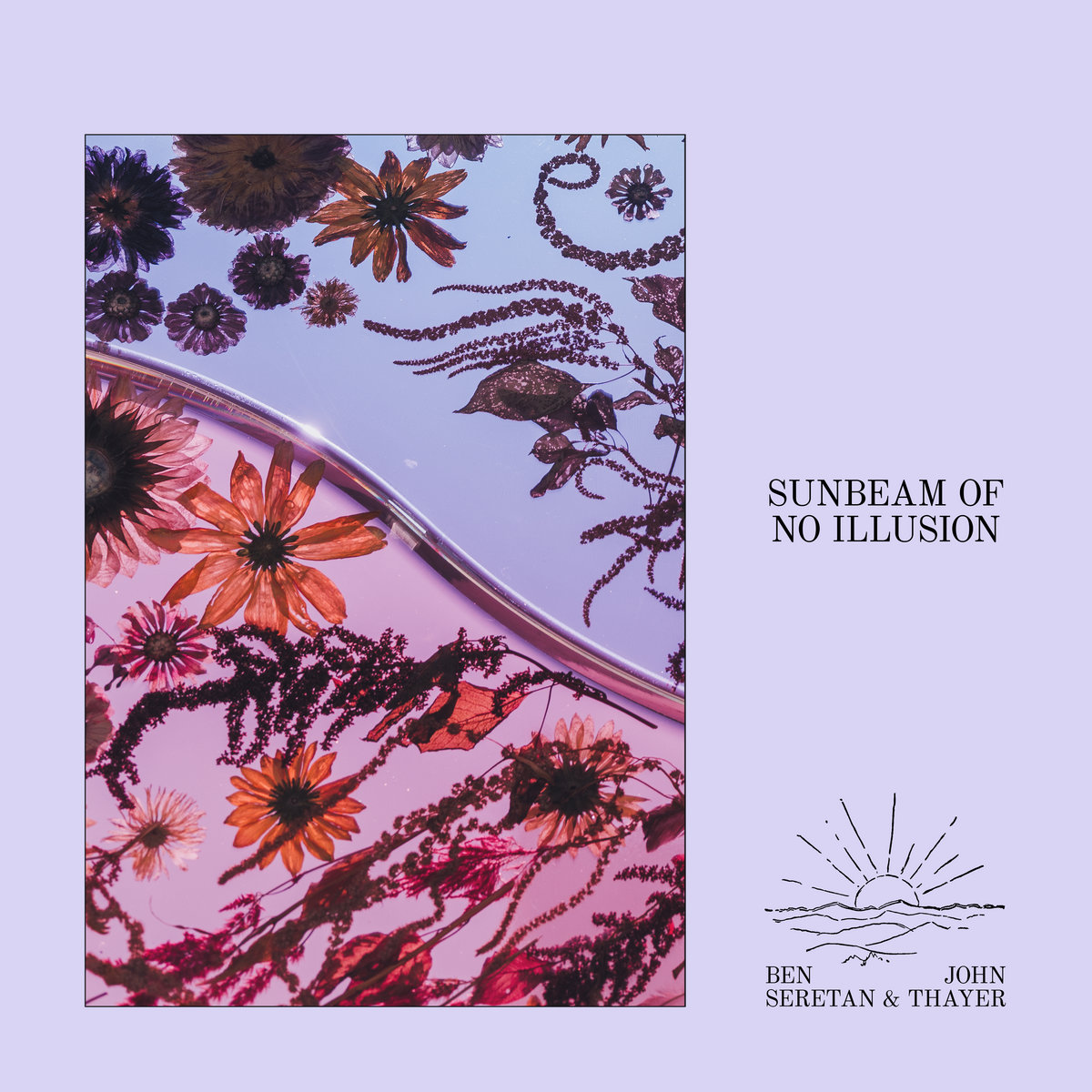
Sunbeam Of No Illusion takes its title from correspondence between Ralph Emerson and Walt Whitman, which is described as “cheeky acknowledgement of the mutual admiration of this project’s partnership”.
For this is the first time Ben Seretan and John Thayer have worked together directly on a project, though their musical paths have crossed on occasion before. Here, they blend largely spontaneous instrumental thoughts with field recordings, literally throwing open the studio door to let the light in – the sunbeam of the title, perhaps. The list of instruments used gives an idea of the density of the project, and the variety of sounds open for use:
Ben Seretan is credited with Fender Rhodes Piano, Moog Matriarch, Juno 106, Supro Lap Steel, Lowrey Organ, Teenage Engineering KOII, Electric Guitar and Assorted Guitar Pedals, while Thayer is listed on Lexicon Prime Time, Delta Labs Effectron II, Crystal Rattles, Temple Block, Brushes, Grass Shakers, Field Recordings, Digitakt, Modular Synthesizer, Tape Echo and Tascam Porta Studio.
What’s the music like?
Extremely restful. This is the musical equivalent of sitting under a big tree in warm weather. There is a breath of breeze here and there, and occasionally the leaves part to reveal a warm burst of sunshine – or they might close in with an unexpected chill.
Whatever happens, the music is drenched in appealing, consonant harmonies and warm textures, beckoning the listener out into the open. Some of these figures are elusive, such as on Memory Garden or Little Winds, where the music floats delicately and wisps of melody make themselves known. The electronic breeze on Valley Spirit is immediately appealing, while the closing Peat Fire, an evocative number with cymbals imitating kindling, is a beauty.
Does it all work?
The unhurried nature of this music is an antidote to fast-paced living, with Seretan and Thayer’s instinctive improvisations unfolding in their own sweet time.
Is it recommended?
It is. An album where the listener can get close to the wind and the trees without having to leave the room they are in, basking in the delights of what Ben Seretan and John Thayer have created. Their descriptive musical pictures are an ambient delight.
by Ben Hogwood, with text lifted from the press release
On Friday, London imprint Mercury KX announced Pioneers, a collaborative album honouring the radical women and gender-expansive artists who reshaped the language of electronic music. Inspired by the landmark documentary Sisters with Transistors, the project brings together a new generation of composers, producers and sonic experimenters to celebrate electronic music’s unsung heroines, not through imitation but through continuation.
Released across two digital chapters this spring, Pioneers forms a living lineage. Twelve new works respond to figures who transformed tape, voltage, voice and performance into tools of liberation.
Side A arrived on Friday 27th March, opening in a state of expanded awareness. You can listen on YouTube music
Arushi Jain’s No Way Back (for Pauline Oliveros) draws from the philosophy of Pauline Oliveros and her practice of Deep Listening. Composed in Raga Bhairav and structured around sustained vocal tones and modular synthesis, the piece treats listening itself as irreversible transformation. Once heard deeply, there is no way back.
Loraine James’ On Time (for Björk) stretches rhythm and atmosphere in tribute to Björk’s boundary-dissolving approach to composition, where digital texture and emotional intensity coexist in constant motion.
For Hand Movements (for Clara Rockmore), Kaitlyn Aurelia Smith honours theremin virtuoso Clara Rockmore, whose invisible gestures shaped one of electronic music’s earliest instruments. Smith channels Rockmore’s balance of engineering precision and hypnotic expressiveness through fluid modular synthesis, tracing motion through voltage.
rRoxymore & Leila Adu summon the avant-pop authority of Grace Jones on I Have Seen That Grace Before. Drawing inspiration from the long-form drama of Slave to the Rhythm, their transcontinental collaboration blurs ambient psychedelia, undulating groove and vocal dualities, reflecting Jones’ fearless negotiation of gender, genre and performance.
On Wind Bathing (for Laurie Anderson), Holland Andrews & yuniya edi kwon transform intimate ephemera into euphoric devotion. Inspired by the singular world-building of Laurie Anderson, the track began with secret violin recordings and love letters before unfolding into something unexpectedly radiant. Intimacy becomes propulsion.
Closing Side A, TAAHLIAH’s Starlight (for Suzanne Ciani) refracts the shimmering architectures of Suzanne Ciani, particularly the romantic synthesiser classic Velocity of Love, into a contemporary meditation where new-age luminosity meets modern electronic form.
Side B, released Friday 17th April, moves deeper into electronic architecture and sonic myth.
Hinako Omori’s You found the allotment (for Delia Derbyshire) pays tribute to Delia Derbyshire’s tape-loop alchemy and mathematical imagination. Built from Moog synthesisers, granulated vocals and analogue tape recording, the track mirrors Derbyshire’s meticulous collage techniques, plotting sound with careful intention.
Kate Simko & Lara Somogyi turn toward the ambient universe of Wendy Carlos on Analog Season. Inspired by Sonic Seasonings and Digital Moonscapes, harp recordings are processed, sampled and re-synthesised into a shared landscape of analogue warmth and microtonal drift, entering into dialogue with Carlos’ expansive and often overlooked ambient work beyond Switched-On Bach.
Footwork innovator Jlin invokes the defiant glamour and rhythmic magnetism of Eartha Kitt on Earth A God, a tribute to performance as power and presence as percussion.
Laurel Halo’s Les Sirènes (for Éliane Radigue) echoes the slow-burning minimalism of Éliane Radigue, embracing sustained tone and psychoacoustic depth where sound becomes environment rather than event.
The album closes with AFRODEUTSCHE’s I See You (for Daphne Oram & Gertrud Grunow), drawing on the philosophies of Daphne Oram and Bauhaus theorist Gertrud Grunow. Created using the Mini Oramics system, the track blends subtle electronics with childlike wonder, offering a meditation on visibility, care and the unseen.
Celebrated for championing boundary-breaking artists, Mercury KX is home to acclaimed composers and innovative musicians such as DJ ANNA, Isobel Waller-Bridge, Ólafur Arnalds, LUXE and Erland Cooper, among many others. The label champions genre-defying, multi-disciplinary artists and curates immersive audio-visual worlds spanning electronic, modern classical, cinematic, alternative and ambient music. With Pioneers, Mercury KX continues that vision, foregrounding work that expands both form and perception.
From early theremin stages to tape machines, from Bauhaus theory to the San Francisco Tape Music Center, from ambient’s outer edges to contemporary club futurism, Pioneers reframes influence as active transmission.
These works do not simply honour the past: they extend its circuitry. Electronic music has always been shaped by women whose innovations were foundational yet often overlooked. Pioneers makes that lineage audible as living voltage.
Tracklisting:
Friday 27th March [Side A – Digital Release]
Side A A1 Arushi Jain: No Way Back (for Pauline Oliveros) A2 Loraine James: On Time (for Bjork) A3 Kaitlyn Aurelia Smith: Hand Movements (for Clara Rockmore) A4 rRoxymore & Leila Adu: I Have Seen That Grace Before (for Grace Jones) A5 Holland Andrews & yuniya edi kwon: Wind Bathing (for Laurie Anderson) A6 TAAHLIAH: Starlight (for Suzanne Ciani)
Friday 17th April [Side B – Digital Release]
Side B B1 – Hinako Omori: You found the allotment (for Delia Derbyshire) B2 – Kate Simko & Lara Somogyi: Analog Season (for Wendy Carlos) B3 – JLin: Earth A God (for Eartha Kitt) B4 – Laurel Halo: Les Sirènes (for Éliane Radigue) B5 – AFRODEUTSCHE: I See you (for Daphne Oram & Gertrud Grunow)
by Ben Hogwood, with text lifted from the press release
Pye Corner Audio has announced a forthcoming new album, More Songs About The Sun, due for release on June 19. His second studio album for Sonic Cathedral is a sequel of sorts to 2022’s acclaimed Let’s Emerge!
The first single, Cycle, is out now on all digital platforms and you can watch the video here:
“Cycle is probably the most direct ‘pop’ song that I’ve written,” explains Pye Corner Audio, aka Martin Jenkins, of the track, which was teased on last week’s vernal equinox and is released today, just ahead of the start of British Summer Time this weekend.
It’s an instant hit of sunshine, the portentous synth intro soon giving way to an indie-dance banger with a rare outing on vocals by Martin and added shoegaze / psych guitars from his sometime Sonic Cathedral labelmate (and Ride / Oasis member) Andy Bell.
You can watch the video below, and also listen / purchase on Bandcamp:
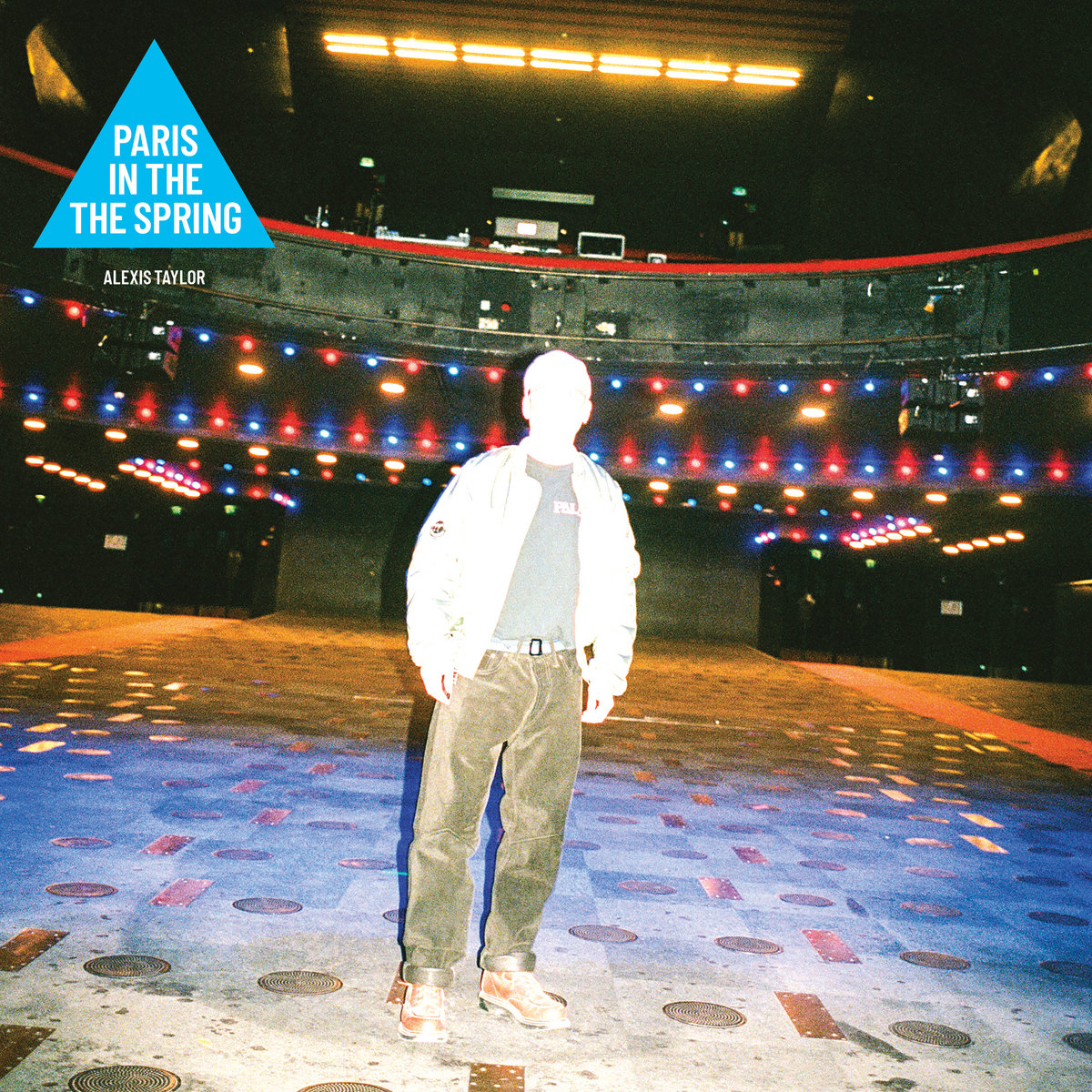
In which the Hot Chip frontman and vocalist Alexis Taylor completes his seventh solo album, this time casting the musical net far and wide with the help of good friend Nicolas Godin, one half of Air.
Nicolas and son Pablo share studio duties on an album whose collaborators also include The Avalanches and Étienne de Crécy, Lola Kirke and, perhaps most strikingly, Scritti Politti mastermind Green Gartside.
What’s the music like?
Given Taylor’s distinctive voice, a lot of the music is instantly recognisable when it comes to the author, but the stylistic departures from Hot Chip’s successful blueprint of soulful club house are frequent and on occasion daring.
These are some of the most emotive songs yet that Alexis has committed to record, especially Colombia, where he moves through bitter regret, and For A Toy, where he asks, “Why do I keep on fucking up the only thing I have ever loved?” There is always wry humour within arm’s reach, though, and in this particular song he is helped by the pure tones of Pale Blue’s Elizabeth Wright.
Elswhere the mood is much more positive, and mp3s Can Make You Cry, On A Whim, the successful hook-up with Gartside, and the outstanding Out Of Phase, with Lola Kirke, all hit the spot. A brave and wholly successful cover of The Rolling Stones‘ Wild Horses shows a vulnerable side, while The Avalanches and Étienne de Crécy fuel dancefloor happiness on I Can Feel Your Love.
Does it all work?
Mostly – and very enjoyably. Taylor really pushes himself creatively, and clearly enjoys doing so.
Is it recommended?
Yes, very much so – Hot Chip fans will love it, and the way in which Alexis Taylor crosses stylistic boundaries with creative freedom is a cause for celebration. Not many vocalists would be this brave, or this successful in their endeavours!
Mike Cadoo returns as Dryft with his fifth album under the moniker, a mere 26 years after he started with Cell.
This is a follow up to From Stasis, released five years ago, and in the words of the press release we find Cadoo “presenting crisper, more immediate compositions”.
What’s the music like?
A compelling mixture of bold beats and dense yet beautifully ambient musical material.
Cadoo has a really strong sense of timing, knowing when to push forward with energetic rhythm tracks and equally when to introduce a weightless keyboard breakdown, without compromising forward momentum.
There is a great deal going on throughout Particle, but with Cadoo’s pacing the likes of Actacrume work especially well, this track dropping a piledriving rhythm just over two and a half minutes in.
Bentithrum is superb, adding weighty beats of concrete to its floated keyboard lines, while Particle itself is a magnificently brooding track, its big beats and expansive soundscape the ideal match. Low Fixture is great, too, with big musical boots on the ground.
Does it all work?
It does – Cadoo’s music evolves consistently and readily, with free inspiration, but remains an ambient listen in spite of some of its sharply pointed beats.
Is it recommended?
Yes, enthusiastically – with the caveat that you really should investigate the other four Dryft albums. This spacey treat goes a long way.



 Arcana.fm