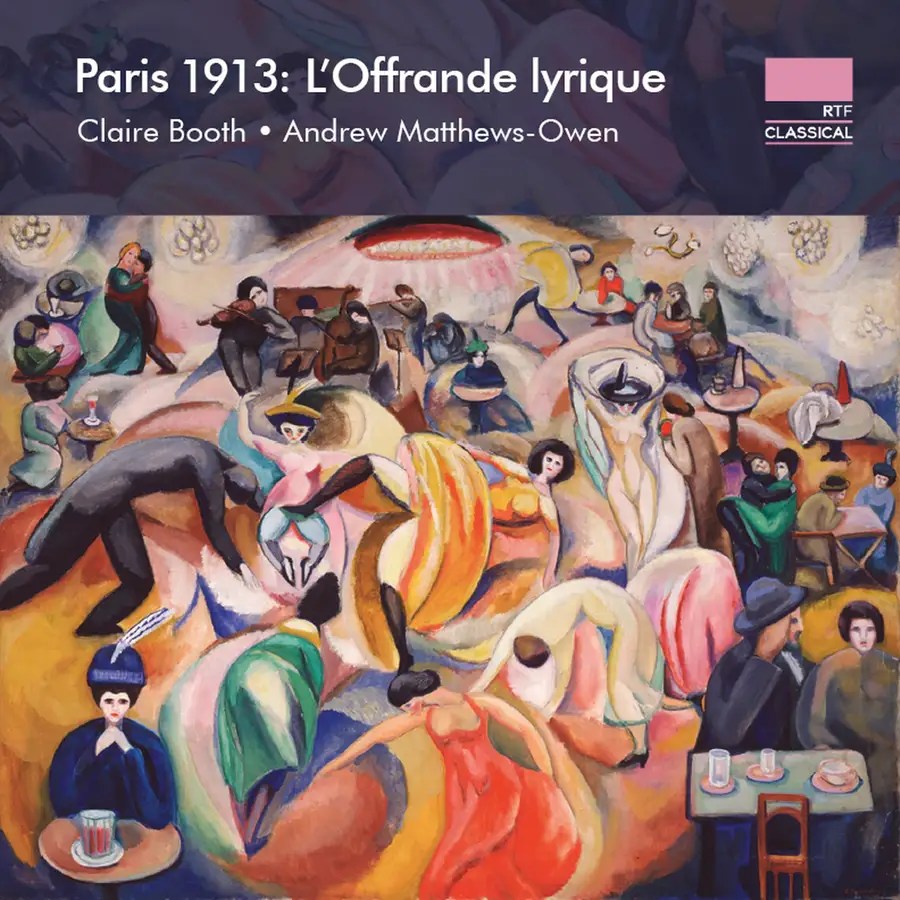
Caplet En regardant ces belles fleurs Milhaud L’innocence Op. 10/3 Hahn À Chloris Ravel arr. Stravinsky Trois poèmes de Stéphane Mallarmé M64 Auric Trois Interludes: Le pouf. Ropartz La Route Durey L’Offrande lyrique Op. 4 Saint-Saëns Petit main Op.146/9 Fauré Il m’est cher, Amour, le bandeau, Op. 106/7 Chaminade Je voudrais être une fleur Debussy Trois poèmes de Stéphane Mallarmé L127 Satie ed. Dearden Trois Poèmes d’Amour Lili Boulanger Clairières dans le Ciel: Vous m’avez regardé avec votre âme Grovlez Guitares et mandolines
Claire Booth (soprano), Andrew Matthews-Owen (piano)
Nimbus RTF Classical NI6455 [66’23”] French texts included Producer & Engineer Raphaël Mouterde
Recorded 11/12 March, 4-6 September 2023 at Wyastone Concert Hall, Monmouth
Reviewed by Richard Whitehouse
What’s the story?
Another enterprising song recital from Claire Booth and Andrew Matthews-Owen, this one focussing on songs that were either conceived, composed or premiered in Paris during 1913 and resulting in an absorbing collection best heard as a diverse while unpredictable totality.
What’s the music like?
Interleaving standalone songs and song-cycles, this recital opens with André Caplet’s take on Charles d’Orléans, its limpid modality highly appealing, then continues with an early song by Darius Milhaud as already demonstrates his distinctive and amusing approach to word-setting, while that by Reynaldo Hahn typifies the teasing charm familiar from his vocal music overall. Maurice Ravel’s triptych to texts by Mallarmé is performed in a version by Stravinsky with its accompanying nonet reduced to piano which, in preserving and maybe even accentuating the music’s questing introspection, represents no mean fete of transcription. Still relatively little known, this certainly deserves to be heard as at least an occasional alternative to the original.
Remembered best as a prolific writer of film scores, Georges Auric had shown a precocious talent for song as is evident in his sensuous setting of René Chalupt. A composer who often wrote on a symphonic scale, Guy Ropartz is heard in a setting of his own verse that amounts to a ‘scena’ in its wide expressive ambit. Interest understandably centres on the eponymous cycle by Louis Durey, a member of Les Six whose increasingly far-left conviction tended to marginalize his creativity yet, as these lucid and empathetic settings of Rabindranath Tagore (as translated by André Gide) confirm, had emerged as a protean talent by his mid-twenties. Hopefully these artists will be encouraged to investigate other of his songs from this period. By contrast, a late song by Camille Saint-Saëns exudes a touching poignancy, while that by Gabriel Fauré typifies the elusiveness of those in his last decade. As is evident here, Cécile Chaminade was a songwriter of style and elegance, then the Mallarmé triptych by Debussy (its first two texts identical to those of Ravel) finds this composer probing the inscrutability of these poems while drawing back from any more explicit intervention. The inscrutability conveyed by Erik Satie’s aphoristic settings (edited by Nathan James Dearden) of his own texts is altogether more playful – after which, the recital continues with a pensive offering by Lili Boulanger, with Gabriel Grovlez’s sultrily evocative setting of Saint-Saëns to finish.
Does it all work?
Yes, given the fascination of this collection taken as a whole and, moreover, the quality of these renditions. Booth is not a singer willing to take the easy option in her interpretations, and so it proves here with singing as fastidious as it is refined, while Matthews-Owen duly instils often deceptively spare accompaniments with understated insight. They contribute a succinctly informative note, but the booklet includes only the French texts with the English translations available at https://rtfn.eu/paris1913/: might it have best the other way round?
Is it recommended?
Very much so. There is much to fascinate even those who consider themselves afficionados of the ‘chanson’, and those who are unfamiliar with much of this repertoire could not have a better means of acquainting themselves with certain of its treasures – hidden or otherwise.
Woman – Marianne Crebassa (mezzo-soprano) Zabelle – Anna Prohaska (soprano) Artisan/Collector – John Brancy (baritone) First Lover/Composer – Beate Mordal (soprano) Second Lover/Composer’s Assistant – Cameron Shahbazi (countertenor) Mahler Chamber Orchestra / Sir George Benjamin
Nimbus NI8116 [60’09’’] English libretto included
Producer & Engineer Etienne Pipard Live performance, 5 July 2023 at Theâtre du Jeu de Paume, Aix-en-Provence
Written by Richard Whitehouse
What’s the story?
Nimbus continues its long association with the music of George Benjamin by releasing his most recent opera, as recorded during its initial production at the Aix-en-Provence Festival and here featuring an impressive line-up of musicians under the direction of the composer.
What’s the music like?
Surprising as was the emergence of Benjamin as an opera composer, he has consolidated his standing accordingly – the ‘lyric tale’ Into the Little Hill (NI5964) duly followed by the full-length Written on Skin (NI5885) then Lessons in Love and Violence (NI5976). In spite of its greater length, Picture a day like this marks his return to the intimacy and understatement of that first venture in terms of its reduced cast and chamber forces – for all that the underlying ‘theme’ seems nothing if not significant in its consideration of life above and beyond death.
Unfolding across seven scenes, the narrative relates a Woman’s search for a ‘happy person’ to redeem the death of her child – during which she encounters a pair of Lovers, a retired Artisan and a renowned Composer; their happiness and contentment in each case pure self-deception. After a despairing monologue, she meets a Collector whose attempted empathy leads her to a garden where the arcadian aspect proves as illusory as the contentment of Zabelle: one whose ostensibly tragic story still enables her to glimpse a future beyond what she has experienced.
Musically this work finds Benjamin at his most subtle and often rarified though never merely inscrutable. Understandably eschewing those respectively sustained expressive build-ups then jarring histrionics of his previous two stage-works, the present opera focusses on incremental changes of emphasis both vocally and instrumentally to maintain a fluid if always perceptible momentum. Allied to this the texture has a poise and finesse, notable even by the standards of this composer, as largely mitigates any sense of the drama played out at an emotional remove.
It could hardly be bettered in terms of performance. Marianne Crebassa brings eloquence and no little fervour to the Woman, while Anna Prohaska evokes Zabelle with mounting gravitas. The other singers are nothing if not attuned to their doubling of roles – notably John Brancy’s fractured Artisan, Beate Mordal’s unfulfilled Composer and Cameron Shahbazi’s narcissistic Lover. Long an able exponent of his own music, Benjamin secures playing of responsiveness from the Mahler Chamber Orchestra as he steers this work forward with audible inevitability.
Does it all work?
Yes, providing one accepts that Benjamin’s idiom is inward if not necessarily inward-looking and elusive without its being inaccessible. The ethos of this opera is likely to be experienced at a remove from the drama it articulates, with the listener becoming absorbed in the onstage action but never coerced into an intended response. That what one takes from listening to it is no more permanent than it is predetermined is itself testimony to the conviction of Benjamin’s and librettist Martin Crimp’s fashioning a parable simultaneously of its own yet outside time.
Is it recommended?
Indeed, given the fascination of its subject, the nature of its treatment and the assurance of its realization. Hopefully a DVD presentation of this or the subsequent Royal Opera production will be forthcoming. Even if or when it appears, this release can be strongly recommended.
Watch
Buy / Further information
For purchase options and more information on this release, visit the Nimbus website.
Published post no.2,303 – Tuesday 17 September 2024
Nimbus NI6446 [56’24’’] Producer and Engineer Phil Rowlands Recorded 28 July 2021 (Symphony), 26 May 2022 (Violin Concerto) at Wyastone Concert Hall, Monmouth
Reviewed by Richard Whitehouse
What’s the story?
The English Symphony Orchestra and Kenneth Woods add to their much lauded 21st Century Symphony Project with this release devoted to Steve Elcock (b.1957), juxtaposing two major works which confirm his standing among the leading European symphonists of his generation.
What’s the music like?
Both works heard here only gradually assumed their definitive form. Composed at stages over almost a decade, the Violin Concerto marks something of a transition between less ambitious pieces for local musicians and those symphonic works which have come to dominate Elcock’s output. Its initial Allegro vivo is a tensile sonata design whose rhythmic energy is maintained throughout, with enough expressive leeway for its second theme to assume greater emotional emphasis in the reprise. There follows a Molto tranquillo whose haunting main theme, at first unfolded by the soloist over undulating upper strings in a texture pervaded by change-ringing techniques, is a potent inspiration. A pavane-like idea soon comes into focus while the closing stage, reaching an eloquent plateau before it evanesces into silence, stays long in the memory. The short but eventful finale is a Passacagliawhose theme (audibly related to previous ideas) accelerates across five variations from Andante to Presto, before culminating in a heightened cadenza-like passage on violin and timpani then a peremptory yet decisive orchestral pay-off.
The Eighth Symphony has its antecedents even further back, having begun as a string quartet in the early 1980s, though it continues those processes of evolution and integration central to the seven such works which precede it. It reflects the impact of the Sixth Symphony by Allan Pettersson (still awaiting its UK premiere after 58 years), but whereas that epic work centres on fateful arrival, Elcock’s single movement is more about striving towards a destination that remains tantalizingly beyond reach. Numerous pithy motifs are stated in the formative stages, as the music alternates between relative stasis and dynamism before being thrown into relief by the emergence (just before the mid-point) of a trumpet melody that goes on to determine the course of this piece as it builds inexorably towards a sustained climax then subsides into a searching postlude. Overt resolution may have been eschewed, yet the overriding sense of cohesion and inevitability duly outweighs that mood described by the composer as ‘‘one of desperation in the teeth of impending catastrophe’’ which, in itself, becomes an affirmation.
Does it all work?
Certainly, given both works receive well prepared and finely realized performances – notable for the way Elcock’s demanding yet idiomatic string writing is realized with real conviction. The concerto is a tough challenge for any soloist and one Zoë Beyers meets with assurance – its close-knit interplay of soloist and orchestra brought off with admirable precision, and its occasional modal subtleties rendered as enrichments of the tonal trajectory. Elcock has been fortunate in his recorded exponents, and this new ESO release is emphatically no exception.
Is it recommended?
Indeed, and good to hear that, as the ESO’s current John McCabe Composer-in-Association, Elcock will feature on a follow-up issue of his pieces Wreck and Concerto Grosso, along with the recent Fermeture. For now, this latest release warrants the strongest of recommendations.
April Fredrick (soprano), Thomas Humphreys (baritone), ESO Chorus, English Symphony Orchestra / Kenneth Woods
Sawyers Mayflower on the Sea of Time (2018)
Nimbus NI6439 [58’57’’] Producer and Engineer Tim Burton Engineer Matthew Swan Live recording, 17 June 2023 at Worcester Cathedral
Reviewed by Richard Whitehouse
What’s the story?
Philip Sawyers’ Mayflower on the Sea of Time was to have been launched with performances in Worcester Cathedral four years ago, but the pandemic inevitably derailed this. Happily, the composer’s largest work so far was finally heard last June in the venue as originally intended.
What’s the music like?
Commissioned to mark the 400th anniversary of the sailing of the Mayflower from Leiden to Plymouth, this is an oratorio in concept but equally a choral symphony in design. Its libretto, mainly by the artist Philip Groom, features set-pieces for various Old and New World figures largely for soprano and baritone alongside summative passages for chorus. Self-deprecating about his literary abilities, Groom yet achieves a viable balance between the characterization of individuals as part of a continuous and cumulative trajectory relating that of ‘the journey’.
There are four continuous parts: Persecution and Journey, a sonata design which informs the Pilgrims’ flight from religious persecution and their decision to cross the Atlantic; Arrival in the New World, a slow movement charting their arrival then tentative initial interaction with native cultures; Survival and Making our Community, a brief scherzo in which the Pilgrims’ industriousness and idealism all too soon becomes its own justification; and Our New World, a sizable rondo-finale whose looking to the future is framed by choruses of growing fervour.
Sawyers’ writing for the chorus is expert and resourceful, not least when this elides between a depiction of Pilgrims or Natives with that of a more abstract commentary, while solo sections allow his lyrical impulse free reign – not least towards the end of the second and fourth parts, closing with luminously ecstatic choruses that accentuate an essentially affirmative message. Worth noting is the poignant incorporation of a motet by Thomas Tomkins into its fourth part, which also sets lines by Walt Whitman with a tangible understanding of its expressive syntax.
Does it all work?
Almost always, and not least owing to the persuasiveness of this performance. April Frederick and Thomas Humphreys (the latter after a slightly strained start) can hardly be faulted in their commitment or insight, while the new-founded ESO Chorus evinces a power and immediacy abetted by Worcester Cathedral’s spacious acoustic to belie its modest forces. The ESO gives its collective all throughout, conveying the textural intricacy and the emotional heft of music whose overall formal integration is fully conveyed through Kenneth Woods’ astute direction.
The initial performances might have fallen through, but the associated educational project did go ahead and enabled several hundred youngsters to experience the piece at first hand. This is worth remembering given Mayflower should have a ready appeal for those who know little of the historical background or, indeed, contemporary music. That it can be rendered by around two-dozen singers ought to commend it to enterprising choral societies able to muster the 45 musicians, especially when Sawyers’ writing for both is often exacting but always practicable.
Is it recommended?
Very much so. The sound captures the resonance of its acoustic with no loss of definition, and there are detailed notes by composer, author and conductor. A pity the actual text could not be included, but that this can be scanned via a QR code is another incentive for younger listeners.
On an autumnal day, Arcana has time with composer Augusta Read Thomas, known affectionately as ‘Gusty’ to her friends. The nickname is more than appropriate, since Gusty is speaking to us from her Chicago home. In a year that has been testing at best, she has taken the time to talk through her new album The Auditions, released by Nimbus in October. The collection proves an ideal introduction to her music, including as it does pieces for brass quintet, carillons and a ballet score for ensemble, The Auditions – of which more later.
Our interview subject is bubbly, engaging and intensely focused – rather like her music. The bubbly aspect is in part related to the recently announced result of the US presidential election. “The year has been so out of body, as we both know in lots of ways, but I’m so happy about Biden and Harris. Then we hear about Pfizer and the vaccines, and as such I feel better. In Chicago we’ve been having record temperatures, and it’s been 75 degrees, like a July day! It has been perfectly sunny, day after day after day, the best November weather I can remember in 30 years, which is definitely a bonus. Right now it’s insanely beautiful outside!”
Is her work as a composer affected by the weather? “Yes, I think so – not so directly as writing dark music on a rainy day, but I do feel that the sun is really a giver of energy. I mean that globally, over a lifetime, not a day-to-day thing. There is energy from the sun that I feel. I don’t know how it translates into the music, but it is a real feeling in my body. For instance, sometimes in my little apartment there is a slant of sun that comes through and I’ll move my chair to sit in it. It feels so beautiful to be having that sunlight and then the slant is moving, so you move the chair a little bit. Then it goes beyond the window, but I will gravitate to sunlight!” The Auditions release encounters different forms of light as you journey through it. “Absolutely. I think that nature is really a great teacher. If you’re going to write a piece of music, you should just look at a tree, and it will tell you a lot. Look at the snowflakes and all the differences in their swirls, then a flower, or a garden – or even DNA, the way that cells reproduce; the ocean. I’ve been telling my students this for decades – look outside, there’s a great teacher right there in the window. It’s really true. If you were to go to my website and just read titles of my works on the alphabetical index, a lot of them are to do with the sun, the moon, nature or spirituality. It is the perfume of my whole catalogue. This CD has evocations of light, or ripple effects like those in the ocean. It is like the caprice of birds, and their beauty – the difference between hummingbirds, flying from the north all the way to the south, and the majesty of the swans.”
We move on to discuss the ballet itself. The Auditions is the idea of moving from this other spiritual space, which is the arcs nos. 1,3, 5 and 7 of the auditions, and then these very earthy, playful jazzy bits. It is like going from the cosmos down to the earth and then back up in the ending. You definitely feel the rise in those arcs. The ballet is modelled on the instrumentation used by Copland’s Appalachian Spring. “It was the 75th anniversary of Appalachian Spring”, she confirms, “and the commission was for an anniversary ballet, with the Martha Graham Dance Company set and costumes, which was amazing. Her choreography for Appalachian Spring was very stylized and of its time – a period piece which was wonderful and absolutely fabulous. Then there was an intermission and then The Auditions. I had to use more or less the same instrumentation, and I added the percussion, a trombone, and a saxophone, so that when you got to my piece it was like smelling a different kind of like world right away. The dance company has many bookings for the show with the two together, but of course they all got postponed. They are touring the show though.”
The list of composers commissioned by the Martha Graham Dance Company is a roll call of some of the 20th century’s finest. “Martha Graham really had a tradition of working with living composers”, she says, “and some great works exist in repertoire because of it. I feel really fortunate to have been receiving this commission. I spent a year on the piece – it’s so detailed, nuanced and sculpted in terms of the form. I worked really closely with the choreographer. In parentheses, there’s a broadcast going out to New York on Sunday night. One of them is going up on my website today, so a lot of people will be able to actually see what the dancing was like. I love it, and wish I could send it over!”
That must be a boon in these times where performances have been scarce or even non-existent. “Absolutely”, she agrees. “One of the other pieces on the disc is Plea For Peace, and there is a version where the solo is played by flute, trumpet and violin. That version just aired on 55 television stations all over the country! That’s a big deal in America, to have things out on the television, but in a pandemic it’s just golden.”
Read Thomas studied with two figureheads of 20th century classical music, Oliver Knussen and Pierre Boulez. “I believe that Oliver Knussen is an ‘A’ list composer”, she says affectionately. “I would put Chopin and Debussy and Ravel on that list, all the greats. I want to say that as loud as possible and I also think, amazingly, he was a great conductor and teacher – he was unbelievable. All of that stems from the central core of being a great musician. Very few people are both – you have some conductors who compose OK, and then you have some composers who conduct, but he was both.”
She fondly remembers their meeting. “When I was in second year college in America, I would have been 21-22 say, he heard a bunch of my music. He invited me to be a fellow at Tanglewood, which in America is a very big deal. So, I was at least ten years younger than the other fellows. We would go through my scores and we would sing the lines, and he taught me a lot about nuance and form and when he was very detailed. Then he brought me back for a second year at Tanglewood, because normally you’re only allowed to go once, and then a third year. I learned a lot from him, and then we continued our friendship. I commissioned his piece Requiem: Songs For Sue, and I brought him to the Chicago Symphony. I have a beautiful score he wrote to me and we would share CDs of people’s music. He did my Helios Choros with the Cleveland Orchestra and also the National Symphony, and he brought my piece In My Sky At Twilight to the Queen Elizabeth Hall with the London Sinfonietta. He just supported me over all those years, and in my little modest way I tried to support him too. We could speak on the phone for a long time about pieces of music. It was a friendship, but I do consider my teacher because in the time I had with him, he taught me a lot but I learned a lot from his music. I studied his music and I teach it too. He was just a great artist.”
Having been fortunate to see Knussen in concert at the Proms, with his visionary programming, it was clear how music was a sharing experience for him. “Totally”, she agrees. “Towards the end of his life, when he did the Scriabin Poem of Ecstasy, he called me up and said, ‘You’ve got to hear this!’ It had all the extra players and stuff, so of course I listened and then I listened again. And then after a step I listened again to that Prom. At the end he did the Piano Concerto by Phil Cashian. For many summers I taught at Tanglewood, and he was a frequent guest. A great, great person.”
Of Boulez, Read Thomas is similarly enthusiastic. “The Chicago Symphony invited me to be their composer in residence, and that came about because Boulez and Barenboim reportedly liked my music. I was young, and it was in the mid-1990s. I was 32 or something like that. Just before that I was commissioned to write a piece, called Words Of The Sea. It’s a four movement piece for orchestra, and it’s easy to find the audio of it. I sent in my manuscript on huge pieces of paper and rolled it, and Xeroxed it, rolled it into the tube and sent it off. I got a call saying they had sent it to Boulez with about twelve other pieces. Then about a month later they called up and said ‘Out of a pile of 12 he’s only going to play one…but it’s yours!’”
Boulez conducted the world premiere of Words Of The Sea, and the two met over the manuscript. “It was a great premiere”, she recalls, “and then that night we had this dinner party with the orchestra, and he turned to me and said he would like to commission another piece. So I did a piece called Orbital Beacons. He was so generous, like he bothered to look at my piece and program it, and it was around this that they invited me to be a composer in residence. He nominated me for a prize for the Siemens Foundation, which I won. It is a generous prize! Then he did the premiere of In My Sky At Twilight, and recorded it as well as taking it to Lucerne. There were lots of different projects.”
Read Thomas’ stories are given with great affection and gratitude. “What I liked about him, and also Knussen, is that they would play my tempos. They were both so precise. I remember with Boulez there was one little thing with In My Sky At Twilight, and he said, ‘I think you have the oboe as mezzo forte there, I think it should be mezzo piano.’ I looked, and said, ‘I think you’re right. So the whole group is sitting there and I remember he had this little box with his pens, so he went into his pen box and opened it, looked around and then he took out the red little red pencil. Then he went on to the score and crossed it out and changed it to mezzo piano. It was very precise, and all about getting it right. The players loved him. They played perfectly and with such artistry. It was a teeny change but it was reflective of the fact that my scores are so detailed.” Knussen’s operating method were not too dissimilar. “Olly was also very precise. I remember when we did In My Sky At Twilight at the South Bank Centre, I said to him, ‘Ollie, it feels too slow – can we keep it going so many bars?’ He looked at me and said, ‘Let me think about it.’ Then, at the show, he did it slower! He came up to me afterward, and said ‘I did it slower! You see, it really works!’ He went with the musicality, and the harmonic rhythm of things.”
Moving back to The Auditions, we discuss the programming of the CD release itself. Was it tricky to get in the right order? “You’re absolutely right. I sat with the engineer and we tried it in lots of different ways. We decided to start with the brass quintet because it’s such a good performance, and it’s very hard! They make it sound easy, but it’s tricky – and it just blasts out of the machine. I’ve been listening to jazz my whole life, so while I am a classical composer, I speak a lot about jazz and my process is very full of improvisations and so forth. What I like about that is starting with be-bop. When you put it in a brass quintet, it’s like, ‘What’s going on?’ You know, there’s no other brass quintet that sounds like that piece, there are no folksong arrangements or church chorales. It’s pure protein in terms of material, a bite size thing that shows lots of different sides of me. The chords are jazz chords, but end up sounding like Stravinsky or Messiaen in this context, like Bebop meets Ravel.”
The next piece presents a contrast. “We thought after the intensity of that to go for the intimacy of Plea For Peace. It’s a beautiful recording, made by Chicago Symphony Orchestra members. You go into this other world, and for the contrast that seemed to be a good place to put that reflection.”
“It’s Ripple Effects next!” she says excitedly. This is a piece for 72 bells, and Renske Vrolijk’s wonderful picture above should be examined when listening to the piece, where each player is clambering over one another to get all the notes played in the final chord. “Some of those bells wouldn’t fit in my room!” she laughs. “One of the interesting things about this piece is that most carillon players play solo. They climb all the way up the tower and they sit there alone, they don’t see their audience, and by the time they get down whoever heard them as walked away. It’s very lonely, and there’s not much repertoire that’s not for solo carillon. Also, a lot of the repertoire is arrangements of a chorale or a song or something. What was really interesting to me was that the first version brought all those people together. The humanity made it very special for that instrument. The two player version is on this recording. It’s tricky, they’re going non-stop with their feet and hands. It multiplies in a way, it sounds like an orchestra in the way it goes, because of the way the bells ring. It’s such an interesting sound world, and again, like the brass quintet, there is no piece that sounds like that – it’s very singular in the carillon repertoire.”
While these pieces are for very different instrumental forces, Read Thomas notes the importance of a connecting thread. “I try to imbue all my pieces with the ‘Gusty’ personality, so if you hear a piece of mine you’re not going to say, ‘Oh well, that sounded like warmed-over minimalism, or retro movie music, or spectralism layer three. There are no categories, it’s just my music. With Plea For Peace, what’s interesting about that piece is it’s just a crescendo, but when you use a text, like post-Hiroshima, or an ancient poet, or a political figure, it narrows. When you make it just a vocalise, the piece means the same in South Korea as it does in North Korea, and as it does in Africa, Azerbaijan or Kansas. That was a big decision, to make it a vocalise, but I think it cuts so much deeper. It feels risky to do it, but in the deepest human way it is like a cry from the heart. While that piece is very total, I still think of it as very singular.”
The Auditions roll-call continues with Two Thoughts About The Piano, with Read Thomas effusive about her soloist. “Daniel Pesca was fabulous. His technical skills are outrageous, but he’s an artist, he sculpts the form as crescendos, and also the repeated notes are hard. He really did a great job. I appreciate his touch.” That is followed by Selene, arranged for percussion quartet and winds. “This is an arrangement that Cliff Colnot made”, says Read Thomas. “He took the string parts and put them in the winds, but the percussion parts are identical. I do think it works, there are certain things like when you get those bass clarinet and bassoons, it’s such a cool colour. I think it’s a very successful arrangement; the credit for it should go to him for the wind parts.”
From vivid experience, Read Thomas’s music consistently creates a picture in the listener’s mind. “One of the things that’s also really interesting to me in my practice and life, is how much, for example, Johann Sebastian Bach can fit into two minutes. If you take one movement of The Well Tempered Clavier, one of the Preludes and one of the Fugues – it’s two minutes, but there is a whole universe there. It starts and there’s just not a note out of place. I’ve really taken that to heart in my music, like the first movement of the Brass Quintet – four minutes is it, that’s all you need to paint the picture. We are matching the material to the duration, and to look at Bach’s Goldberg Variations, some of those movements are less than a minute, but there’s a whole universe there. I guess if I had to summarise, generally I’m a poet and not a novelist. I write shorter pieces with every word in place, every dash, every thought, and every line break to use a poetry metaphor, every adjective too. It’s only four minutes but that really interests me. This CD in a way brings out the poet side.”
The same tenets apply with music of longer duration. “The Auditions is a longer piece, but it still breaks down into much shorter sections”, she explain. “It is a kind of pure, protein poetry. You have to edit and sculpt move the comma, so to speak. I really believe that form conserves energy, and I say that to my students all the time. It’s three words but they’re very important. If you have the material and form that are allied, a four minute piece – like Plea For Peace – projects out to a universal statement that is 20 minutes, but you say it in a very short time. That kind of craft, for lack of a better word, I learned from Oliver Knussen. He was a miniaturist also, and so was Boulez. My main model would be Bach but those other two were the same.”
Our conversation pans out to consider the past year and all its challenges. Has it been difficult a a composer? “I will answer that in two layers, if you don’t mind”, she says thoughtfully. “The first layer is that I’m very mindful that we have a lot of people on this planet without shelter, water, healthcare and food, and so on. Also, in my opinion, the systemic racism is outrageous and should have been set right centuries ago. I would like to say loud and clear, that black lives matter. There is a whole social conscience side, and it is important to state that before I say number two, because they are very much interlinked. I think that when we look back in 10 years of what was created in COVID, there is going to be a burst of creativity, which is great. For me, typically, I travel every week. For 200 days a year I’m just zooming around all the time, and I’ve been doing that for 25 years. Then, all of a sudden, I stopped, and when I was cancelling travel and hotels I was thinking, ‘how did I do this?!’ To be honest with you I have been writing, non-stop, and have had enormous focus. It has been a huge boon. I’ve also continued with online teaching, so it has been really busy. I can’t wait to share what I’ve just made with people.” It is reassuring to hear a positive benefit to the imposed isolation, but not surprising when you consider the creativity such adversity can often inspire. “It is, but for me it’s not the adversity, because I’m really trying to help in whatever way I can. For 30 years I wish there was more than 24 hours in a day, and I typically work like 16 hours a day because I like to. I like to get at least eight or nine hours’ composing and then maybe five hours of teaching and then citizenship work. I think after this, with the whole work / home / travel thing, I think a lot will change for big corporations, and for artists. We realise now that certain things really can be done.”
Finally, I have to ask about the origins of Gusty’s nickname. She smiles warmly. “I have been called that since I was a little girl, because we had ten kids in the family and I was the tenth. Since I’ve been about two it was always my name. Then, as my life developed, then it seemed better for the public to have my formal name, which was fine given name at birth. So we just ended up using that. By coincidence the initials are A-R-T. It just fell into place!”
Augusta Read Thomas’s new release The Auditions is available on Nimbus Records. To listen to clips and for purchasing options, visit the Wyastone website. The composer’s own website contains a great deal of information behind the music, with multimedia and details of future performances. To read more, click here



 Arcana.fm