
In concert – Orchestra of the Age of Enlightenment: Bach Brandenburg Concertos @ Queen Elizabeth Hall

Orchestra of the Age of Enlightenment

J.S. Bach
Brandenburg Concertos:
no.1 in F major BWV1046 (dir. Huw Daniel)
no.3 in G major BWV1048 (dir. Margaret Faultless)
no.5 in D major BWV1050 (dir. Margaret Faultless)
no.4 in G major BWV1049 (dir. Huw Daniel)
no.6 in B flat major BWV1051 (dir. Oliver Wilson)
no.2 in F major BWV1047 (dir. Rodolfo Richter)

Queen Elizabeth Hall, London
Wednesday 13 November 2024

Reviewed by Ben Hogwood Pictures (c) Mark Allan

The music of Bach proves a great source of consolation for many in uncertain times, and the underlining feeling from this packed concert was that the Orchestra of the Age of Enlightenment had offered just that, deep into their tour of the great master’s complete Brandenburg Concertos.

The six concertos, written for a variety of instrumental ensembles, were published just over 300 years ago in 1721 and sent to Christian Ludwig, Margrave of Brandenburg. In a crowded field, they have become one of Bach’s best-loved groups of works, and although they were not designed to be played together they respond extremely well to a concert such as this.

It is difficult to imagine a better set of performances than those given by the OAE, playing without a conductor in the spirit of the compositions, assigning the direction of each concerto to the uppermost string player. The program was introduced with a spark by violinist Margaret Faultless, whose enthusiastic demeanour set the tone for the evening. As the notes of the Brandenburg Concerto no.1 in F major lifted off the page Bach’s inspiration was immediately apparent, like walking into a room of animated conversation. The horns of Ursula Paludan Monberg and Martin Lawrence were front and centre, pointed aloft in a necessary but striking pose. The balance between the 13 players was ideal, not just in the busy first movement but in the emotive Adagio, led by the beautiful tones of oboe trio Clara Espinosa Encinas, Sarah Humphrys and Grace Scott Deuchar. Yet the horns took centre stage, powering the bright Allegro, before a perky series of Menuetto dances were bisected by a bracing second trio.

One of the many joys of the concert was the different sonorities of each piece, which changed to nine string instruments for the Brandenburg Concerto no.3 in G major. This had the requisite spring in its step for the quicker outer movements, especially the jovial dialogue of the third. Meanwhile the ensemble elaborated on Bach’s two written chords that make up the slow movement, where the focus was on violin (Faultless) and harpsichord (Steven Devine) Their tasteful improvisations were an ideal foil.

Completing the first half was the Brandenburg Concerto no.5 in D major, in effect an early keyboard concerto. The seven players were positioned closer to the audience, allowing greater intimacy and the chance to appreciate some of the wondrous sequences in the first movement. Taking the lead here were flautist Lisa Beznosiuk, who recorded the concertos with the orchestra back in 1987, alongside Faultless and Devine. They delivered a sublime Affettuoso second movement, a moment of reflection from the fast movements where Devine was a revelation, his virtuosic brilliance never too showy even in the trickiest of cadenzas.

To begin the second half of the concert the mellow sonorities of the recorders took the lead in the Brandenburg Concerto no.4 in G major, with beautiful clarity achieved by Rachel Beckett and Catherine Latham. Violinist Huw Daniel mastered the busy figuration of his part with considerable flair, while the poise of the accompanying ensemble was consistently satisfying. This concerto is deceptively forward looking, with pointers towards Beethoven in the slow movement, which here benefited from the weighty support of viola da gamba (Richard Tunnicliffe) and double bass (Cecilia Bruggemeyer), both ever presents through the evening. The pugnacious finale, with one of Bach’s many earworms, was great fun in the hands of these nine players.

The colours darkened appreciably for the Brandenburg Concerto no.6 in B flat major, whose highest instrument is the viola. Bach’s scoring here is remarkably inventive, and was brought to life as Oliver Wilson led a fluent account of the first movement. The violas showed their versatility as melody instruments in the reduced scoring of the Adagio, reduced from seven to four players and enjoying its elegant dance-like figurations, before the syncopations of the Allegro were winningly delivered.

Finally the Brandenburg Concerto no.2 in F major was a suitably upbeat piece on which to finish, with soloist David Blackadder – having waited an hour and a half to play – enjoying his moment on stage. He made the trumpet line look – and sound – straightforward, when with this instrument it is anything but! Again the balance was carefully wrought, so that the intricate violin contributions of director Rodolfo Richter could be clearly heard. A lightness of touch from the 11 players brought the phrasing of the Andante to life, with some typically spicy harmonies stressed, before the brilliant colours of the closing Allegro assai, and a celebratory closing statement.

It was a treat to hear the six Brandenburg Concertos presented in this way, a reminder that – in the words of Huw Daniel – these concertos deserve to be the centre of attention. The humming of the audience afterwards was testament to their lasting appeal, 300 years on.

You can listen to the Orchestra of the Age of Enlightenment’s recordings of the Brandenburg Concertos from 1987-88 for Virgin Classics below:

Published post no.2,362 – Thursday 14 November 2024

In concert: Steven Isserlis, Orchestra of the Age of Enlightenment / Maxim Emelyanychev – Saint-Saëns Cello Concerto no.1 & ‘Organ’ Symphony

Saint-Saëns
Phaéton Op.39 (1873)
Cello Concerto no.1 in A minor Op.33 (1873)
Danse macabre Op.40 (1874)
Symphony no.3 in C minor Op.78 ‘Organ’ (1885-6)

Steven Isserlis (cello, below), Matthew Truscott (violin), Orchestra of the Age of Enlightenment / Maxim Emelyanychev (above)

Royal Festival Hall, London
Thursday 26 January 2023

Reviewed by Ben Hogwood Steven Isserlis picture (c) Satoshi Aoyagi

Top marks to the planning team of the Orchestra of the Age of Enlightenment, for scheduling a night of Saint-Saëns in January! They chose a rousing quartet of works as part of the orchestra’s Sounds For The End Of A Century series, in what may have been a first live encounter for the orchestra with the French composer’s music.

They were matched with a suitably dynamic conductor, Maxim Emelyanychev throwing heart and soul into the music as we explored numerous links between Saint-Saëns and Liszt. This was done through a pair of symphonic dramas, one to open each half, the Cello Concerto no.1 and the Symphony no.3, the Organ, dedicated to Liszt himself.

The first drama told the story of Phaéton. Drawn from Greek mythology, it tells how the child of sun god Helios drives his chariot recklessly across the sky – from which he is felled by Jupiter’s lightning bolt. The action was thrillingly conveyed here, the vehicle veering wildly from the start in the quickfire violin lines. The warm second theme offered a little respite but all too quickly the thunderbolt arrived, delivered with maximum drama by three timpanists, Adrian Bending, Florie Fazio and Tom Hunter.

The second drama was Danse macabre, originally a song but now a seasoned favourite in its orchestral guise. The devilish solo violin role was taken up by orchestra leader Matthew Truscott with some relish, playing with vigour from his position just behind the woodwind. Emelyanychev’s pacing was ideal, and while the dance initially felt a little soft it transpired he had been saving the full fury of the orchestra for the final rendering of the theme, unleashed in a thoroughly satisfying blast.

Steven Isserlis joined the notably reduced orchestral forces for the Cello Concerto no.1, another popular piece full of melody and incident. Isserlis has championed the music of Saint-Saëns throughout his career, and this performance found him in his element, lovingly attending to the tender second theme of the first movement and the opulent Allegretto, while fully opening up to the virtuoso demands of the outer sections. Dialogue with the orchestra was brisk and full of smiles, while the structure of the concerto – a single movement in line with the piano concertos of Liszt – was expertly handled in league with Emelyanychev.

As a thoughtful encore Isserlis marked what would have been the 78th birthday of Jacqueline du Pré, choosing the most appropriate encore – The Swan from Saint-Saëns Carnival of the Animals. Accompanied by Emelyanychev on the orchestra piano, the cellist gave a serene yet searching account.

Finally we had the rare chance to hear the Organ Symphony in period instrument guise, with a blast from the Royal Festival Hall organ and James McVinnie. While the third is by some distance Saint-Saëns’ most popular symphony, it should be noted that a concert of either the fine Symphony no.2 or the work titled Urbs Roma would not go amiss before too long.

Here, however, was a piece written in dedication to Liszt at the surprising invitation from the Royal Philharmonic Society, and premiered at the long-demolished St James’s Hall near Piccadilly in London. It is easy to forget just how original a piece this is, with a large orchestra including not just organ but a piano (with two pianists), two harps and more. There is also an impressive resourcefulness on the part of the composer with his thematic material, which Emelyanychev took the chance to illustrate throughout.

The nervy first movement harked back to the motion of Phaéton’s chariot, albeit now riddled with anxiety, its syncopated nature leaving room for doubt. Consolation was on hand in the form of the substantial section marked Poco adagio, a noble utterance whose poise unexpectedly anticipates Elgar in style. The entrance of the organist here was expertly handled by McVinnie, whose familiarity with the Royal Festival Hall instrument enabled him to achieve an ideal balance with the orchestra. He did this through some wholly rewarding registration choices.

As a consequence the slow movement was deeply emotional, its quiet moments accentuated by Emelyanychev and the soft strings, played with little vibrato. The hurried Scherzo was a vivid contrast to this, and brilliantly played, before the doors were flung open for the famous finale.

McVinnie led with authority, securing a lovely, grainy sound from his instrument for the thunderous C major chord at the start. The two pianists, playing what seemed to be a modern instrument, caressed the upper reaches of the texture with delicate arpeggios. Emelyanychev steered clear of sentimentality in his interpretation, a move which actually heightened the impact of the piece and carried us to a thrilling conclusion.

A blast of C major to see January into the long grass was most welcome – what more could a concert goer want?!

You can read all about the 2022/23 season and book tickets at the Orchestra of the Age of Enlightenment website.

In Concert – Soloists, Choir and Orchestra of the Age of Enlightenment / John Butt: Haydn: ‘Nelson’ Mass and ‘Trauer’ Symphony

Haydn
Symphony no.44 in E minor Hob.I:44 ‘Trauer’ (1772)
‘Ganz Erbarmen’ from The Seven Last Words of our Saviour on the Cross Hob.XX:2/2 (1786, choral version 1796)
Missa in angustiis (‘Nelson’ Mass), Hob.XXII:11 (1798)

Sofie Ticciati (soprano), Bethany Horak-Hallett (mezzo-soprano), Hugo Hymas (tenor), Robert Davies (bass), Choir and Orchestra of the Age of Enlightenment / John Butt

Hall One, Kings Place, Friday 30 September 2022

Reviewed by Ben Hogwood

Full marks should go to the OAE and Kings Place planning teams for this concert. Somehow they anticipated that what was required on the last day of September 2022 was a ‘mass in time of fear’ – and in doing so unwitting delivered the ideal response at the end of a week of great political uncertainty. The subtitle was given by Haydn to a substantial work better known as the Nelson Mass, so called because it was performed in the presence of Nelson and Lady Hamilton when they visited the composer at Eisenstadt in 1800.

First, though, we heard a work from the composer’s Sturm und Drang period. His Symphony no.44, the only one of his 104 in the key of E minor, has the nickname Trauer on account of the performance of its slow movement at Haydn’s funeral. It falls in the middle of a particularly rich vein of creativity in the Haydn symphony, where he was exploring less common key centres and instrumental possibilities. This performance was given by just 17 players but they gave a sound that could have been made by an orchestra double the size. They caught the dark undertones of its lean and jagged first movement, reminding us of how dramatic Haydn symphonies can be. John Butt was an embodiment of the vigorous performance, drawing the wit and dance rhythms from the Menuetto but also enjoying the relative sweetness of the trio section, with outstanding high horn playing from Ursula Paludan Monberg. The muted Adagio was beautifully done, finding the serene corners of the major key, while the finale had terrific drive, the strings digging in with gritty staccato.

A curious inclusion followed, the second movement of the choral version of Seven Last Words of our Saviour on the Cross. Concentrating on Christ’s promise to his fellow crucified prisoners that they too would see paradise, Haydn offers a vision of redemption that the four vocal soloists portrayed after a period of initial solemnity. The choir, positioned around the balcony, sang down to the audience and were ideally balanced by Butt, who was always cajoling them on to more.

He did likewise in an outstanding performance of the Nelson Mass, which was compelling from first note to last. Described by no less than Haydn scholar HC Robbins Landon as ‘arguably his greatest composition’, it began with a dramatic Kyrie, laying an immediate sense of occasion. With brass and timpani alongside the 17-strong chorus on the balcony, there was fear and tumult in the music, which reached an apex in the Benedictus, an extraordinary passage of writing for the time. Soprano Sofie Ticciati was a subtly commanding presence, especially in this section, and she had sterling harmonic support from fine mezzo-soprano Bethany Horak-Hallett, who came into her own with a terrific solo at the start of the Agnus Dei. Hugo Hymas and Robert Davies were excellent too, the latter’s burnished bass tones matching the sweet violins in the Qui tollis section of the Gloria.

The choir sang with composure but with great passion, too, mirroring the input of their conductor, who had the measure of the Kings Place acoustic. This gave the big numbers – Gloria, Credo and Agnus Dei especially – the reverberation they needed at the end to follow their emphatic conclusions. By the end of the latter movement the darkness was completely vanquished, Haydn’s firm beliefs given their surest possible foundation. This was an outstanding concert, and a memorable contribution to the Voices Unwrapped series at Kings Place. Here the voices were not just unwrapped, they were ringing in the venue’s recesses long after the audience had departed.

In concert – Orchestra of the Age of Enlightenment / Iván Fischer: Mozart’s Final Flourish

Orchestra of the Age of Enlightenment / Iván Fischer

Royal Festival Hall, Southbank Centre, London
Friday 7 February 2020

Mozart
Symphonies: no.39 in E flat major K543; no.40 in G minor K550; no.41 in C major K551 ‘Jupiter’ (all composed in 1788)

This concert was recorded for broadcast on BBC Radio 3 on Wednesday 12 February. You can listen to it here

Reviewed by Ben Hogwood

Few orchestras inspire their audience as consistently as the Orchestra of the Age of Enlightenment. Tonight was no exception, presenting ‘Mozart’s Final Flourish’ – his three final symphonies, nos. 39-41, written unusually in a short space of time, without commission, in 1788. The three works represent Mozart’s mastery of the symphonic form, and as conductor Iván Fischer explained to us before the performances began, there is an argument for the three works being viewed as one.

Fischer structured the concert to support his point, the trinity performed in order but with the interval positioned between the second and third movements of the Symphony no.40. This did not prove as much of a hindrance as expected, for the ‘one giant stucture’ – seen as such by no less than Nikolaus Harnoncourt, Fischer’s teacher – was merely paused half way through. Fischer encouraged applause between movements, a tactic which fragmented the performance a little but added to the relaxed atmosphere and will have encouraged first-time attendees.

The performances were very fine indeed. Symphony no.39 in E flat major, no.543 in Köchel’s catalogue of Mozart compositions, does not always get the appreciation it deserves. This is a shame as it is a wonderfully affirmative work, packed full of good tunes that responded well to the orchestra’s lean sound and fresh phrasing. The slow movement Andante was really nicely characterised, its middle section appropriately stern, while the busy finale chattered excitedly, Fischer leading the conversation.

The Symphony no.40 in G minor came as something of a shock to audiences with its ‘Sturm und drang’ approach, in keeping with Haydn and other artistic movements of the day but clearly plumbing emotional depths for the composer. The first movement was tautly argued, relenting a little for the Andante which was perhaps too relaxed in tone. When we returned after the interval the Menuetto disappeared rather quickly, with Fischer’s brisk tempo and an absence of repeats, while the fourth movement brought more abstract qualities to the fore before its final flourish.

And so to the Symphony no.41 in C major, nicknamed the ‘Jupiter’ 40 years or so after its publication. What a remarkable achievement this is, its surface simplicity masking complex inner workings with the serenity of a swan. Fischer, who smiled throughout, revelled in another fine performance, typified by the extra spring given to the exuberant second theme of the first movement. The tender heart of the Andante cantabile was aided by a lovely muted string sound, while the floated delivery from the violins helped the deceptively straightforward themes in the Menuetto. All this was headed for the finale, however, and its masterful fugue. This conversation between parts is the closest thing to perfection in Mozart’s symphonic writing, and the OAE relished both their individual parts and the ensemble workings resulting from them, building enough kinetic energy to sweep us home.

This was a thought provoking and ultimately uplifting evening, and the ideal setting of the scene for anyone moving on to Beethoven next!

Further listening and viewing

A reminder that this concert was recorded for broadcast on BBC Radio 3 on Wednesday 12 February. You can listen here

You can find out more about the Orchestra of the Age of Enlightenment on their website, and you can get an introduction to them in a minute through the video below:

The orchestra appear not to have recorded Mozart’s last three symphonies, but their one-time guest conductor Frans Brüggen made these excellent live recordings with the Orchestra of the 18th Century. They sit relatively closely to the sound heard at this concert:

Ask the Audience at the BBC Proms – Sam Hogwood on Verdi’s Requiem

Ask The Audience Arcana at the Proms
sammi-2This is the final installment of this year’s series where Arcana invites a friend to a Prom who does not normally listen to classical music. In an interview after the concert each will share their musical upbringing and their thoughts on the concert – whether good or bad! Here, it felt right to bring the editor’s wife along! So Samantha Hogwood (above) gives her thoughts on Prom 74.
Soloists, BBC Proms Youth Choir, Orchestra of the Age of Enlightenment / Marin Alsop

Verdi Requiem (1874)

You can watch this Prom on the BBC iPlayer here

Arcana: Mrs Hogwood, what was your musical upbringing?

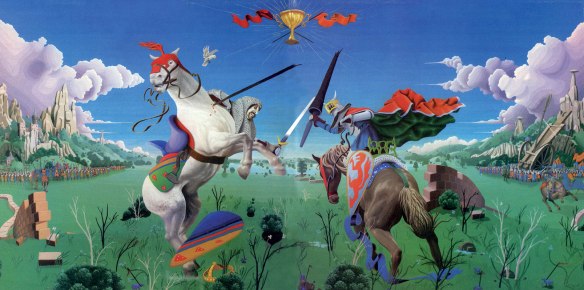
Well a lot of it was from my father, who’s now a silver fox…and we were brought up on things like Pink Floyd, Queen and Fleetwood Mac, and lots of blues and jazz – though no specific names jump out at me. He used to play things like Rick Wakeman, Mike Oldfield’s Tubular Bells, Jean Michel Jarre’s Oxygene – all that kind of stuff – and all sorts of what might be considered wacky music! There was one particular album – Rick Wakeman I think – where it was like a battle. King Arthur I think it was, and there was a cover where there was a horse being stabbed, I remember lying on the floor behind the sofa with my dad’s headphones on, imagining what it was like to do battle, and feeling sad that so many horses must have died. I was completely knocked out by things like that.

king-arthur

The cover of Rick Wakeman‘s King Arthur

There are so many amazing bands, but things that stick in your mind…and music I used to hear when sharing a flat with my dear friends Kate and Jan. I think of Fleetwood Mac, Stevie Nicks, Judy Tzuke, then bands like Hawkwind, The Clash and loads more. Listening to Abba with my dear friend Anne as well. I used to hate the Sex Pistols though because they used to gob on everyone! I love Orb-type stuff, the Chemical Brothers, Basement Jaxx, and Underworld had a massive influence on me when I moved down to London. I used to listen to loads of music then, in my room.

Could you name three musical acts you love, and why you love them?

Well we’ve seen the Super Furry Animals together a lot, and I love them so much because they’re wacky, original and colourful:

I used to love David Lee Roth, and had a poster of him over my bed. It wasn’t that I fancied him necessarily – well, I did! – but it was the cockiness he portrayed, the glint in his eye, the kind of music he sang and the humour as well – like the song Just A Gigolo, with his band mates onstage – a bit like Magic Mike. I went to three or four concerts on my own to see him!

I would say Joni Mitchell too, because every time I hear her voice she takes me to a place that I completely identify with, whether it’s Big Yellow Taxi, Blue or Heartbreak – stuff that you’ve done that you know you can’t get back, you have to accept it. It’s joyous but heartbreaking too, and every time I hear her I just want to melt. I know all the words, all the nuances, and all the notes, and I love her songwriting.

What has been your experience of classical music so far?

Well quite a lot from the beginning, because my mum and dad used to listen to stuff like Strauss – the music to 2001 – or Holst‘s The Planets­ – but there was a whole lot more. Apparently I kicked off about learning classical guitar, so they took me to do that, and I got to grade 8. Mum and Dad do like to regale the fact that I was so frustrated with practising that I once bit my guitar! There were chew marks around it! That’s basically what they will remember. I did very well in exams but I used to bite my guitar a lot and was locked in my room and made to practise. I gave it to a woman in London.

Then I met you – my husband now! – and we realised we had a lot in common. You would suggest stuff to go and see. We talk about music a lot, and I used to regale the music I listened to – and still do now. After a period of time I went to the Proms with you, but I haven’t been very often. I love listening to classical music, and we’ve been to see Holst’s The Planets and Britten’s War Requiem, which was incredible but more depressing – but the voices lifted you up. I’m really lucky to have seen that, but I do find it difficult to sit still while I’m listening for a long period of time at concerts, where I would like to move around. If I was watching a film it would be different.

How did you rate your first Proms experience?

It was mind blowing. It made my hair stand on end, as soon as I heard the orchestra and the singers I was blown away. There was one particular part that they use a lot in the X-factor, that we’re all familiar with – which is really annoying – but I loved it. It was colourful and beautiful. There were dips on occasion when the soloists were singing, which is what seems to happen, but I would say I was really listening to it, and at times I was closing my eyes and feeling the music.

I absolutely loved it, but I’ve been to a few concerts with you and so I guess you knew I would like it! I’m very good at switching myself off and on again from the day, because you can’t go somewhere in a bad mood and enjoy a concert, so I find you do have to do that sometimes.

I haven’t been to the Proms as often as you have but I think it is an amazing cultural institution that has been going for so long. I think they have been good at introducing new things, and having the tickets where you can stand is really good. I definitely think they could do more to introduce classical music to the greater public though, because I know for a fact those who have heard it on advertisements or TV have no idea where it’s come from, or the context, and they would love to go and see it. They could do more to introduce the more general classical music to encourage people.

That’s where I think your website could be the most amazing thing. Nobody makes enough of an effort to introduce people to new kinds of classical music. We’ve got loads of friends who love the classical music we’ve played at parties, from 1 o’clock in the afternoon, people who have loved it but don’t know an awful lot about it. It would be amazing if we could encourage more people like that along to the Proms to experience the environment, because tonight was absolutely gorgeous and amazing!

Would you go again?

Definitely. I loved it!

Verdict: SUCCESS