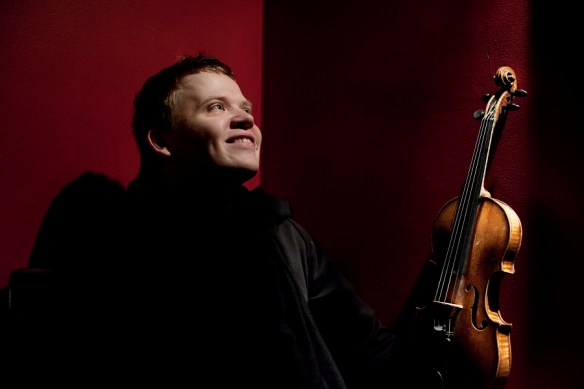
On Record – Helsinki Philharmonic Orchestra / Pekka Kuusisto; BBC Scottish SO / Martyn Brabbins – Jaakko Kuusisto: Symphony (BIS)

BBC Scottish Symphony Orchestra / Martyn Brabbins (Birthday Variations); Helsinki Philharmonic Orchestra / Pekka Kuusisto (Symphony)

Various Pictured Within: Birthday Variations for M.C.B. (2019)
Jaakko Kuusisto (comp. Pekka Kuusisto & Eskola) Symphony Op.39 (2020-21)

BIS 2747 [66’32”]
Producers Andrew Trinick (Variations), Robert Suff (Symphony) Engineers Graeme Taylor (Variations), Enno Mäemets (Symphony)
Live recordings, 13 August 2019 at Royal Albert Hall, London (Variations); 8 December 2022 at Music Centre, Helsinki

Reviewed by Richard Whitehouse

What’s the story?

The BIS label issues one of the most fascinating among recent releases, one that juxtaposes a latter-day equivalent to Elgar’s Enigma Variations with a posthumously completed symphony by one of Finland’s leading conductors which now becomes a tribute to his untimely passing.

What’s the music like?

It was clearly a great idea that the BBC commission a piece to mark Martyn Brabbins’s 60th birthday, featuring 14 composers with whom this stylistically most wide-ranging of current British conductors has been associated. The outcome is Pictured Within: Birthday Variations for M.C.B. – each composer having provided a variation on the ‘anonymous’ theme for what here becomes an inverse take on Elgarian procedure in the latter’s Variations on an Original Theme; a work whose ground-plan also furnishes the formal framework of the present piece.

It is worth considering the ways in which these composers seem either inhibited or liberated by their placing (determined beforehand by Brabbins) within the overall scheme. Given this theme – understated to a fault – yields its potential more from the harmonic then melodic or rhythmic angle, the most successful tend to make a virtue of such constraints: thus the ‘Tact 60’ of Variation I finds Dai Fujikura hinting guardedly at ‘C.A.E.’. David Sawer capriciously conjures ‘H.D.S-P.’, while Sally Beamish offers a deftly ironic parallel to ‘R.B.T’ and Colin Matthews rumbustiously complements ‘W.M.B.’ Iris ter Schiphorst captures the pensiveness if not the geniality of ‘R.P.A.’, whereas violist-turned-composer Brett Dean proves a natural fit for the undulating poise of ‘Ysobel’ and Win Henderickx evokes ‘Troyte’ with real gusto.

His ruminative Variation VII finds Richard Blackford emulating more the connection with a country house than ‘W.N.’, while Harrison Birtwistle throws caution to the wind in a darkly inward contrast to ‘Nimrod’, and ‘Sixty Salutations’ finds Judith Weir in an engaging take on the halting charms of ‘Dorabella’. Gavin Bryars rouses himself to unexpected activity in his reading of ‘G.R.S.’, whereas Kalevi Aho is more suited to the sombre eloquence of ‘B.G.N.’ and Anthony Payne ably plumbs the inherent mysteries of ‘***’. John Pickard then takes on the daunting challenge of ‘E.D.U.’ in The Art of Beginning – the mingling of portentousness and humour appearing to make light of its Longfellow association, but whose organ-capped apotheosis confirms real appreciation of the ‘right ending’ as constituting an art unto itself.

The coupling is as unexpected as it proves apposite. Remembered as a notable violinist and a versatile conductor, Jaakko Kuusisto (1974-2022) turned increasingly to composition and, at his untimely death through brain cancer, had planned a symphony for Osmo Vänskä and the Minnesota Orchestra. Acting on behalf of his widow, his younger brother Pekka and copyist Jari Eskola realized this piece from several minutes of extant fragments such that Kuusisto’s Symphony takes its place as the last statement by one who ostensibly had much more to give.

Playing just over 25 minutes, the work falls into two separate movements. Shorter and more outwardly cohesive, the first of these emerges as imperceptibly as it evanesces – taking in a tersely rhythmic central episode, then a warmly expressive melody with more than a hint of American post-Minimalism. Almost twice as long, the Lento seems more discursive but no less absorbing – picking up where its predecessor left off as it builds to impulsive climaxes, separated by an eloquent span derived from a chorale-like theme. Nothing, though, prepares one for the ending – a sequence of quietly interlocking ostinato patterns, evidently inspired by light signals beamed in the Gulf of Finland and underpinned by undulating timpani. The effect is haunting and unworldly but, for these very qualities, wholly fitting as a conclusion.

Does it all work?

Pretty much always. Those expecting an Elgarian ‘re-run’ may be disconcerted by Pictured Within, but this only serves to reinforce the stylistic autonomy and variety of the composers involved (three of whom sadly no longer with us) in what is a tribute to Brabbins’s acumen for involving them in the first instance. Quirky and compelling, the Kuusisto is appreciably more than a labour of love on behalf of those who brought about its completion: both works deserving revival for their intrinsic merits rather than commemorating a particular occasion.

Is it recommended?

Absolutely. These live performances (that of Pictures Within being that of the premiere) have come up well as presented here, while there are detailed notes on each piece by John Pickard and Jaani Länsiö. This fascinating release more than justifies itself musically and artistically.

Buy

For purchasing options, and to listen to audio clips, visit the Presto website. For more information on the artists, click on the names for more on Martyn Brabbins, Pekka Kuusisto, the BBC Scottish Symphony Orchestra and the Helsinki Philharmonic Orchestra For dedicated resources on the composer, you can visit a website dedicated to Jaakko Kuusisto

Published post no.2,265 – Friday 9 August 2024

New Music at the BBC Proms

For our UK readers, a nod in the direction of BBC4 tonight – where there is a chance to experience some of the standout new music heard during this year’s BBC Proms festival.

There is a chance to experience more of one of today’s standout orchestral composers, Andrea Tarrodi – her Birds Of Paradise is featured, inspired by footage from David Attenborough’s Planet Earth and performed by the Deutsche Kammerphilharmonie Bremen, conducted by Pekka Kuusisto (above, photographed by Mark Allan).

From the first night comes Let There Be Light, by Ukrainian composer Bohdana Frolyak, while the National Youth Orchestra perform The Whole World, a heady new work from Errolyn Wallen.

You can watch from 8pm here

On record – Aurora Orchestra / Nicholas Collon: Music of the Spheres (DG)

Pekka Kuusisto (violin), Iestyn Davies (countertenor), Sam Swallow (vocalist), Aurora Orchestra / Nicholas Collon

Mozart Symphony no.41 in C major K551 ‘Jupiter’ (1788)
Richter Journey (CP1919) (2019)
Dowland arr. Muhly Time Stands Still (1603)
Adès Violin Concerto ‘Concentric Paths’ (2005)
Bowie arr. John Barber Life on Mars? (1971)

Deutsche Grammophon 4838228 [69′]

Recorded 9 June 2019, Maida Vale Studio 1, London

Written by Ben Hogwood

What’s the story?

Only the Aurora Orchestra could put together an album running from Mozart to David Bowie. Yet as we have seen from their previous themed releases such as Insomnia and Road Trip, there are no gimmicks involved in their musical choices and a clear theme runs through the programming.

Music of the Spheres is no exception, beginning with Mozart’s Jupiter symphony before music from Max Richter (Journey), Dowland via Muhly (Time Stands Still) and the Violin Concerto of Thomas Adès, subtitled Concentric Paths. The soloist here is Pekka Kuusisto, while the Aurora play the Jupiter symphony entirely from memory, as they did in the BBC Proms in 2016.

What’s the music like?

There is something for everyone here. Mozart’s Jupiter symphony is his 41st and final essay in the genre, setting a new bar for the form when it was completed. While the first three movements are particularly fine it is the finale that comes in for the greatest acclamation, for its well-nigh perfect fusion of melody and counterpoint.

Richter’s Journey CP1919, is inspired by and named after the discovery of the first Pulsar star. It fits perfectly onto the tail of the Mozart, running at a slow speed and operating in C minor rather than the earlier piece’s key of C major.

By contrast Adès’ Concentric Paths operates in a wider orbit, the violin soaring at great heights over the compelling orchestral writing, which has in its spiralling strong echoes of the music of Benjamin Britten. As soloist Pekka Kuusisto has described, ‘it’s hyper-emotional music for people in an accelerating world’.

Complementing these instrumental pieces are two songs of identical length but very different form – a serene early 17th century song from Dowland and one of the best-known pop songs of the 20th century. Having heard from Jupiter and CP1919, Sam Swallow asks, to effective arranged accompaniment, is there Life On Mars?

Does it all work?

Pretty much! The Jupiter gets an athletic performance from the Aurora Orchestra – no dallying here, or lingering on expressive notes. That does mean a darkening of the slow movement, and maybe some constricted phrases, but by contrast it means an exciting first movement, a mysterious Menuetto and a lithe finale, busy and brilliantly played.

The Richter is haunting and really effective, its simplicity leaving the orchestra plenty of room to create a remote atmosphere. The songs are great too – Iestyn Davies is the perfect choice for the Dowland, with Nico Muhly’s sensitive orchestration, while Sam Swallow puts his own stamp on Life on Mars? without losing the essence of the original, which is an impressive achievement.

Yet the performance I kept coming back to was Pekka Kuusisto’s white-hot rendering of the Adès. This is terrifically difficult music to play, but he makes it sound easy even at the highest points of the violin range, and the moods range from serenity to power and even anger as the music moves relentlessly forwards. On occasion I have to admit I find Thomas Adès music hard to relate to emotionally, but this is a clear exception and the music digs deep.

Is it recommended?

Yes. The Aurora’s albums are great at bringing music of very different origins together, exposing new elements and old qualities, and it does so again here. Freshly minted Mozart and brilliantly played contemporary works, plus a good deal of imagination. What’s not to love?

Listen

Buy

You can purchase this recording from various digital outlets via the Presto website

BBC Proms 2016 – Pekka Suusisto, Thomas Dausgaard and the BBC Scottish Symphony Orchestra

Pekka Kuusisto High Res 6 - credit Maija Tammi

Pekka Kuusisto (c) Maija Tammi

Prom 27; Royal Albert Hall, 5 August 2016

You can watch this Prom from its BBC broadcast – the Grime and Tchaikovsky here and the Stravinsky here

For sheer musical enjoyment this Prom took some beating.

Right from the start it was clear the players of the BBC Scottish Symphony Orchestra were at the Royal Albert Hall to enjoy their Friday night, and in Pekka Kuusisto they had a more than willing accomplice.

It was Kuusisto’s first appearance at the festival, and as he arrived onstage he gazed in wonder at the full hall, taking in its scope and bidding a cheery ‘hello’ to the front ranks of the Prommers. At that moment you sensed his performance, even before he played a note, had gone up a gear.

Sure enough, his performance of Tchaikovksy’s Violin Concerto was dazzling, but he was careful not to let technical feats overshadow the core of the music’s emotion. As the longer first movement unfolded so did the ardent, lyrical phrases, until we reached the solo cadenza, where just a flick of the eyes and arms were enough to get the audience laughing. Kuusisto plays a lot of his music as though for the first time, the childlike innocence (not to mention his boyish face!) a combination of pure enjoyment. The audience, wrapped up in the occasion, applauded as though he had finished, fully aware there were two more movements to come.

These were the doleful Canzonetta, reminding us of the serious circumstances in which the piece was composed (Tchaikovsky’s disastrous and shortlived marriage, made in spite of his convictions around his homosexual orientation) and a finale that brushed all that aside, its main tune from the violin scampering all over the orchestra as they tried to keep up.

Both violinist and orchestra rightly received a rapturous ovation, but Kuusisto was not done, returning for a traditional Finnish song. Following Sol Gabetta’s lead from the First Night he did the singing, while BBC SSO leader Laura Samuel gamely added a rustic accompaniment. Even the audience were involved, singing one of the phrases as Kuusisto brought the house down.

Even after that the enjoyment was yet to peak, for Thomas Dausgaard – who had shaped Tchaikovksy’s phrases rather beautifully – led them in a vibrant account of Stravinsky’s Petrushka. The composer’s second ballet is perhaps his most tuneful, full of Russian folk song references as it tells the tale of the ultimately doomed puppet. The colours of this performance were given by the BBC SSO at their very best, with superb contributions from Mark O’Keeffe and Eric Dunlea (trumpets), a beautiful, child-like solo from flautist Charlotte Ashton, and wonderful contributions from solo woodwind, brass and percussion alike – not to mention the brilliant efforts of pianist Lynda Cochrane and Julia Lynch on celesta.

Dausgaard was enjoying himself, and although on occasion the music was a little fast it was never less than energetic, the players relishing the shades of colour in The Shrovetide Fair, and the irresistible hooks and dance rhythms Stravinsky threads through the music.

Dausgaard is due to take over full time as chief conductor of the orchestra in the autumn, and on this evidence the two look set for a fruitful musical relationship.

eardleyCatterline in Winter (c) The estate of Joan Eardley.
Beginning the concert was the first part of Helen Grime’s Two Eardley Pictures, a new piece commissioned by the BBC and with its second part today. This one, Catterline in Winter, portrayed the fishing village of the North of Scotland, capturing it in steely, metallic colours – reflecting the dark grey sky and the icy blasts of a seemingly ever present wind. It is always difficult to appraise a new piece on first hearing, but this was an impressive and brightly lit score that is well worth hearing for a second time – preferably in the company of the second, Snow.

Ben Hogwood

Wigmore Mondays – Pekka Kuusisto & Nicolas Altstaedt: Music for violin and cello

kuusisto-altstaedt

Pekka Kuusisto (violin), Nicolas Altstaedt (cello)

Wigmore Hall, London, 23 May 2016

written by Ben Hogwood

Audio (open in a new window)

http://www.bbc.co.uk/programmes/b07c3r1b

Available until 23 June

What’s the music?

J.S.Bach – Two part inventions (c1720-23) interspersed with Widmann – Duos for violin and cello (2008) (24 minutes)

Ravel – Sonata for violin and cello (1920-22) (23 minutes)

Spotify

In case you cannot hear the broadcast, recordings of the music played can be found on the Spotify playlist below where available. Not all of the Widmann pieces have been recorded yet, but where possible good alternative versions have been used:

About the music

As the Wigmore Hall programme writer Gerald Larner notes, the combination of violin and cello is a surprisingly scarce one in classical music. There are hardly any recognised works for the pairing, the two most notable being duos by Ravel and Kodály, but just recently the German composer and clarinettist Jörg Widmann (b1973) has shown real creativity in his 24 duos.

They make an ideal contrast with the Bach Inventions, which transcribe seamlessly from keyboard to violin and cello, the violin taking the right hand part and the cello the left. In doing so they bring out the counterpoint behind the music. Widmann’s pieces are more about instrumental colour, but they have melody too – and he enjoys sending up particular dance forms and such, especially when he includes a James Bond theme in the final piece!

Even a composer as accomplished as Ravel did not find the combination of violin and cello an easy one. He began the Sonata in 1920 as a tribute to Debussy, but did not finish it for another year and a half, distracted by a house move and fuelled by the need to give his music a new austerity. Despite the use of only two lines the composer’s flair for harmonic movement still comes through, though the piece does still sound impressively modern.

Performance verdict

A wholly enjoyable concert, thanks to the chemistry between two performers who clearly enjoy their craft. Pekka Kuusisto has always been a charismatic violinist but Nicolas Altstaedt more than matched him here, and because they were in close proximity on the Wigmore Hall stage it was easy to see them as one instrument rather than two.

The interpolation of Bach and Widmann was a clever one, because the music of the former was notable for clean lines and impeccably worked out counterpoint, while the latter concentrated on colours, feelings and dance forms. Moving between the two extremes was a constant source of musical stimulation, and was brilliantly performed – especially in the final Widmann piece, a real tour de force.

The Ravel was superb, helped by the ability of these performers to project while playing incredibly quietly. Because of this the slow movement was the most searching of the four emotionally, potentially a tribute to the departed Debussy. The faster movements were thrilling, showing Ravel’s close relationship with differing dance forms but also the many and varied ways in which he extracts instrumental colour.

The encore, Sibelius’ first published piece, was inspired in its simplicity.

What should I listen out for?

Bach / Widmann

1:38 Bach Invention no.1 in C – there is a beautiful simplicity about Bach’s writing as the violin takes what would have been the right hand of the keyboard, and the cello the left. The counterpoint (i.e. the intertwining of melodies between the instruments) is immaculate.

3:19 Widmann Duo no. XIV Capriccio­ – Widmann’s coloristic effects include snapped pizzicato (plucking) and sudden, jarring phrases, as though the instruments are having a bit of a bout.

5:06 Bach Invention no.4 in D minor­ – after the outbursts of the Widmann it is almost a surprise to return to the clean tonality of the Bach, but it works well – and again the cello part finds itself in exact imitation of the violin

6:10 Widmann Duo no. XVI Petit ballet mécanique (Pas de deux) – a short and shady duo this, with short phrases and implied moods that never fully establish themselves.

7:10 Bach Invention no.6 in E – again Bach’s simplicity is all that matters here. The key of E major makes for a nice, open sound as the strings play with little vibrato.

11:17 Widmann Duo no. XXII Lamento – here Widmann is casting his mind back to the Baroque period, and the strings play close together with no vibrato – a stark sound

13:48 Bach Invention no.8 in F – a much quicker invention that works well in its string arrangement, the rapid movement of Bach’s figures passed between the instruments

14:41 Widmann Duo no. XXI Valse bavaroise – an exaggerated form of pastiche from Widmann here, with scratchy discords and long notes flying between the instruments, not to mention some pretty outrageous glissando passages from the cello!

16:46 Bach Invention no.14 in B flat – a quieter, more reverential piece.

18:38 Widmann Duo no. XIII Vier Strophen vom Heimweh – another slow Widmann piece, using a lot of double stopping so that it sounds more like a string quartet. Again the sound is cold, due to the use of mutes and the almost complete lack of vibrato.

20:48 Bach Invention no.15 in B minor – a solemn mood hangs over this invention, which again is played with very little vibrato – though the players do allow themselves a few liberties with variations of speed and volume.

22:31 Widmann Duo no. XXIV Toccatina all’inglese – a tour de force of virtuosity, this is the first of the Widmann pieces to be an obvious display vehicle for the two players, who rush up and down the fingerboard. There is an extended passage of plucking that briefly gives the music a Far Eastern feel, and there is a tune – where can you spot On her Majesty’s Secret Service?

Ravel

29:00 The first movement has shadowy beginnings, emerging as though from the mists – with the violin and cello very close together as they exchange musical thoughts. The clean timbres are a result of the players using harmonics – where the string is very lightly touched with the fingers on the left hand rather than pressed.

35:05 A faster movement that begins with both instruments plucking, and finds Ravel exploring a great many colours and combinations from this seemingly limited instrumental pairing. The sparse texture is a challenge for him, and sometimes he enhances it with scratched phrases and an almost complete lack of sustain, as in the passage from 36:10 onwards, with the cello’s furious chords.

39:08 The slow movement, a bleak utterance – and it is tempting to think it might owe its inspiration to the recently finished First World War. It takes a long time for the mood to rise above anything other than grim contemplation, but when it does there is a passionate piece of writing in the centre of the movement. Ravel, though is ultimately a positive composer, and this can be heard in the last phrases, which effectively shift the music from darkness to light.

46:04 The last movement reasserts a positive frame of mind with a vigorous jig, the two instruments playing with plenty of energy and rhythmic punch. The tune is catchy too! Ravel is the master of using instrumental effects for colour rather than for their own sake, and that is very much the case here, with harmonics, pizzicato, double stopping and different bowing techniques giving him a wide variety of shades. It is partly what makes this duo such compelling listening.

Encore

54:40 The fascinating encore is Water Droplets, the first published piece by the eight year old Jean Sibelius. It is incredibly simple – played entirely in pizzicato – but is all the more effective for that, as it paints such a vivid picture in its minute-long duration!

Further listening

Having mentioned the Kodály Duo for violin and cello it makes sense to include that as the extra listening here – on the same album as a substantial work for the combination by Erwin Schulhoff:

Meanwhile the video clip below gives an introduction to Jörg Widmann’s music for string quartet: