ECMA showcase – Pacific Quartet Vienna at the Wigmore Hall

pacific-quartet

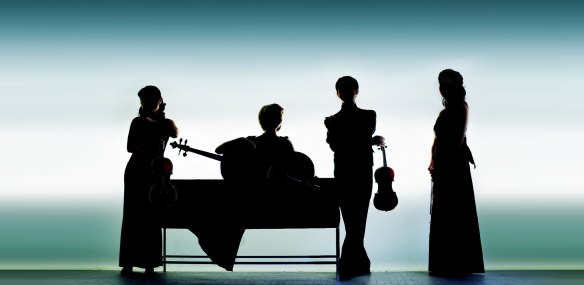
Pacific Quartet Vienna (Yuta Takase, Eszter Major (violins), Chin-Ting Huang (viola), Sarah Weilenmann (cello))

Mozart String Quartet in D minor, K421 (1783)

Schumann String Quartet in A major Op.41/3 (1842)

Wigmore Hall; Saturday January 28, 2017

Flying in the face of Brexit, the European Chamber Music Academy is a body established in 2004 by the Alban Berg Quartet founder Hatto Beyerle.

It provides training for flourishing chamber ensembles, and here gave a showcase for the Pacific Quartet of Vienna, a chance for them to play at the hallowed Wigmore Hall for the first time.

There was much to admire. A nicely balanced program of Mozart and Schumann began with one of the six quartets the former composer wrote and dedicated to Haydn. The D minor is the darkest quartet of the six, exploring more oblique harmonies and melodies than the composer normally would. The quartet gave a nicely poised performance, the obdurate and slightly gruff outer movements punctuated by flashes of light. The slow movement was light and beautifully floated, as though they were performing an aria, while the trio section of the stern minuet took the weight away completely, a note of mischief added to the duets between leader Yuta Takase and violist Chin-Ting Huang.

For the Schumann the quartet had a noticeably warmer sound, and they bought joy to one of the composer’s happiest utterances, written in the wake of his marriage to Clara. The lyrical first movement and romantic third were affectionately played, Huang giving maximum expression to the melodies. The scherzo was fun but eventually paled in the shadow of the finale, which gets obsessed with a ten note motif to the point of distraction. Here it cropped up with amusing regularity, the intervening sections deliberately contrasted with it so that it felt like home.

This was an impressive first Wigmore outing for the quartet, who clearly enjoyed the experience and the music they brought with them. I would wager it won’t be the last!

You can read more about forthcoming ECMA events at their website, while further information about the Pacific Quartet Vienna can be found by clicking here

The Genesis of Minerva: Schumann and the Young Brahms – Minverva Piano Trio

minerva-piano-trio

Minerva Piano Trio (above): Michal Cwizewicz (violin), Richard Birchall (cello), Annie Yim (piano)

St John’s Smith Square, London; Sunday 23rd October, 2016

Schumann Piano Trio No.1 in D minor Op.63 (1847)

Birchall Contours (2014)

Brahms Piano Trio No. 1 in B, Op. 8a (original 1854 version)

A season-long residency as Young Artists at St John’s is enabling the Minerva Piano Trio to schedule several worthwhile recitals. None fitted the bill more than this afternoon’s programme, culminating in a rare revival for the First Piano Trio of Brahms as heard in its original version.

Completed when he was barely into his twenties, this is the only work from the outset of Brahms’s maturity to have survived essentially as it was conceived. That the composer substantially re-wrote it in 1889 (after his temporary ‘retirement’ from composition) but allowed the versions to co-exist suggests that, dissatisfied though he may have become with them, he was unable to suppress those earlier thoughts. One does not look to the 1854 version for formal unity or finesse, but it certainly has the edge in terms of expression and tonal cohesion.

The opening Allegro is as much about charting an emotional course through its constituent themes than fashioning them into a logical argument, yet such is the imaginative resource with which Brahms elaborates his material that the movement as it evolves becomes its own justification. The Minerva audibly appreciated this with playing as perceptive as the music required, then was equally inside the Scherzo with its alternately brusque and elegant ideas – and an intriguingly fugitive ending that the revision streamlines into something less arresting.

With its multiple allusions to the then nascent Lieder tradition, the Adagio casts a magnetic if unsettling spell and the Minerva accordingly brought out its exquisite ambiguity in full measure. No less impressive was a Finale which, irrespective of how convincing – or otherwise – is its reworking (and Clara Schumann’s strictures cannot be lightly dismissed), the audacious homecoming in B minor is here suffused with inevitability such as the older and wiser Brahms was unable to achieve by modulatory means alone: a QED in every sense.

A commanding performance, then, and the Minerva had been hardly less inside the idiom of Schumann’s own First Piano Trio at the start of this recital. Whether or not the emergence of his wife Clara’s masterly work for the medium just a year before was indeed the catalyst, the present piece harnesses those sombre hues often to the fore in Schumann’s later music with a textural translucency which never spills over into opacity. This, at least, was the impression left by a reading that plotted a resolute course through the discursive design of the opening movement then clarified the scherzo’s rhythmic intricacy without sacrificing its poise. The plangent ‘song without words’ that follows was seamlessly dovetailed into the finale, which unfolded with no lack of incident on its way to a decisive while tenuously affirmative close.

Coming between these expansive staples of the repertoire, Contours by the Minerva’s cellist Richard Birchall proved a diverting entity – its four brief movements amounting to a discreet unity that, with its evocative Nocturne and engaging Fast Waltz, confirmed a real grasp of this difficult medium. There was further music at the close – when, in response to generous applause, the Minerva gave an easeful reading of the Andante from Clara Schumann’s Piano Trio in G minor. An eloquent conclusion to an impressive recital by an ensemble which is clearly going places.

Richard Whitehouse

The Minerva Piano Trio returns to St John’s for further concerts on 9th March and 1st June 2017. Further information can be found at the St John’s website. You can hear more of the trio below:

Wigmore Mondays – Steven Isserlis & Olli Mustonen in Prokofiev, Schumann and Mustonen

steven-isserlis-olli-mustonen

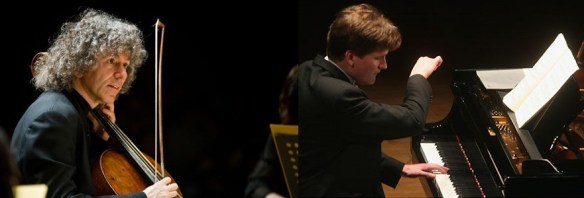
Steven Isserlis (cello), Olli Mustonen (piano) (both above)

Schumann 3 Romances, Op 94 (1849) (11 minutes); 3 pieces from Album für die Jugend, Op 68: Sheherazade; Winterszeit I & II (1848) (9 minutes)

Olli Mustonen Frei, aber einsam (UK premiere) (2014) (4 minutes)

Schumann arr. Isserlis Intermezzo from F.A.E sonata (1853) (3 minutes)

Prokofiev Cello Sonata in C, Op 119 (1949) (23 minutes)

Listen to the BBC Radio 3 broadcast here, until 2 November

Arcana’s commentary

Schumann is arguably Steven Isserlis‘ favourite composer. The clues are there in the enthusiasm with which the cellist talks about his music, the affection he gives to each of the melodic lines, and in this concert the construction of an imaginative suite of works for cello and piano, where his natural and extremely intimate lyrical side was to the fore.

Schumann did not write a fully-fledged sonata for cello and piano, but he did complete a number of pieces either directly for the combination or in a form that could be naturally arranged. Such is the case with the 3 Romances, published for oboe and piano as Schumann’s Op.94 but making a seamless transition to the cello.

In this performance the first Romance (from 1:47 on the BBC iPlayer) is a little doleful, the second (from 5:22) is notable for a relatively stormy central section, while the third (9:13) brings the instruments together in thoughtful unison.

After this Isserlis sat head bowed, listening intently as Olli Mustonen performed pieces from Album for the Young as though he and the listener were the only two people in the room. The first piece is Sheherazade (from 13:19), finding the level of intimacy that Schumann’s pieces for the young so consistently achieve, then from 17:10 we hear Winterszeit I and then the changing moods of Winterszeit II (19:01)

Mustonen himself then turns composer, with Frei, aber einsam (from 22:06), a piece for Isserlis alone written with the grace and intimacy of Schumann. It also has a bit of his childlike mischief when it gathers confidence – rather like a bird emerging from the nest – and starts flying along.

Mustonen uses the notes F-A-E as his starting point – which offers a strong like to the next work, heard from 26:46 we hear a tender performance of an arrangement of Schumann’s Romance for the collaborative FAE Sonata, a work written in tandem with Brahms (who contributed the famous Scherzo) and Albert Dietrich. It uses the notes ‘F-A-E’ in the simplest possible way – but also the most personal.

Following this attractive suite is the Cello Sonata of Prokofiev. Typically for the Russian composer this is full of good tunes, and in this performance (from 32:26) Isserlis and Mustonen bring them all to life in a vivacious performance. Isserlis had his way with the audience in the hall, too, with a few glances that sent up the more humourous moments of the second movement perfectly (from 42:46). There is music of romantic power, too, whether in the powerful climax of the first movement (at 41:11) or in the big finale (from 47:27) which sweeps impressively through its return to the main tune at 51:47.

A wonderfully affirming concert ends on a sad note with a tribute to the late conductor and violinist Sir Neville Marriner, the face of the Academy of St Martin-in-the-Fields, who passed away the day before at the age of 92. Isserlis chose the second of Schumann’s Five Pieces in Folk Style (from 56:42), and with Mustonen proceeded to give a touching and affectionate encore.

Further listening

For more music related to this concert, try the Schumann and the FAE playlist on Spotify below. This includes the whole of the collaborative FAE Sonata, the oboe and piano version of the 3 Fantasy Pieces in a wonderful recording from Heinz Holliger and Alfred Brendel and, to finish with, a rare recording of the Cello Sonata no.1 by Myaskovsky. He was the composer who raved about Prokofiev‘s Cello Sonata after its early performances – so here is his own moment in the sun:

by Ben Hogwood

BBC Proms – Nielsen Fifth Symphony; Schumann Violin Concerto & Jörg Widmann’s Armonica – BBC Philharmonic / Storgårds

prom-23-1

John Storgårds conducts the BBC Philharmonic at the BBC Proms on Monday 1 August. (c) Chris Christodolou

Prom 23; Royal Albert Hall, Monday 1 August 2016

Widmann Armonica (2006) [UK premiere] [Christa Schönfeldinger (glass harmonica), Teodoro Anzellotti, (accordion)]

Schumann Violin Concerto in D minor (1853) (Thomas Zehetmair, violin)

Sibelius The Tempest – Prelude (1925)

Nielsen Symphony No.5 (1922)

Listen on the BBC iPlayer here

Tonight’s Prom brought a first visit this season from the BBC Philharmonic, conducted by its principal guest conductor John Storgårds in a wide-ranging programme which began in ethereal near-silence and ended in a blaze of affirmation rarely equalled this past century.

The relative silence was to be found in Armonica, among the most distinctive pieces by Jörg Widmann in that it features a solo role for glass harmonica – partnered here by the more abrasive sound of accordion in music which emerges into then evanesces out of focus; heard against a backdrop where indebtedness to Ligeti’s earlier orchestral works does not preclude a wealth of imaginative textures, particularly in the opening minutes. Christa Schönfeldinger and Teodoro Anzellotti interacted seamlessly, not least in those overly gestural closing pages.

prom-23-2

Christa Schönfeldinger performs Widmann’s Armonica with and Teodoro Anzellotti, John Storgårds and the BBC Philharmonic at the BBC Proms. (c) Chris Christodolou

Perhaps it was such ethereal sounds that the ailing Schumann heard over the troubled weeks prior to his final breakdown. If so, little of this otherworldliness found its way into the Violin Concerto which was his last major work. Its having been kept under wraps for eight decades, then miraculously relocated near the outset of the Nazi era, has passed into legend. Musically the piece can verge on the routine, not least a first movement whose progress is more than a little dogged due to insufficiently contrasted ideas, then a finale whose underlying polonaise rhythm abets the repetitiveness. Best is a slow movement that revisits Schumann’s ‘romanza’ idiom a last time; its enervated aura exquisitely judged by Thomas Zehetmair and Storgårds – musicians who have (uniquely?) encountered this unsettling work both as soloist and conductor.

The emotional temperature rose appreciably in the second half – first with the Prelude from the extensive incidental music Sibelius wrote for a Copenhagen production of The Tempest. Guardedly admired at first, it has latterly been hailed as a precursor of tonal innovations half a century on. While his account was not lacking for physical immediacy, Storgårds chose to emphasize those modal contours that spread across woodwind and brass as the piece moves beyond its climax towards as tenuous a resolution as any during the first half of last century.

How to wrest resolution from apparent chaos was the goal for Nielsen in his Fifth Symphony, a work that has rightly moved towards the centre of the repertoire over the past two decades. Consistency was the watchword of Storgårds’s interpretation – finding an unarguable ‘tempo giusto’ for the initial half of the first movement, its unfolding across shifting tonal planes as finely articulated as the intensifying ambivalence that suddenly clears going into the Adagio rejoinder. The climax had suitably majestic import, and it was hardly Paul Patrick’s fault if his side-drum ‘cadenza’ was outshone by John Bradbury’s plangent clarinet solo in the coda. The second movement’s propulsive opening Allegro was well judged and if Storgårds risked momentum in the curious bitonal transition, the ensuing Presto had the right headlong energy.

Nor was there any lack of focus in the fugal Andante which gradually works its way to where the earlier resolve can be regained, albeit now with a formal and expressive closure as makes possible a thrilling peroration that was superbly gauged at the end of this impressive reading.

Richard Whitehouse

Wigmore Mondays – Florian Boesch & Malcolm Martineau in Schumann & Wolf

boesch-martineau

Florian Boesch (baritone), Malcolm Martineau (piano)

Wigmore Hall, London, 4 July 2016

written by Ben Hogwood

Audio (open in a new window)

http://www.bbc.co.uk/programmes/b07j3vm5

Available until 3 August

What’s the music?

Schumann Die beiden Grenadiere Op.49/1; Abends am Strand Op.45/3; Die feindlichen Brüder Op.49/2

Märzveilchen Op.40/1; Muttertraum Op.40/2; Der Soldat Op.40/3; Der Spielmann Op.40/4 (all 1840) (20 minutes)

Wolf Goethe Lieder: Der Schäfer; Phänomen; Wandrers Nachtlied; Anakreons Grab; Harfenspieler I – III (18 minutes)

Schumann Belsatzar Op.57 (1840) (5 minutes)

Spotify

Florian Boesch has recorded a disc of Schumann but only one of the songs in this concert (Belsatzar). Here is a playlist containing all of the songs, using recordings made by the great baritone Dietrich Fischer-Dieskau:

About the music

1840 was an extraordinary year for Robert Schumann’s musical productivity. His so-called ‘year of song’, it saw him write 138 songs in total – including the eight in this recital program. Among the choice are four settings of Heine, which certainly preyed on the composer’s dark side.

In a similar vein, the year 1888 was a hugely productive one for the song composer Hugo Wolf. The tenor Ian Bostridge wrote this very fine introduction to the songs of Wolf for the Guardian in 2006. He wrote a whole songbook setting some of Goethe’s poetry, collected in 22 songs through 1888 and 1889, in the composer’s late twenties. The seven we hear are illustrations of the composer’s ability to combine melodic originality and a piano part that helps set the words in context, including the three songs of the downtrodden harpist.

Performance verdict

Florian Boesch’s baritone is an extraordinary instrument, and it is perfectly suited to the darker recesses of these Schumann settings, especially the Heine songs. Here is some of the composer’s most descriptive vocal music, and it is incredibly effective in this performance, not just for Boesch’s insights but for Malcolm Martineau’s ever colourful piano pictures. Here the colours are predominantly grey and black, but the steely edge to his lower register tone is crucial to the impact of the text and makes the moments of lighter relief – for there are a few! – ever more telling.

Similar forces are at work in the music of Wolf, which Boesch brings to thoughtful life. He is particularly effective in the slower songs such as Wandrers Nachtlied, where he and Martineau exhibit wonderful control of the drawn out phrases.

What should I listen out for?

Schumann

1:48 Die beiden Grenadiere (The two grenadiers) text

The piano’s terse introduction is quickly picked up by the baritone, who sings of the battle in dark tones. At 4:18 the song breaks into the melody of La Marseillaise, as the French grenadier expresses his wish to be buried on home soil should he die.

5:13 Abends am Strand text

A chilling song.

8:47 Die feindlichen Brüder (The hostile brothers) text

The singer and piano are closely aligned here. Initially the mood is a brooding one in preparation for the brothers’ fight, but then hostilities break out and the tempo quickens considerably, the piano stooping ever lower, well below the range of the singer.

11:20 Märzveilchen Op.40/1 (March violets) text

The mood lightens a little for Schumann’s celebration of the flowers, described by the poet as ‘a pair of laughing blue eyes’.

12:54 Muttertraum Op.40/2 (A Mother’s Dream) (Adelbert von Chamisso) text

The piano part is characteristically intimate for this soft reverie – but the peace does not last long, for there is a dark side in the form of a raven outside the window (from 14:10) at which point the singer’s tone gets progressively darker, to the depths of the end.

15:26 Der Soldat Op.40/3 (The Soldier) (Adelbert von Chamisso) text

There is a military air from the start of the piano introduction, with fanfares and ceremony, but again the mood is steely dark, right through to the drama of the bullets fired in the last verse, where the poet ‘shot him through the heart’.

18:20 Der Spielmann Op.40/4 (The Fiddler) (Adelbert von Chamisso) text

There are bright festivities at the start of this song, but again it is not long until darker thoughts emerge, the baritone sinking lower in his range as he sings of the bride of the story, who ‘looks like whitewashed death’.

Wolf

23:29 Der Schäfer (The Shephard) text

A darkly humourous song about a lazy shepherd, set by Wolf with some far-reaching harmonies and lazily decorated piano lines.

24:57 Phänomen (Phenomenon) text

A slow song, offering consolation at its end.

26:52 Wandrers Nachtlied (Wanderer’s Night Song) text

A slow and deeply sorrowful song, with long, drawn-out phrases – completed by Martineau’s soft postlude, lost in thought.

30:06 Anakreons Grab (Anakreon’s Grave) text

The contemplation at Anacreon’s Grave is not as sorrowful as one might think, ‘beautifully graced with verdant life’ in Goethe’s words. The song speaks of rest rather than torment.

32:45 Harfenspieler I text

Not surprisingly the piano imitates the harp beautifully at the start, though the vocal line that follows is quite stern, the singer imploring ‘leave me to my torment’!

36:25 Harfenspieler II text

Another predominantly slow setting, portraying a wretched man with dark tone in the singer’s voice and a reserved piano part.

38:49 Harfenspieler III text

The most dramatic of the three Harfenspieler settings, a tormented singer, in ringing tones, lamenting how the heavenly powers ‘let the wretched man feel guilt’.

Schumann

43:26 Belsatzar (Belshazzar) text

This extraordinary song runs through a whole gamut of moods and emotions. It begins with the Babylonian king singing with great bravado, his boasting and the piano’s tumbling figures adding to the sense of giddiness. At 45:24 he proclaims, ‘I am the king of Babylon!’ After this the song turns, the king fearful, until the famous writing on the wall passage, which sends a chill through the spine from 46:17. There is no coming back from here for the king, murdered by the end.

Encore

49:45 Described as ‘Twitter of the nineteenth century’ by Florian Boesch, this is Schumann’s Verratene Liebe Op 40/5 – another von Chamisso text – and it’s over in 45 seconds!

Further listening

Florian Boesch is a remarkable talent – and has forged a formidable partnership with Malcolm Martineau. Here they are in a complete album of Schumann, including the first of the composer’s Liederkreis cycles: