BBC Proms 2023 – Christian Tetzlaff, BBC Symphony Orchestra / Sakari Oramo – Weir, Schumann & Elgar

Prom 51 – Christian Tetzlaff (violin), BBC Symphony Orchestra / Sakari Oramo

Weir Begin Afresh (BBC commission, world premiere) (2022-3)
Schumann Symphony no.1 in B flat major Op.38 ‘Spring’ (1841)
Elgar Violin Concerto in B minor Op.61 (1907-10)

Royal Albert Hall, London
Thursday 24 August 2023

by Ben Hogwood photos by Andy Paradise / BBC

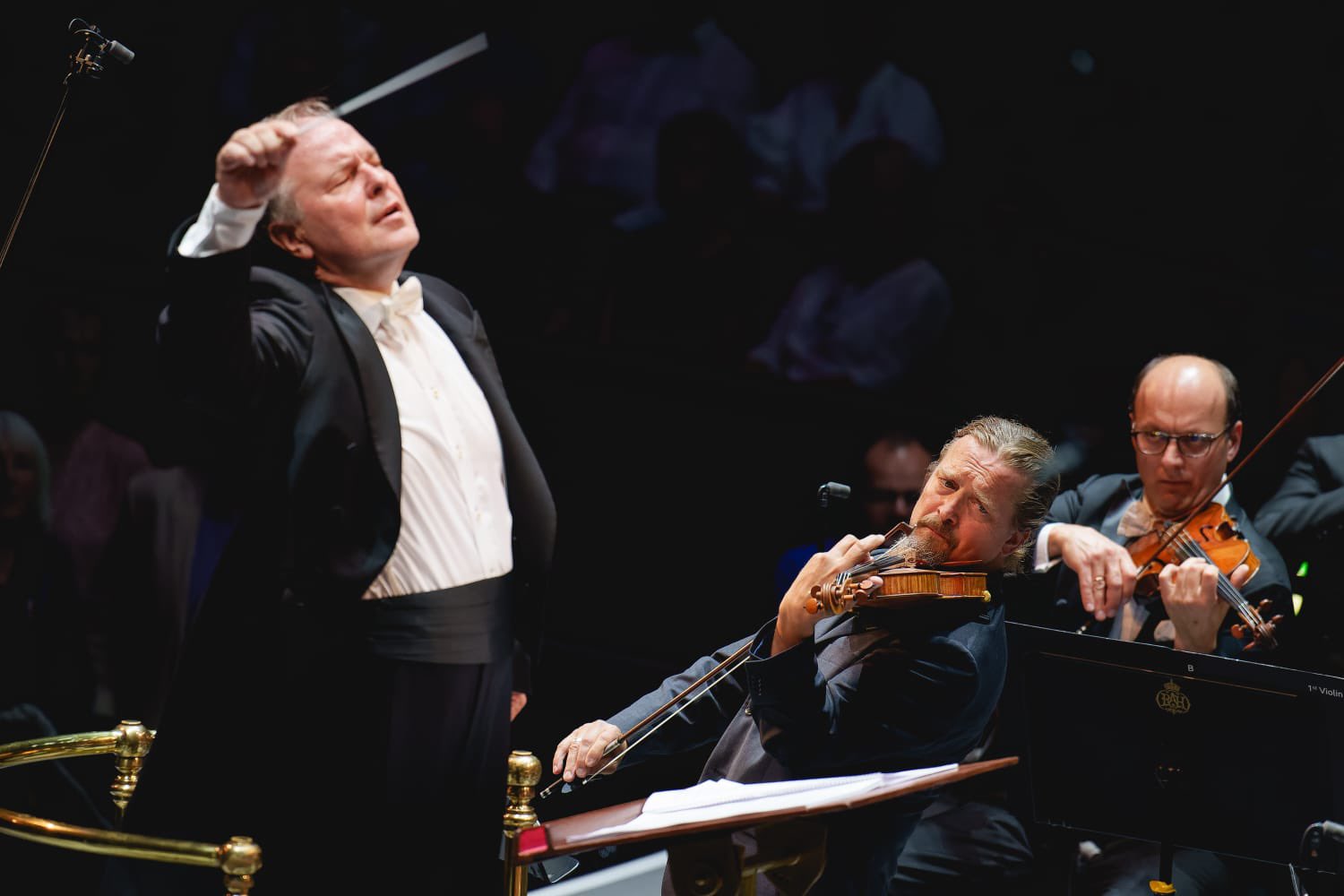
The BBC Symphony Orchestra and their chief conductor Sakari Oramo have been on fine form this Proms season, and for their fourth outing together chose a concert whose first half celebrated the vibrancy of spring.

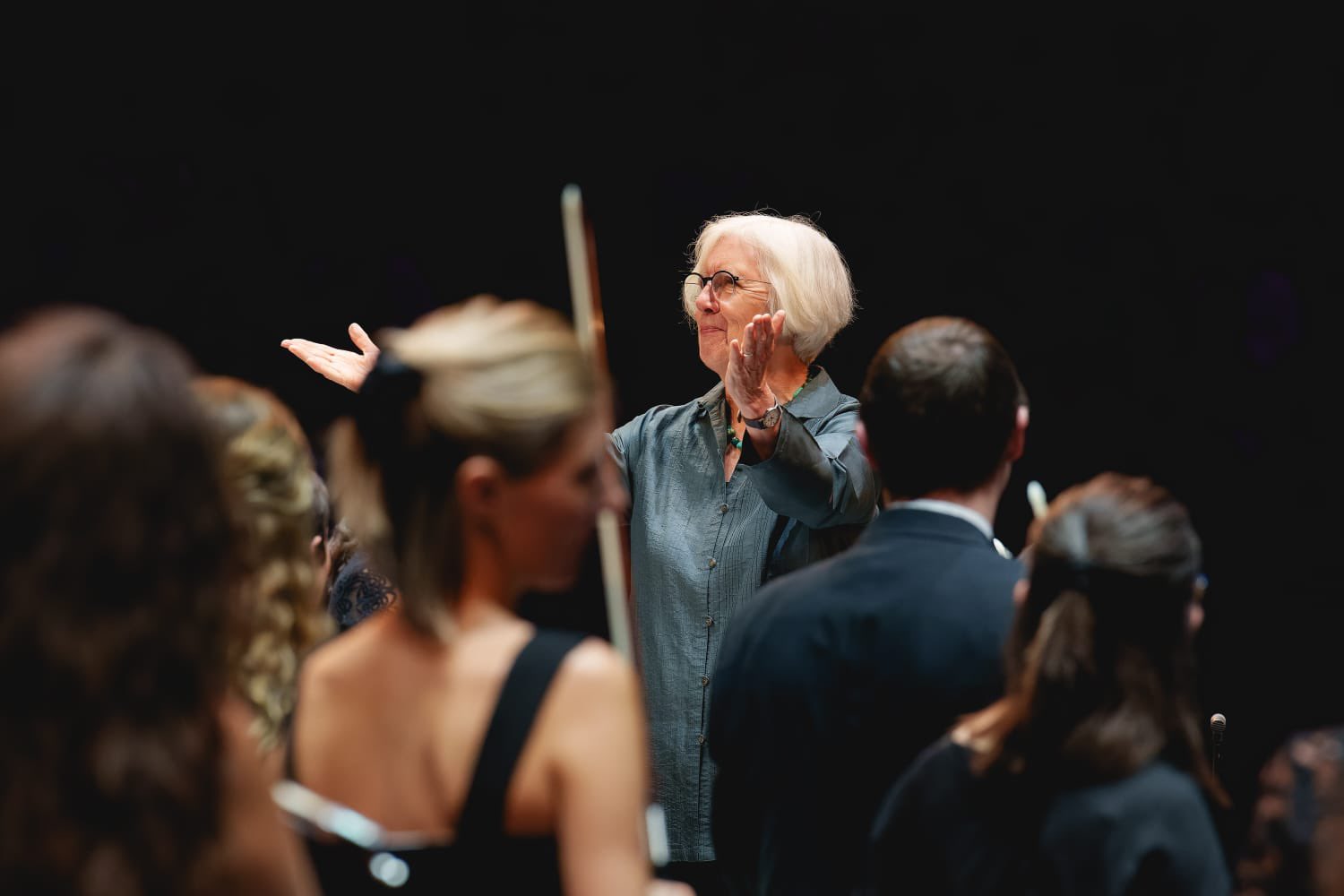
Judith Weir (below) has already written about green matter for orchestra, with her tone poem Forest premiered in 1995 and appearing at the Proms in 2019. Begin Afresh, its title inspired by Philip Larkin verse, takes a more forensic approach, looking at the wonder of trees in an urban setting. Effectively a musical diary, it begins in April, where we found orchestra leader Igor Yuzefovich teaming up with the woodwind section to lead an awakening from months of darkness. Fresh textures and opulent harmonies promised much, but October assumed a heavier tread, trees struggling to produce leaves with the onset of colder weather. Darker colours, including the sharper tone of the piano, came to the fore, but there was strong resolve reminiscent of Sibelius in the colours and phrasing, tonal but restless. True darkness set in among the lean lines of February, where roots fought against the frost, their sinewy profiles etched by the lower strings. Begin Afresh found its victory to be hard-won, but proved to be an attractive and pictorial piece deserving of more outings in the future.

Schumann’s Spring symphony, written in 1841 in the heady aftermath of his marriage to Clara, occupied an odd place in the program but benefited from a freshly minted performance. The initial fanfare set the tone for an interpretation of clarity and poise, the burbling woodwind on fine form. The ensuing Allegro molto vivace was bracing, and was complemented by a softly voiced second movement Larghetto. Here the softer shades were ideally weighted, the strings’ intimate thoughts conveyed with deep feeling. The Scherzo found the violins applying extra force, the theme balanced by two light-footed trio sections that danced happily. Oramo’s fluent reading of this wonderful symphony ended with a convincing last movement affirmation.

If spring was the main focus of the first half, Elgar’s Violin Concerto was ideally suited to late summer. There are many violin concertos in this year’s season – 13 at last count – and although this is the longest work by some distance, it did not tarry here. This was thanks in part to relatively quick tempo choices but mostly due to wholehearted investment from Oramo and soloist Christian Tetzlaff, who clearly loves the piece. From his first statement the violinist was in full, assertive control yet his most meaningful contributions were also the quietest, beckoning the audience in to Elgar’s most intimate thoughts and emotions.

The orchestral counterpoint was clearly and carefully managed by Oramo, himself a dignified Elgarian, with opportunity given for the strings to release ardent feelings in the climax points. The main themes were lovingly delivered, especially in the rapt slow movement Andante, the audience largely silent as the compelling dialogue took hold. While Tetzlaff took every opportunity for virtuoso display, reminding us that no less a violinist than Fritz Kreisler commissioned this work in 1904, none of the acrobatics were for personal gain. Instead they were at the service of Elgar’s expression, which made the final pages all the more telling. As the quiet music took hold a chill spread through the music, a sombre realisation that love – in this case – might not prevail. This realisation unwittingly found a parallel, a musical realisation of the temperatures dropping and the nights drawing in as they do in late August.

The concerto may have had an affirmative finish but these thoughts remained, reinforced by a tastefully restrained encore of the Andante from Bach’s Solo Violin Sonata no.2 in A minor BWV1003. As with the performance before, it was beautifully judged.

For more on the 2023 BBC Proms, visit the festival’s website at the BBC. Meanwhile click on the artist names for more on Christian Tetzlaff, Sakari Oramo and the BBC Symphony Orchestra.

Online Concert: Alina Ibragimova & Cédric Tiberghien at Wigmore Hall – Schumann: Violin Sonatas 1 & 2

Alina Ibragimova (violin), Cédric Tiberghien (piano)

Schumann
Violin Sonata no.1 in A minor Op.105 (1851)
Violin Sonata no.2 in D minor Op.121 (1853)

Wigmore Hall, Monday 15 May 2023 1pm

by Ben Hogwood

It is only in relatively recent years that the violin sonatas of Robert Schumann have begun to get their proper dues. Schumann wrote three such works, sitting at the mature end of his output, and each is shot through with concentrated feeling.

The Violin Sonata no.1 was written in an unfortunate climate, Schumann admitting that it was reflecting a period when he was ‘very angry with certain people’. Certainly its beginning here, with Alina Ibragimova deep in concentration, had a furrowed brow and a darker mood. Yet it was not long in this performance when shafts of sunlight appeared, especially when the harmony moved into the major key. A period of intense reflection was followed by a drive to the finish, propelled by Cédric Tiberghien‘s flowing piano.

The second movement, effectively a slow movement and a scherzo combined, had an appreciably lighter mood with which to begin but cut to a more agitated frame of mind for the scherzo, its contours ideally negotiated by these two fine performers.

The relatively short sonata finished with a busy and determined third movement, digging in but also drawing back to reveal lighter colours and moods. Schumann’s dispute, it seems, was resolved.

The Violin Sonata no.2 is almost twice the length of its predecessor, and is perhaps beginning to reach the status its musical content deserves. To begin with it is an imposing proposition, and Ibragimova brought a granite-like surety to the double stopping, revealing hints of Bach in the responding recitative. In spite of the first movement’s substantial dimensions, it was consistently compelling in this performance, with passionate violin and flowing piano responding really well to each other and maintaining a really satisfying balance. The opening theme coarsed with drama but the broad phrases of the later theme became assertive and ultimately dominant.

The scherzo showed typically energetic Schumann figure, but remained anxious around the edges until its final acclamation. Meanwhile the third movement presented an opportunity for reflection in the plaintive but highly expressive pizzicato with which it began, both performers enjoying the hymn-like nature of the theme even in its loosely strummed form. Gradually the substance of the theme revealed itself, beautifully expressed in natural phrasing, especially in the second variation, with double stopping from the violin.

The finale pushed forward with great urgency, Ibragimova pushing the relentless theme forward while Tiberghien gave a substantial and weighty supporting voice. The two finished each other’s sentences as Schumann’s motifs passed between the instruments, before an emphatic and rapturous finish in the major key.

The musicians were not quite finished, treating us to a beautifully weighted account of Schumann’s song Abendlied as an encore.

For more livestreamed concerts from the Wigmore Hall, click here

In concert – Vilde Frang, CBSO Chorus and Orchestra / Mirga Gražinytė-Tyla – Elgar: Violin Concerto; The Panufniks & Schumann

Vilde Frang (violin), City of Birmingham Symphony Orchestra / Mirga Gražinytė-Tyla

Elgar Violin Concerto in B minor Op.61 (1909-10)
Andrzej & Roxanna Panufnik Five Polish Folk Songs (1940, rec. 1945, rev, 1959, orch. 2022) [CBSO Centenary Commission: World Premiere]
Schumann Symphony no.1 in B flat major Op.38 ‘Spring’ (1841)

Symphony Hall, Birmingham
Wednesday 8 March 2023

Reviewed by Richard Whitehouse

The relationship between Elgar and Schumann is a fascinating one, aspects of which surfaced in this coupling of the former’s Violin Concerto with the latter’s First Symphony; the City of Birmingham Symphony Orchestra joined by principal guest conductor Mirga Gražinytė-Tyla.

As with Sibelius not long before, Elgar was an able violinist whose solitary concerto for his instrument makes no technical concessions. There is also a symphonic dimension as seemed uppermost in the thoughts of Vilde Frang, her formidable technique (rightly) geared towards the work’s conveying emotions within an expansive while methodical framework. This was evident in the opening Allegro, the impetus of its initial tutti maintained by flexible handling of contrasted themes on to a climactic development whose intricacy was abetted by the clarity of the orchestral playing. Even finer was a central Andante whose main melodies, among the composer’s most affecting, were never indulged across the course of a movement where the expressive profile remains teasingly intangible right through to those soulful concluding bars.

Maybe the balance between display and insight slipped in the final Allegro molto, with Frang losing focus slightly during its more extrovert passages. Once the accompanied cadenza was underway, however, there was no doubting the rapport of soloist and orchestra as earlier ideas are recalled and speculatively transformed in what comes near to being a confession of intent. Nor was the sudden re-emergence of that earlier energy at all underplayed as the coda heads to its affirmative resolution: one whose conviction duly set the seal on a memorable reading.

After the interval, an additional item in the guise of Five Polish Folksongs written by Andrzej Panufnik after the outbreak of war, reconstructed at its close and orchestrated by his daughter Roxanna so the stark originals for children’s or female voices – with pairs of flutes, clarinets and bass clarinet – were cushioned by these richer orchestral textures. The CBSO Youth and Children’s choruses (finely prepared by Julian Wilkins) gave their all in what were appealing yet at times overly diffuse arrangements of settings that are best heard in their original guise.

So to Schumann’s ‘Spring’ Symphony, a piece whose encapsulating mid-Romantic sentiment seemed uppermost in MG-T’s insightful and, for the most part, convincing account. Evocative fanfares launched the opening Allegro in fine style, the often fitful momentum of its lengthy development vividly maintained through to a sparkling coda. Arguably too slow for its ‘song without words’ format, the Larghetto yet exuded undeniable pathos and made a spellbinding transition into the Scherzo. A (too?) leisurely take on its first trio took the listener unawares, but the winsome closing bars prepared well for a final Allegro whose animated progress was enlivened by delectable woodwind and horn playing on the way to its decisive close. Should MG-T return in future seasons, further Schumann symphonies would be more than welcome.

The CBSO returns next week in a rare UK hearing of Weinberg’s First Sinfonietta, alongside Schumann’s Piano Concerto with Kirill Gerstein and an extended selection from Prokofiev’s Romeo and Juliet – this latter and the Elgar also featuring in a Barbican concert the next day.

You can read all about the 2022/23 season and book tickets at the CBSO website, and click here for the Romeo and Juliet concert, repeated at the Barbican here. Click on the artist names for more on Vilde Frang and Mirga Gražinytė-Tyla, or composer Roxanna Panufnik

Playlist – Daniel Barenboim

Yesterday marked the 80th birthday of the great pianist and conductor, Daniel Barenboim.

In celebration Arcana has compiled a playlist from just a fraction of his many, many recordings. There is so much from which to choose, as Barenboim’s discography runs from early days at EMI, and recordings with his late wife, cellist Jacqueline du Pré, through a substantial body of work for Warner Classics to his current ‘home’, Deutsche Grammophon.

Our small but perfectly formed playlist includes an extract from his most recent release of Schumann symphonies, with the Berlin Staatskapelle, but also some of those early recordings, including a Beethoven piano trio with du Pré and violinist Pinchas Zukerman:

Playlist – Natalia Gutman

Today marks the 80th birthday of the distinguished Russian cellist Natalia Gutman.

A pupil of Mstislav Rostropovich, Gutman has performed and recorded with legendary conductors Kirill Kondrashin, Yevgeny Svetlanov, Gennadi Rozhdestvensky and Yuri Temirkanov among many others. Alfred Schnittke wrote a number of pieces for her, including his first Cello Concerto.

In the biography on her website, Elizabeth Wilson writes that ‘as an enthusiast of chamber music she formed an important musical relationship with the exceptional violinist Oleg Kagan, who became her husband. Together they formed a trio with Sviatoslav Richter, who also frequently acted as Natalia’s duo partner.

You can enjoy her artistry through the Spotify playlist below, including recordings of concertos by Shostakovich and that dedication from Schnittke: