Ask the Audience at the BBC Proms – Dean Francis on Bartok and Dvořák

Ask The Audience Arcana at the Proms
dean-francisThis is the first in a new series where Arcana invites a friend to a Prom who does not normally listen to classical music. In an interview after the concert each will share their musical upbringing and their thoughts on the concert – whether good or bad! Here, Dean Francis (above) gives his thoughts on Prom 25.

Alban Gerhardt (cello); Ildikó Komlósi (mezzo-soprano), John Relyea (bass), Royal Philharmonic Orchestra / Charles Dutoit

Dvořák Cello Concerto in B minor (1895)
Bartók Duke Bluebeard’s Castle (1911)

You can listen on the BBC iPlayer here

Arcana: Dean, what was your musical upbringing?

It was really wide and varied. I grew up with my great grandparents, and they came over from Jamaica in the 1960s. I was heavily influenced by that, and was listening to blue beat and ska. In Jamaica the musical influences are really wide, so they’ll listen to a lot of country like Kenny Rogers or church-influenced stuff, Jamaican gospel and American gospel. I used to hear tapes with church services and things.

My grandparents listened to more reggae – Bob Marley, John Holt, Gregory Isaacs – but my mum was born here and went to school in West London, and she listened to stuff like Boy George and punk, Prince, The Cure, literally everything! My auntie was only a couple of years older than me and she would be listening to Bros and Mariah Carey!

My own personal influences were hip hop early on. I think my first concert was either Cypress Hill or The Beastie Boys, and the first record I bought was a Barrington Levy record, so I was all over the place really! Nowadays I think kids have a watered down view of music, it’s made specially for them. We used to listen to what our parents listened to, in my house at least – not the latest kiddie sound. There was no jumping about to stuff like Miley Cyrus, the stuff I’d listen to would be at family parties, dancing with adults.

Could you name three musical acts you love, and why you love them?

Ice Cube. His music was descriptive of what was going on at the time in America, and it’s almost the polar opposite of the lyrical content of mainstream hip hop now. I guess his life is quite inspiring, starting in NWA and going on film. I grew up with the Predator and Lethal Injection albums at the time.

Going back to reggae I would say someone like Buju Banton, I listened to him a lot, and met him, before he went to prison. Another reason for liking him is his music is good, but if you listen to him talk about what was going on in the world, the politics of the time – living in the West you get a very different view of the politics because of the media.

Even in Jamaica, although it’s The West, you realise that people have got a lot more common sense than you might expect in relation to places perceived as ‘more learned’. They are closer to nature, doing more practical jobs and living off the land, so they have a different view of the world. You don’t get people getting bullshitted, people are smart and on the ball – and so he was telling me stuff about life and wisdom, and he was inspiring in his mindset and how driven and aware he was of whats going on politically.

More recently I would say Loco Dice, because I’ve had some good moments out with him DJing with good friends. His music has energy that brings people together, and that transmits itself in the music he plays. So that’s my three – but you could ask another time and I’d give you a different answer!

I think I tend to like music that has an energy and makes a connection with people. I get bogged down by dirge! I would always listen to something like the Arctic Monkeys over Katie Melua, say!

What has been your experience of classical music so far?

The school I went to had a lot of classical music. It was quite funny and we had a teacher who drank whisky at the primary school I went to! He would play the piano, and I think he used to like Holst. It was quite good, even though we didn’t appreciate it at the time. I think everybody at some point should be exposed to the music of the world, it helps, you know?

With real electronic music and some of the music they play now, it can dumb you down because you’re not exposed to real instruments.

Really I’ve taken it upon myself to go to things, I’m not really averse to any kind of music. If people have invested their time and craft, it will be worth seeing. It’s like sport, you know, you watch it at the Olympics because you know it’s the best of its kind. There is so much classical music in films you don’t realise it’s happening as well!

How did you rate your first Proms experience?

I thought it would be more stuffy, but because it’s classical I would say you get an older demographic. That’s good in one way but it would be good for younger people to think it’s accessible. I think it’s a perception thing, and a shame really – it’s just music at the end of the day! There shouldn’t be that perceived snootiness. It was a really good experience though.

What did you like about it?

I like the emotion of the music. Some of the descriptive parts of moods and nature, like water and fire in the Bartók, that’s really good if a good composer can capture those moments.

What might you improve about the experience?

Not much really, but more how they can engage younger people so that it doesn’t become too stuffy.

What did you think of the Dvořák?

I liked that, especially the first movement. The second movement, it felt less interesting to my ear, but it was all really good. It reminded me a bit of a 1930s or 1940s Western, I can’t remember what. It wasn’t quite as good as the second piece!

What did you think of that, the Bartók?

I really liked the bits of impending doom, but it was also contrasted with light moments. When you’ve got a night where you’re reading the words it makes it very obvious what the composer is trying to do. It’s a like a piece of art with the audio describing the tour.

Would you go again?

Yeah, definitely. It would be a great place to take a date!

Verdict: SUCCESS

You can read Arcana’s review of the whole Prom here – and you can listen to it on the BBC iPlayer

BBC Proms 2016 – Bluebeard’s Castle & Dvořák Cello Concerto with Alban Gerhardt

gerhardt

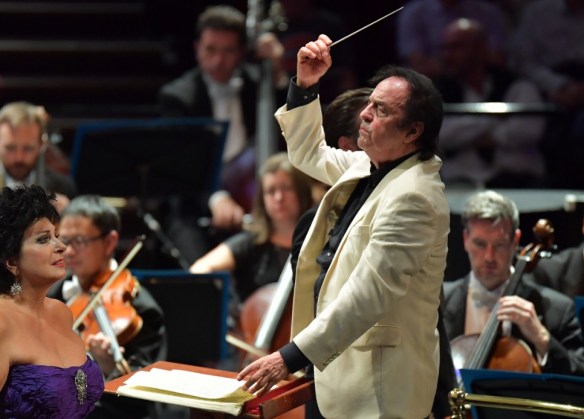
Alban Gerhardt pictured during his performance of the Dvořák Cello Concerto, with the Royal Philharmonic Orchestra conducted by Charles Dutoit (c) Chris Christodoulou

Prom 25; Royal Albert Hall, 3 August 2016

You can listen to the Prom on the BBC iPlayer

The course of this Prom ran true to the plot of the psychological drama that unfolded in the second half. Bluebeard’s Castle was a darkly lit tour de force, but before that we had the small matter of Dvořák’s Cello Concerto to attend to.

The best-loved of all cello concertos, this is a piece where the cello really sings, but has to come from within the orchestral sound to do so. Alban Gerhardt was the ideal vehicle, with probing insights and a wonderful, song-like delivery that brought out the best of Dvořák’s bittersweet lyricism. His duet with the Royal Philharmonic Orchestra woodwind and brass, subtly but expertly managed by the seemingly ageless Charles Dutoit (now 80!) was sublime.

bluebeardThings took a much darker tone after the interval as Bartók’s first stage work exerted a chilling grip on the Royal Albert Hall. There was little to no coughing here, all eyes focused on the sonorous John Ralyea (Duke Bluebeard) and his latest ill-fated lover Judit (Ildikó Komlósi). Their exploration of the seven doors of Bluebeard’s Castle were vividly brought to life by Dutoit, using all his expertise with French orchestral music to bring out the parallels in the Hungarian Bartók’s own writing, but also finding the darkness beneath that really drives the work.

Komlósi was superb, every sleight of her eyes telling a thousand words, while harps, strings, horns, woodwind and brass all told the silvery tale in turn. Ralyea, meanwhile, brought his incredibly sonorous tones to the spoken introduction, setting the scene perfectly. Unsettling through the drama was – perhaps unwittingly anticipating The Shining, and the use of Bartók’s music in one of its crucial scenes – this was a performance holding the audience captive from the first dark note to the last.

Ben Hogwood

BBC Proms – Nielsen Fifth Symphony; Schumann Violin Concerto & Jörg Widmann’s Armonica – BBC Philharmonic / Storgårds

prom-23-1

John Storgårds conducts the BBC Philharmonic at the BBC Proms on Monday 1 August. (c) Chris Christodolou

Prom 23; Royal Albert Hall, Monday 1 August 2016

Widmann Armonica (2006) [UK premiere] [Christa Schönfeldinger (glass harmonica), Teodoro Anzellotti, (accordion)]

Schumann Violin Concerto in D minor (1853) (Thomas Zehetmair, violin)

Sibelius The Tempest – Prelude (1925)

Nielsen Symphony No.5 (1922)

Listen on the BBC iPlayer here

Tonight’s Prom brought a first visit this season from the BBC Philharmonic, conducted by its principal guest conductor John Storgårds in a wide-ranging programme which began in ethereal near-silence and ended in a blaze of affirmation rarely equalled this past century.

The relative silence was to be found in Armonica, among the most distinctive pieces by Jörg Widmann in that it features a solo role for glass harmonica – partnered here by the more abrasive sound of accordion in music which emerges into then evanesces out of focus; heard against a backdrop where indebtedness to Ligeti’s earlier orchestral works does not preclude a wealth of imaginative textures, particularly in the opening minutes. Christa Schönfeldinger and Teodoro Anzellotti interacted seamlessly, not least in those overly gestural closing pages.

prom-23-2

Christa Schönfeldinger performs Widmann’s Armonica with and Teodoro Anzellotti, John Storgårds and the BBC Philharmonic at the BBC Proms. (c) Chris Christodolou

Perhaps it was such ethereal sounds that the ailing Schumann heard over the troubled weeks prior to his final breakdown. If so, little of this otherworldliness found its way into the Violin Concerto which was his last major work. Its having been kept under wraps for eight decades, then miraculously relocated near the outset of the Nazi era, has passed into legend. Musically the piece can verge on the routine, not least a first movement whose progress is more than a little dogged due to insufficiently contrasted ideas, then a finale whose underlying polonaise rhythm abets the repetitiveness. Best is a slow movement that revisits Schumann’s ‘romanza’ idiom a last time; its enervated aura exquisitely judged by Thomas Zehetmair and Storgårds – musicians who have (uniquely?) encountered this unsettling work both as soloist and conductor.

The emotional temperature rose appreciably in the second half – first with the Prelude from the extensive incidental music Sibelius wrote for a Copenhagen production of The Tempest. Guardedly admired at first, it has latterly been hailed as a precursor of tonal innovations half a century on. While his account was not lacking for physical immediacy, Storgårds chose to emphasize those modal contours that spread across woodwind and brass as the piece moves beyond its climax towards as tenuous a resolution as any during the first half of last century.

How to wrest resolution from apparent chaos was the goal for Nielsen in his Fifth Symphony, a work that has rightly moved towards the centre of the repertoire over the past two decades. Consistency was the watchword of Storgårds’s interpretation – finding an unarguable ‘tempo giusto’ for the initial half of the first movement, its unfolding across shifting tonal planes as finely articulated as the intensifying ambivalence that suddenly clears going into the Adagio rejoinder. The climax had suitably majestic import, and it was hardly Paul Patrick’s fault if his side-drum ‘cadenza’ was outshone by John Bradbury’s plangent clarinet solo in the coda. The second movement’s propulsive opening Allegro was well judged and if Storgårds risked momentum in the curious bitonal transition, the ensuing Presto had the right headlong energy.

Nor was there any lack of focus in the fugal Andante which gradually works its way to where the earlier resolve can be regained, albeit now with a formal and expressive closure as makes possible a thrilling peroration that was superbly gauged at the end of this impressive reading.

Richard Whitehouse

Proms premiere – Tansy Davies – Re-greening

tansy davies composer

Tansy Davies

National Youth Orchestra of Great Britain – without a conductor (Prom 31)

Duration: 9 minutes

BBC iPlayer link

http://www.bbc.co.uk/events/e8r2mb

What’s the story behind the piece?

In an interview for Arcana, Tansy Davies detailed how Re-greening, written for all 164 players of the National Youth Orchestra without a conductor, is essentially an introduction to Mahler’s Symphony no.9, the piece they performed without a break afterwards.

In the interview, which can be read in full here , Davies explains how “the way the music is layered to me suggests a forest like quality; interweaving arpeggio-type figures bubbling or erupting up from the cold earth in winter, and scales or lines reaching up to the light”.

Did you know?

Before making her way as a composer, Davies sang and played guitar in a band. That was probably until she won the BBC Young Composers’ Competition in 1996!

Initial verdict

Re-greening begins with bright sounds like a forest coming to life – the opening percussion stroke, a bright, metallic sound, feels like the first sun of the day.

Then we hear the rustling of the orchestra, with harmonics from the stringed instruments and shrill woodwind that sound like the birds, sonorous brass. A song is sung by the orchestra, the popular and ancient song Sumer is icumen in, essentially a hymn that glorifies in the arrival of a new season or a new day. The chant continues, surrounded by a large orchestral sound that is used economically. The brass are prominent, Davies making great use of a big space with percussion and a huge string section.

Davies layers the sounds, so that it feels like several chords are piled up on top of each other in a full bodied texture. Then towards the end the orchestra sing again, this time a canon from English Renaissance composer Thomas Tallis, set like the earlier song in C major,. This proves an unusual and moving experience when set among the excited cacophony from the rest of the instruments.

Second hearing

tbc!

Where can I hear more?

There are a couple of excellent Tansy Davies discs in circulation, partly because her music seems to be very aware of its surroundings, i.e. it is aware of the culture – both popular and classical – in which it is written. So far she has tended towards chamber pieces that are of manageable length but considerable intensity. That much is very clear from her Troubairitz disc for Gabriel Prokofiev’s Nonclassical label, which includes the excellent Neon for chamber ensemble – and from the Spine disc for NMC, which includes the Saxophone Concerto with Simon Haram:

https://open.spotify.com/album/6RZsGqMpOm3D9Kgx3YH1l3

https://open.spotify.com/album/1lr0MOXLf5xc1nLmER9EGY

Under the Surface at the Proms – About Schmidt

Prom 73, 10 September 2015 – Vienna Philharmonic Orchestra / Semyon Bychkov at the Royal Albert Hall

schmidt
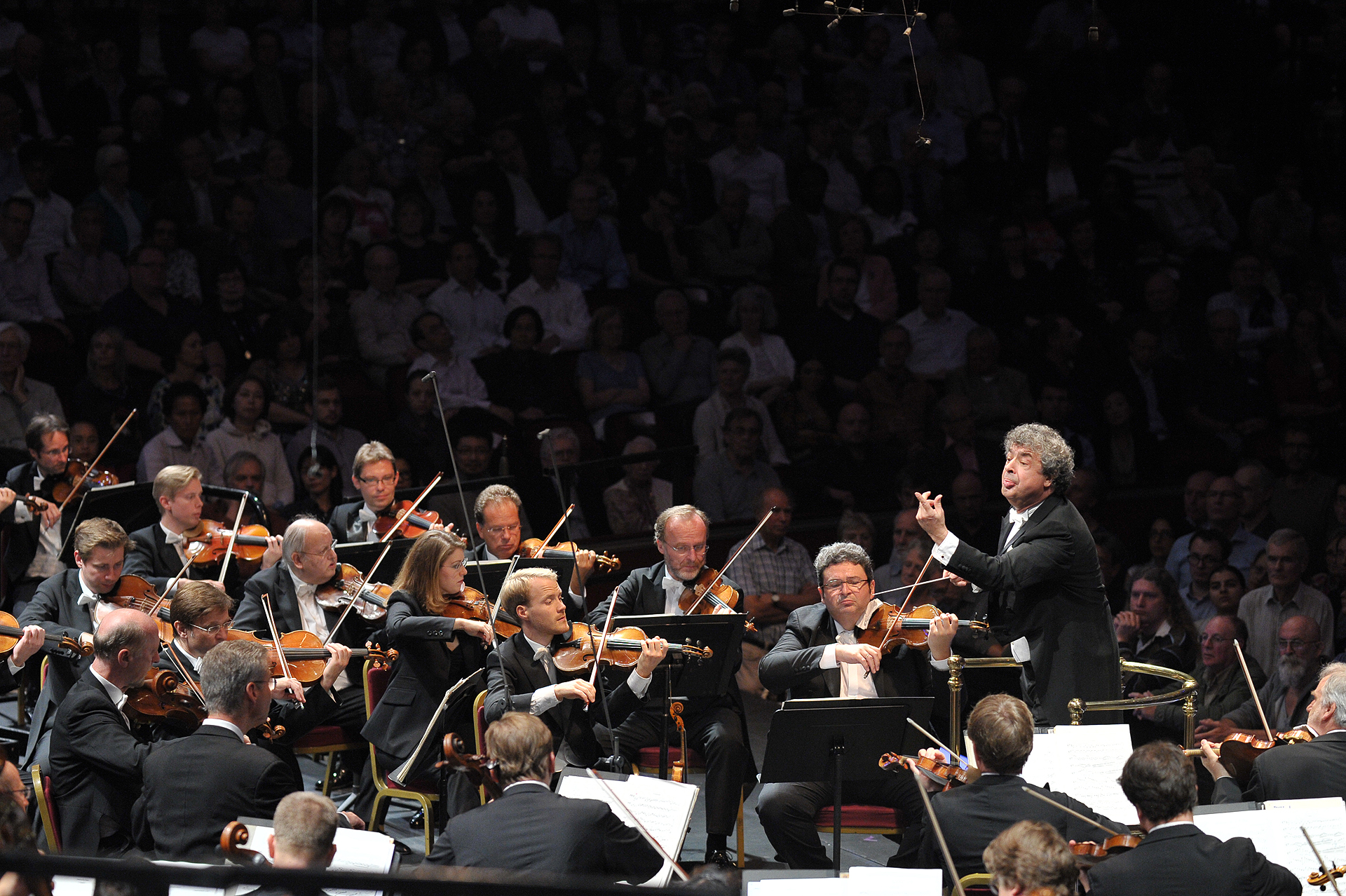
Semyon Bychkov conducts the Vienna Philharmonic Orchestra in Schmidt at the Royal Albert Hall. Photo (c) Chris Christodoulou

Symphony no.2 in E flat major
http://www.bbc.co.uk/events/ewbfxj#b068tnhg

‘Some music has to wait before it finds its place in the sun.’

This standout quote comes from an interview in the Proms program with conductor Semyon Bychkov, who conducted the Vienna Philharmonic Orchestra in this concert of two late Romantic symphonies. The work to which he referred was not BrahmsThird Symphony, which received an occasionally beautiful but ultimately rather lethargic performance in the first half, but the Second Symphony of Franz Schmidt, completed in 1913.

Schmidt’s music has only visited the Royal Albert Hall in full on two previous occasions. The Fourth Symphony, which experienced a revival when Frans Welser-Möst and the London Philharmonic Orchestra won a Gramophone Award for a recording of it in 1996, was heard at the festival in 1998. The relative success of this was followed by the massive sacred piece Das Buch mit Sieben Siegeln (The Book of the Seven Seals), which followed a similar path, recorded by Welser-Most in 1996 and performed by the same conductor in 2000.

Schmidt was a wholly suitable choice of composer for the Vienna Philharmonic, who have been revisiting important works in their history this year. Unlike the Brahms third they did not give the premiere of the Schmidt, but the connections with the composer are close. He became a member of the orchestra in 1896, where he played as a cellist – though he did not get on with Gustav Mahler, conductor at the time. Bychkov has championed the Second Symphony with other orchestras, so it made sense to finally bring it to the Vienna Philharmonic. From what I could tell this was their first season performing this or any of his symphonies. So what of the piece itself?

Written on a large scale, the Second clocks in at around 50 minutes. It is in three movements, the large second movement dominating at around half the length of the piece – and it was the centrepiece here. A colourful and richly layered set of variations on a theme, it delights in exploring a number of completely contrasting moods, drawing unusual textures from the orchestra that reveal Schmidt the organ composer. A few of the variations sound uncannily like right hand keyboard figures played at speed, with amazing clarity of colour.

There were clear influences from Bach, Beethoven, Mahler, Richard Strauss and Bruckner – yet the music was nothing like a copy of any of these composers. Instead Schmidt managed to stamp his own personality on the piece, shying away from obvious statements so that the mood was at times strangely elusive, on occasion reluctant to commit to emotion with obvious meaning.

It had operatic qualities, for sure, which could be felt in the ebb and flow of the drama and in the swell of the melodies – but the unusually luminous colours dominated, Schmidt using the orchestra in his own individual way. Here he wrote especially taxing parts for violins and violas, but the crowning glory was the massive brass chorale that appeared towards the end and was resolved without fuss.

Only the Proms could have presented this combination of orchestra and music, and should be congratulated for doing so. It was expertly performed and well received, and should go a long way to giving Schmidt’s music the chance of a revival it deserves. It will be interesting to come back in five years and see if anyone else has taken up the baton from Bychkov.

Want to hear more?

A playlist combining the Second and Fourth Symphonies can be heard here:

Meanwhile for the massive Das Buch mit Sieben Siegeln (The Book of the Seven Seals), in a recent recording made for Chandos under conductor Kristjan Jarvi, click on the link below:

This is the last Under the Surface feature of this year’s Proms. There will be more explorations of rare repertoire on Arcana in the coming months, both through recordings and concerts. Stay tuned!