In concert – Lukas Sternath, BBC Singers, Symphony Chorus & Orchestra / Sakari Oramo @ BBC Proms: Bliss ‘The Beatitudes’, Grieg & Gipps

Lukas Sternath (piano), Elizabeth Watts (soprano), Laurence Kilsby (tenor), BBC Singers, BBC Symphony Chorus, BBC Symphony Orchestra / Sakari Oramo

Gipps Death on the Pale Horse Op.25 (1943) [Proms premiere]
Grieg Piano Concerto in A minor Op.16 (1868 rev.1907)
Bliss The Beatitudes F28 (1961)

Royal Albert Hall, London
Sunday 7 September 2025

Reviewed by Richard Whitehouse Photos (c) BBC / Chris Christodoulou

This evening’s Prom – launching the final week of the present season – was billed as ‘Grieg’s Piano Concerto’, no doubt the reason why many in the audience were attending while hardly being the most interesting aspect of a typically adventurous programme from Sakari Oramo.

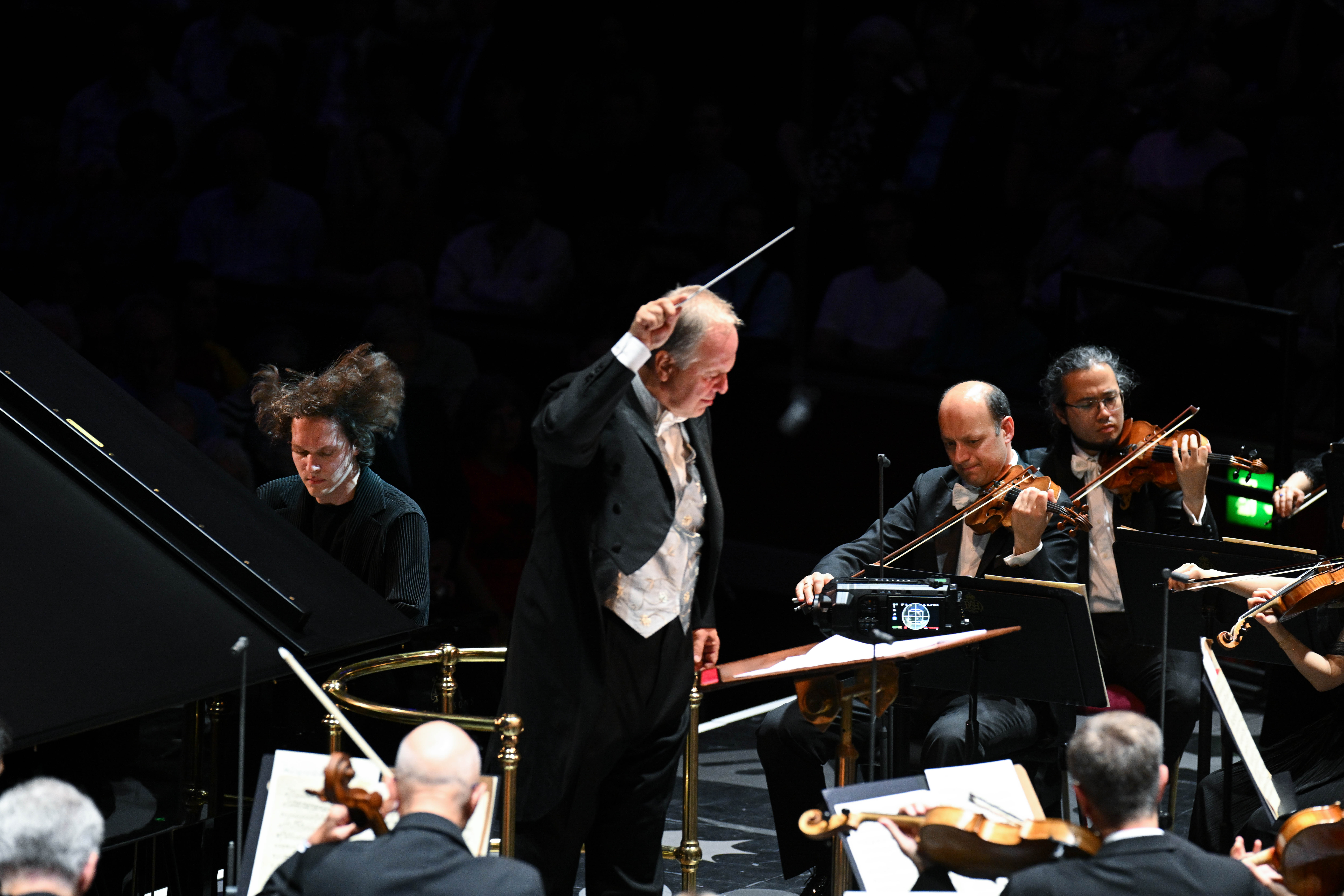
In the event the Grieg received a responsive reading from Lukas Sternath (below, with Oramo), the Viennese pianist who, still in his mid-20s, was most at home in more inward passages. The second theme of the initial Allegro was enticingly taken up after a heartfelt rendering by cellos, as was the Adagio’s eloquent melody and that first emerging in the finale on flute, where it was soulfully rendered by Daniel Pailthorpe. Nor were the more demonstrative aspects underplayed – Sternath having the measure of a cadenza whose mounting rhetoric was pointedly reined-in, while the finale’s outer sections were incisively inflected prior to an apotheosis which felt the more exhilarating through its absence of bathos. A melting take on Richard Strauss’ early song Morgen!, transcribed with enviable poise by Max Reger, served to reinforce Sternath’s formidable pianistic credentials.
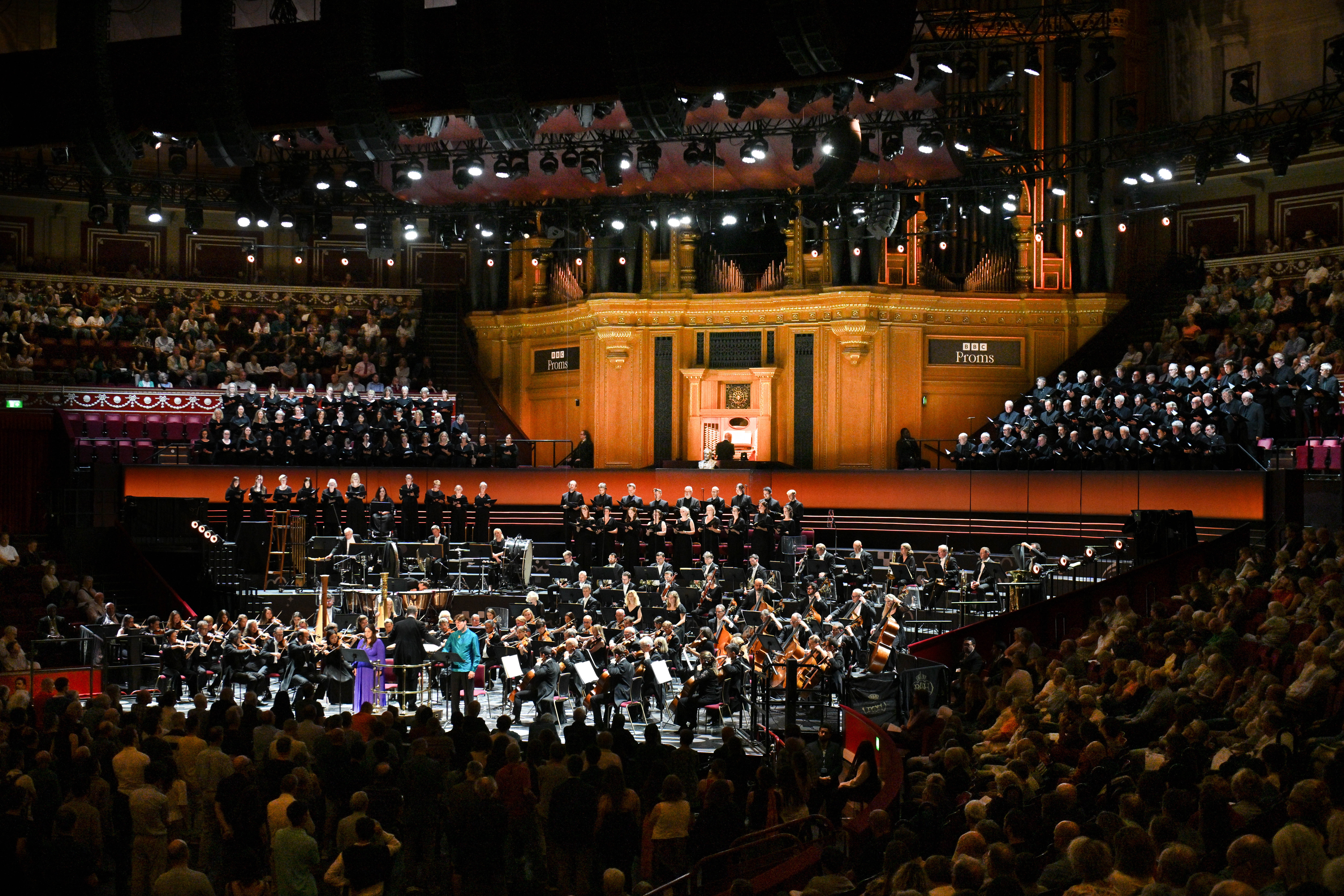
The 50th anniversary year of Sir Arthur Bliss’s death has seen a gratifying number of revivals, few more significant than that of The Beatitudes. The misfortune of its premiere having been moved from Coventry’s new Cathedral to its Belgrade Theatre, thus freeing up rehearsal time for Britten’s War Requiem, rather condemned it as an also-ran from the outset. Yet Bliss had created a piece unerringly suited for the consecration in what, in itself, remains an impressive conception. Unfolding as 14 short sections which can be grouped into six larger movements, this is less a cantata than a choral symphony. Setting all nine Beatitudes, Bliss none the less merged several of these and interspersed them with settings from three 17th-century and one 20th-century ‘metaphysical’ poets to commemorate the past from the vantage of the present.

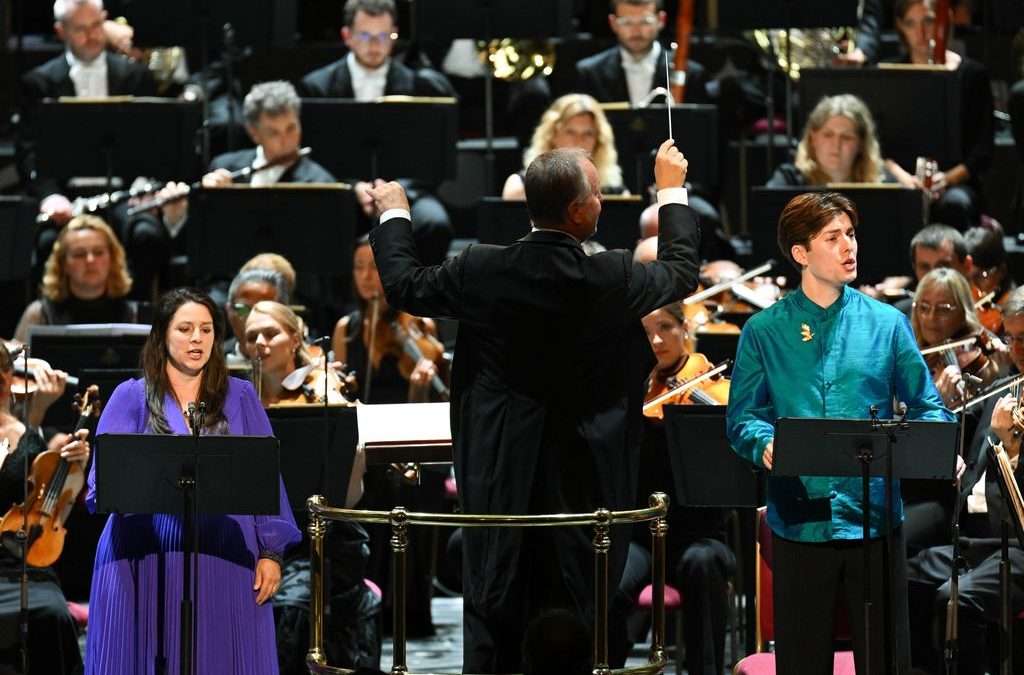
The texts, drawn from Henry Vaughan, George Herbert and Jeremy Taylor, anticipate a future redemption – as, more ambivalently, does Dylan Thomas in And death shall have dominion which builds implacably to the climactic Ninth Beatitude and Voices of the Mob prior to the hard-won serenity of the Epilogue. That The Beatitudes has enjoyed relatively few revivals is less to do with its intrinsic quality than the demands of its choral writing, to which the BBC Symphony Chorus and BBC Singers did notable justice. Elizabeth Watts responded with real sensitivity and perception to some radiant soprano writing and while Laurence Kilsby was a little effortful in the more demonstrative passages, he brought conviction to a tenor role both fervent and compassionate. Nor did Richard Pearce disappoint with his extensive organ part.
Oramo paced the 50-minute entity superbly as to make one hope he will tackle more works by Bliss – not least the masterly Meditations on a Theme by John Blow, which has inexplicably fallen through the net this year. He had started tonight’s concert with a most welcome revival for Death on the Pale Horse – the succinctly eventful tone poem by Ruth Gipps which, while it might not capture the visceral drama of Blake’s eponymous engraving, distils an evocative atmosphere from pithy initial ideas that audibly reflects the circumstances of its composition.

Click on the artist names to read more about soloists Elizabeth Watts, Laurence Kilsby and Lukas Sternath, the BBC Singers, BBC Symphony Chorus and BBC Symphony Orchestra, and their conductor Sakari Oramo. You can also click to read more about composers Arthur Bliss, Ruth Gipps and the BBC Proms

Published post no.2,652 – Tuesday 9 September 2025

In concert – Mark van de Wiel, Philharmonia Chamber Players – Gipps & Weber

Philharmonia Chamber Players [Mark van de Wiel (clarinet, above), Eugene Lee, Fiona Cornall (violins), Scott Dickinson (viola), Karen Stephenson (cello)]

Gipps Rhapsody in E flat major (1942)
Weber Clarinet Quintet in B flat major Op.34 (1811-15)

Royal Festival Hall, London
Thursday 20 February 2025

Reviewed by Ben Hogwood Picture of Mark van de Wiel (c) Luca Migliore

This free concert in the Royal Festival Hall was a breath of fresh air. Bolstered by visitors, the auditorium was a heartening two-thirds full, the audience made up of families, tourists and workers seeking musical enlightenment. Yours truly fell into the latter category!

The Philharmonia Orchestra have played to this type of crowd for decades now, either by way of introduction to their evening concerts (like this one) or providing a standalone concert focusing on a particular composer (Music of Today) or instrument.

In this instance they covered all bases, with music for clarinet and string quartet introduced from the stage by principal clarinet Mark van de Wiel. The ensemble began with a relative rarity, Ruth GippsRhapsody in E flat major only coming in from the cold in recent years. Dedicated to her fellow RCM student and future husband, Robert Baker, it is an attractive piece with affection evident from its soft, pastorally inflected first statement. However Gipps’ folk-inspired variant on the opening theme steals the show, firstly heard on cello then subsequently joined by its companions, the clarinet finally singing eloquently over pizzicato strings.

In his talk Van de Wiel’s love of the piece was evident, before he introduced another sleeping giant, Weber’s Clarinet Quintet. Often sitting in the shade of its illustrious companions by Mozart and Brahms, this winsome piece – written for clarinettist Heinrich Baermann – demonstrates just how far the instrument had progressed in the two decades since Mozart’s Clarinet Concerto.

Van de Wiel demonstrated how his clarinet, with 17 keys, was at an advantage to that of Baermann’s ten, in theory reducing the difficulty. His modesty, however, was made clear in the virtuoso demands Weber still makes on the instrument, a fully-fledged soloist, with all manner of tricks up its sleeve.

To Weber’s credit this is not at the expense of musical quality or emotional impact, for although we enjoyed some flights of fancy in the first movement Allegro there was plenty of feeling in the dialogue between clarinet and string quartet. A tender, operatic second movement followed, then an airy and enjoyably mischievous Menuetto rather fast for dancing perhaps but charming all the same. Then came the brilliantly executed finale, living up to its Allegro giojoso marking as Van de Wiel mastered Weber’s increasingly athletic demands with flair and musicality.

Happily both pieces have been recorded as part of a new album forthcoming from the quintet on Signum Classics, where they will team this repertoire with Anna Clyne’s Strange Loops. If the performances match these live accounts, they will constitute a fine document from one of Britain’s very best clarinettists. As though to confirm this, the assembled throng left wreathed in smiles.

For details on the their 2024-25 season, head to the Philharmonia Orchestra website

Published post no.2,452 – Friday 21 February 2025

The 19th Malcolm Arnold Festival, 2024

posted by Ben Hogwood – text copied from the festival’s press release:

One of England’s most colourful and charismatic composers – Sir Malcolm Arnold (1921-2006) – is to be celebrated at the 19th International Malcolm Arnold Festival; an annual programme of events centred around the multi-faceted composer and his music. The composer’s hometown of Northampton will host a day of live music-making on Saturday 19 October, and a specially procured programme to attract listeners from around the world will live-stream on Sunday 27 October.

SATURDAY 19 OCTOBER – LIVE MUSIC CONTINUNES ALL DAY

Continuing his successful presentations in both live and digital formats, Festival Director Paul Harris is extending the reach of Malcolm Arnold’s music to listeners everywhere, with live concerts and a Symposium hosted in the composer’s hometown, and a specially conceived live-stream day, presenting recorded performances and talks, this year with a particular focus on Arnold’s songs and choral works – a relatively little-known area of the composer’s output.

Paul Harris says: “This year we are offering three concerts within central Northampton (Malcolm’s birthplace), all in walkable distances from each other. We are delighted that Saturday’s launch concert will take place at St Peter’s, marking the reopening of the church as a performance space.”

Launched by composer, Matthew Taylor, listeners will be able to enjoy a programme of rousing music for brass, one of Malcolm Arnold’s most popular genres as a renowned trumpet player himself, performed by Spectacle Brass Quintet lead by Nick Budd. Following this there will be a performance of the composer’s second String Quartet performed by students from the Royal Birmingham Conservatoire.

Live music continues throughout the day, transferring to All Saints’ Church, just a short walk away, with music for choir and organ to include the composer’s psalms and part songs, his John Clare Cantata, and Turtle Drum; familiar to many from school days. Also featured will be Arnold’s Organ Variations: five variations by living composers and one new variation written especially by Jonathan Whiting for this year’s Festival.

Demonstrating the exuberance of Arnold’s works and some of his finest and most popular tunes, the Festival’s Gala Concert takes place at Northampton Guildhall and will be performed by the  Northamptonshire County Youth Concert Band and Orchestra (NMPAT) who are regular guests at the Festival. The Festival will end with a short Symposium hosted by Matthew Taylor discussing all things Arnold.

HOW TO BOOK
Tickets are £10 per concert or £25 for a day ticket, available at the door or book in advance online. Students and under 18s are admitted FREE of charge.
www.malcolmarnoldfestival.com

ONLINE DAY (FREE live-stream) – SUNDAY 27 OCTOBER

FREE-to-view and presented live by Director Paul Harris, the Festival’s complimentary digital live-stream day will take place on Sunday 27 October and features performances of some of Malcolm Arnold’s greatest solo, chamber and orchestral music as well as talks, lectures and exclusive interviews.

Paul Harris says, “The day is structured around the years that have their anniversary this year; 1934, 1944, 54, 64, 74 …etc. and what Malcolm was writing and doing in those years. We are also featuring all of his wonderful songs as the central theme performed by Claire Thompson and Scott Mitchell – Malcolm is not well-known for his vocal writing and our programme will give a fascinating insight into this genre. Also a host of Arnold specialists will be contributing through their knowledge and enthusiasm to bring together another fascinating and engaging day of music making.”

Harris himself will give a talk on Malcolm Arnold at the Royal College of Music, and there are further talks by Arnold authorities including Dr. Timothy Bowers, Dimitri Scarlato, Eleanor Fox, Gus Woodward, and BBC Radio 3 broadcaster and long-time Arnold enthusiast, Martin Handley.

Amongst the assortment of Malcolm Arnold’s chamber works will be historic recordings and specially recorded performances by students from Chethams’ School and the Royal College of Music. Soloists taking part, who will also introduce their pieces, include soprano, Claire Thompson, pianists Scott Mitchell and Lynn Arnold, and oboist Ewen Millar.

Amongst those pieces featured will be Kensington Gardens for Oboe, a piece by Arnold’s fellow composer at the Royal College of Music, Ruth Gipps, known affectionally to Malcolm as ‘Widdy’. Written for Gipps’ own instrument and piano, this is an engaging short suite of three pieces named Elfin Oak, Fat Pigeon and Chestnut Trees.  Alongside Arnold’s songs from his own Kensington Gardens are his William Blake Songs, which were hailed by Gipps as “the real Malcolm”.

Both dramatic and playful in tone, the Sinfonietta No. 3, Arnold’s third “Little Symphony” completed in September 1964, extends the scope of his two earlier essays in this form and is scored for a classical chamber orchestra, demonstrating all the usual hallmarks of the composer’s inventiveness in smaller scale.

From the same year, the celebratory Water Music was commissioned by the National Trust for the opening of the Stratford Canal. In three movements, the piece was written for wind and percussion to be played on a raft moored on the River Avon, and later transcribed by the composer for full orchestra.

HOW TO VIEW
Live-stream FREE to view. Refer to the website for further information including the full programme: www.malcolmarnoldfestival.com

Published post no.2,290 – Tuesday 3 September 2024

On record – Peter Cigleris: Dedication – The Clarinet Chamber Music of Ruth Gipps (Somm Recordings)

gipps

Ruth Gipps
The Kelpie of Corrievreckan Op.5b (1939)
Quintet Op.16 (1941)
Rhapsody in E flat major Op.23 (1942)
Clarinet Sonata Op.45 (1955)
Prelude, Op.51 (1958)

Peter Cigleris (clarinet) with Gareth Hulse (oboe); Duncan Honeybourne (piano); Tippett Quartet [John Mills and Jeremy Isaac (violins), Lydia Lowndes-Norcott (viola) Bozidar Vukotic (cello)]

SOMM Recordings SOMMCD0641 [67’37”]

Producer Siva Oke
Engineer Michael Wright

Recorded 1 and 2 November 2020 at Menuhin Hall, Stoke d’Abernon, Surrey

Written by Richard Whitehouse

What’s the story?

SOMM Recordings marks the 100th anniversary of the birth of Ruth Gipps (1921-99) with this collection of her chamber music featuring clarinet, all of which was written with Robert Baker (her husband for 57 years) in mind and all of which here receives its first recordings.

What’s the music like?

A gifted oboist, pianist and conductor, Gipps was an all-round artist whose accomplishment was matched by a feisty temperament (as this writer recalls) laced with bitterness at the lack of recognition latterly accorded her, though nothing of this is audible in the music heard here.

The Rhapsody in E flat for clarinet and string quartet is one of this composer’s most lyrical pieces – its single movement twice alternating ruminative content and trenchant interplay, if without losing sight of the music’s essential poise, for all that a deeper and more ambivalent vein of expression comes to the fore – to be encapsulated by the clarinet cadenza at its close. Inspired by a poem from Charles Mackay’s 1851 collection, The Kelpie of Corrievreckan for clarinet and piano evokes its source in lively and often wryly humorous terms – its capering progress evidently not intent on taking this tale of the ill-fated protagonist unduly seriously.

Most substantial here is the Quintet for oboe, clarinet and string trio. Its four movements open with an Allegro of elegant restraint, whose modally inflected writing denotes allegiance to an English pastoralism prevalent over its deftly wrought and self-effacing course. There follows an Adagio whose calmly methodical progress admits of appealingly wistful emotion, then the Energico injects a welcome degree of wit into proceedings; before the final Allegro returns to more serious matters as it steers this work to a close the more affecting for its understatement.

British music for solo bass clarinet is not abundant, but Gipps’s Prelude is a notable addition to a mainly radical repertoire; its stealthy unfolding informed by an acute sense of continuity across this instrument’s timbral and registral extent, so it unfolds as an unbroken melodic arc. Finally, the Sonata for clarinet and piano – its initial Allegro starting with a Maestoso gesture which has a pervasive influence over what follows. If this opening movement feels relatively impersonal, the Andante must rank among Gipps’s most eloquent in its unforced pensiveness, then the Scherzando abounds in a quizzical humour continued by the final Allegro – its stern Maestoso prefacing music whose limpid asides do not offset the carousing energy at its close.

Does it all work?

Yes, on its own terms. As with many composers who took against the more radical aspects of British cultural policy after 1960, Gipps was inherently a conservative whose music is often less reactionary than often supposed. It certainly provides a stern test of musicianship which the present artists – not least clarinetist Peter Cigleris – meet head-on, in performances that bring out the idiomatic feel of Gipps’s writing for the instrument(s) at hand while conveying the reticent, yet discernible and often appealing personality that comes through in her music.

Is it recommended?

Indeed, not least given detailed and realistic sound, along with informative notes from Robert Matthew-Walker. Hopefully the cycle of Gipps’s symphonies will be completed by Chandos – but, for now, the present release marks her centenary as she would doubtless have wished.

Listen & Buy

You can discover more about this release and listen to clips at the SOMM Recordings website, where you can also purchase the recording. For more information on Ruth Gipps, click here – and for more on Peter Cigerlis, click here. More information on the Gipps symphonies, as recorded by Chandos, can be found here

In concert – CBSO / Mirga Gražinytė-Tyla: Ruth Gipps, Adès & Brahms

City of Birmingham Symphony Orchestra / Mirga Gražinytė-Tyla

Gipps Symphony no.2 Op.30 (1945)
Adès
: The Exterminating Angel Symphony (2020) [CBSO Centenary Commission: World premiere]

Brahms Symphony no.3 in F major Op.90 (1883)

Symphony Hall, Birmingham
Wednesday 4 August 2021

Written by Richard Whitehouse

This unexpected yet worthwhile addition to the City of Birmingham Symphony Orchestra’s season saw the revival of two works recently heard along with a belated premiere – twice postponed – for one of the most notable among the orchestra’s impressive roster of Centenary Commissions.

Its UK premiere guardedly received four years ago, Thomas Adès’s third opera felt limited as to provocative intent by the difficulty of transferring its theme of Spanish religious fascism to a different era. What was undeniable is the suitability of its numerous orchestral passages to being rendered in a more abstract context, hence The Exterminating Angel Symphony heard tonight. Its four sections arguably amount to a symphonic suite rather than symphony per se, yet their formal follow-through undoubtedly makes for a cohesive and finely balanced entity.

Mirga Gražinytė-Tyla evidently thought so – obtaining an incisive response in the ‘Entrances’ music whose expressive ambivalence intensifies second time around, then a virtuosic one in ‘March’; its malevolence building over a remorseless side-drum tattoo in a vivid foretaste of what lies ahead. Although it draws on one of the opera’s love-duets, ‘Berceuse’ seems a little unyielding in its emotional content despite the allure of scoring as was always apparent here.  It remains for ‘Waltzes’ (following without pause) to provide a suitable finale and, while this extended and ingeniously organized sequence of fragments from across the opera undeniably evokes a notable precedent in terms of its inexorable motion toward ultimate catastrophe, the animation and sheer panache of the CBSO’s playing brought about a suitably emphatic close.

Before this MGT again made a persuasive case for the Second Symphony by the orchestra’s one-time oboist Ruth Gipps, the contrasted sections of its single movement – a martial scherzo and eloquent Adagio framed by an ambivalent Moderato and cumulatively energetic Allegro – audibly unfolding as variations on an evocative theme heard at the start. An autobiographical aspect, concerning personal aspirations near the end of war, explains this piece’s confessional nature. Whether or not it will undergo several further decades of neglect remains to be seen.

After the interval came Brahms’s Third Symphony, which orchestra and conductor had given before the lockdown last December. Tonight, however, the first movement (exposition repeat taken) was purposefully controlled with real cumulative thrust, a less than decisive transition into the reprise affording the only lapse in momentum prior to a coda of unfettered eloquence. The Andante was once again unerringly shaped in terms of its ruminative contrasts, and if the third movement had now become a little torpid, this hardly affected its unforced pathos. MGT rightly made the finale the culmination in every sense, her tautening of tension at the apex of its development yielding as tangible an expressive frisson as did the coda – where the work’s main motif descends as if from afar to secure the most transfigured of emotional touchdowns.

A memorable addition to an inevitably truncated yet memorable (and for all the right reasons) season, which the CBSO repeated at the Proms the following night. Beyond that, the autumn portion of its 2021/22 season has just been announced.

You can find information on the CBSO’s new season here.