

Gershwin Cuban Overture (1932)
Villa-Lobos Fantasia for Saxophone W490 (1948)
Copland Danzón cubano (1942)
Milhaud Scaramouche Op.165c (1937/9)
Copland Appalachian Spring – Suite (1944/5)
Barber Symphony No. 1, Op. 9 (1935-6, rev, 1942-3)
Jess Gillam (saxophones, above), City of Birmingham Symphony Orchestra / Jaume Santoja Espinós (below)
Symphony Hall, Birmingham
Wednesday 20 October 2021
Written by Richard Whitehouse
This evening’s concert by the City of Birmingham Symphony Orchestra took a break from ‘standard’ repertoire to focus on music by composers either American or with an American focus, in a programme which rung the changes to often vibrant and always appealing effect.
A familiar radio presence, Jess Gillam has already encouraged renewed interest in the music for classical saxophone, as her contributions amply demonstrated. Little heard in his lifetime, the Fantasia by Villa-Lobos is among those more modest creations of a composer known for his (over-reaching) ambition – its three short movements drawing animated and ruminative responses from the soloist enhanced by a restrained orchestration. Swapping soprano for the alto instrument, Gillam returned for Milhaud’s Scaramouche which was no less engaging in this arrangement than the original for two pianos; whether in its incisive opening movement, soulful central interlude or its final Brazileira which could hardly fail to provoke a response from orchestra and audience – the latter evidently appreciative of such an infectious display.

The CBSO captured the spirit of both pieces, thanks not least to former assistant conductor Jaume Santoja Espinós, who had opened the concert with Gershwin’s Cuban Overture – the percussion-clad exuberance of its outer sections a telling foil to the haunting pathos of those canonic textures at its centre. Copland’s Danzón Cubano can seem irritating in its rhythmic over-insistence, but Espinós brought an unsuspected wit and subtlety to this amalgam of coy nonchalance with an orchestration recalling Stravinsky’s forays into ‘crossover’ at this time.
Latin-American traits made way for those of a Europeanized East Coast after the interval, Espinós directing the suite from Copland’s Appalachian Spring with a cohesion as brought out expressive contrasts between the various sections without these becoming too episodic. The idealization inherent in this ‘Ballet for Martha’ can hardly be gainsaid, yet the chaste eloquence of its musical content came through no less affectingly – not least as the familiar ‘Variations on a Shaker Hymn’ subsided into the serene inevitability of the final evocation.
The highlight was a welcome revival for Barber’s First Symphony, whose continuous design marries Sibelian formal precision with that unabashed emotionalism closer to Russian music from this period, with a cumulative impact to its four-in-one trajectory which was palpably in evidence. From the stark foreboding with which it begins, through the relentless impetus of its ‘scherzo’ and consoling poise of its ‘slow movement’ (felicitous oboe playing by Emmet Byrne), to the inexorable force of its closing passacaglia, this was a performance to savour.
An eventful evening, then, and was more to come with a post-concert informal performance from the quintet El Ultimo Tango, familiar from its several recordings and here providing a 30-minute overview of Astor Piazzolla for what was a – necessarily – belated tribute in the year of his centenary. Those wanting a longer selection can hear this group at CBSO Centre next February, while the CBSO returns next week for a programme of mainly French music from conductor Kevin John Edusei with Kirill Gerstein in both of Ravel’s piano concertos.
Further information on the CBSO’s current season can be found at the orchestra’s website. For more on Jess Gillam, click here – and for more on El Ultimo Tango, here. For more information on Jaume Santoja Espinós, head to the conductor’s website


 The final Ask The Audience from the 2017 BBC Proms is with Leanne Mison, who promotes and endorses an impressive roster of electronic music artists for Bang On PR. Leanne talks to Arcana about a Prom given by the Royal Stockholm Philharmonic Orchestra and their chief conductor Sakari Oramo, – with two solo vocal turns from the superstar New York soprano Renée Fleming.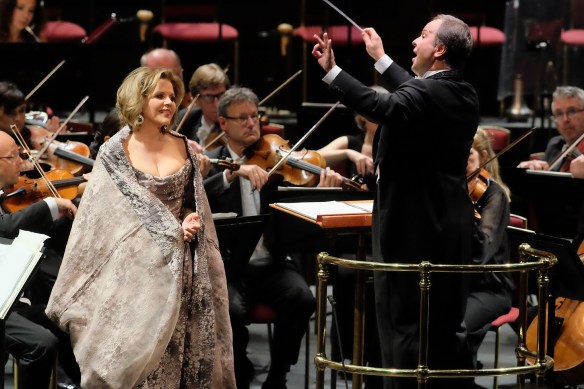
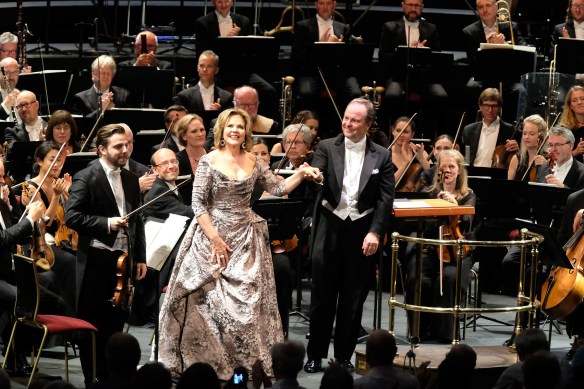 Fleming’s contributions grouped into a loose theme of distant light and transformation. Barber’s Knoxville: Summer of 1915 is a love letter to the American home, and its dappled evening sunlight flickered beautifully under the hands of Oramo, the composer’s warm harmonies setting the scene for Fleming’s characteristically full bodied interpretation. She inhabited the storyteller’s guise with effortless and instinctive calm, though the animated middle section was also very well judged. With just the right amount of sentimentality, this was an ideal performance, and an aptly chosen encore of the song Sure on this shining night blazed a similar trail.
 Finally we heard Carl Nielsen’s Second Symphony, ‘The Four Temperaments’, receiving its second Proms performance in three years after the festival’s complete neglect of it in the 20th century. It is a powerful piece, and this account made a strong impression. Although the feverish first movement (Choleric) was convincing and brilliantly played the emotional centre lay in the Melancholic third movement, where Oramo wrought music of impressive angst and depth. Nielsen’s struggles were resolved by the Sanguine finale, where the composer lets rip perhaps a little too easily, but again the structure and the melodic groups made perfect sense. Oramo has built a strong affinity with the Danish composer’s music over the years, and there was something very satisfying in these days of disunity at seeing a Finn conduct a Swedish orchestra in Danish music.
