
Arcana at the Proms – Prom 27: Silja Aalto, Anssi Kartunen, Seong-Jin Cho, BBC Symphony Orchestra / Sakari Oramo – Saariaho, Mozart & Richard Strauss ‘Alpine’ Symphony

Saariaho Mirage (2007) [Proms premiere]
Mozart Piano Concerto no.9 in E flat major K271 ‘Jeunehomme’ (1777)
Richard Strauss Eine Alpensinfonie Op.64 (1911-15)

Silja Aalto (soprano), Anssi Karttunen (cello), Seong-Jin Cho (piano), BBC Symphony Orchestra / Sakari Oramo

Royal Albert Hall, London
Friday 9 August 2024, 6pm

reviewed by Richard Whitehouse Photos (c) Mark Allan

Soon to begin his 12th season as chief conductor of the BBC Symphony Orchestra, Sakari Oramo made his second Proms appearance this season for what proved a typically diverse and resourceful programme whose stretching over 230 years of Western music was the least of its fascinations.
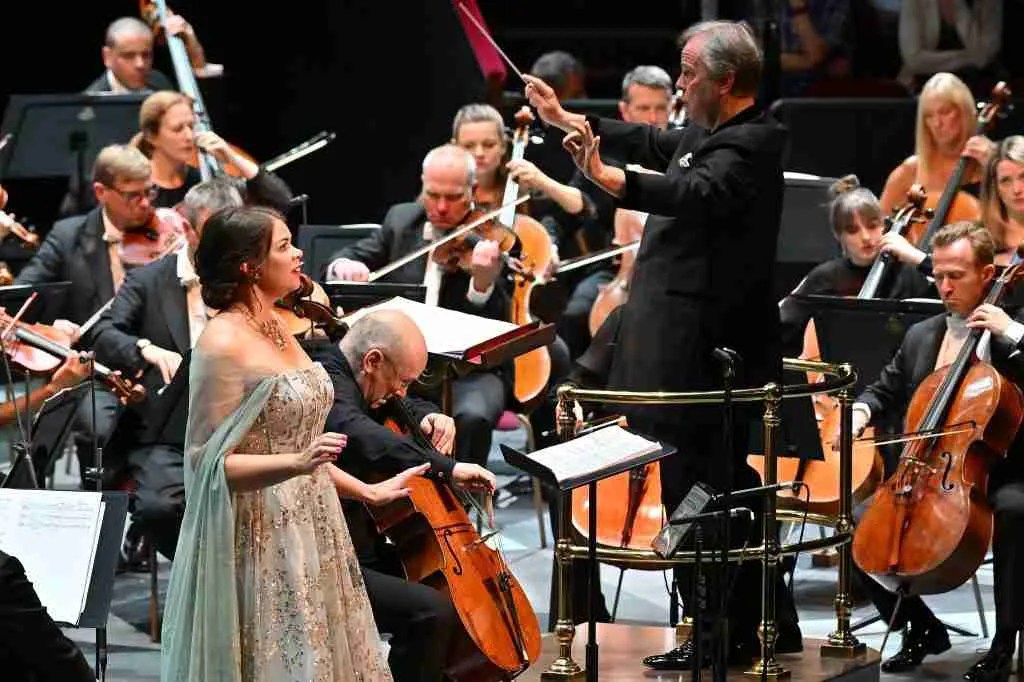
Her untimely death last year made a memorial to Kaija Saariaho more necessary and Mirage was a judicious choice, its setting lines by Mexican shaman María Sabina drawing a suitably theatrical response from Silja Aalto (above) – alongside who, Anssi Karttunen (long-time collaborator with this composer) weaved between the vocal and orchestral writing almost as an ‘alter-ego’ of subdued if beneficent presence. Musically the piece is typical of Saariaho from this period in aligning intricate texture with a mounting fervour at times ecstatic and ultimately fulfilled.

It may have been a ‘jeunefemme’ for whom Mozart actually wrote his Ninth Piano Concerto, but this remains its composer’s earliest unequivocal masterpiece and one with which Seong-Jin Cho (below) evidently feels real affinity. Not least in an opening Allegro whose arresting repartee at the start set the tone for an incisive traversal whose pianistic agility, not least in the first of Mozart’s cadenzas, was never without its inward asides. Such introspection came to the fore in the Andantino, its interplay of archaic and ‘modern’ harmonies yielding a plangency which found soloist and conductor as one. Nor was the finale’s central Menuetto without ruminative poise, set in relief by the buoyant Presto sections either side. Impressive music-making, then, that Cho continued with his deftly eloquent take on the second movement of Ravel’s Sonatine.

The last and most inclusive of Richard Strauss’s tone poems, An Alpine Symphony has received more than its share of tendentious reviews (and perfunctory programme notes), so credit to Oramo for emphasizing those purely musical qualities which, much more than its being a ‘bourgeois travelogue’ or even existential statement, duly determine this most formally and expressively integrated of its composer’s such works. As was evident at the outset: Alpine vistas emerged via a preludial crescendo that headed seamlessly into the ascent with its assembly of offstage horns, placed to advantage on the right of the gallery, then frequently arduous traversal above the treeline and on to the glacier prior to the summit. Its attendant ‘Vision’ drew an affecting soliloquy from oboist Tom Blomfield, then resplendent response from a 125-strong BBCSO.

What goes up tending to come down makes the following portion most difficult to sustain in terms of its ongoing momentum. The present account marginally lost focus here, but not in a mesmeric evocation of that eerie calm before the thunderstorm; organ and percussion adding to the overall mayhem before the relative calm of encroaching sunset. Ausklang is no mere epilogue – here, it afforded transcendence in the amalgam between those human and natural domains, while ensuring an overall fulfilment in the face of night with its inevitable closure.

The piece has come into its own since first appearing at these concerts 42 years ago and, if tonight’s reading did not quite touch all relevant bases, it conveyed the work’s measure like few others in tribute to the continuing creative partnership of this conductor and orchestra.

For more on this year’s festival, visit the BBC Proms website – and to read more on the artists involved, click on the names: Seong-Jin Cho, Silja Aalto, Anssi Karttunen, the BBC Symphony Orchestra and their chief conductor Sakari Oramo, and the official website of Kaija Saariaho and her works

Published post no.2,268 – Monday 9 August 2024

In concert – Seong-Jin Cho, London Philharmonic Orchestra / Edward Gardner: Wagner, Beethoven & Tippett

Seong-Jin Cho (piano), London Philharmonic Orchestra / Edward Gardner

Wagner Parsifal – Prelude to Act One (1878)
Beethoven Piano Concerto no.4 in G major Op.58 (1805-6)
Tippett Symphony no. 2 (1956-7)

Symphony Hall, Birmingham
Wednesday 10 April 2024

Reviewed by Richard Whitehouse

Although the London Philharmonic Orchestra’s ongoing season might not have been among its most enterprising, this evening’s concert confirmed how Edward Gardner is influencing both this orchestra’s programmes and its approach to standard repertoire as well as modern classics.

Beginning with the Prelude from Wagner’s Parsifal is certainly playing for high stakes and, while it afforded no revelations, this performance seemed nothing if not aware of the piece’s searching grandeur where the placing of motifs and those silences between them is crucial to its overall cohesion. A pity, perhaps, that Gardner opted for the ‘concert ending’ in which the close of the first act is laminated onto what went before instead of merely allowing the music to remain in expectancy, but this detracted only slightly from the majesty of what was heard.

Beethoven’s Fourth Piano Concerto then provided a perfect foil, not least in a performance so attentive to the interplay between soloist and orchestra. It helped that Seong-Jin Cho, winner of the Chopin International Competition in 2015, had an innate feeling for that ‘give and take’ necessary in this most integrated of the cycle; his fastidious while never uninvolving pianism heard to advantage over an initial movement where gradual evolution was uppermost, though his take on Beethoven’s earlier and less capricious cadenza was not lacking virtuosity. He and Gardner were at one in conveying the elemental call-and-response of the Andante, a brief but profound entry into a final Rondo whose vivacity was judiciously balanced with a ruminative poise, where lower woodwinds and strings emerged at the fore prior to the exhilarating close.

Some 66 years following its problematic premiere (restarted after a collapse of ensemble just minutes in), Tippett’s Second Symphony now enjoys regular revival though it could hardly be said to play itself. A keen advocate of this composer (witness his acclaimed recording of The Midsummer Marriage), Gardner paced the opening Allegro unerringly – pointing up contrast between its vigorous and yielding themes, while securing the requisite impetus in its lengthy development then a surging energy in its coda. Punctuated by Paul Beniston’s superb trumpet playing, the Adagio was almost as fine even if a slower underlying tempo might have brought even more depth to some of Tippett’s most evocative and spellbinding music; not least during its central build-up in the strings to a climax whose stark curtailing feels more than prescient.

Reservations as such centred on the Presto – undeniably well articulated in terms of rhythmic precision, while lacking the swiftness or velocity for its obsessive interplay and its Dionysiac culmination really to hit home. By contrast, the final Allegro was far from the anti-climax it can seem. Gardner had its measure from the jazzy introduction, via an inventive sequence of variations then sensuously descending melody on strings against shimmering woodwinds, to those cumulative ‘gestures of farewell’ that ended this performance in ecstatic ambivalence.

If not definitive, this was certainly an absorbing and memorable account as will hopefully be made available on the LPO’s own label (the concert having been broadcast live on Radio 3): one that rounded off what proved to be a judiciously planned and finely executed programme.

Click on the link to read more on the current LPO concert season, and on the names for more on pianist Seong-Jin Cho, conductor Edward Gardner and a website devoted to composer Sir Michael Tippett. The LPO’s new recording of The Midsummer Marriage can be found here

Published post no.2,148 – Sunday 14 April 2024

LSO: Always Playing – Rachmaninov, Shostakovich & Balakirev tonight at 7pm

Tonight’s London Symphony Orchestra concert promises a trio of Russian treats. Firstly Seong-Jin Cho is the soloist in Rachmaninov‘s Piano Concerto no.2 – surely one of the best-loved of all piano concertos. Following this is another Russian work with piano, Balakirev‘s Islamey – only this time in the orchestral arrangement by the Italian composer Alfredo Casella. An exotic piece, it is a travelogue inspired by a visit to the Caucasus.

Following this we have the chance to marvel at the prodigious Symphony no.1 by the teenage Shostakovich. His graduation piece, it shows already the hallmarks that were to distinguish him as an exceptional symphonist in the 20th century.

Gianandrea Noseda, currently in the midst of a Shostakovich symphony cycle with the London Symphony Orchestra for their LSO Live label, conducts this performance from March 2019, which you can watch on the orchestra’s YouTube channel from 7pm tonight here:

https://www.youtube.com/watch?v=RahkVrwnnxU&feature=youtu.be