New music – Guy Johnston’s British cello odyssey

from the press release, edited by Ben Hogwood

With his 1692 ‘Segelman, ex hart’ Stradivarius Cello, loaned to him from a private sponsor through the Beare’s International Violin Society, Guy Johnston embarks on a British cello odyssey, including the world premiere of a new cello concerto by Joseph Phibbs in January 2026.

To mark Bliss’ 50th anniversary, Johnston’s recording of Arthur BlissCello Concerto with the Royal Liverpool Philharmonic Orchestra conducted by Andrew Manze is released digitally on 25 July, 2025 on Onyx Classics. It will form a later album release with the Britten Cello Symphony.

Following a performance at the 2025 Hatfield Music Festival on 12 October 2025, Johnston will record The Protecting Veil with the Britten Sinfonia directed and led by Thomas Gould in live concerts on 28 and 29 October, 2025 at St. Sophia’s Greek Orthodox Church in London. The album will be released on Signum in the summer of 2026.

Completed in 1988, Tavener’s The Protecting Veil was begun in response to a request from cellist Steven Isserlis for a short piece. It developed into a more substantial work, and was subsequently commissioned by the BBC for the 1989 Proms season. Like many of Tavener’s compositions, this work reflects the composer’s Orthodox religious faith. The inspiration for the piece comes from the Orthodox feast of the Protecting Veil of the Mother of God, which commemorates the apparition of Mary the Theotokos in the early 10th century at the Blachernae Palace church in Constantinople in grave danger from a Saracen invasion.

As Tavener explained, “the cello representers the Mother of God and never stops singing throughout. One can think of the stings as a gigantic extension of her unending song…the first and last sections relate to her cosmic beauty and power over a shattered world.”

Johnston met Tavener on a number of occasions and was touched to be asked by Britten Sinfonia to perform The Protecting Veil last year on the occasion of what would have been the composer’s 80th anniversary. Johnston was keen to record The Protecting Veil at St Sophia’s, where Tavener used to attend mass.

On 16 January 2026, Johnston will give the world premiere of Joseph PhibbsCello Concerto at the Barbican with the BBC Symphony Orchestra conducted by Clemens Schuldt. In 2021, Johnston previously premiered Joseph Phibbs’ Cello Sonata, partly based on an Elizabethan pavane found in the archive of Hatfield House.

Phibbs, who is a huge admirer of Britten, commented,

“The main focus of this concerto is on melody, and how this might be explored in various ways over the uniquely wide range of the cello. The work is symphonic in structure, adopting a multi-movement form as opposed to the traditional three, and ends with a short ‘Vocalise’ (song) for cello and strings which soars to the very top of the cello’s high register. Elsewhere, a dramatic opposition between soloist and orchestra is emphasized. At the forefront of my mind while composing this work has been the wonderfully varied facets of Guy’s playing, which I have admired for many years. It’s been a huge privilege and excitement to write for such a special performer”

In September 2026, Johnston will record Britten’s Cello Symphony with the RLPO conducted by Andrew Manze for Onyx Classics to coincide with the composer’s 50th anniversary (Britten d. on 4 December 1976). The album will include the Bliss Cello Concerto (previously released digitally).

The 2025-2026 season coincides with Johnston’s returns to the Royal Academy of Music as a Professor of Cello. This role will see him offer bespoke tuition to cello students throughout the year. Johnston started out as a professor at the Academy in 2011, later becoming visiting professor. The appointment follows Johnston’s recent relocation back to the UK following his tenure at the Eastman School of Music in Rochester, NY, from 2018 to 2024.

Johnston commented,

“I’m thrilled to have returned last year to the UK with my family for this exciting series of recordings, commissions and performances.”

Published post no.2,600 – Saturday 19 July 2025

On Record – Chu-Yu Yang & Eric McElroy – An English Pastoral (Somm Recordings)

Venables (arr. composer) Violin Sonata Op.23a (1989 arr. 2018)
Finzi Elegy Op.22 (1940)
Gurney ed. Venables Eight Pieces (1908-09)
Bliss Violin Sonata B12 (c1914)
Venables Three Pieces Op.11 (1986)

Chu-Yu Yang (violin), Eric McElroy (piano)

Somm Recordings SOMMCD0700 [75’45”]
Producer Siva Oke Engineer Adaq Khan

Recorded 13-14 April 2024 at St Mary’s Church, St Marylebone, London

Reviewed by Richard Whitehouse

What’s the story?

Although the Taiwanese violinist Chu-Yu Yang and the American pianist Eric McElroy have found success independently, their appearances as a duo have firmly established them before the public across a wide repertoire, not least the music which is featured on this new release.

What’s the music like?

The title of this album might be thought to speak for itself, yet An English Pastoral amounts to more than an exercise in wanton nostalgia. Alongside early if not wholly uncharacteristic music by Ivor Gurney and Arthur Bliss – contemporaries whose outlooks were transformed through war service – it takes in one of Gerald Finzi’s most affectingly realized instrumental pieces and works by Ian Venables whose 70th birthday is just weeks away at time of writing. A programme, moreover, as cohesive in recorded terms as it would be heard as a live recital.

The centrepiece here is a sequence of pieces by the teenage Gurney such as demonstrates no mean assurance in this testing medium. Hence the Elgarian wistfulness of Chanson Triste or respectively poetic and bittersweet evocations as are In September and In August. A winsome Romance is the most elegantly proportioned of these eight pieces, with the elaborate Legende more discursive in its (over-) ambition. The poignant A Folk Tale and an engaging Humoreske have a succinctness to confirm that, with Gurney as with most composers, less is often more.

The players seem as emotionally attuned to this music as they are when mining the expressive subtleties of Finzi’s Elegy which, composed barely a year into the Second World War, offsets its yielding nostalgia with passages of simmering anxiety. Nor do they disappoint in the single movement that was all Bliss completed – if, indeed, he ever envisaged any successors – of his wartime Violin Sonata; its cautious if never inhibited handling of ‘phantasy’ form implying a transition from his earlier Pastoralism to the innovation of those pieces which came afterward.

Venables proves no less adept combining violin and piano, not least when adapting what was previously his Flute Sonata as to emphasize the pensive raptness of the first movement or its alternately playful and plaintive successor. Witness, moreover, the astutely judged trajectory of his Three Pieces as it moves from the blithe lyricism of its initial Pastorale, through the unforced eloquence of its central Romance, to the incisive energy of its final Dance – thus making for a sequence that could have been a ‘sonatina’ had the composer designated it thus.

Does it all work?

Pretty much always. Nothing here sounds less than idiomatic in terms of being conceived for this medium, a tribute to the skill of these players in realizing the intentions of the composers in question. For those listeners who still (rightly) attach importance to such things, the layout is viable but it might have been improved by interpolating the Gurney pieces – most of which are what might be termed ‘medium slow’ – across the release as a whole rather than grouping them all together at its centre, but this is relatively less of a consideration in streaming terms.

Is it recommended?

Indeed it is. The recorded ambience could hardly be bettered in terms of this medium, while Yang contributes detailed and informative annotations. Hopefully he and McElroy will have a chance to record further such collections, whether or not in the ‘English Pastoral’ tradition.

Listen / Buy

You can read more about this release and explore purchase options at the Somm Recordings website

Published post no.2,578 – Saturday 28 June 2025

In concert – Raphael Wallfisch, BBC Concert Orchestra / Martin Yates: English Music Festival opening concert – A Night of Bliss

Raphael Wallfisch (cello), BBC Concert Orchestra / Martin Yates

Alwyn The Innumerable Dance – An English Overture (1933)
Delius ed. Beecham A Village Romeo and Juliet – The Walk to the Paradise Garden (1907)
Bliss Cello Concerto F107 (1969-70)
Vaughan Williams Heroic Elegy and Triumphal Epilogue (1901 rev. 1902)
Bate Symphony no.2, Op.20 (1937-39) [World Premiere]

Dorchester Abbey, Dorchester-on- Thames
Friday 24 May 2025

Reviewed by Richard Whitehouse Photos (c) John Francis

The Walk to the Paradise Garden’s filling the expanse of Dorchester Abbey can only mean the English Music festival was again underway, Martin Yates drawing a response from the BBC Concert Orchestra that exquisitely conveyed the acute pathos of Delius’s operatic interlude.

This opening concert had begun with another reclamation from William Alwyn’s early output. Offshoot of his early fascination with William Blake, The Innumerable Dance is more a tone poem than overture – ‘English’ or otherwise. Its initial phase crescendos in a potent evocation of sunrise, and if the livelier music that follows sounds comparatively anodyne, its finesse of instrumentation (with harp and celesta much in evidence) and its formal deftness made for a welcome revival. How about including Alwyn’s Second or Fifth Symphonies at a future EMF?

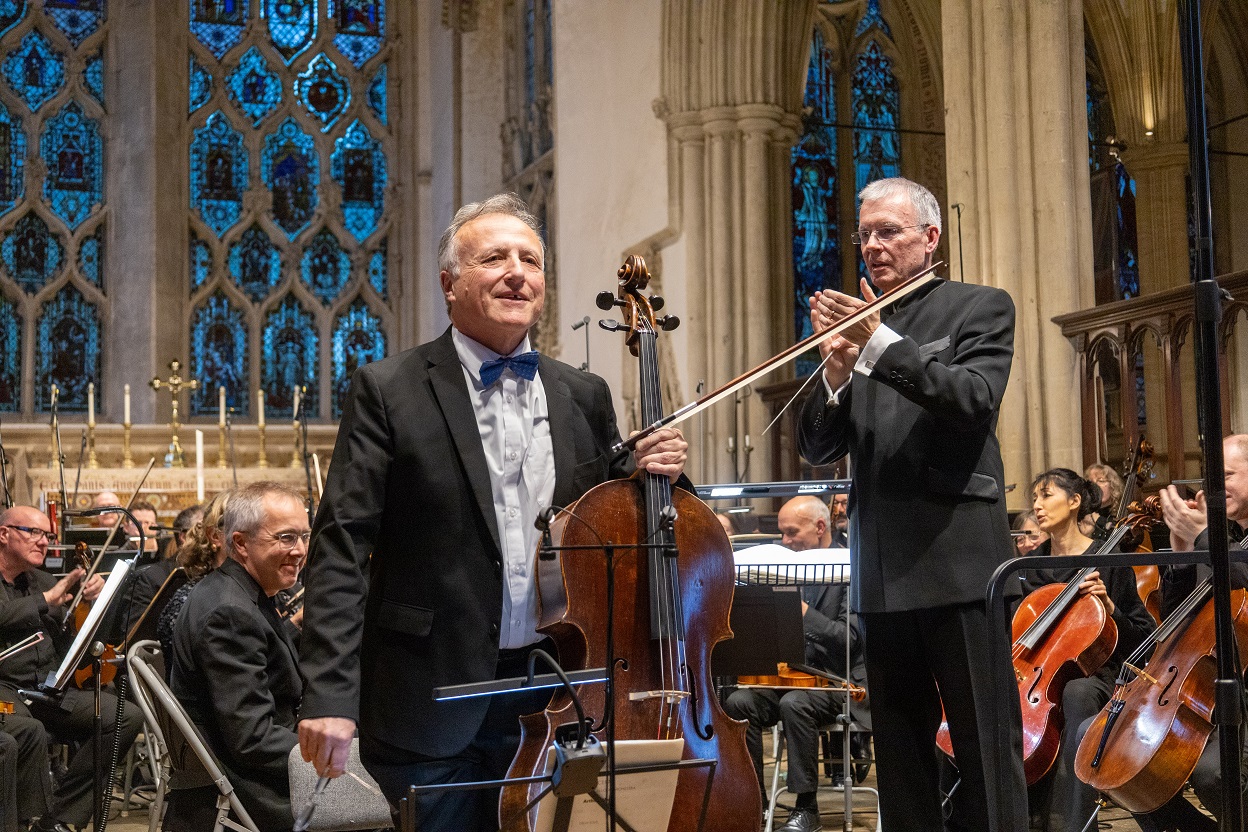
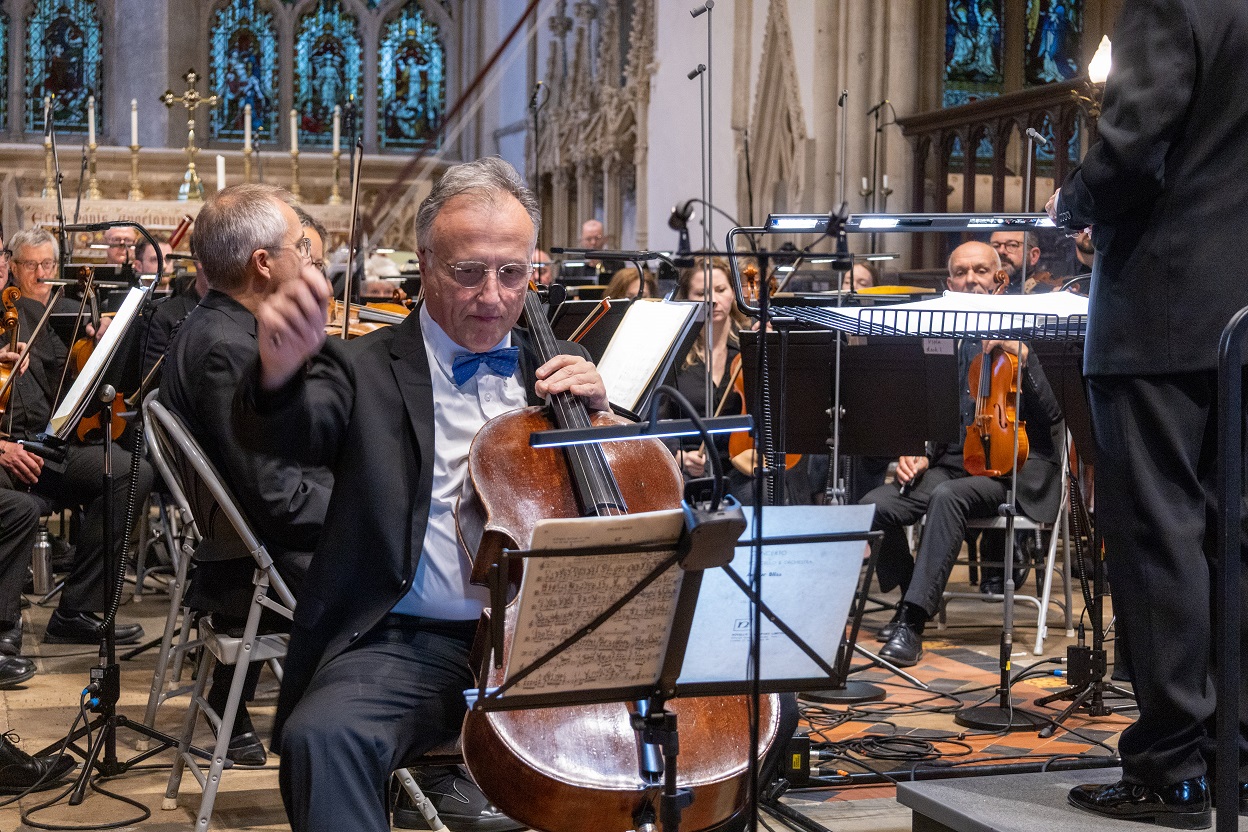
Arthur Bliss has enjoyed a veritable upsurge of performances in this 50th anniversary of his death, with his Cello Concerto among the finest works from that creative Indian Summer of his last decade. Compared with those for piano and violin before it, it eschews Romantic-era trappings in favour of Classical lucidity and proportion; its initial Allegro as much impulsive as decisive in its unfolding, with a semi-accompanied cadenza for its development in which Raphael Wallfisch (above) dovetailed effortlessly with orchestra. Subdued and poignant, the central Larghetto doubtless draws on the distant past in its heartfelt rumination, and while the final Allegro seems to dispel such memories, its progress is shot through with an ambivalence as makes the closing exchanges less than conclusive. Not least in this persuasive performance.

After the interval, another worthwhile revival in Heroic Elegy and Triumphal Epilogue with which Vaughan Williams, then in his late twenties, sought eminence among his peers. Only the first part, its fatalistic tread underpinning an eloquent theme on horns, was played at the time – the composer likely unsure if those episodic build-ups and rhetorical overkill of what follows were justified. Thanks to Yates’s assured direction, this music sustained itself up to a fervent apotheosis presaging the first movement from Sinfonia Antarctica half a century on.

Yates has always sought to include a world premiere in his EMF concerts and tonight saw that of Stanley Bate’s Second Symphony. A composer who rather snatched defeat from the jaws of victory, he doubtless had high hopes for a piece written in Paris and London but not accepted (if indeed it was ever put forward) for performance. Shostakovich’s Fifth has been suggested as precursor but a more likely precedent is VW’s Fourth, not least with the fractious progress of an Allegro whose starkly contrasted themes build towards a combative development then resigned coda. Sombre and fatalistic with a powerfully wrought culmination, the Andante is its highlight and the ensuing Scherzo puts the rhythmic syncopation of that in Walton’s First to very different if hardly less effective ends (which have been even more so placed second).

If it fails to clinch the whole, the finale’s alternately baleful expression and propulsive motion secures a rousing peroration then a coda which, if its serenity is borne out of exhaustion rather than affirmation, fittingly ends a work whose motto might well be that of ‘travelling in hope’.

Published post no.2,544 – Sunday 25 May 2025

In concert – Roberts Balanas, Ealing Symphony Orchestra / John Gibbons: Electrifying Ealing – Bernstein, Ángela Luq, Coleridge-Taylor & Bliss

Roberts Balanas (electric violin, below), Ealing Symphony Orchestra / John Gibbons (above)

Bernstein orch. Kostall & Ramin Symphonic Dances from West Side Story (1957 arr. 1961)
Luq Electric Violin Concerto ‘Machina Humana’ (2023-24) [World Premiere]
Coleridge-Taylor Valse de la reine Op.22/3 (1899)
Bliss A Colour Symphony Op.24 (1921-22, rev, 1930)

St Barnabas Church, Ealing, London
Saturday 10 May 2025

Reviewed by Richard Whitehouse Picture of Roberts Balanas (c) Kiril Kozlov

Another typically enterprising concert by the Ealing Symphony Orchestra and its longstanding music director John Gibbons, featuring the first performance (albeit not designated such) of a major work for electric violin and pieces from a diverse trio of British or American composers.

It might have been orchestrated by regular collaborators Irwin Kostall and Sid Ramin, but the Symphonic Dances from Leonard Bernstein’s West Side Story is as characteristic of the latter’s idiom as it is representative of his most successful musical. Rhythmically a little straightlaced in the Prologue, the performance audibly hit its stride with a Somewhere of melting pathos then a vivacious Scherzo leading to an impulsive Mambo, before the insouciant Cha Cha and ominous fugal Cool presaged a visceral Rumble then a Finale of heartfelt eloquence.

Lauded for her work with electronics, Spanish composer Ángela Luq evidently had no qualms when tackling a full-scale concerto for electric violin. Comprising four contrasted movements, Machina humana duly exploits those timbral and expressive possibilities of its solo instrument – whether in the intricate rhythmic dialogues of its opening Machina, the lucid textures and sensuous harmonies of Sueño (Dream), the impulsive conflict between soloist and orchestra of Animal, then the surging emotions of the final Amar (Love). Musical content may have lacked memorability, with the work rather falling short of its ambition (at least as expressed in the composer’s programme note), but the virtuosity or finesse of Roberts Balanas in realizing this innovative project was unarguable, with the Ealing SO audibly relishing its involvement.

No doubt this piece will secure even greater attention when soloist, orchestra and conductor tour it to Latvia in due course. Maybe on that occasion Gibbons will take the opportunity to give what would likely a first hearing there of Valse de la reine by Samuel Coleridge-Taylor. Third in a sequence of Four Characteristic Waltzes, this is a reminder that its composer was highly adept at ‘light’ music; its halting gait and its affecting lyricism to the fore in what was a welcome revival and a pertinent reminder of his legacy at the time of his premature death.

It also made a telling entrée into A Colour Symphony by Arthur Bliss. This 50th anniversary-year of his passing has led to a notable upsurge in performance and not least of what remains his best-known orchestral work. Whether or not Gibbons has previously conducted it, he had the measure of this piece. Purple made for a thoughtful yet never turgid prelude; one whose stately processional found immediate contrast in the alternate impetus and effulgence of the scherzo that is Red. Nor was there any underplaying of that ambivalent and even ominous element which underpins the outwardly placed unfolding of Blue, a slow movement which leads effortlessly into the finale that is Green with its intricately arrayed double-fugue that builds to a peroration whose outcome is a true declaration of intent thrillingly conveyed here.

An impressive performance, then, which once again confirmed Gibbons’s prowess across the broad spectrum of British orchestral music. Hopefully the Ealing SO will be able to include more Bliss in future programmes, this being music it had clearly taken to its collective heart.

Published post no.2,541 – Thursday 22 May 2025

In concert – The London Chorus and New London Orchestra / Adrian Brown: VE Day 80th Anniversary Concert @ Holy Trinity Church, Sloane Square

Petroc Trelawny (orator), The London Chorus, New London Orchestra / Adrian Brown

Vaughan Williams Six Choral Songs (1940)
Martinů Memorial to Lidice (1943)
Walton Spitfire Prelude and Fugue (1942)
Bliss Morning Heroes (1929-30)
Holst/Rice I Vow to Thee My Country (1921)

Holy Trinity Church, Sloane Square, London
Thursday 9 May 2025

Reviewed by Richard Whitehouse

The London Chorus and New London Orchestra have put on notable concerts in recent years, few more ambitious than this programme to mark not merely the 80th anniversary of Victory in Europe Day but also the 50th anniversary of Sir Arthur Bliss’s death in appropriate manner.

The first half comprised an unlikely but effective sequence of pieces written at the start of or during the Second World War. Rarely revived as such, Vaughan Williams’s Six Choral Songs to be Sung in Time of War works well as a whole: settings of Shelley that touch on aspects of courage, liberty, healing, victory, then pity, peace and war – before A Song to the New Age characterizes its utopian leanings in subdued and even ambivalent terms which seem typical of its composer. Suffice to add that the London Chorus had the full measure of its aspiration.

Two succinct if otherwise entirely different pieces brought out the best from the New London Orchestra. Rarely so overt in emotion, Martinů was well-nigh explicit when commemorating Nazi atrocities in music of plangent harmonies and chorale-like fervency both evocative and affecting. Derived from his score to the film The First of the Few, Walton had come up with a showpiece whose ceremonial prelude is vividly countered by its incisive fugue – making way for a brief if poignant interlude before matters are brought to a head in the rousing peroration.

Although intimately bound up with the First World War, Morning Heroes is wholly apposite for the present context. Conceived as the exorcism of his wartime experiences, Bliss’s choral symphony elides deftly between a distant past and its present; the first of its five movements featuring an orchestral introduction to set out the underlying mood and salient motifs, before Hector’s Farewell to Adromache had Petroc Trelawny eloquently evoking that scene on the ramparts of Troy without excess rhetoric. Adrian Brown’s understated direction meaningfully pointed up the expressive contrast between this and The City Arming – the setting of Walt Whitman whose interaction of chorus and orchestra was powerfully sustained right through   to the simmering unease at its close, with the onset of hostilities in the American Civil War.

The two parts of the central movement saw each section of the London Chorus come into its own: the women in Vigil, a confiding take on lines by Li-Tai-Po (Li Bai) such as relates the emotions of those left behind; and the men in The Bivouac’s Flame, plangently evoking life at the front with further lines from Whitman’s Drum Taps. Choral forces reunite in Achilles Goes Forth to Battle, a setting from later in The Iliad which brings about the work’s climax via The Heroes – a rollcall commemorating those of Antiquity. After this, the starkness of Wilfred Owen’s Spring Offensive is the greater for its sparse accompaniment – Trelawny’s oration a model of understatement as this segued into the setting of Robert Nichols’s Dawn on the Somme with those ‘morning heroes’ themselves evoked affirmatively if fatalistically.

A concert which ended in fine style with Holst’s stirring anthem had begun in subdued fashion with Dawn on the SommeRonald Corp’s elegy, given hours after his death was announced. Someone who had always given his all to this chorus and orchestra, he will be greatly missed.

Ronald Corp OBE (1951-2025)

Published post no.2,530 – Sunday 11 May 2025