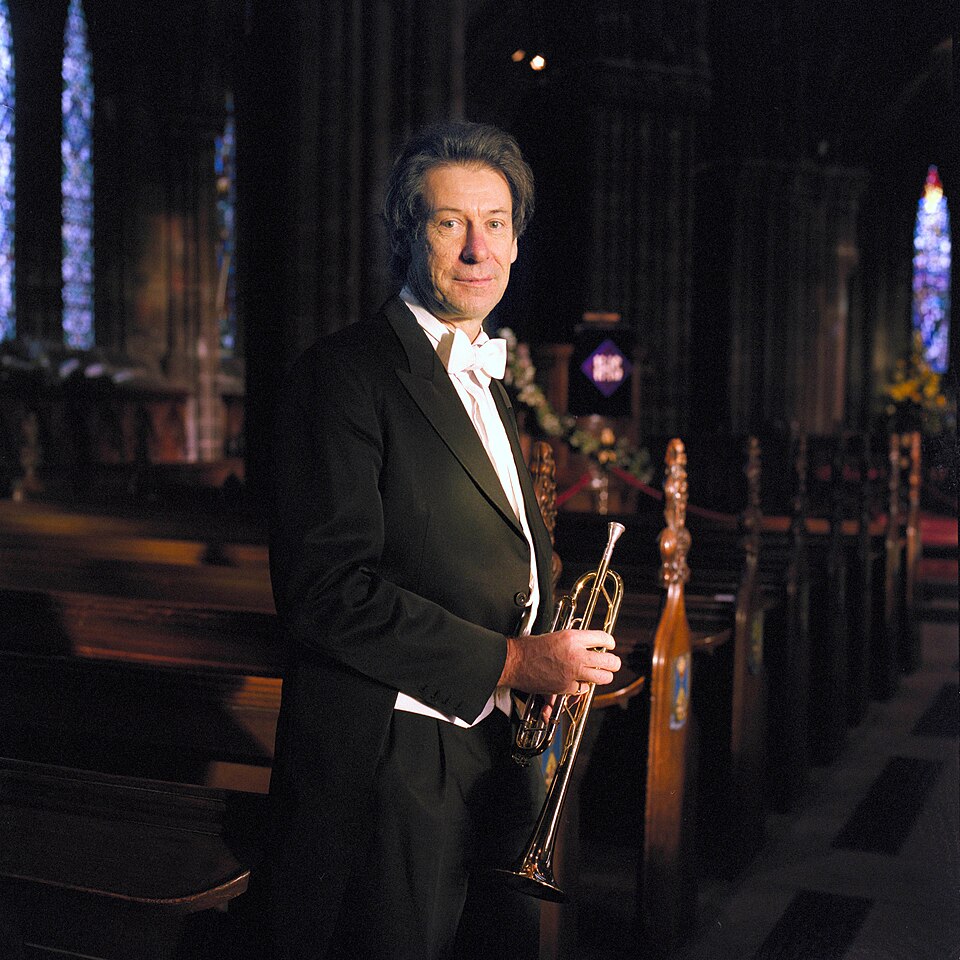
by Ben Hogwood Picture courtesy of Wikipedia / Thechisholm
Last week we heard the sad news of the death of trumpeter and conductor John Wallace, at the age of 76. There have been a number of affectionate obituaries for John that refer to his character, musicianship and academic influence among many other positive qualities. Wallace was principal trumpet of the London Symphony Orchestra from 1976 to 1995, and along the way blossomed into an international soloist of considerable repute.
In 1981 he played at the wedding of Price Charles and Princess Diana, joining soprano Kiri te Kanawa in a performance of Handel’s Let The Bright Seraphim:
He also formed The Wallace Collection in 1986, an influential brass ensemble whose flexible approach brought brass music to new audiences. Several composers wrote for Wallace, among them Sir Peter Maxwell Davies, Sir Malcolm Arnold, Sir James MacMillan and Robert Saxton.
Arcana has put together a playlist in honour of John Wallace, featuring the concertos written by Arnold and Maxwell Davies, along with the latter’s Litany for a Ruined Chapel between Sheep and Shore, written for Wallace to perform solo in 1999.
Wallace also features as soloist in Haydn’s much-loved Trumpet Concerto, Prayer of St Gregory by Alan Hovhaness and a commanding performance by the Wallace Collection of Berlioz’s Grande Symphonie Funèbre et Triomphale. There is also a pop nugget, Wallace playing piccolo trumpet on The Alan Parsons Project’s Don’t Let It Show, from the album I Robot.
Listen, enjoy, and appreciate the ability of a wonderful player whose presence will be greatly missed
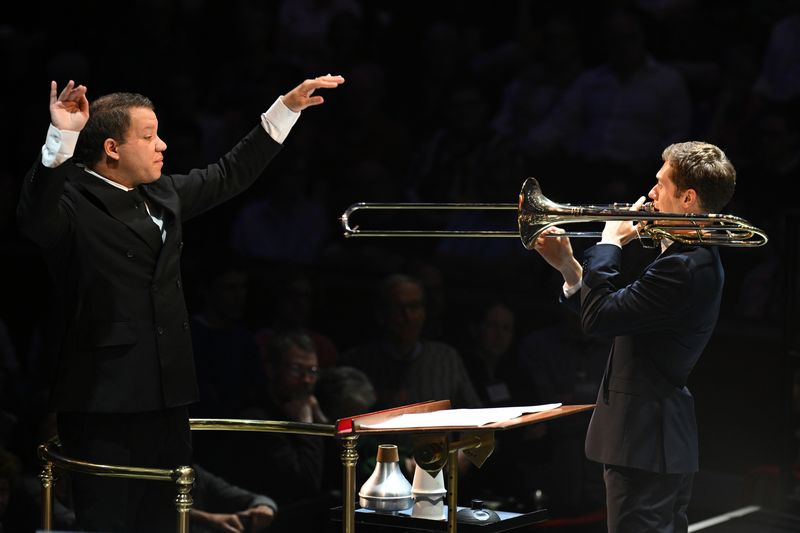
Peter Moore (trombone), London Symphony Orchestra / Ryan Bancroft
Vaughan Williams English Folk Song Suite (1923) Schuller Eine kleine Posaunenmusik (1980) [Proms premiere] Tippett Triumph (1992) [Proms premiere] Arnold arr. Johnstone English Dances Set 1 Op.27 (1950, arr. 1965) Grainger The Lads of Wamphray (1904), Country Gardens (1918, arr. 1953), Lincolnshire Posy (1937)
Royal Albert Hall, London Saturday 30 August 2025 11am
Reviewed by Richard Whitehouse Photos (c) BBC / Chris Christodoulou
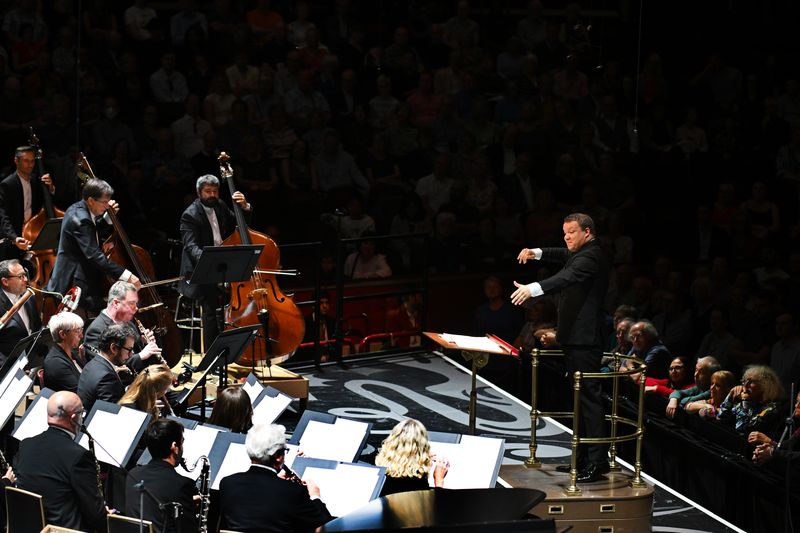
His pained countenance may have adorned its programme cover but Sir Simon Rattle’s ‘routine surgery’ meant this morning’s Prom was directed by Ryan Bancroft, though the works played by woodwind and brass (and basses) of the London Symphony Orchestra remained the same.
The concert duly breezed into life with Vaughan Williams’ English Folksong Suite, heard in its original scoring for concert (i.e. – military) band such as imparts a forthright impetus to its outer marches – the former alternating brusqueness with insouciance, and the latter similarly balancing energy with geniality. In between these, the intermezzo provided welcome respite with its soulful medley. Expert as are the arrangements for orchestra by Gordon Jabob or for brass band by Frank Wright, this remains the ideal medium for an unassuming masterpiece.
It would have been remiss of the Proms not to include a piece by Gunther Schuller in the year of his centenary, with Eine Kleine Posaunenmusik being a fine choice in context. Fastidiously scored for trombone and ensemble, whose wind and brass melded into tuned percussion with notable solos from piano and harpsichord, its five succinct movements outline a succession of vignettes in which Peter Moore sounded as attuned expressively as technically. With music as distinctive as this, Schuller’s fourth appearance at these concerts will hopefully not be his last.
Surprising that Michael Tippett’s Triumph should have remained so obscure within his output. Seemingly made during work on The Rose Lake, this ‘Paraphrase on Music from The Mask of Time’ is for the greater part his arrangement of the oratorio’s sixth movement, though it could be heard as encapsulating his music over the decade from the mid-’70s. The main portion pits fractured lyricism against dissonant outbursts as befits its genesis in a setting of Shelley’s The Triumph of Life and, if the closing affirmation sounds added-on, its finality is hardly in doubt.
There could hardly have been a more pointed contrast than with Malcolm Arnold’s initial set of English Dances – its sequence of winsome, bracing, elegiac then energetic numbers ideally conveyed in Maurice Johnstone’s arrangement. Their concision was thrown into relief by the relative garrulousness of The Lads of Wamphray, an early example of Percy Grainger’s love for folksong which, in this instance, rather outstays its welcome. Rattle presumably enjoys it and Bancroft gave it its head, but its inclusion here was not warranted by its musical quality.
From the other end of Grainger’s career, his concert-band arrangement of Country Gardens exudes all the wit and irony of his later creativity. It made a canny upbeat into Lincolnshire Posy, one of a select handful of concert band masterpieces and where the LSO gave its all. Thus, the incisive Lisbon (Dublin Bay) was followed by the pathos-drenched Horkstow Grange then intricately imaginative Rufford Park Poachers; the jaunty The Brisk Young Sailor by the darkly rhetorical Lord Melbourne (very different from Britten’s elegiac take).
The surging impetus of The Lost Lady Found brought to a suitably rousing close this suite and what was a fine showcase for the LSO woodwind and brass, an unexpected if welcome appearance by Bancroft and, above all, a demonstration of the potential of the concert band.
Malcolm Arnold, by permission Fritz Curzon. Text adapted from press release by Ben Hogwood
Demonstrating why Sir Malcolm Arnold is one of the most versatile and resourceful composers; ’20 for 20’ is the theme celebrating the 20th Malcolm Arnold Festival with performances of all 20 of the composer’s Concertos for solo instruments taking place in Northampton, the town of his birth, over the course of the weekend 18-19 October 2025.
Directed by Paul Harris, The Malcolm Arnold Festival is an annual programme of events celebrating one of England’s most prolific, colourful and charismatic composers – Sir Malcolm Arnold (1921-2006), who is probably best known for his internationally famous film scores, symphonic showpieces, and a canon of powerfully emotive semi-autobiographical symphonies.
INVENTIVENESS ON A SMALLER SCALE – MALCOLM ARNOLD’S CONCERTOS
Perhaps less well-known are Malcolm Arnold’s concertos, written throughout his long career and characteristic of the composer’s versatility in writing for a wide range of instruments and in appealing to both performer and listener alike; as such, they demonstrate all the hallmarks of the composer’s inventiveness in smaller scale.
Malcolm Arnold’s scoring for the concerto tends to favour the reduced forces of chamber orchestra or string orchestra and, according to Arnold authority Timothy Bowers; “Within an Arnold Concerto we find a lighter and more intimate world of expression. The influence of Sibelius in particular was embedded in Arnold’s concept of symphony form and scale”, explains Bowers. “He was also attracted to the sound world of Béla Bartók, particularly his ‘night music’.”
As a composition student of Gordon Jacob at the Royal College of Music and honing his craft as Principal Trumpet amongst the brass elite of the London Philharmonic Orchestra, Malcolm Arnold immersed himself in the workings of the orchestra and went on to become one of England’s most skilled and versatile composers, with the ability to write for any instrument that was called for.
“Arnold was far more productive in this field than most of his contemporaries”, says Timothy Bowers, “and this suggests that the concerto was especially important to him as a form. The best of his Concertos are amongst the finest works that Arnold created, and as a body of work they represent a highly personal approach to the genre. The experience of listening and studying the Concerto series as a whole is immensely rewarding.”
Of the twenty ‘Concertos’ with opus numbers, seventeen are for instrumental soloist, of which three are duo-concertos, the majority lasting around fifteen minutes. The earliest were written for friends and colleagues, which lead to commissions from world-renown soloists including Denis Brain (horn), Julian Bream (guitar), Benny Goodman (clarinet), Michala Petri (recorder), and Julian Lloyd Webber (cello), hence those written for more unusual solo instruments, such as harmonica, organ, and piano duo, and in some cases more than one work for the instrument requiring both a different approach in style and orchestral forces.
Some are better known and more regularly performed than others and some are considered masterpieces of the genre, such as the Flute Concerto no.2, and the Concerto for Guitar and Chamber Orchestra.
HEAR ALL 20 CONCERTOS OVER A WEEKEND OF LIVE MUSIC
Festival Director Paul Harris is a composer and clarinettist as well as one of the UK’s leading educationalists and authors. As Malcolm Arnold’s co-biographer, he has worked tirelessly, as Founder-Director of the Malcolm Arnold Festival, to present the composer’s genre in an accessible and exciting format and to provide a platform for both professional and student musicians to perform the composer’s works.
“We’re delighted to be holding the Festival at the very prestigious Cripps Hall which is part of Northampton School for Boys – the very school the young Malcolm Arnold attended!”, says Paul Harris. “For Saturday’s evening concert we transfer to St Matthew’s Church which will provide the opportunity to hear a rare performance of the ‘Grand Concerto Gastronomique’ for Waiter, Eater and Food; a suite of short orchestral pieces, in characteristic Arnold style, and calling for a wordless soprano in tribute to Dame Nellie Melba!
Taking part this year are the LGT Orchestra – an award-winning string ensemble featuring talented young soloists from over 20 nations; Equilibrium Symphony Orchestra – who’s young musicians already have professional solo experience, as well as regional orchestras and youth ensembles that include Bedford Sinfonia, Berkshire Youth Symphony Orchestra, and the London Choral Sinfonia.
GALA CONCERT, GUEST SOLOISTS AND A WORLD PREMIERE
Saturday evening’s Gala Concert provides the opportunity to hear Malcolm Arnold’s Concertos for Trumpet, Harmonica, and Organ, with soloists Nick Budd, Shima Kobayashi and Thomas Moore, while pianist John Lenehan will perform a World Premiere of his own two-hand arrangement of the Concerto for Two Pianos (3 hands) and Orchestra.
The Festival will be welcoming a plethora of guest soloists including: Joshua Milton and Nico Varela, (piano); Poppy Beddoe and Christian Hoddinott, (clarinets); Emmanuel Webb and Elif Ece Cansever, (violins); Hugh Millington and Gonçalo Maia Caetano, (guitars); Michala Petri, (recorder) –who will also be giving a talk; Maria Filippova and Daisy Noton, (flutes); Sarah-Jane Bradley, (viola); Daniel Fergie, (oboe); Junyu Zhou, (saxophone), and Ben Goldsheider and Finnian Smith, (horns).Conductors include Hilary Davan Wetton, Mattea Leow, Ian Smith, Jonathan Burnett and Ben Copeman.
The Festival programme will include complementary works by Malcolm Arnold’s composition teacher, Gordon Jacob; one of his major influences, Jean Sibelius, and fellow composers William Walton, Ruth Gipps, and Malcolm Williamson.
HOW TO BOOK
Day Ticket – allows entry to either Saturday or Sunday’s concerts, priced at £15
Weekend Ticket – allows entry to both days, priced at £25 Under 18s/Students, FREE
Gala Concert – priced separately at £10. Under 18s/Students, FREE
Arnold Commonwealth Christmas Overture Op.64 (1957) Clarinet Concerto no.1 Op.20 (1948) Divertimento no.2 Op.24 / Op.75 (1950) Larch Trees Op.3 (1943) Philharmonic Concerto Op.120 (1976) The Padstow Lifeboat Op.94a (arranged for orchestra by Philip Lane)
BBC Philharmonic Orchestra / Rumon Gamba
Chandos CHAN20152 [68’50″’] Producers Brian Pidgeon and Mike George Engineers Stephen Rinker, Richard Hannaford and John Cole Recorded 5 & 6 December 2019, 29 July at MediaCity UK, Salford
Reviewed by Ben Hogwood
What’s the story?
This collection of six pieces from Sir Malcolm Arnold’s composing career stretches from one of his first published pieces, Larch Trees, to one of his last, the Philharmonic Concerto. Both were written for the London Philharmonic Orchestra, for whom he played trumpet from 1941 until 1948, and with whom he maintained a close association as a composer.
In between these pieces Chandos have chosen a satisfying mix of styles to reveal Arnold as a multi-faceted composer, not just the humourous one of which we hear most. That side of his writing is happily celebrated through The Padstow Lifeboat and the Divertimento no.2 for orchestra reveals the happiness he found through writing for children and young people, being young at heart himself.
The Commonwealth Christmas Overture finds Arnold in commission mode, called upon to write the music for Royal Prologue: Crown and Commonwealth, a programme narrated by Sir Laurence Oliver to preface the 25th Christmas speech by a ruling monarch. Completing the collection is the first of many concertos from Arnold’s pen, and the first of two for clarinet.
What’s the music like?
Chandos have already presented us with a good deal of Sir Malcolm Arnold’s music, and this is further enhanced by a programme giving us first recordings and revealing each side of the composer’s personality.
The Commonwealth Christmas Overture gets proceedings off to a suitably ceremonial start, with plenty of bluster and high jinks, all buoyed by colourful percussion. The influence of William Walton is immediately evident, for the main theme has more than a little in common with his own ceremonial march Crown Imperial, but Arnold goes on to develop it in his own inimitable way.
The Clarinet Concerto is a compact piece, deft and slightly bluesy in the outer movements but pausing for meaningful reflection in the Andante, the emotional centre of the work.
The Second Divertimento, long thought lost, is a fun piece where a lot happens in nine minutes! Using a traditional-sounding structure, Arnold has a lot of fun with the bracing Fanfare, atmospheric Nocturne and grand Chaconne, harnessing the power of the large orchestra.
The two pieces for the London Philharmonic are next, and are vividly contrasting pieces of work. Larch Trees is an evocative musical sketch, reminiscent of Moeran in the way it pans out over the rugged terrain of northern England, while also confiding intimately in its listeners through the woodwind. The Philharmonic Concerto is more obviously noisy and confrontational, this late work utilising the dissonance which will be noted by those familiar with Arnold’s later symphonies. This is not comfortable music but it is brilliantly written, challenging the orchestra to throw off their shackles. The probing violin lines of the Aria offer a chance for deeper reflection.
Finally The Padstow Lifeboat, one of Arnold’s brass band treasures, with its persistent ‘wrong note’ which warns all shipping. It makes for the ideal sign-off.
Does it all work?
Yes, and wonderfully so. Rumon Gamba has enjoyed a long and fruitful association with Arnold’s music and comes up trumps here, leading the BBC Philharmonic Orchestra in some characterful and personal accounts. Arnold could hardly wish for better advocacy and understanding, the conductor charting his youthful prowess in Larch Trees, whose softer contours benefit from excellent recording by the Chandos engineers.
The Clarinet Concerto no.1 is brilliantly played by Michael Collins, negotiating the wide leaps of the solo part with aplomb, while responding with grace in the soulful slower sections. The strings of the BBC Philharmonic exploit the depths of the darker slow movement, its temperature appreciably colder by the end.
Is it recommended?
Enthusiastically. This is an anthology that will appeal to seasoned Arnold listeners, for its mix of the familiar and a curio or two, while it is also the ideal place for those new to the composer. If you are after some music to combat the onset of January, you have come to the right place!
Listen
Buy
For more information and purchasing options on this release, visit the Chandos website
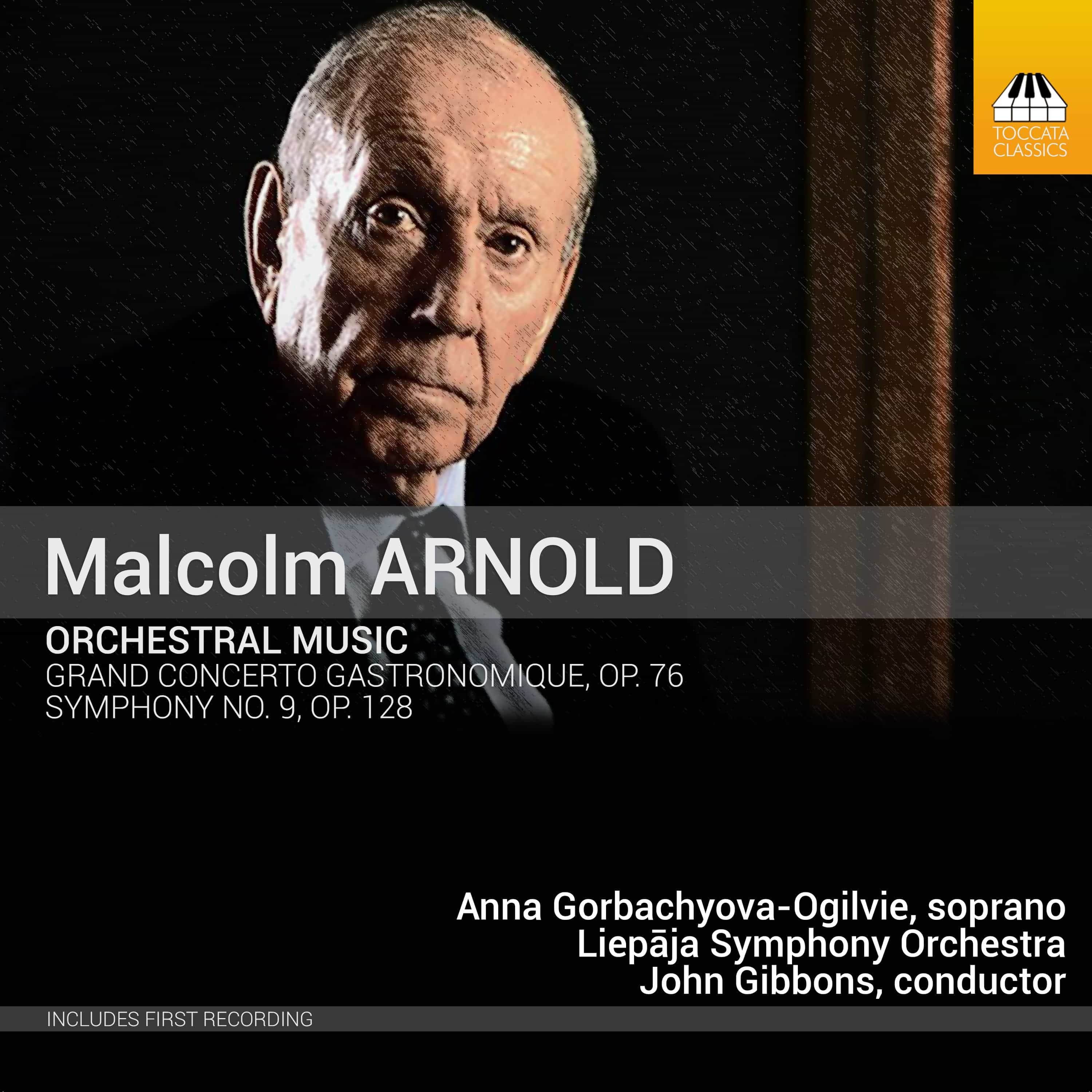
Malcolm Arnold Grand Concerto Gastronomique Op.76 (1961) Symphony no.9 in D Op.128 (1986)
Anna Gorbachyova-Ogilvie (soprano, Concerto), Liepāja Symphony Orchestra / John Gibbons
Toccata Classics TOCC0613 [57’30”]
Producer Normands Slāva Engineer Jānis Straume
Recorded 14-16 June 2021 at Great Concert Hall, Liepāja
Written by Richard Whitehouse
What’s the story?
Toccata Classics marks the centenary of Malcolm Arnold’s birth (falling on October 21st) in a pertinent coupling of his final symphonic statement with music finding this composer at his most irreverent and, by so doing, juxtaposes the two sides of his creativity to startling effect.
What’s the music like?
It was the compositional hiatus resulting from emotional breakdown then tortuous recovery as provided the catalyst for the Ninth Symphony, whose superficial simplicity belies the anguish beneath its surface. John Gibbons (who had earlier conducted this work in London, as part of a nine-year Arnold cycle, and Northampton) brings tangible expectancy to the opening Vivace, its arresting initial gestures soon revealing that textural starkness which goes on to define the whole work, with a circuitous evolution even more marked in the Allegretto – an intermezzo whose wistful theme effects less a series of variations than poignant searching for formal and expressive closure. The ensuing Giubiloso is more overtly a scherzo with its headlong motion or trenchant exchanges between wind and strings, yet even here a curious detachment prevails.
Arnold’s eight previous symphonies each concluded in a relatively short and decisive finale, but the Ninth’s final Lento proves anything but – its sustained slowness abetted by restrained dynamics and a sparseness of detail which could have made for unrelieved gloom were it not for those myriad ‘shades of grey’ the composer draws from his reduced palette. An additional factor is Gibbons’s pulse for this movement as a tactus (one-second) rather than crotchet beat, leading to a traversal several minutes less than earlier recordings by Andrew Penny (Naxos), Vernon Handley (BMG) or Rumon Gamba (Chandos) and, as a result, making the cadential chord one of benediction than resignation. Whether or not this approach convinces depends on how one views the symphony overall, but there can be no doubting its sincerity of intent.
Composed for the Astronautical Music Festival – the last of several events inspired by Gerard Hoffnung – Grand Concerto Gastronomique is Arnold at his most uproarious. Its designation ‘for Eater, Waiter Food and Large Orchestra’ betrays a visual aspect not essential for enjoying this 15-minute consumption of Brown Windsor soup, roast beef, cheese, Peach Melba – with a sensuous cameo by soprano Anna Gorbachyova-Ogilvie – then coffee with brandy; framed by a Prologue and Epilogue of due portentousness, but thankfully no ‘Mr Creosote’ in evidence.
Does it all work?
As a coupling, yes. As to content, the Ninth Symphony will likely always divide opinion as to whether it is what Arnold intended or merely the best that he was able to achieve after the traumas of the preceding decade, but no-one could accuse Gibbons of realizing it as other than a cohesive entity whose formal proportions are as precisely judged as its expressive trajectory is purposefully conveyed. Listeners not convinced by those earlier recordings should certainly hear this new account, lucidly and persuasively rendered by the Liepāja Symphony Orchestra.
Is it recommended?
Yes, enhanced by thought-provoking booklet notes from Timothy Bowers along with realistic sound. Should still-missing orchestral pieces by Arnold (notably the Op. 1 First Divertimento or the Op. 12 Symphonic Suite) come to light, Gibbons will hopefully be asked to record them.



 Arcana.fm