
In Concert – Sir Stephen Hough, Soloists, CBSO Chorus, City of Birmingham Symphony Orchestra / Omer Meir Wellber: Beethoven & Haydn

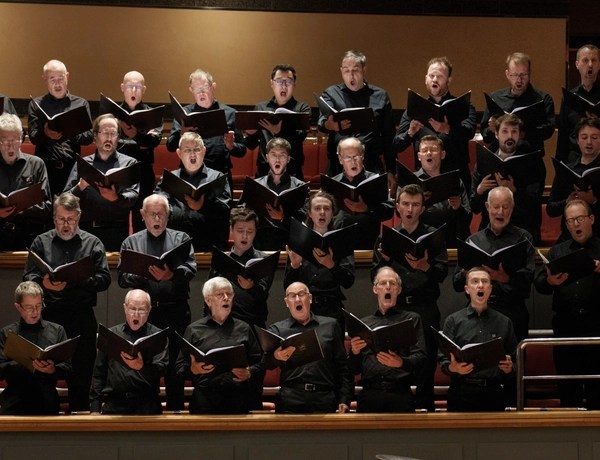
Sir Stephen Hough (piano, below), Lauren Urquhart (soprano), Georgia Mae Ellis (mezzo-soprano), Luis Gomes (tenor), Alexander Grassauer (bass), CBSO Chorus (above), City of Birmingham Symphony Orchestra / Omer Meir Wellber (conductor & harpsichord/director)

Beethoven (/Hough) Piano Concerto no.3 in C minor Op.37 (1800, rev. 1803)
Haydn Missa in Angustiis, Hob.XXII/11 (‘Nelson Mass’) (1798)

Symphony Hall, Birmingham
Thursday 19 February 2026

Reviewed by Richard Whitehouse

That tonight’s concert from the City of Birmingham Symphony Orchestra featured music by Beethoven and Haydn might have been indicative of a straight-ahead or mainstream concert but, as things turned out, neither programme nor music-making could be deemed predictable.

Sir Stephen Hough has no doubt played Beethoven’s Third Concerto many times with, moreover, his take on the outer movements not far removed from his much-praised Hyperion recording. The initial Allegro was lithe and impetuous if at times a touch hectoring (and Matthew Hardy was uncharacteristically reticent in that spellbinding passage after the cadenza), with the final Rondo treading a fine line between humour and irony at its most distinctive in the modulatory transition to the main theme, or that improvisatory solo flourish prior to the nonchalant coda.

Interest naturally centred on the slow movement – a Largo designated Con gran espressione in its ‘re-imagining’ by Hough (above). Itself part of a project instigated by this evening’s conductor, Omer Meir Wellber, to re-examine works in the core repertoire, this duly retains Beethoven’s instrumentation but renders the main theme, introduced by the soloist, as a hushed chorale for strings which pervades what follows. All well and good had that chorale become more than a static backdrop, against which Hough’s welter of skittish figuration sounded overly confined to the upper register. Neither was the climactic return of the first movement’s principal theme other than an affectation, nor the upsurge leading directly into the finale without contrivance. One respected Hough’s following of his muse, even if the outcome felt less than convincing.

Having not unreasonably given Hough the benefit of any doubt, the audience was nonplussed with his encore – the last of Schoenberg’s Six Little Pieces that, written after Mahler’s funeral on 17th June 1911, yields a rapt eloquence even at less than the ‘very slow’ tempo prescribed.

As searching products of his late maturity, the six ‘name day’ Masses that Haydn wrote around the turn of the 19th century remain too little heard at orchestral concerts; save for the ‘Nelson Mass’ whose actual title, Mass in Troubled Times, makes explicit the cultural turmoil from of which it arose. This must also have occasioned its unyielding orchestration with trumpets and timpani but no woodwind, plus a dextrous continuo part allotted here to harpsichord and from which Wellber directed with a sure sense of where this most combative of masses was headed.

Vocally the solo writing favours soprano and bass, with Alexander Grassauer making the most of his mellifluous contributions and those of Lauren Urquhart impassioned yet tonally uneven in more animated passages. Georgia Mae Ellis and Luis Gomes handled their secondary roles with real finesse, while chorus-master David Young drew a laudable response from the CBSO Chorus (arrayed on stage with what might be felt the choral equivalent of ‘free bowing’). Taut and incisive, the epithet ‘symphonic’ as applied to this work can rarely have been so apposite.

The performance certainly set the seal on a concert which rightly encouraged a reassessment of both works and, by so doing, underlined Wellber’s own interpretative convictions. Having last appeared with the CBSO almost six years before, his return should be so long in coming.

To read more about the CBSO’s 2025/26 season, visit the CBSO website. Click on the names for more on conductor Omar Meir Wellber, pianist Sir Stephen Hough and soloists Lauren Urquhart, Georgia Mae Ellis, Luis Gomes and Alexander Grassauer.

Published post no.2,804 – Friday 20 February 2026

On Record – David Quigley – The Fair Hills of Éire: Irish Airs and Dances (Heritage Records)

david-quigley

David Quigley (piano)

Beach The Fair Hills of Éire Op.91 (1922)
Esposito Two Irish Melodies Op.39 (1883)
Field Go to the Devil and Shake Yourself (1798)
Hammond Miniatures and Modulations (2011) – No. 5, Old Truagh; No. 21, The Beardless Boy
Hennessy Variations sur un air Irlandais ancien Op.28 (1908)
Hough Londonderry Air (2014)
Martin Sionna – Spirit of the Shannon (2018)
Moeran Irish Love Song (1926); The White Mountain (1929)
Smith Paraphrase on ‘The Last Rose of Summer’ Op.173 (1883)
Stanford arr. Grainger Four Irish Dances Op.89 (1916) – no.1: Maguire’s Kick; no.4: A Reel

Heritage Records HTGCD152 [62’39”]
Producer / Engineer David Marshalsea

Recorded 9 & 11 April 2022 at Elgar Concert Hall, The Bramall, University of Birmingham

Reviewed by Richard Whitehouse

What’s the story?

The enterprising Heritage label continues its association with David Quigley in this recital   of Irish piano works as cover over two centuries, reminding listeners of the wealth of folk or traditional music from that island and its influence on successive generations of composers.

What’s the music like?

Published as Favorite (sic) Irish Dance Arranged as a Rondo for the Piano Forte, the first item is not unreasonably attributed to the teenage John Field and make for a breezy recital-opener – following which, pianist Stephen Hough demonstrated his prowess as an arranger with what is surely the most famous of all Irish melodies. Two pieces by the Italian émigré Michele Esposito – the trenchant Avenging and Bright, followed by the pensive Though the Last Glimpse of Erin – complement each other ideally, whereas the first from a set of dances by Charles Villers Stanford exudes bracing humour most likely accentuated in this idiomatic arrangement by no less than Percy Grainger. By some distance the longest piece here is from Swan Hennessy, an Irish/American later resident in France – his 12 variations on an (unidentified) theme in the lineage of various such works from the 19th century but diverting in its ingenuity. Best known as an inquiring pianist, Philip Martin the composer is represented by this evocative set of ‘rhapsodic variations’ written for the present artist.

Sidney Smith’s Paraphrase de concert on another Irish staple is the most virtuosic music and would make a dashing encore even today. Philip Hammond is the other contemporary composer featured – the present brace, part of a sequence of 21 drawn from the Edward Bunting collection and likewise written for Quigley, respectively searching and animated     in their emotional profile. From among her many mood-pieces, that by Amy Beach yields       a limpid poetry that more than deserves to provide the title for this collection overall. An English composer with direct Irish ancestry, Ernest Moeran’s predilection for all-things Celtic is made plain by the two pieces heard here, their recourse to traditional melodies enhanced by an idiomatic pianism which adds greatly to the winsomeness of their appeal. Back, finally, to those Stanford/Grainger dances with the fourth from this set a reminder that the former, whatever his formidable reputation as a pedagogue, was never averse to indulging his Irish roots in the writing of music as scintillating as it remains appealing.

Does it all work?

Admirably. Quigley is as committed to the music of his homeland as have been numerous of his predecessors, not only with performing these pieces in recital but also by finding ways of integrating them into a cohesive overall programme. Only one achieves (just) the 10-minute mark and another is almost eight minutes, making them ideal for combining into a judicious sequence – one which, at little more than an hour’s length, can be enjoyed at a single hearing. Quigley will hopefully have the chance to mine the ‘Irish piano-book’ further in due course.

Is it recommended?

Indeed. Quigley is a perceptive exponent of this repertoire, his Kawai Shigeru SK-EX heard to advantage in the spacious yet detailed acoustic of the Elgar Concert Hall. With succinctly informative notes from Andrew H. King, this recital warrants the warmest recommendation.

For further information on this release, and to purchase, visit the Heritage Records website, and for more on David Quigley click here

In concert – BBC Philharmonic Orchestra & Jac van Steen – David Matthews Symphony no.10 world premiere, Schubert & Brahms

jac-van-steen

Brahms Piano Concerto no.1 in D minor Op.13 (1854-8)
Schubert
Overture to Rosamunde D797 (1820)
David Matthews
Symphony no.10 Op.157 (2020-21) [World premiere]

Stephen Hough (piano, below), BBC Philharmonic Orchestra / Jac van Steen (above)

MediaCity UK, Salford Quays
Friday 20 May 2022, 3pm

Written by Richard Whitehouse

A substantial programme was the order of the day for this afternoon’s studio concert from the BBC Philharmonic with Jac van Steen, given at the orchestra’s regular base in MediaCityUK and that featured a first performance anywhere for the Tenth Symphony by David Matthews.

Whereas his previous symphony was written for relatively modest dimensions, the Tenth marks a return to larger forces: triple woodwind (with doublings), four horns, three each of trumpets and trombones, tuba and four percussionists alongside timpani, celesta, piano, harp, and strings. It also finds Matthews (above) retackling the one-movement format that dominated his earlier symphonies, allied to a subtle process of developing variation such as ensures unity across a varied and eventful discourse. Not least when that massive opening chord sets out a long-range tonal and harmonic trajectory for this work overall, and to which a pensive (offstage) cor anglais solo then intensifying string fugato provide both continuation and contrast by anticipating the types of expression and motion as variously come to the fore.

Distinctive in themselves yet drawn into a tensile and cohesive entity, the constituent sections take in a wistful intermezzo then an agile scherzo on the way to a central culmination whose increasingly explosive energy likely marks a point of greatest engagement with that opening chord. The music duly heads into a slower episode of sustained emotional raptness, elements heard earlier gradually being recalled through an unforced while never discursive process of reprise towards a coda whose ending seems the more conclusive for its poised equivocation. An absorbing and often gripping exploration of symphonic tenets such as Matthews has long pursued, persuasively realized by the BBCPO and van Steen – whose support of the composer – having already recorded the Second, Sixth and Eighth Symphonies – hardly needs restating.

Before the interval, Stephen Hough (above) was soloist in Brahms’s First Piano Concerto – a piece he has given many times (not least a memorable reading at London’s Royal Festival Hall in the early 1990s, Andrew Davis also giving a seismic account of the Symphony by the late Hugh Wood). There was emotional breadth aplenty in the initial Maestoso, but also latest energy as came to the fore in a combative development and tempestuous coda. Nor was the symphonic aspect underplayed in what is still the most monumental opening movement of any concerto.

If the central Adagio lacked a degree of repose in its orchestral introduction, Hough’s take on its almost confessional solo passages brought the required inwardness, with the course of this movement towards its agitated peak or enfolding serenity at its close never in doubt. Nor was that of the closing rondo, especially a central episode whose string fugato was deftly rendered then the piano’s gentle response enticingly conveyed. After the cadenza, horns and woodwind emerged as if leaving a benediction prior to the triumph that coursed through those final bars.

Throughout this performance, van Steen was an alert and responsive accompanist – then put the BBC Philharmonic through its paces with an animated account of Schubert’s Rosamunde (a.k.a. Die Zauberharfe), which made for an engaging if unlikely entrée into the Matthews.

For more information on David Matthews you can visit his website here. For more on the artists in this concert, click on the names to access the websites of Stephen Hough, Jac van Steen and the BBC Philharmonic Orchestra

In concert – Stephen Hough, CBSO / Edward Gardner: Saint-Saëns, Mazzoli & Debussy

hough-gardiner

Stephen Hough (piano), City of Birmingham Symphony Orchestra / Edward Gardner

Saint-Saëns Piano Concerto no.4 in C minor Op. 44 (1875)
Mazzoli Violent, Violent Sea (2011)
Debussy La Mer L109 (1903-05)

Symphony Hall, Birmingham
Wednesday 19 May 2pm

Written by Richard Whitehouse

It may have been almost six months since the City of Birmingham Symphony last played to live audiences, but the frisson of expectation was palpable as the orchestra gradually took the stage for this first of nine concerts that, at around an hour’s duration, are being heard at 2pm then again at 6.30. The design of Symphony Hall’s platform makes it possible, moreover, to take out the raised platforms and so accommodate a larger number of musicians than would otherwise be possible in what is (hopefully!) a transitional period out of lockdown. Current restrictions still entail the spreading out of listeners, a small price to pay given the quality of acoustic at almost any point in this auditorium, while the rapid entry and exit procedures also enabled punters to assess the remodelled catering areas in advance of their June reopening.

As conducted by Edward Gardner, this programme featured works by two French composers with more in common than either could have suspected. Saint-Saëns nearly always brings out the best in Stephen Hough, and so it proved in this regrettably rare revival of the Fourth Piano Concerto. Its four sections grouped into two movements (a design the composer returned to a decade on with greater panache if less subtlety in his Third Symphony), the piece touches on aspects of sonata, variation and rondo procedures while its plain-spun material is developed in various and intriguing ways. This plus the close integration of soloist and orchestra often makes for a sinfonia concertante than concerto per se, yet there is no lack of virtuosity such as Hough despatched with alacrity – not least the cascading passagework in the final Allegro.

Saint-Saëns and Debussy evinced no mutual esteem, but as the former integrated symphonic elements into his concerto, so did the latter in his ‘three symphonic sketches’ which comprise La Mer. Here the CBSO came into its own, not least in the purposefully contrasted sequence of From Dawn to Midday on the Sea with its crepuscular writing for solo wind and divided strings through to a climactic chorale of visceral immediacy. Perhaps interplay of timbre and texture in Games of the Waves could have been more deftly handled, but Gardner exerted a firm grip over its course then drew real pathos from the final bars. He also found a persuasive balance between the volatile and poetic aspects in Dialogue of the Wind and the Sea, while maintaining steady momentum as issued forth in the chorale on its proudly affirmative return.

Between these works, Violent, Violent Sea by the highly regarded American composer Missy Mazzoli elicited a wholly different response as to its marine concept. Here it is the constant yet rarely insistent melding of translucent harmonies and pulsating rhythms (stemming from marimba and vibraphone) as underpin this music; the sustaining of whose atmosphere is the keener for its succinct duration. The ranging of its relatively modest forces across the extent of the platform also made for rather greater impact than might otherwise have been the case. It certainly added to the attractions of a programme which launched this series of concerts in impressive fashion. The CBSO returns next Wednesday with Nicholas Collon at the helm for a sequence that ends with the uncompromising defiance of Shostakovich’s Fifth Symphony.

For further information about the CBSO’s current series of concerts, head to the orchestra’s website

For further information about Missy Mazzoli, click here

In concert – A week locked into Wigmore Hall

At 1pm on Monday June 1st, live music-making returned to the Wigmore Hall and BBC Radio 3.

While we have been incredibly fortunate to enjoy live streams of music from around the world since lockdown began, this felt like something extra special. A whole month of lunchtime concerts, served up by our finest chamber music venue in conjunction with BBC Radio 3, and streamed on the Wigmore Hall website. With a selection of top class artists, all of whom live close enough to journey in and play, all that was missing was the audience – but this added extra poignancy, offering us private moments with the musicians in our own home, a deluxe version of what BBC Radio 3 has been giving us for decades. A note should be made for presenter Andrew McGregor‘s broadcasting manner, expertly paced and perfectly weighted.

The musical riches in the first week have been many and varied. The first concert was ideally placed, Steven Hough giving us Busoni’s epic realisation of Bach’s Chaconne in D minor and Schumann’s lovelorn Fantasie in C major. In some performances of the Bach-Busoni the virtuoso elements of the piece take over at the expense of feeling, but not here. Hough shaped the phrases with great care, bringing out the gusto when it was needed but giving an incredibly well-balanced account of a familiar showpiece.

With Schumann’s Fantasie he gave a flowing performance of a notoriously difficult work, made all the more poignant because of its circumstances, written in isolation by a composer pining for his wife Clara. There was joy, too – the march theme of the second movement ringing out with bell-like clarity, while the resolution at the end, softly voiced, left a lasting smile.

Tuesday’s song recital from soprano Lucy Crowe and pianist Anna Tilbrook had the themes of Hope and Longing – appropriately in the awful context of world events, which saw the concert begin with a two-minute period of reflection on racial inequality and violence.

Crowe began on high, judging her vibrato beautifully for Thomas Arne’s aria O ravishing delight, before three Schumann songs found her vocal control matched by her communication with the audience, in spite of the empty hall. The sound world of Berg’s 7 frühe Lieder is very different, with challenges of tricky melodic intervals and words by seven different poets, but the soprano handled them effortlessly, helped by Tilbrook’s painterly application of light and shade for the corners of Berg’s nocturnal settings.

The pair moved on to a selection of poignant folk songs, none more so than the unaccompanied She moved through the fair, before English lyrics old and new from Thomas Dunhill, Ivor Gurney, Vaughan Williams and Madeline Dring. It was a touching recital with both soprano and pianist clearly on the same page.

Few guitarists would expect to receive compliments on the quality of their quiet playing…but that was what stood out immediately from Sean Shibe’s solo recital on the Wednesday. With a collection of attractive Scottish dances the listener was drawn in from the start and borne to the beauty of the Highlands, the tunes carrying on the air in performances of extraordinary intimacy.

The same could be said for Shibe’s performance of Bach’s Lute Suite in E minor, carefully studied but delighting in the expressive interplay between the parts, bringing Bach’s notes clean off the page. Steve Reich’s Electric Counterpoint was even better, Shibe moving to a Fender to play the 12th part of this multilayered composition. The waves of sound echoing around the Wigmore as the guitarist, now barefoot, completely lost himself in the music.

Oboist Nicholas Daniel and pianist Julius Drake, both Wigmore regulars and musical partners for 40+ years, crammed their Thursday lunchtime with music old and new, all of personal significance.

They included two short premieres, the wide open textures of Huw Watkins’ haunting Arietta and the uncertainties of Michael Berkeley’s A Dark Waltz, written in lockdown. There was a rarity,too, in the first broadcast performance of Liszt’s darkly coloured Élegie, originally written for cello and piano but here in a recently unearthed version with for cor anglais.

Howard Ferguson’s arrangement for oboe and piano of Finzi’s substantial Interlude was beautifully paced and deeply felt in that slightly elusive way in which the composer writes, Drake absorbing the extra parts with ease. Meanwhile Ferguson’s arrangements of three pieces for pedal piano by Schumann studies were also nicely done. Later we heard three attractive shorter pieces from Madeline Dring, and finally Nicholas Daniel showed off the oboe’s versatility in three rewarding arrangements of popular songs, including The Girl From Ipanema and capped by All The Things You Are. A note, too, for the pair’s deeply felt and beautifully observed Bach encore, Jesu, Joy of Man’s Desiring, prefaced by a sensitive introduction.

Last but not least, Pavel Kolesnikov and Samson Tsoy reminded us what an intimate form of communication the piano duet can be. As the pair live together they have experienced isolation in each other’s company, and that in itself brought an extra poignancy to their lovingly played selection of BrahmsLiebeslieder Waltzes, a profound Schubert Impromptu in A flat from Tsoy and a bittersweet clutch of six Waltzes, Ländler & German Dances from Kolesnikov.

Together the pair enjoyed the humour and lightness of touch in Beethoven’s 8 Variations on a theme of Count Waldstein, but the best was saved for last and a wonderful performance of Schubert’s Fantasia in F minor. Recognised as one of the finest works in the piano duet repertoire, it received a performance led by Tsoy that moved from almost painful introspection to passionate outbursts five minutes later. The scherzo section had plenty of cut and thrust, while the whole piece, ideally paced, built to an almost overwhelming strength of feeling, capped by an intensely dramatic pause before the softly voiced opening theme returned.

What a musical week it has been – and looking at the roll call it looks like we are in for another three weeks of equally fine and moving insights. You can catch up with all the concerts on the links above and are strongly advised to do so, for there are some incredibly fine performances waiting to be heard. Live concerts may not be with us for a while yet, but in the meantime these intimate hours with some of our best classical music artists are an ideal substitute.

You can see the schedule for forthcoming Wigmore Hall livestreams here, the series resuming courtesy of cellist Steven Isserlis and pianist Mishka Rushdie Momen on Monday 8 June.