Online concert – Steven Isserlis & Connie Shih mark the centenary of Saint-Saëns @ Wigmore Hall

steven-isserlis

Saint-Saëns Cello Sonata no.1 in C minor Op.32 (1872)
Liszt Romance oubliée S132 (1880)
Fauré Romance Op.69 (1894)
Saint-Saëns Romance in F major Op.36 (1874)
Bizet arr. Hollman Carmen fantaisie (not known)
Willaume La noce bretonne Op.14 (pub. 1924)
Holmès arr. Isserlis Noël d’Irlande (1897)
Hahn 2 improvisations sur des airs irlandais (1894 rev. 1911)
Saint-Saëns Cello Sonata no.2 in F major Op.123 (1905)

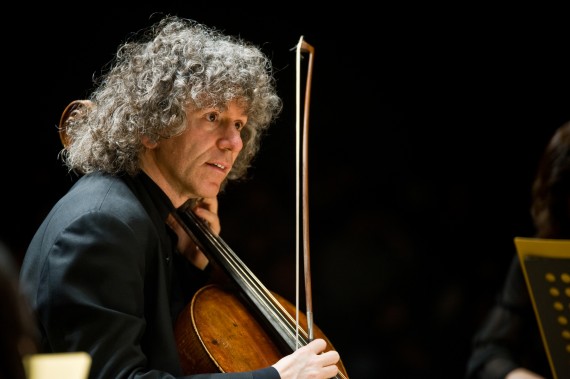
Steven Isserlis (cello, above), Connie Shih (piano, below)

Wigmore Hall, London
Thursday 16 December 2021

Written by Ben Hogwood

This well-devised program to mark the centenary of the death of Saint-Saëns was put together by cellist Steven Isserlis and his regular partner, pianist Connie Shih. They presented the composer’s two cello sonatas, the first of which was recorded by Isserlis back in 1992, in an intriguing historical context.

There is no room for shrinking violets in the first movement of the Cello Sonata no.1 in C minor Op.32, a relatively early work, and both performers threw themselves headlong into the music. Saint-Saëns was a virtuoso pianist, and on occasion his writing for the instrument is as demanding if not more so than the instrument it is ‘accompanying’. Here however the two were on equal terms, with plenty of cut and thrust in a dramatic first movement. The C minor casting and stormy start draw parallels with Beethoven, and these were built upon in the players’ compelling dialogue. The improvisatory slow movement was ideally poised, with an air of mystery in its central section where the cello was in its lowest register, complemented by twinkling figures from the piano. The Allegro moderato third movement returned us to powerful, passionate music, Isserlis’ double stopping passages immaculately delivered and Shih finding the necessary definition and phrasing in a superbly played piano part.

A full 32 years elapsed between the first sonata and its sequel, the Cello Sonata no.2 in F major Op.123. By this time the 70 year-old composer’s style had developed considerably. It is a substantial piece, running over 35 minutes, and is perhaps less-performed on that basis, not to mention the demands made on the performers. Isserlis and Shih showed what a fine work it is, however, in a performance that was gripping from the off, full of passion but also finding the more elusive statements in the quieter music, where Saint-Saëns could be found writing subtle but far-reaching sleights of harmony.

A joyous opening paragraph surged forward with considerable energy, powering an impressive and flowing first movement, Shih harnessing the power of the piano but continuing to hold a sensitive balance. She led off a capricious scherzo, whose variations were brilliantly characterized, from a limpid third variation (marked Tranquille) to a rippling Molto allegro that followed.

The heart of the piece, however, lies in the substantial Romance, a dreamy slow movement with a beautiful melody and a profound middle section turning towards the minor key. Both played with poise and affection, finding the centre of music the audience could fully lose themselves in. The last movement, which the composer promised ‘will wake anyone who’s slept through the rest of the piece’, was terrific, working from its deceptively innocuous opening phrase to throw off the shackles and end in celebratory mood. Isserlis was typically generous with his expression, with Shih deserving credit for her technical command and shapely melodic phrasing. The octaves towards the end were especially well-handled.

While the two sonatas were the main works of the concert, the complementary pieces were no less involving, providing an ideal foil. Firstly we heard from Saint-Saëns’ close friend Liszt, one of his few works for cello and piano. The Romance oubliée began with a recitative, with beautiful tone in the held notes from the cello, setting the (intense) mood. Then another great friend (and pupil), Fauré – whose Romance uses the whole range of the cello, starting in the mysterious depths and ending in the rarefied upper register. Saint-Saens’ own warm-hearted Romance in F major Op.36 was affectionately recounted, before the showstopping Carmen fantasie from Saint-Saëns’ friend and regular recital partner, Joseph Hollman. This was a showstopper, with quickfire dances and a pizzicato Habanera, stylishly done by Isserlis.

Shorter pieces followed from Gabriel Willaume, Reynaldo Hahn and Augusta Holmès, each with fascinating connections to the composer. Willaume’s La noce bretonne (The Breton wedding) was rather moving, its distant drone growing in feeling and power before passing by and disappearing again. Hahn’s 2 improvisations were songlike and affecting in their simplicity, a soulful Willow Tree especially, before an arrangement by Isserlis of Holmès song Noël d’Irlande, its pentatonic language easy to absorb.

This was a very fine concert, with playing of an exceptionally high standard by both artists, but crucially with the involvement that told us how Saint-Saëns, in particular, could combine virtuosity with deep feeling, contrary to some opinion. It is hard to imagine how his centenary could have been better observed – and it ended with a perfectly weighted account of The Swan, one of his most famous shorter pieces – taken as it is from Carnival of the Animals. Isserlis needed only to introduce it with a wave of the hand.

You can watch this concert on the Wigmore Hall website for the next 28 days – and you can hear most of the music played by Isserlis and Shih on the Spotify playlist below, with some of the recordings drawn from their recent album Music from Proust’s Salons. That disc can be heard (and purchased) from the BIS website
BBC Proms – Steven Isserlis, LPO / Jurowski: Stravinsky, Bach, Walton & Hindemith

jurowski-proms

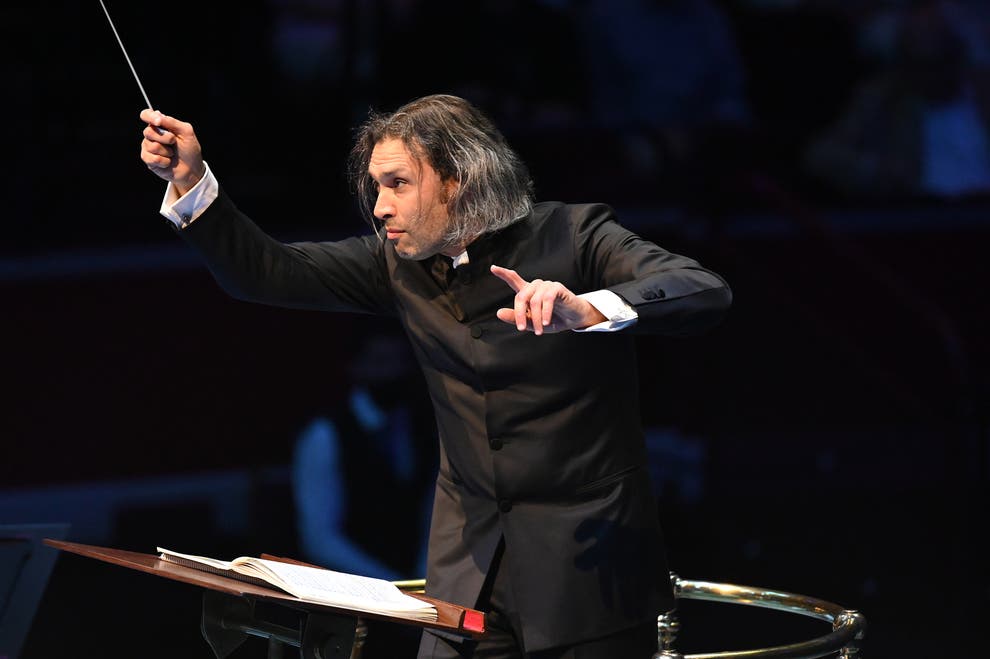
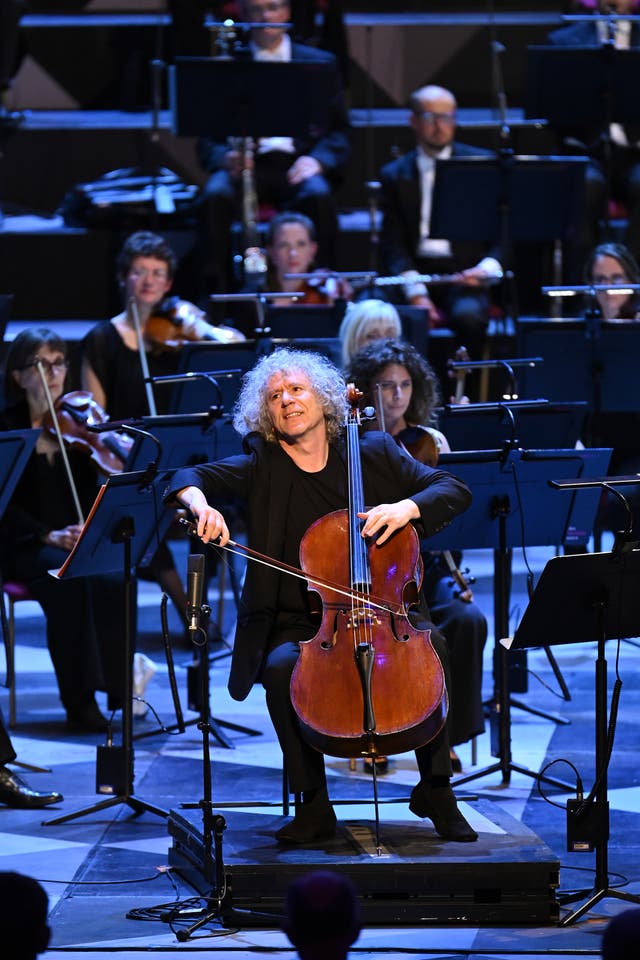
Steven Isserlis (cello, below), London Philharmonic Orchestra / Vladimir Jurowski (above)

Stravinsky Jeu de cartes (1935-6)
Walton
Cello Concerto (1955-6)
Bach (arr. Goldmann)
14 ‘Goldberg’ Canons BWV1087 (1742-4 arr. 1977)
Hindemith
Symphony ‘Mathis der Maler’ (1933-4)

Royal Albert Hall, London
Thursday 12 August 2021

Written by Richard Whitehouse; pictures (c) Chris Christodoulou

Vladimir Jurowski this evening concluded his highly impressive 14-year tenure as Principal Conductor of the London Philharmonic Orchestra with a thoughtfully conceived and well-proportioned programme; one which typically played to this orchestra’s strengths as much as to his own.

Although it can seem something of an ‘also-ran’ in the context of his compositions from the period, Stravinsky’s Jeu de cartes lacks for little in terms of that rhythmic effervescence as was engagingly evident in this performance – Jurowski pointing up the humour and even occasional glimmers of pathos that inform what can easily seem music written on autopilot. The LPO responded with a trenchancy and alacrity as held good throughout this ‘ballet in three deals’, the tonal punning of whose culmination at least ensures a humorous outcome.

Walton’s Cello Concerto used to be regarded with even less favour than Stravinsky’s ballet, but this piece (written by its composer at much the same age) is now seen as more than the enervated recycling of past success. Steven Isserlis (above) has long advocated its cause, and there was little doubting his commitment in a reading of perceptiveness and finesse. At times his spare and even fragile tone tended to recede into even so restrained and transparent as this, Jurowski mindful to rein in those brief climactic moments of the outer movements, but the artful interplay of the central scherzo did not lack for incisiveness or irony. Nor, after the second of the solo variations in the finale, was there any absence of rapture as soloist and orchestra are reconciled in drawing the music through to its close of fatalistic acceptance.

After the interval, a novelty in an arrangement by composer-conductor Friedrich Goldmann (1941-2009) of the 14 canons latterly identified from Bach’s printed copy of his Goldberg Variations. Arranged for a Stravinskian post-classical orchestra, these intricate and arcane studies in canonic dexterity emerge from gentle aridity to luminous elaboration with spare, methodical elegance such as intrigues and disengages in equal measure. Hardly something one expected to hear at such an occasion or this venue, though worth hearing all the same.

In its reiterating the values of Enlightenment humanism, moreover, this prepared admirably for Hindemith’s Symphony ‘Mathis der Maler’; premiered on the cusp of Germany’s descent into barbarous self-destruction, and a plea from the committed – however reluctantly – artist for a rational response as might be worth emulating today. The alternately radiant and tensile unfolding of Concert of Angels was perfectly judged, as too the plaintive resignation of the brief if affecting Entombment. The Temptation of St Anthony then made for an elaborate finale, but Jurowski paced it superbly – the plangent central interlude thrown into relief by the impassioned episodes on either side, then its anguished introduction by an apotheosis whose ultimate wresting of triumph from adversity remains thrilling as a statement of artistic intent.

A performance to savour, then, not least as John Gilhooly presented Jurowski with the Gold Medal of the Royal Philharmonic Society in recognition of services to music – an accolade with an illustrious history, which can rarely have been more deserved than on this occasion.

You can find more information on the BBC Proms at the festival’s homepage

Listening to Beethoven #101 – Sonata for piano and cello no.2 in G minor Op.5/2


Jean-Pierre Duport, cellist and composer – print made by Baron Dominique Vivant Denon

Sonata no.2 for piano and cello in G minor Op.5/2 (1796, Beethoven aged 25)

Dedication Friedrich Wilhelm II, King of Prussia
Duration 27′

Listen

Background and Critical Reception

Beethoven and Jean-Louis Duport are thought to have performed both Op.5 sonatas for piano and cello at the court of King Frederick William II between 20 May and 3 July 1796 in Berlin. Nothing is known of the performances themselves, which are thought to have been private affairs – though the cellist’s brother, Jean-Pierre (above) would almost certainly have been in attendance.

The second of Beethoven’s ‘duo for a new duo’ is a very different work to its partner, and yet, as Marc D. Moskovitz and R. Larry Todd write in their superb book Beethoven’s Cello, ‘one could hardly imagine one without the other’.

Here we find Beethoven working in the key of G minor for the first time in his published output, a tonality to which he would hardly return across his entire output. He marks the occasion with a language we have not heard in his chamber music before. For, as Steven Isserlis writes in his booklet notes for Hyperion, the work ‘takes us firmly into the opera house’. He notes the theatrical aspects of the music throughout, from the grand introduction – ‘practically a full movement in its own right’ where ‘the lengthy silences seem to hover over a chasm of darkness’. This leads to a full-blown Allegro, described as ‘the most explosive (and surely the longest) movement of any duo sonata written up till that time’. The finale is a different beast, its protagonists off the leash and cavorting around the stage. Isserlis tells of how ‘He plays with the listener, reprising every possible section almost to the point of eye-rolling (was he being paid by the minute?!)’

Despite their chalk and cheese nature there are qualities common to both Op.5 works. Beethoven does not use a slow movement in either, meaning the only truly slow music we hear is towards the start of each piece. He uses quick, showy third movements, carefree and fast, wrapping up each of the pieces with memorable tunes.

Moskovitz and Todd declare that by the end of Beethoven’s two Op.5 sonatas, he had ‘single-handedly altered the history of the instrument, and changed forever how composers viewed and exploited its potential. Beethoven had written music fit for a king, but in the process created works that ennobled the composer’s art.’

Thoughts

The G minor sonata is a remarkable work, an ideal counterpart to its high spirited companion. There is a lot more shade in Beethoven’s writing here, perhaps inevitably given his choice of a minor key, but as Steven Isserlis says there is a great deal of authentic theatricality.

The introduction is truly dramatic, the piano pacing around impatiently as the cello leads with profound musical statements. Then the music settles on a ‘pedal’ note which gets increasingly tense, waiting to break out into the Allegro.

Once this part of the work begins, the listener is propelled forward towards Brahms in the way the cello and piano interact, using melodies ripe for expansive development. Passionate exchanges follow, a wholly absorbing set of musical ideas. Sometimes the cello is shadowed by the inner parts of the piano; at other times the keyboard is allowed to run free in a display of virtuosity, but Beethoven writes a taut musical argument which is wholly engaging.

The finale trips along in the major key, sporting lighter thematic ideas. Beethoven is out to have fun, but here he is looking forward again. This music sounds very similar in content to the finale of a much later piece, the Piano Concerto no.4 – also in G major. How versatile Beethoven’s thoughts were to become!

Recordings used and Spotify playlist

Steven Isserlis (cello), Robert Levin (fortepiano) (Hyperion)
Heinrich Schiff (cello), Till Fellner (piano) (Philips)
Miklós Perenyi (cello), András Schiff (piano) (ECM)
Mstislav Rostropovich (cello), Sviatoslav Richter (piano) (Decca)
Pierre Fournier (cello), Wilhelm Kempff (piano) (DG)

As with Op.5/1, the playlist below contains a handful of recordings of the piece, including Mstislav Rostropovich and Sviatoslav Richter, Heinrich Schiff and Till Felner. Miklós Perenyi and András Schiff and Pierre Fournier and Wilhelm Kempff. Fournier and Kempff give a passionate performance, Perenyi and Schiff live closer to the edge – but as with Op.5/1 I return to fortepianist Robert Levin and cellist Steven Isserlis, their reading jumping off the page as it alternates between power and affectionate tenderness.

The below playlist includes most of the recordings mentioned above save Isserlis and Levin – to hear clips from this you can visit the Hyperion website

You can chart the Arcana Beethoven playlist as it grows, with one recommended version of each piece we listen to. Catch up here!

Also written in 1796 Haydn – B-flat major, Hob.XXII:10

Next up Abschiedsgesang an Wiens Bürger

Listening to Beethoven #100 – Sonata for piano and cello no.1 in F major Op.5/1


Jean-Louis Duport, cellist and composer – portrait by Remi-Fursy Descarsin

Sonata no.1 for piano and cello in F major Op.5/1 (1796, Beethoven aged 25)

Dedication Friedrich Wilhelm II, King of Prussia
Duration 25′

Listen

Background and Critical Reception

Before Beethoven, the cello was an instrument with its roots in accompaniment. The first edition of Bach’s solo suites was yet to appear. Some composers, notably Vivaldi and Boccherini, brought the instrument forward in wonderful solo concertos, and wrote sonatas with harpsichord for private use. However neither Haydn nor Mozart wrote for the instrument in a singular capacity. Haydn’s piano trios assign the cello faithfully to the bass line, while the string quartets of both composers rarely elevated its profile. Notable exceptions occur in Mozart’s last three quartets, written for Friedrich Wilhelm II, King of Prussia.

Five years after Mozart’s death, Beethoven paid a visit to the King’s court in Berlin, where two cellist brothers were working – Jean-Pierre and Jean-Louis Duport. To honour the occasion Beethoven composed a pair of substantial sonatas published as Op.5 and explicitly stated to be ‘for piano with cello’. It is thought the younger Duport, Jean-Louis, gave the premiere of both Op.5 works, with Beethoven himself taking on the challenges of the piano part.

The composer’s aim was to unite the two instruments in the way Mozart had done through his sonatas for piano and violin, though as Steven Isserlis notes in his writing for Hyperion, Op.5 no.1 is more like a concerto for the two. In his foreword for the thoroughly engaging book Beethoven’s Cello, by Marc D. Moskovitz and R. Larry Todd, Isserlis describes how Beethoven was ‘rattling the cage of classicism’ with these two works.

The book proceeds with a forensic but wholly accessible look at this piece and its innovations, not to mention its instinctive and joyful writing for the instruments. ‘For the first time ever, the cello and piano, collaborating as equals, begin the conversation together, in unison’. The dotted-note style is ‘a patent reference to the royal dedicatee, the Prussian monarch’, leading to an Allegro that has ‘an abrupt about-face…a playfully buoyant piano theme’.

The Allegro is the main body of the work, and is complemented by a Rondo third movement where, as the book explains, Beethoven ‘again stretched his musical canvas’, broadening the structure of a typical Rondo (where three different ideas appear in the order ABACABA) to incorporate yet more melodic ideas.

Thoughts

This is one of the most original statements in Beethoven’s music so far. As he did in the Op.1 piano trios, Beethoven is using a relatively new form to broaden his means of musical expression, this time using a form completely untouched by Haydn and Mozart. Here he has the freedom to set his own rules as well as expand the previous ones.

The shock of the new runs through this piece. Beethoven appears to have been intoxicated by the freedom of writing for the cello in a solo capacity, and for such a distinguished dedicatee. He takes risks, leaving no stone unturned while exploring the relationship between the two instruments. At his disposal are many memorable tunes, worked with daring twists and turns through far ranging harmonies and textures.

You can sense the composer literally rubbing his hands as he presents both the Duport brother and himself a fiendish but ultimately surmountable set of musical posers.

The introduction of Op.5 no.1 would have raised a few eyebrows at the first performance, and still does when you consider, as Steven Isserlis noted, that ‘Beethoven was practically inventing the medium as he wrote’. The slow introduction establishes the partnership and a genial atmosphere. It is fully realised in a substantial and joyous Allegro where cello and piano trade thoughts and literally bounce off each other, bursting with enthusiasm.

Looking at the timings for the movements suggests an imbalance, with a first movement of a quarter of an hour (including the introduction) and a second movement of 7 minutes, but there is no suggestion of this at all in listening to the work. The third movement is bright and lively, with one of those tunes you end up whistling in the street after a concert, and there are more opportunities for both instrumentalists to demonstrate their skill in the king’s presence. Beethoven moves them to distant keys towards the end, playing with his audience as he anticipates the final straight.

This is wonderful music, giving its listener both then and today the fullest possible sense of discovery. Piano and cello form a true partnership, with Beethoven once again showing his ability for true innovation. This is another form transformed – with many more to come!

Recordings used and Spotify playlist

Steven Isserlis (cello), Robert Levin (fortepiano) (Hyperion)
Heinrich Schiff (cello), Till Fellner (piano) (Philips)
Miklós Perenyi (cello), András Schiff (piano) (ECM)
Mstislav Rostropovich (cello), Sviatoslav Richter (piano) (Decca)
Pierre Fournier (cello), Wilhelm Kempff (piano) (DG)

The playlist below contains a handful of recordings of this piece, from notable duos such as Mstislav Rostropovich and Sviatoslav Richter, Heinrich Schiff and Till Felner. Miklós Perenyi and András Schiff and Pierre Fournier and Wilhelm Kempff. All those listed are brilliant partnerships, compelling from first moment to last – especially Perenyi and Schiff. Yet the one I return to most often is the partnership between fortepianist Robert Levin and cellist Steven Isserlis, playing the music as though it was written yesterday in an account of spontaneity and joy.

The below playlist includes all the recordings mentioned above save Isserlis and Levin – to hear clips from this you can visit the Hyperion website

You can chart the Arcana Beethoven playlist as it grows, with one recommended version of each piece we listen to. Catch up here!

Also written in 1796 Haydn –  Mass in C major, Hob.XXII:9 Missa in tempore belli (‘Mass in Time of War’)

Next up Sonata for piano and cello in G minor Op.5/2

In concert – Steven Isserlis & Mishka Rushdie Momen @ Wigmore Hall

It must have been extremely special for Steven Isserlis to be playing the music of three of his favourite composers at the Wigmore Hall on this day – even more so as the date fell on the birthday of one of them, Robert Schumann.

He is one of the cellist’s greatest musical loves, and the sense persists that Isserlis is still discovering more things that make it so. One of Schumann’s many strengths is the versatility of his music, meaning pieces such as the 3 Romances Op.94, originally written for oboe and piano and given to his wife Clara as a Christmas present in 1849, can easily be performed with violin or, indeed, the cello.

https://www.youtube.com/watch?v=ShGi4k7mKWU

Schumann’s birthday was marked by a performance of unaffected romantic beauty from Isserlis and pianist Mishka Rushdie Momen, very much on an equal footing playing the composer’s first instrument. The pair caught the doleful and slightly inquiring nature of the first romance beautifully, while the surge of feeling in the central music of the second was a strong cumulative wave. The third, its theme given in a darker shade, was briefly introspective in its unison phrases but then more overtly passionate.

Before Schumann came another ‘birthday’ composer. Beethoven’s 250th is not likely to receive quite so much live coverage as it would have done in a year without a pandemic, but what it lacks in quantity it will surely make up for in quality. The Sonata for piano and cello no.1 in F major, the first of a pair published as the composer’s Op.5, is the ideal concert opener. It begins in slight trepidation of what it is about to discover, but then, on establishing what is effectively a new form of writing for the cello and piano together, throws itself headlong into the rapids.

The Allegro that comes after that first sense of discovery was joyous indeed, with lovely dialogue in play between the two protagonists. Isserlis smiled frequently, as though revelling in the combination of favourite music and venue once again, while Momen’s clear phrasing dovetailed neatly with the cello’s, owning some of the really tricky right hand runs with fearless accuracy.

The second movement had a terrific burst of energy, the sun breaking through at every possible opportunity when its catchy theme made several reappearances. The pair also gave a nice air of mystery when Beethoven suddenly departed from ‘home’ and ended up in a number of seemingly unrelated tonal centres, before reassuring us with the warmth of the home key once again.

As he introduced his favourite 20th century cello sonata, there was a sense of Isserlis’ heart almost bursting with the chance to play music live again. He described his discovery of Fauré’s late music as ‘being outside a door but then passing through and wondering why on earth I had been outside’, before the pair played the Cello Sonata no.1 in D minor Op.108, the first of two such works from the Frenchman.

This was a very fine performance indeed, Isserlis and Momen watchful and urgent at the start, its music wracked with uncertainty but nonetheless pushing forward with great conviction. The Andante slow movement began lost in thought, the bell-like toll of the piano matched by Isserlis’ rich legato tone, before reaching heights of passion that the final movement also delivered, the performers now glorying in the major key and Fauré’s bursts of sunshine, the strong resolve of the first movement bringing its ultimate reward.

The pair finished with a profound account of Isserlis’ own transcription of a Bach chorale prelude, Ich ruf’ zu dir, Herr Jesu Christ, in which – as the cellist noted – Bach says it all.