
Talking Heads: Paul Wee

by Ben Hogwood

Paul Wee is a true one-off. An in-demand commercial barrister by day, he is also an extraordinary pianist, capable of taking on some of the most demanding pieces in the repertoire. The combination of a passion for his art and thirst for a challenge has led to award-winning recordings of the music of Thalberg and of Beethoven arranged by Liszt, both for the BIS label.

Yet arguably his greatest recording achievement to date concerns the music of Charles-Valentin Alkan, the 19th-century French composer who was one of the great virtuosos of his day. Wee has mastered two massive works by the composer – his Symphony for Solo Piano and the Concerto for Solo Piano. The latter will form an entire lunchtime concert with which he will make his eagerly anticipated Wigmore Hall debut, on Saturday 15 June. A tempestuous hour of music lies ahead – so while he flexes his muscles in preparation, Arcana managed to get some time with him to explore not just Alkan but a number of other irons he has in the fire.

Firstly, Paul recalls vividly his first encounter with Alkan’s music. “It was when I was in high school, in New York City”, he says. “I heard a live recording of Marc-André Hamelin playing the Symphony for Solo Piano, and I was awestruck immediately!”

His decision to take on the concerto was inspired by similar feelings. “I was immediately taken by the Concerto for Solo Piano when hearing it for the first time: it’s an astonishing musical construction, which makes an extraordinary and unforgettable impact. I didn’t know of any other work like it in the repertoire and knew that I had to give it a go myself.”

The piece is notorious for the demands Alkan makes on the performer, but as Wee confirms the rewards are greater still. “The technical challenges are reasonably self-evident; in the numerous passages where Alkan is displaying the ‘virtuosity’ of the (virtual) ‘soloist’, the writing – whilst always remaining very idiomatic and practical, characteristically for Alkan – can sometimes approach the limits of conventional pianism”, he says. “The emotional (or musical) challenges are mainly twofold: first, bringing to life the (extraordinarily theatrical) drama and rhetoric in the second movement Adagio; and second, maintaining the intensity of the Concerto’s narrative arc across its 50-minute wingspan. But when these challenges are met, it makes for one of the most incredible experiences that the piano repertoire has to offer.”

Wee has recorded the concerto for BIS, an album released in 2019. Has his view of the piece changed since then? “Yes – in relation to both the Concerto’s sound world, and also its pacing, especially in the Allegro assai. As ever it’s difficult to explain this in words, so the best thing for anybody interested is to come and hear it live!”

Alkan is a composer who inspires great dedication among his fans, and Wee considers the elements of his music that lead to these feverish reactions. “I think it is the sheer power and quality of his finest works, which offer extraordinary experiences quite unlike anything else that the 19th century has to offer. The fact that Alkan and these works are not as widely known as they should be can often lead to fans of Alkan’s music to (rightly!) encourage others to discover this music for themselves. That’s exactly what I hope to be doing myself when bringing the Concerto to Wigmore Hall.”

Anyone approaching Alkan’s music for the first time is in for a treat. “It depends on what work they are hearing. If the Concerto, they should prepare themselves for an epic, but nevertheless very accessible, musical narrative; a very wide variety of pianistic experiences, from some of the greatest heights of 19th-century virtuoso piano writing, through to tender intimacy and lyricism, with much quasi-operatic dramatic intensity and rhetoric along the way. Overall, the listener should prepare themselves for the extraordinary cumulative impact of the work, which builds across all three movements and which in a good performance can be utterly overwhelming.”

Presenting this work in the Wigmore Hall is something of a dream for Wee, who recalls his most memorable musical experiences in the venue. “Wigmore Hall is probably my most visited concert venue, and my own personal highlights reel would be too long to list in full! But some illustrative examples would have to include recitals by Marc-André Hamelin playing Haydn, Mozart, Liszt, Fauré, and Alkan in November 2009; Benjamin Grosvenor playing Mendelssohn, Chopin, Ravel, and Liszt in June 2016; and Mark Padmore and Paul Lewis in Schubert’s Winterreise in June 2022.”

Expanding from Alkan, Wee has somehow found time to discover and record concertos by two names unfamiliar to many devotees of classical music – Adolph von Henselt and Hans von Bronsart (above). It is another addition to his small but formidably constructed discography for BIS – and not a recent discovery, either. “I discovered the Henselt in my teens,”, he says, “after reading about it in books by Harold Schonberg and David Dubal, and seeking out recordings by Raymond Lewenthal and Marc-André Hamelin. I came to the Bronsart later, after being captivated by Michael Ponti’s recording of the slow movement.”

The recordings Wee mentions were made with a symphony orchestra, but for the new album he is paired with the Swedish Chamber Orchestra, under Michael Collins. “One of the greatest difficulties of the Henselt lies in making the piano part, with all of its detailing and intricacies, audible over the sound of the orchestra”, he explains. “In nearly all cases, large swathes of the passagework (especially in the finale) are simply swallowed and inaudible beneath the weight of a modern symphony orchestra. In teaming up with the Swedish Chamber Orchestra for this recording, I think we have been able to present a different view of the Henselt in particular, which presents Henselt’s (quasi-Mendelssohnian) piano writing with a new immediacy and clarity, whilst maintaining power and heft where needed. Of course, the Swedish Chamber Orchestra is not just any old chamber orchestra; it has a particular reputation for being “the chamber orchestra that can sound like a symphony orchestra”, and I think that anybody hearing (say) the opening tutti of the Bronsart Concerto will be astounded by the vigour and intensity that the Swedish Chamber Orchestra brings to the proceedings. I think they have been the perfect partner for this recording.”

He continues to move forward with recording plans…“but as there are still a few moving pieces here and there, all I will say for now is to watch this space. But my future recording plans with BIS are very exciting, and I’m looking forward to sharing them when I can say more…”

Looking further afield, what other music would he like to explore? “The list is far too long: the piano literature is so wide and so rich, and I find many things to love in nearly every one of its corners. In addition to that, the music that I might want to play and enjoy for myself will not necessarily be the same as the music that might be thought to sell well if I were to record it. So there are many dimensions to this question, which do not necessarily interrelate. Again, I think that all I can say is that there are some very interesting projects in the pipeline, so watch this space!”

In the meantime he will continue with his two complementary disciplines. “Absolutely: I have no desire to give up my legal career and become a full-time musician. I enjoy my work as a commercial barrister; it’s challenging, constantly stimulating, and ultimately very satisfying. On the musical side, I wouldn’t be averse to playing a few more concerts here and there, but probably nothing more than that. I wouldn’t ever want for the piano to become my day-to-day life. I am much happier with the piano being my escape from everyday life, which (for me) is my career at the Bar.”

He expands on how the two very different elements of his life are complementary. “The most important factor is that each presents an escape from the other. When my legal practice is especially demanding (which, as any lawyer will tell you, can frequently be the case), I can take a quick 5- or 10-minute time-out at the piano, and for that window, I am completely disconnected from the strains and stresses of the law: I return to my desk refreshed. In the other direction, my legal career has helped me hugely as a pianist by (perhaps paradoxically) ensuring that the piano is not my day-to-day life, as I mentioned above. Whenever I sit down at the piano, it’s never out of obligation, but out of joy. These days I have a completely different relationship with the instrument than what I used to have when I thought (as a teenager) that I wanted to be a concert pianist. I think the freedom that underpins my relationship with the piano these days has been essential in making me the pianist that I have become.”

Finally, he considers the music he anticipates seeing as a concertgoer this year – when time allows. “As it happens, this year I am going to far fewer concerts than usual, given the demands of family life (our second daughter was born in December and is just six months old). So I’m often going to concerts at shorter notice than usual. That said, I’m hoping to see Benjamin Grosvenor in the Busoni Concerto at the Proms, and I have Igor Levit’s September 2024 recital in my diary, where he’ll be playing the Liszt transcription of Beethoven’s Seventh Symphony: these are fabulous transcriptions that should be played in concert far more frequently, so I’m delighted to see him bringing this to London. I’m also planning to see Nikolai Lugansky at Wigmore Hall in December 2024, where he’ll be playing (among other things) his own stunning transcription of scenes from Götterdämmerung. I’m sure there will be many other concerts along the way!”

For information on Paul’s Wigmore Hall debut, on Saturday 15 June at 1pm, click on this link. You can read more about Paul at his website, and explore his discography at the Presto website

Published post no.2,207 – Wednesday 12 June 2024
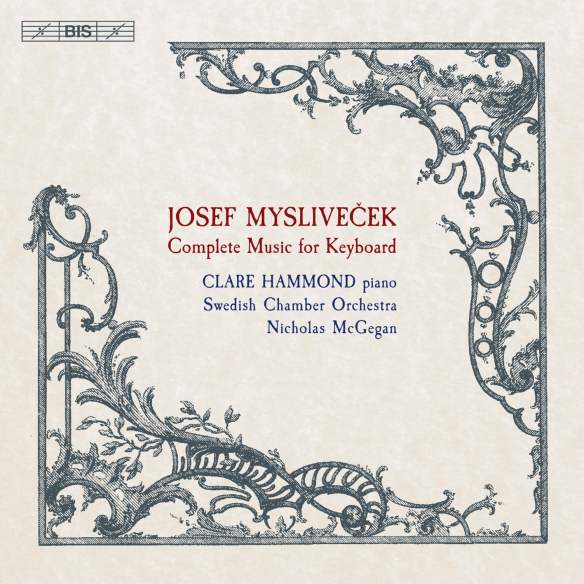
On record – Clare Hammond, Swedish Chamber Orchestra / Nicholas McGegan: Mysliveček: Complete Music for Keyboard (BIS)

Clare Hammond (piano), Swedish Chamber Orchestra / Nicholas McGegan

Josef Mysliveček (1737-1781)
Keyboard Concerto no.1 in B flat major (late 1770s)
Six Easy Divertimenti for Harpsichord or Piano-forte (1777)
Keyboard Concerto no.2 in F major (late 1770s)
Six Easy Lessons for the Harpsichord: Sonatas 1-6 (1780)

BIS BIS-2393 [74’22”]

Producer and Engineer Thore Brinkmann

Recorded March 2018 at the Örebro Concert Hall, Sweden

Written by Ben Hogwood

What’s the story?

Not many composers could claim to have influenced one of the greatest composers to have lived, but Il Boemo (The Bohemian) could do just that. Josef Mysliveček, to whom the nickname was applied, was a Czech composer of rare standing and a mentor to Mozart in the 1770s. He had a life of eyebrow-raising but ultimately tragic events, culminating with his death in great poverty in Rome in 1781, having nearly lost his nose a couple of years earlier to a botched operation.

Clare Hammond’s interview for this site puts more musical detail onto his fascinating tale. More importantly this disc for BIS serves notice of Mysliveček’s standing as an important musical figure and prodigiously talented composer. If you like Mozart, his music is a natural but essential step for further exploration.

What’s the music like?

Really enjoyable. The Piano Concerto no.1, where Hammond is joined by the Swedish Chamber Orchestra conducted by Nicholas McGegan, has a sparky personality, with plenty of vigour in its fast outer movements and elegance in the softly voiced central slow movement. There is an economy of thought, too – it finishes quickly with the minimum of fuss.

Clare Hammond clearly loves this music, and she plays with poise but also enjoys the instinctive nature of Mysliveček’s writing. The solo works are notable for their compressed construction, never threatening to outstay their welcome and on occasion producing unexpectedly dark undercurrents.

She is alive to these and handles the technical challenges really well. The Six Easy Divertimenti sound anything but unless they are in her hands! She makes the most of their tendencies to surprise, as in the mysterious pauses on some pretty exotic chords in the fifth piece.

The Piano Concerto no.2 has some notable syncopations in its first movement, as well as some adventurous harmonic diversions, before slipping into the minor key for a profound slow movement. Some of the music is contrary, staying away from big technical displays when you might expect them, but the third movement has a spring in its step nonetheless.

The Six Easy Lessons (again sounding pretty difficult!) bring parallels with the keyboard music of Domenico Scarlatti, and receive crisp and characterful performances. The second movement of the First Lesson reminds of the Czech composer’s tendency to spice up his melodies with chromatic movement, and this is one of many good tunes to be found throughout these spirited pieces.

Does it all work?

Yes. The structure of Mysliveček’s output from Hammond gives an ideally balanced disc, with the concertos complemented by the solo works. The clarity of her performance ensures it can be heard in the best possible light, and recording from the BIS engineering team is ideal.

Is it recommended?

Yes, and it fills a gap in the 18th century discography. Here is an important figure on whom the spotlight so rarely shines – and we are grateful to Hammond and McGegan for directing it to the right place.

Stream

Buy

You can buy this release directly from the BIS website

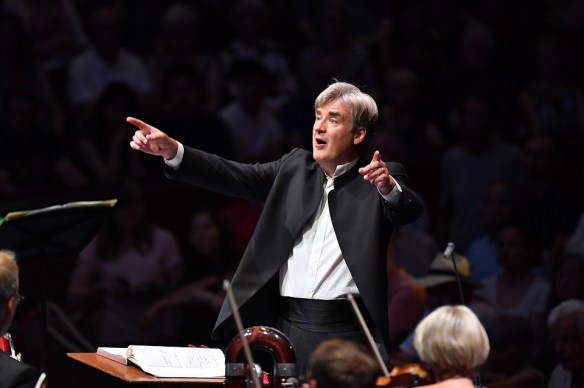
BBC Proms: The Brandenburg Project – Swedish Chamber Orchestra / Thomas Dausgaard

Proms 29 & 30: Soloists, Swedish Chamber Orchestra / Thomas Dausgaard
Prom 29
J.S. Bach Brandenburg Concerto no.1 in F major BWV1046
Mark-Anthony Turnage Maya (2014)
J.S. Bach Brandenburg Concerto no.3 in G major BWV1048
Anders Hillborg Bach Materia (2017)
J.S. Bach Brandenburg Concerto no.5 in D major BWV1050
Uri Caine Hamsa (2015)

Prom 30
J.S. Bach Brandenburg Concerto no.4 in G major BWV1049
Olga Neuwirth Aello – ballet mécanomorphe (2017)
Brett Dean Approach – Prelude to a Canon (2017)
J.S. Bach Brandenburg Concerto no.6 in B flat major BWV1051
J.S. Bach Brandenburg Concerto no.2 in F major BWV1047
Steven Mackey Triceros (2015)

Royal Albert Hall, Sunday 5 August 2018

You can watch this Prom by clicking here

Reviewed by Richard Whitehouse. Photos (c) BBC/Chris Christodoulou

If musical authenticity has largely banished J.S. Bach’s Six Brandenburg Concertos (BWV1046-51) from the standard repertoire, then the brace of Proms that constituted The Brandenburg Project enabled near-capacity audiences to experience what was once the foundation of this tradition. This was hardly the large-scale Bach that would once have been a familiar fixture at these concerts, but the playing of the Swedish Chamber Orchestra – by turns incisive and sensitive – and unfailingly astute direction of Thomas Dausgaard served these pieces well.

A quirky collection this is too. Uncertain as to its date (Bach’s promotional autograph to the Margrave of Brandenburg dates from 1721 but the music was likely in existence up to a decade earlier) and hardly constituting a logical or systematic key sequence (being in F, F, G, G, D and B flat respectively), it positively invites juxtaposition with works either akin in genre or inspired by their specific precedent. It was this latter factor which underlies the present project, with six diverse composers commissioned to write a piece inspired by the Brandenburg in question.

The Brandenburg Project – 1

With its relatively expansive four-movement structure and its virtuosic use of a (then) sizable complement of wind and strings, the First Concerto anticipates the Concerto for Orchestra of two centuries hence. Dausgaard secured a suitably forthright response, not least in the diverse ‘quodlibet’ that is the finale; the SCO then providing eloquent support for cellist Maya Beiser in Mark-Anthony Turnage’s Maya. Although the least ‘connected’ to its Brandenburg in terms of concept and follow-through, this was an impressive showing for its soloist’s long -limbed phrasing and mellifluous tone – even if its two halves witnessed relatively little sense of expressive contrast or intensification. The fact that Turnage completed his contribution so far in advance of the project’s taking place suggests his response as being a generalized one.

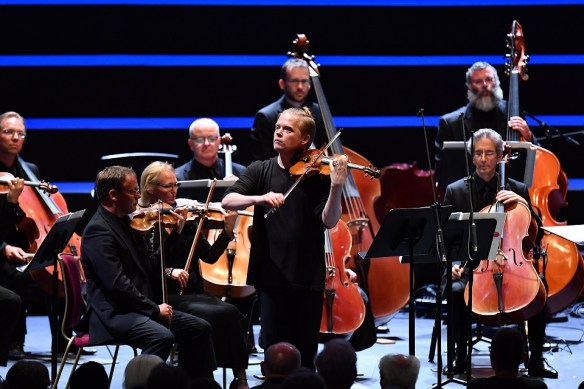
Long the most famous (rather, immediately recognizable) of the set, the Third Concerto is a blueprint for the Concerto for Strings beloved of the high Baroque era. The SCO relished the robust and incisive contrapuntal interplay of its outer movements; the (deliberately?) absent slow movement being provided on this occasion by Anders Hillborg, who then drew upon its plaintive understatement in the slow section of his Bach Materia. With its prelude of anticipatory tuning, headlong workout between violin and double-bass in its scherzo, then a finale whose interaction of soloist and ensemble was as much vocal as instrumental, it was a showcase for ‘improvising violinist’ Pekka Kuusisto as communicated readily to the audience, even if its attractions (not for the first time in Hillborg) seemed to lie primarily on the surface.

Whether or not the first Concerto for Keyboard, the Fifth Concerto is an intriguing take on that nascent genre; its elaborate harpsichord part scintillating in Mahan Esfahani‘s rendition (not least the headlong ‘cadenza’ passage), with the more circumspect contributions of flute and violin no less appealingly taken by Fiona Kelly and Antje Weithaas. They remained in their respective roles for Uri Caine’s Hamsa, joined by the composer on piano for a piece whose ominous-sounding title is no more than the Arabic for ‘five’. What ensued was an object lesson in composing-out an already elaborate structure and it was hardly Caine’s fault if, at the end of a lengthy programme, this piece outstayed its welcome. Certainly, his attentive pianism and formal finesse would have held one’s attention in any other context.

The Brandenburg Project – 2

With its dextrous and, in the elevated central Andante, plangent interplay of violin and two recorders (the preferred option for those mythical ‘fiauti d’echo’ so designated by Bach), the Fourth Concerto is perhaps the most immediately attractive of these works; despatched with relish and not a little pathos by Kuusisto in partnership with Per Gross and Katarina Widell. As part of her response, Olga Neuwirth pointedly eschewed Double or even Triple Concerto connotations for a single flute as heard against an ensemble with two obligato trumpets and portable typewriter as part of the continuo. This, along with judicious use of tuning systems, gave her ‘ballet mécanomorphe’ which is Aello (2017 – the title that of a retributive Harpy) an insubstantial and capricious aura not without its more ominous and suspenseful qualities.

That the final two instalments segued directly between Brandenburg and commission was not their least fascination. In his Prelude – Approach to a Canon, Brett Dean came up with a methodical extemporisation where he and fellow violist Tabea Zimmermann pursued a fine line in ‘call and response’ with the ensemble; motifs from the Sixth Concerto being variously evoked and denied prior to a rhetorical lead-in to the Bach such as Schnittke might well have relished. With its scoring for low strings and its accordingly dark sonorities, this is the most intriguing of the Brandenburg’s – a Concerto for (or at least predicating) Two Violas whose intricately polyphonic opening movement makes way for winsome elegance in the Adagio then gallant buoyancy in the finale. Qualities to the fore in this most probing of accounts.

The segue was in the opposite direction for the final pairing, with the Second Concerto a putative Sinfonia Concertante whose modest dimensions belie the plethora of timbres and textures derived from its solo quartet. Kelly and Weithaas were partnered by oboist Mårten Larsson and trumpeter Håkan Hardenberger, their overt élan during the outer movements complemented by their wistful poise in the Andante. A sustained note from trumpet duly provided a link into Triceros  Steven Mackey’s typically resourceful response that deploys ‘family’ instruments (piccolo/alto flute, cor anglais and flugelhorn/piccolo trumpet) in music whose ingenious variations on Bach motifs readily evoke the title’s ‘three-horned chameleon’ through to a heady culmination then full-circle resumption of that trumpet note.

Maybe it would have been preferable to hear this latter trilogy in the published order (2-4-6), or at least end with the Sixth Concerto so that Bach’s music could have framed proceedings. Even so this was a fascinating and engrossing project, judiciously conceived and unfailingly well executed, such as confirmed both the intrinsic greatness of the Brandenburg Concertos and their continued relevance three centuries on. Might a similar Proms project be considered utilizing Bach’s Four Orchestral Suites or Handel’s Op. 6 Concerti Grossi? Let us hope so.