Arcana at the opera: Fidelio @ Garsington Opera

Beethoven’s Fidelio, Garsington Opera at Wormsley, Stokenchurch, UK | Pictured: Robert Murray (Florestan); Sally Matthews (Leonore) | Image © Julian Guidera 2025

Fidelio (1804-5, rev. 1814)

Music by Ludwig van Beethoven
Libretto by Joseph Sonnleithner and Georg Friedrich Treitschke, after Jean-Nicolas Bouilly
Sung in German with English surtitles

Leonore, disguised as Fidelio – Sally Matthews (soprano), Florestan, her imprisoned husband – Robert Murray (tenor), Don Pizzarro, prison governor – Musa Ngqungwana (bass-baritone), Rocco, gaoler – Jonathan Lemalu (bass-baritone), Marzelline, his daughter – Isabelle Peters (soprano), Jacquino, prison warder – Oliver Johnston (tenor), Don Fernando, king’s minister – Richard Burkhard (baritone), First Prisoner – Alfred Mitchell (tenor), Second Prisoner – Wonsick Oh (bass)

John Cox (original director), Jamie Manton (revival director), Gary McCann (designer), Ben Pickersgill (lighting)

Garsington Opera Chorus, The English Concert / Douglas Boyd

Garsington Opera, Wormsley
Friday 27 June 2025

review by Richard Whitehouse Photos by (c) Julian Guidera

Few operas have been subject to matters of time and place as has Fidelio. Beethoven’s sole opera, by his own admission, caused him the greatest difficulty among all his works to ‘get right’ and, even today, it can all too easily emerge as a compromise between what had been intended and what (conceptually at least) was feasible. All credit, then, to Garsington Opera for this revival which not only avoided the likely pitfalls first time around but has improved with age – in short, a production that amply conveys the essence of this flawed masterpiece.
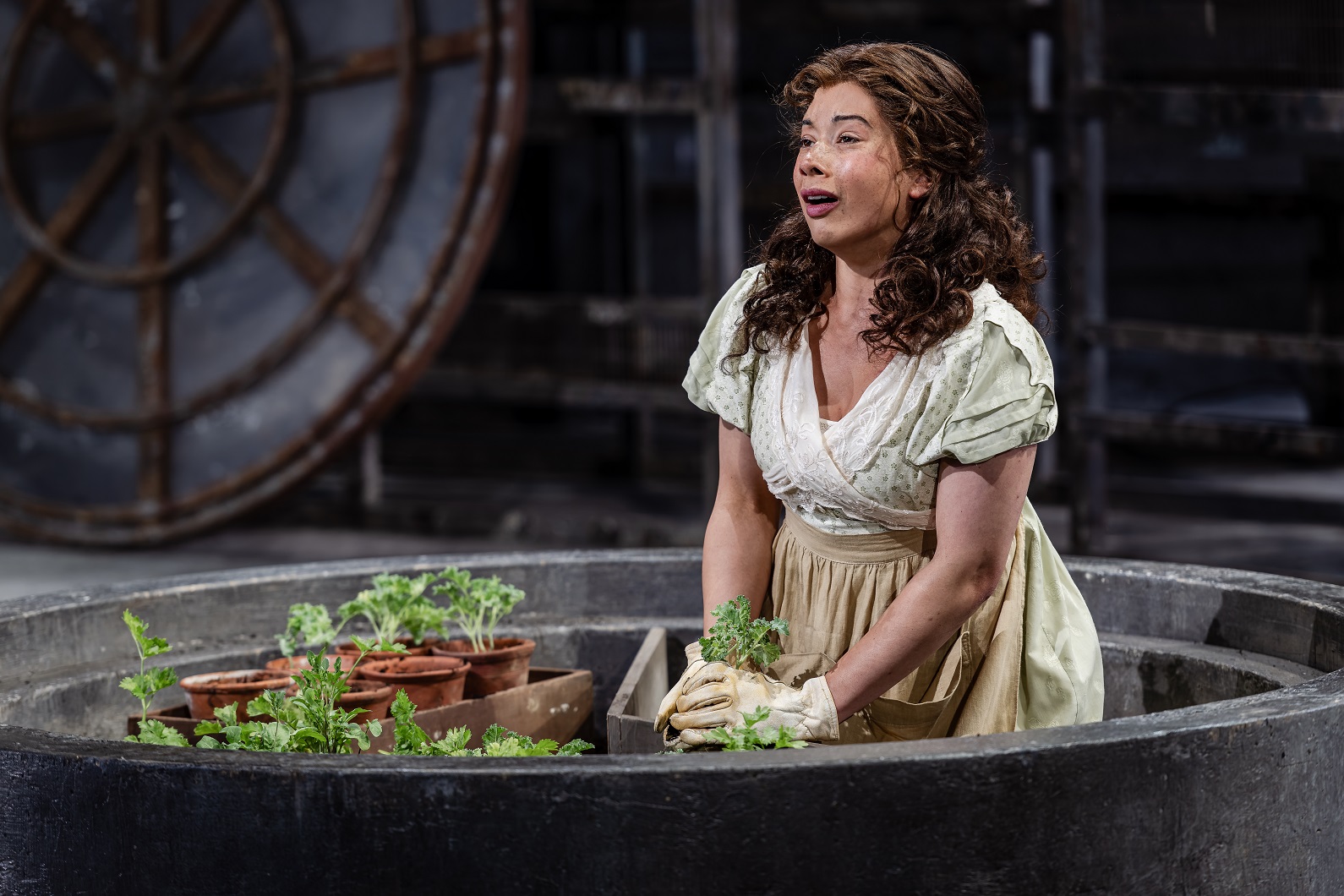
Beethoven’s Fidelio, Garsington Opera at Wormsley, Stokenchurch, UK | Pictured: Isabelle Peters (Marzelline) | Image © Julian Guidera 2025

That original staging had been directed by John Cox, whose productions are rarely less than durable and with such as his 1973 Capriccio or his 1975 The Rake’s Progress being close to definitive. For this second revival, Jamie Manton has streamlined the basic concept such that everything which takes place can be envisaged from the outset and hence ensures consistency across the production as a whole. He is abetted by Gary McCann’s designs, their monochrome stylings imparting a grim uniformity which could not be more fitting given that this drama is played out around and inside a prison. In particular, the hole front-of-stage from out of which the prisoners emerge and into which Florestan is to be committed is a device made elemental merely by its presence, while the final scene avoids the agitprop from an earlier era in favour of a straightforward tying-up of narrative loose-ends the more affecting for its understatement. Effective without being intrusive, Ben Pickersgill’s lighting enhances the changing moods of an opera which takes in domestic comedy and visceral drama prior to its heroic denouement.

Beethoven’s Fidelio, Garsington Opera at Wormsley, Stokenchurch, UK | Pictured: Garsington Opera Chorus | Image © Julian Guidera 2025

Vocally the opening night was a little uneven without there any real disappointments. If Sally Matthews initially sounded a little inhibited in the title-role, this most probably reflected its ambivalent nature rather than any lack of expressive focus; certainly, her commitment in the ‘Abscheulicher…Komm Hoffnung’ aria such as defines her emotional persona was absolute, as was her seizing hold of that climactic quartet to which the entire drama has been heading. Sounding as well as looking his part, Robert Murray avoided the rhetorical overkill that too often mars portrayals of Florestan – his mingled vulnerability and fatalism maintained right through to the duet ‘O namenlose Freude’ whose eliding of elation and doubt intensified its emotive force whatever its actual length, though without pre-empting what is still to come.

Beethoven’s Fidelio, Garsington Opera at Wormsley, Stokenchurch, UK | Pictured: Musa Ngqungwana (Don Pizarro); Richard Burkhard (Don Fernando) | Image © Julian Guidera 2025

As Don Pizarro, Musa Ngqungwana was imposing in presence and thoughtful in approach – his lack of histrionics preferable in a role which too often descends into caricature. That said, he was upstaged in their duet ‘Jetzt, Alter, jetzt hat es Eile!’ by Jonathan Lemalu who was in his element as Rocco; materialist aspiration outweighed by the humanity invested into a role where comedy rapidly gives way to pathos. Marzelline and Jaquino may have but little to do after the first scene, but Isabelle Peters was eloquence itself in her aria ‘O war ich schon mit dir vereint’ while Oliver Johnston veered engagingly between eagerness and consternation. Richard Burkhard made for an authoritative if never portentous Don Fernando, while Alfred Mitchell and Wonsick Oh afforded touching cameos during a memorable ‘Prisoners’ chorus’.
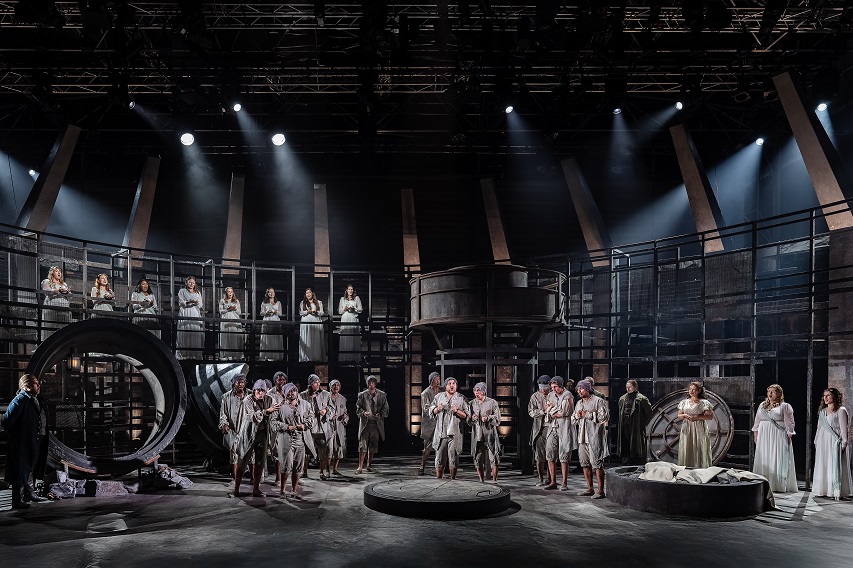
Beethoven’s Fidelio, Garsington Opera at Wormsley, Stokenchurch, UK | Pictured: Jonathan Lemalu (Rocco); Isabelle Peters (Marzelline); Garsington Opera Chorus | Image © Julian Guidera 2025

Nor was the Garsington Opera Chorus to be found wanting as a whole in its contribution to the finales of each act – the first as moving in its pallor, infused with radiance, as the second was in the unfettered joyousness which offset any risk of that final scene becoming merely a celebratory tableau. The English Concert sounded rarely less then characterful, even though humid conditions likely explained some occasionally approximate intonation – happily not in Rachel Chaplin’s scintillating oboe obligato which shadows Florestan’s aria ‘In des Lebens Frühlingstagen’ as if an extension of his character. Douglas Boyd directed with assurance an opera with which he has long been familiar, his tempos unexceptionally right and always at the service of the opera. The author Michael Oliver was surely correct in his observation that the Leonore original is superior in theatrical terms to the Fidelio revision, yet this latter was nothing if not cohesive through Boyd’s astute dovetailing of individual numbers, as between speech and music, so that any seeming discontinuities were made more apparent than real.

Some 211 years after the successful launch of its final version and Fidelio remains an opera acutely sensitive to political context and polemical intent. Beethoven himself was, of course, partly responsible for this but subsequent generations have sought, often recklessly, to foist their own preoccupations onto his music so as to distort or even negate its essence. There was no risk of that happening here thanks to the balanced objectivity of this production but also to its conviction that the composer’s guiding vision is, and always will be, its own justification.

Fidelio runs until 22 July 2025 – and for further information and performances, visit the Garsington Opera website

Published post no.2,581 – Monday 30 June 2025
Proms at … Cadogan Hall 3: The English Concert / Kristian Bezuidenhout

The English Concert / Kristian Bezuidenhout (harpischord, above)

Purcell (1659-95)
The Virtuous Wife (before 1694): Overture (1:45 on the broadcast link below)
The Fairy Queen (1692): Hornpipe (4:38)
The Virtuous Wife (before 1694) – First Act Tune (5:41)
The Indian Queen (1695): Rondeau (8:41)
Chacony in G minor (c1678) (10:21)
Marchand (1669-1732)
Pièces de clavecin, Book 1: Allemande (publ. 1702) (17:33)
de La Guerre (1665-1729)
Violin Sonata in D minor (publ. 1707) (20:46 – 35:45)
Telemann (1681-1767)
Sonata in A minor, TWV 43:a 5 (unknown date) (39:43 – 48:47)
Handel (1685-1759)
Trio Sonata in G major Op.5/4 (publ. 1739) (50:02 – end)

Cadogan Hall, Monday 5 August 2019

Reviewed by Ben Hogwood

You can listen to this Prom on BBC Sounds here

This was a really interesting hour of music from the English Concert and director / harpsichordist Kristian Bezuidenhout, and it was all the more refreshing for a willingness to look beyond the more conventional repertoire you might have expected as part of the Proms’ look at 800 years of music in the Cadogan Hall chamber concerts this year.

Petroc Trelawny, always a consummate professional when introducing at the venue, gave helpful context behind the works chosen, and explained how each was looking to emulate the French style that was so fashionable thanks to the tastes and influence of Louis XIV, the ‘Sun King’.

First up was Henry Purcell, who was of course a popular figure and well enough established in England – but the choices here were not conventional. The Virtuous Wife, a comedy for the stage (beginning at 1:45 on the broadcast link), is just one example of many works Purcell wrote for the theatre in England. In this performance the overture was perhaps a touch too virtuous to begin with, though by the time the music broke at 2:43 a natural tempo and phrasing had been reached. The Fairy Queen’s Hornpipe (4:38) was vigorous, with a satisfying twang to the theorbo strings of William Carter.

The First Act Tune (5:41) was pensive but nicely phrased, showing off Purcell’s rich chromatic spectrum, and was followed by a graceful Rondeau, dancing slowly but elegantly (8:41), before the Chacony (10:21), one of his most famous instrumental pieces that we often hear today for string orchestra. It is a powerful set of variations over a ‘ground’ (a pre-set bass and chord progression) that gathers in intensity.

Next we had solo harpsichord, Bezuidenhout showing off his instincts in an improvisatory Allemande by the French composer Louis Marchand (17:33), with some expansive harmonic twists. That was followed by a dazzling Violin Sonata no.1 in D minor by Élisabeth Jacquet de La Guerre (20:46). Written in 1707 as part of a set dedicated to Louis XIV, it was deftly handled here by Tuomo Suni, with its six short movements marked as Prelude (20:46), Presto (23:20), Adagio (25:18), Presto-Adagio (26:00), Aria (29:53) and Presto (33:36). The Presto-Adagio showed not just only Suni’s clear tone, without vibrato, but the punchy ‘continuo’ accompaniment from Bezuidenhout and viola da gamba player Piroska Baranyay. A similarly crunchy sound inhabits the final Presto, after a graceful Aria.

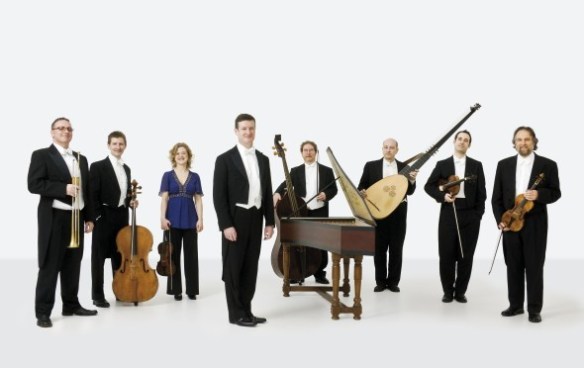
Telemann’s enormous output can sometimes mask his achievements as a composer, and the Sonata in A minor – little known, it seems – showed itself to be an accomplished and dramatic piece, ‘praising the instrumental texture’ as Bezuidenhout explained. Bolstered by the double bass of Christine Sticher, the English Concert (above) really benefited from the extra depth to their sound, meaning a Trio Sonata had seven people on the platform managing the three parts!

The short suite made references to Poland, France and Italy in a Grave (39:43), Allegro – Adagio (40:32), Allegro (44:10), Largo e staccato (45:43) and final Allegro (46:15). The stylish performance had a rustic feel in the faster movements, with an earthy snap to the staccatos of the fourth and a brilliant cut and thrust to the final Allegro.
Finally Handel, and a brightly voiced Trio Sonata in G major Op.5/4, the kind of which he would surely have played with friends in his Brook Street flat in London. This performance played the piece in a different order to the norm, beginning with the ‘second’ movement, marked A tempo ordinario (50:02), which had an enjoyably full texture from the seven instruments, and then moving onto the ‘first’, an Allegro (53:55), where the violins took a more prominent role. An elegant Minuet (56:04) followed, then a Passacaille (58:02), with increasingly elaborate lines spun over a recurring bass line – which itself became enjoyably coarse.

An enlightening hour of music, then, which you are encouraged to enjoy on the link above.

Listen

The playlist below replicates the concert in available recordings, and includes the Gigue movement of the Handel which appears to have been omitted from the original concert:

Meanwhile to enjoy the many and varied delights of Purcell’s complete Theatre Music, the below recording from Christopher Hogwood and the Academy of Ancient Music will bring much pleasure:

On record: Alessandro Scarlatti – Con eco d’amore

scarlatti-watts

The extremely promising young soprano Elizabeth Watts delivers a stunning disc of arias from operas and cantatas by Alessandro Scarlatti, in the company of The English Concert and Laurence Cummings. The disc is released by Harmonia Mundi

What’s the music like?

Elizabeth Watts and Laurence Cummings deliver a well-chosen selection of arias here, representing the many and varied moods the Italian baroque composer Alessandro Scarlatti can conjure up in his vocal works.

We move from the high energy bout between soprano and trumpet, Se geloso è il mio core, to the dreamy Mentr’io godo in dolce oblio, in arias tending to last between three and five minutes. Scarlatti is a very expressive composer, responding to the words with music that taxes his performers.

Does it all work?

Without question. The levels of musicianship here are uncommonly high, and that’s before we even get to talking about Elizabeth Watts. Trumpeter Mark Bennett is outstanding in his role as the soprano’s opponent in Se geloso è il mio core, the sort of work in which composers of Scarlatti’s day specialised. Violinist Huw Daniel is then exceptionally good in his role as soloist in the cadenzas of Esci omai.

Yet it is nonetheless Watts who steals the show, because she can go from the high register bravura of Figlio! Tiranno! O Dio! to the withdrawn, sensitive singing of Nacque, col Gran Messia and the sparing use of vibrato for the opening strains of Ombre opache, a lament from the cantata Correa Nel Seno Amato, which contains arguably the most powerful music here.

The real technical showstopper is D’Amor l’accesa face, from the serenata Venere, Amore e Ragione, where Cupid warns against showing too much desire. Watts’ performance suggests the opposite is in fact the case!

Cummings and The English Concert are very fine image painters, and their dramatic orchestral response in the recitativo from Erminia, Qui, dove al germogliar, is illustrative of the power they have at their disposal – and Cummings secures from them particularly careful attention to detail on the volume of their contributions.

Is it recommended?

Unreservedly. With performances of great enthusiasm and technical command, you will find few if any discs of the Baroque era to better this one in 2015.

Listen on Spotify

You can hear Con eco d’amore on Spotify here: