In concert – Leila Josefowicz, CBSO / Thomas Søndergård: Richard Strauss, Adès & Brahms

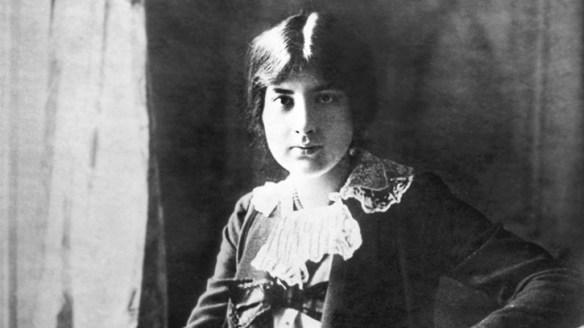
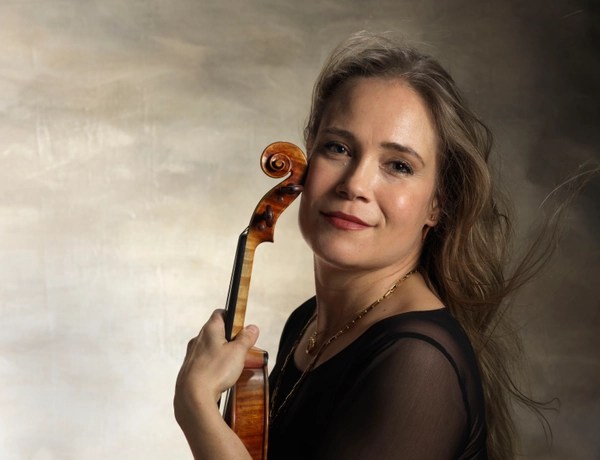
Leila Josefowicz (violin, above), City of Birmingham Symphony Orchestra / Thomas Søndergård (below)

Richard Strauss Don Juan Op.20 (1888)
Adès Violin Concerto, Op.24 ‘Concentric Paths’ (2004)
Brahms Symphony no.2 in D major Op.73 (1877)

Symphony Hall, Birmingham
Thursday 10 October 2024

Reviewed by Richard Whitehouse Pictures (c) Tom Zimberoff (Leila Josefowicz), Chris McDuffie (Thomas Søndergård)

He may be spending more time in the US than in the UK these days, but Thomas Søndergård tonight made a timely reappearance with the City of Birmingham Symphony Orchestra in a programme such as placed a highpoint among recent concertos between two established German classics.

Richard Strauss‘s Don Juan poses few technical issues for an orchestra these days – the only proviso about this performance being its almost too easy unfolding, the initial stages seeming suave rather than impetuous and emotional contrasts following on almost too seamlessly. Yet the central ‘love’ episode featured a melting contribution from oboist Lucie Sprague, with horns duly firing on all cylinders in a unison theme ultimately capped by a silence of tangible anticipation then a postlude of hushed resignation – heroic aspiration submerged in an aura of starkest fatalism.

If much of Thomas Adès’ music the past two decades has been of a conceptual brilliance that outweighs its intrinsic content, the Violin Concerto is destined to endure and rightly so given these Concentric Paths complement each other in a finely balanced totality. One, moreover, with which Leila Josefowicz identifies wholeheartedly: despatching its brief outer movements with an energy and a panache so that Rings conveyed a volatility channelled towards greater affirmation in Rounds; between them, the relatively expansive Paths proved a chaconne as methodical in evolution as it was affecting in its suffused intensity. Assured in her handling of the solo part, Josefowicz dovetailed it unerringly into orchestral writing as resourceful as any the composer has written. Those in the audience unfamiliar with it were most likely won over.

Many of those present were no doubt looking forward to BrahmsSecond Symphony after the interval, where Søndergård (above) and the CBSO did not disappoint. Outwardly its composer’s most equable such piece, this yields more than its share of ambiguities and equivocations that were rarely absent here. Not least in the opening movement, its unforced progress duly taking in an eventful development whose granitic culmination set its easeful themes at a notably uncertain remove, then with a coda whose restive horn solo was eloquently rendered by Elspeth Dutch. Søndergård was no less probing in the Adagio, flexibly paced so its autumnal main theme did not override the more whimsical and anxious elements which inform its longer-term progress. Certainly, the closing reflection on that theme cast a potent shadow on what had gone before.

The other two movements are usually thought to present few if any interpretative problems, so credit to Søndergård for finding no mean pathos in those reiterations of the Intermezzo’s main theme – not least when it returns as a winsome coda. Nor was the final Allegro lacking in incident, such as that spellbinding transition into the reprise whose epiphanic aspect was not lost on Mahler. Given its head without sounding at all rushed, the coda then emerged as the ebullient though never grandstanding peroration which Brahms himself surely intended.

A resounding close to an impressive performance, and there should be more music-making on this level next week when the CBSO is joined for the first time in many years by former chief guest conductor Mark Elder for an enticing programme of Brahms, Janáček and Shostakovich.

For details on the 2024-25 season A Season of Joy, head to the City of Birmingham Symphony Orchestra website. Click on the names to read more about violinist Leila Josefowicz, conductor Thomas Søndergård and composer Thomas Adès.

Published post no.2,331 – Monday 14 October 2024

Live review – Nicola Benedetti, Royal Scottish National Orchestra / Thomas Søndergård: Polska Scotland opening concert

nicola-benedetti-rsno

Nicola Benedetti (violin, photo by Martin Shields), Royal Scottish National Orchestra Thomas Søndergård

RSNO Studio, Glasgow
Broadcast Friday 16 April 2021, available online until Friday 30 July 2021

Weinberg Rhapsody on Moldavian Themes Op.47/1 (1949)
Szymanowski Violin Concerto no.1 Op.35 (1922)
Panufnik Sinfonia Sacra (Symphony no.3) (1964)

Written by Ben Hogwood

The first concert of the Royal Scottish National Orchestra’s Polska Scotland season provided a tempting mix of 20th century pieces. The season is exploring connections between the two countries, and watching the accompanying video (at the bottom of this page) reveals a number of interesting and pertinent connections, not least in the orchestra itself.

The choice of repertoire here was refreshing, too. Szymanowski’s Violin Concerto no.1 is more of a regular repertoire piece these days, but the same could certainly not be said of the inclusions from Mieczysław Weinberg, the Polish composer who found his way to Moscow in the 1940s, and Andrzej Panufnik, who fled Warsaw for London ten years later.

Weinberg’s parents moved to Poland from Moldova in 1916, and this concert began with the composer’s Rhapsody on Moldavian Themes, exploring the heritage of his parents through the development of contrasting folk tunes. In this way he was following the lead of folk-based pieces for orchestra from the likes of Kodály, Enescu and Bartók, relishing the chance to project and develop the music of their home countries through the concert hall.

The RSNO strings were appropriately deadpan at the start, their cold and muted contributions expertly controlled and matched by suitable lighting in the hall. The woodwind gave heartfelt, soulful contributions, as did the orchestra leader, violinist Sharon Roffman, and these led to thrills and spills as the RSNO powered through the faster sections, urged on by Thomas Søndergård.

Polska-scotland

Nicola Benedetti was the soloist in Szymanowski’s Violin Concerto no.1, a piece she started to play at the age of 16. Having lived with it for approximately the same length of time, she noted the increased popularity of the piece – and talked through how conductor Sondergaard’s vision of the music was slower than hers, giving her a renewed perspective.

The violin emerged rather magically from the brief but colourful orchestral introduction and dominated almost throughout, rich of tone and with extremely secure intonation. The vivid colours were an overriding feature of this performance, Søndergård achieving a sound balance between soloist and orchestra, but within the ensemble he probed the deeper shades of Szymanowski’s lyrical writing. Benedetti was passionate and driven, the searing high notes carrying easily above the orchestra and then doing their own work in ardent outpouring of the complex cadenza. Søndergård gave the piece more room than it normally receives, but this was to its benefit – and the capricious ending was beautifully weighted.

First violinist Jane Reid then recounted a Polish tour for the orchestra in 1978, which opened with Panufnik’s Sinfonia Sacra, receiving its first performance in the country. It was a daring choice from conductor Sir Alexander Gibson, given the composer’s departure for London in 1954, but Reid’s vivid account spoke of tears in the Warsaw audience. Indeed, it is hard to understand why the piece is not performed more today – given the Weinberg revival of late, the music of Panufnik is just as deserving.

This performance from the RSNO was intensely moving. The powerful opening fanfares of Vision I from the brass were razor sharp, and cut to an equally heartfelt Vision II from the strings, icy cold music of solemn countenance. This was blown apart by Vision III, where driven percussion gave way to onrushing strings the surging brass in music of dissonance and disquiet. The contrast with the final Hymn was even greater, the strings united again in a cold chorale, but gradually the music thawed and grew in power.

Sondergård expertly marshalled this section and its steady build, taking a broad tempo but controlling the unwavering intensity of Panufnik’s writing. The brass fanfares were resolute, but the final statement of the hymn had great resolve, an ultimately triumphant end – even if the dissonances remained, defiant to the finish.

This was a superb start to a season which promises much, with works to come from Lutosławski, Bacewicz and more Szymanowski – Nicola Benedetti will return to play his Violin Concerto no.2. On this evidence, all the online concerts are highly recommended.

You can watch the concert on the Royal Scottish National Orchestra website here

For more information on the Royal Scottish National Orchestra digital season, you can visit their website here

RSNO Friday Night Club – Richard Strauss & Berg

Tonight, Friday 17 April, the RSNO Friday Night Club returns with an intriguing pair of characters. The first is Richard Strauss‘s Don Juan, one of his most celebrated symphonic poems, in which the 24-year old composer paints a portrait of the serial philanderer. Its high spirits mask a darker underbelly. Thomas Søndergård conducts.

Mezzo-soprano Karen Cargill then joins the orchestra in a performance of Berg‘s Seven Early Songs. These very late Romantic nuggets, completed 20 years after Don Juan, show Berg straining at the limits of tonality and finding great intensity as he sets the work of seven different poets.

You can watch the on the orchestra’s website here, or join on Facebook here

Prom 8 – BBC NoW & Thomas Søndergård: The Music of Lili Boulanger & Morfydd Owen

Prom 8: Bertrand Chamayou  (piano), BBC National Orchestra of Wales / Thomas Søndergård

Lili Boulanger D’un matin de printemps; D’un soir triste (1917-8)

Mendelssohn Piano Concerto no.1 in G minor Op.25 (1831)

Morfydd Owen Nocturne (1913)

Schumann Symphony no.4 in D minor Op.120 (original 1841 version)

Royal Albert Hall, Friday 20 July 2018

Reviewed by Ben Hogwood

You can watch this Prom on BBC4 on Sunday 22 July here

Debussy and Bernstein may be the blockbuster anniversary composers this Proms year, but there are several composers whose cause is arguably more important. We heard two of them in this intriguing Prom from the BBC National Orchestra of Wales and their outgoing chief conductor, Thomas Søndergård.

Lili Boulanger and Morfydd Owen died far too early, in their twenties, but both left works telling of an original style that should have been heard far more often than they have – which sadly is the case for all female composers. Happily the BBC has made a commitment to start putting that right, and this Prom went back to the second decade of the 20th century with two short pieces from Boulanger (below).

D’un matin de printemps (Of A Spring Morning) caught the ear immediately. Completed in 1918, it was slightly furtive at times, as though describing flowers shyly poking their heads into the fresh morning air. The transparent orchestration drew parallels with Debussy, and the colourful textures and positive harmonies made for an ideal, descriptive curtain raiser.

By contrast D’un soir triste (Of A Sad Evening) wore a troubled frown. Here the music was more ominous but also more exotic, its use of modal melodies extending its reach towards the East. Again Boulanger’s orchestration was exquisite, with a lovely rasp to the bass clarinet in the texture, and some powerfully wrought climaxes strengthened the intensity of feeling but failed to shake off the preoccupied state of mind. Both pieces made a lasting impact.

Morfydd Owen’s Nocturne began the second half. Written just before the First World War, this was an intriguing piece that was livelier than you might expect from a piece bearing that name. Initially the shady textures found the orchestra depicting the half light of the evening, but as well as atmospheric pictures there were attractive dance episodes, Owen breaking towards lighter music with a twinkle in her eye. She returned to this music on several occasions, each time casting the tune in a slightly different setting, before the piece finished with a silvery harp, sweeping us away into the night.

Complementing the anniversary composers was music from Mendelssohn and Schumann. The former’s Piano Concerto no.1 in G minor was brilliantly dispatched by Bertrand Chamayou, whose stylish playing emphasised Mendelssohn’s precocious writing for the instrument at the age of 22. Initially the speed of the music was a bit too fast, and the Royal Albert Hall acoustic didn’t help here, but soon pianist and orchestra were aligned in a performance light on its feet and, in the Andante slow movement, tender at its heart. As a well chosen encore Chamayou, popular with the Prommers, gave Liszt’s arrangement of Mendelssohn’s On Wings of Song.

Finally Schumann, and the original 1841 version of his Symphony no.4. Søndergård connected the four movements into a satisfying whole, bursting with melody, but here again made sure the slow movement had plenty of air. There can be a foreboding atmosphere to this symphony, mindful of the mental struggles that dogged the composer throughout his life, but here the BBC NoW, energetically led by Lesley Hatfield, found the positive mood running through its core. The most dramatic music of the night came in the transition between the obdurate scherzo and the triumphant finale, Sondergard stripping back the textures to a cold, hollow sound before surging forward to the rousing finish.