
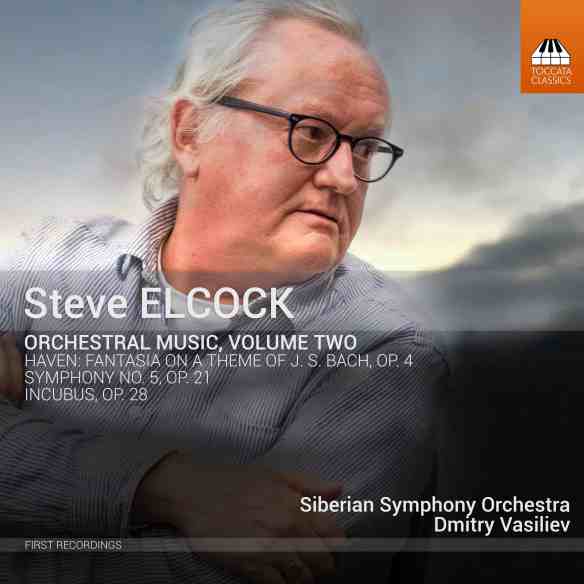
On record: Steve Elcock: Orchestral Music, Volume Two (Toccata)

Steve Elcock
Incubus Op.28 (2017)
Haven: Fantasia on a Theme by J.S. Bach Op.4 (1995, rev. 2011-17)
Symphony no.5 Op.21 (2014)

Siberian Symphony Orchestra / Dmitry Vasiliev

Producer/Engineer Sergei Zhiganov
Recorded 8-12 July 2019, Philharmonic Hall, Omsk

Toccata Classics TOCC0445 [77’20”]

Reviewed by Richard Whitehouse

What’s the story?

Toccata Classics continues its coverage of Steve Elcock (b1957) with this second instalment of orchestral music – dominated by the Fifth Symphony with provocative allusions to its most famous predecessor, together with shorter yet distinctive pieces from either end of his output.

What’s the music like?

Although it marks a return to the four-movement format of his first two such works, the Fifth Symphony is hardly conventional in formal or expressive follow through. As with the almost contemporaneous Fifth by the late Christopher Rouse, the presence of that archetypal ‘No. 5’ feels undeniable – even more so given Elcock’s explicit referencing at the start of each outer movement; a head-on approach hardly less confrontational than that with Beethoven Nine in Tippett’s Third Symphony a half-century ago. In all other respects, Elcock goes entirely his own way: the visceral charge of that beginning quickly subsides into an opening movement whose restive searching seems becalmed emotionally while not tonally, as the music strives increasingly to regain its initial energy before relapsing into a mood of pervasive desolation.

The next two movements unfold without pause as a contrasting duality. As its title suggests, the Ostinato builds explosive impetus over a remorseless rhythmic motto that climactically implodes to leave a musing clarinet melody as expands into the ensuing Canzonetta. Less a slow movement than extended intermezzo, what might have brought a return to the earlier sombreness rather assumes a more compassionate aura that makes possible the final Allegro. Comparable to the first movement in its scale, this unfolds as a sonata design of unflagging dynamism whose twin themes are drawn into a process of continuous development on route to a peroration which, though it could hardly evince the triumph of Beethoven, is never less than affirmative in its bringing the work decisively and, moreover, demonstrably full circle.

A notable achievement, then – less ruggedly distinctive if ultimately more cohesive than the Third Symphony (recorded on TOCC0400), and evidently a statement with which to reckon. It is preceded here by two pieces that further attest to the consistency of Elcock’s underlying vision. Haven: Fantasia on a Theme by J.S. Bach takes the Sarabande from the First Violin Partita as basis for a series less of variations than of paraphrases such as pass from nostalgia, through militaristic brutality, to renewed concord with the theme newly explicit at the close. Derived from a recent string quartet, Incubus is a study in nocturnal imaginings – ostensibly the result of insomnia – which seems predictable only in its marshalling a disparate range of ideas into a taut ‘curtain raiser’ whose outcome is the more telling for being so unexpected.

Does it all work?

It does. Just occasionally taxed in those more demonstrative passages, the Siberian Symphony Orchestra otherwise yields little to the Royal Liverpool Philharmonic as to the conviction of its playing, with Dmitry Vasiliev demonstrating an absolute grasp of Elcock’s combative musical vision.

Is it recommended?

It is. Orchestral sound has commendable heft and perspective, while Francis Pott’s extensive annotations situate all three pieces within an appropriately wide context. Hopefully Elcock’s Fourth Symphony will feature on the next volume in what is an absorbing and valuable series.

Listen

Buy

For further information, audio clips and purchase information visit the Toccata Classics website. For more on Steve Elcock you can visit the composer’s website

On record – Alexander Tcherepnin: My Flowering Staff (Toccata Classics)

Alexander Tcherepnin My Flowering Staff (1912-13)

Inna Dukach (soprano), Tatyana Kebuladze (piano), with Paul Whelan (bass) Acmeist Male Choir

Toccata Classics TOCC0537 [57’55”] Russian (Cyrillic) text and translation included

Producer/Engineer Jeremy Gerard

Recorded 21-23 June 2017, 29 December 2018 and 4 January 2019 at the Gurari Studios, National Opera Center, New York City

Written by Richard Whitehouse

What’s the story?

Toccata Classics comes up with another first in My Flowering Staff, a song-cycle of almost an hour’s length by Alexander Tcherepnin (1899-1977), most of whose content was divided across three separate collections and has only now been returned to its original conception.

What’s the music like?

His reputation established initially through his piano music (a representative selection from which, including several archival recordings by the composer, can be found on TOCC0079), Tcherepnin worked intensively on setting this volume of lyrics by Sergei Gorodetsky (1884-1967) during 1920-21, before he summarily abandoned the project with three texts awaiting music. Instead, he published 24 of these songs – albeit to French translation – as his Opp. 15, 16 and 17, then never returned to the song format on such a scale. The other songs remained unheard until 2018, by which time the original Russian texts of the published items had been restored and the undeniable ambition of Tcherepnin’s vision could be more readily adduced.

Not that adducing such a vision is therefore straightforward. Gorodetsky may have reined-in his more abstruse symbolism when he penned these 38 lyrics during 1912-13, but a tendency towards inward communing is seldom far away and it could be precisely this obscurity which attracted Tcherepnin in the first instance; enabling him to align his own preoccupations with the passage from youth to maturity, and from innocence to experience, with the poet’s own ruminations. Anyone expecting a continuity of narrative akin to the song-cycles of Schubert will only be disappointed, yet the fervency of Tcherepnin’s approach is its own justification.

Stylistically, too, these songs exude those attributes of inward ecstasy and ominous anxiety as Tcherepnin’s older contemporaries had previously found in this poet. Vocal lines tend toward the declamatory and have recourse to a wide compass, while the piano writing is harmonically questing without becoming congested or unidiomatic (hence the imposing solo that precedes the 22nd poem) – a consequence of his mastery over this instrument whether as composer or performer. The expressive ambit is opened-out with a setting of the 16th poem for bass and (optional) male chorus, while the overall cycle is framed by an Epigraph and Epilogue which distil those qualities of yearning and fulfilment that dominate the cycle as a whole. Whether Tcherepnin thought its execution to have fallen short of its ambition cannot now be answered.

Does it all work?

Almost, though it is not always easy to perceive the formal trajectory Tcherepnin was intent on pursuing or to what expressive end it was directed. That said, the omitted songs are quite the equal of those he did publish and to hear them all in sequence affords its own fascination. It helps when Inna Dukach renders the overall cycle with just the right alternation of plangent rhetoric or confiding intimacy and receives astute accompaniment from Tatyana Kebuladze. Nor are Paul Whelan and Acmeist Male Choir found wanting in their solitary contribution.

Is it recommended?

Yes, given the conviction of this performance and excellence of recorded sound. Benjamin Folkman’s detailed annotations go a long way to elucidating Tcherepnin’s conception, while Dina Dukach’s English translation similarly clarifies many aspects of Gorodetsky’s musings.

Listen

Buy

You can discover more about this release at the Toccata Classics website, where you can also purchase the recording.

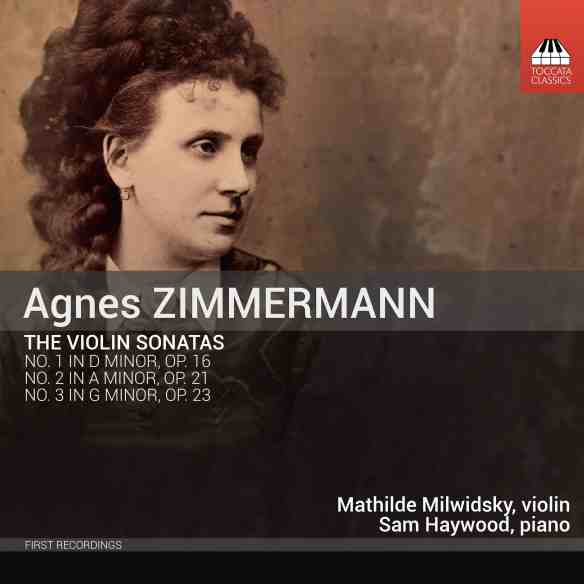
On record – Agnes Zimmermann: The Violin Sonatas (Toccata Classics)

Agnes Zimmermann
Violin Sonata no.1 in D minor Op.16 (1868)
Violin Sonata no.2 in A minor Op.21 (1875)
Violin Sonata no.3 in G minor Op.23 (1879)

Mathilde Milwidsky, violin; Sam Haywood, piano

Toccata Classics TOCC0541 [84’36”]

Producer Michael Ponder
Engineer Adaq Khan

Recorded 6-7 April 2019, 10 November 2019 at Middlesex University, London

Written by Richard Whitehouse

What’s the story?

Toccata Classics continues its not inconsiderable coverage of women composers with this disc of the violin sonatas by Agnes Zimmermann (1947-1925), little recognized as a composer but whose achievements as pianist, teacher and editor were readily acknowledged by her peers.

What’s the music like?

Born in Cologne but largely resident in London, Zimmermann long enjoyed a reputation for her pianism throughout Europe. Her own output is not extensive and mainly from her earlier years, with these three sonatas a notable addition to British music of the mid-Victorian era.

Lasting around 28 minutes, the format of these sonatas is consistent without being predictable. Each begins with a finely proportioned Allegro, the First Sonata being most straightforward in its purposefully contrasted main themes. That of the Second Sonata is more understated, its main themes merging into a seamless continuity whose ominous import is briefly disrupted in the central development. As to the Third Sonata, this commences with greater expansiveness then maintains such deliberation through its intensive development and on to a fatalistic coda.

Each sonata has a Scherzo, placed second in the initial two sonatas. That of the First Sonata brings appealing animation and rhythmic subtlety, not least as regards its warmly ruminative trio. By contrast, that of the Second Sonata has a lively insouciance which is accentuated by some deft syncopation and a notably winsome trio. That of the Third Sonata is placed third (not entirely justifiably) and is itself closer to an intermezzo on account of its halting main theme, to which the trio offers only minimal contrast in its mixture of elegance and pathos.

The slow movements are all designated Andante. That of the First Sonata is an ostensible ‘song without words’ and evinces a distinctly Mendelssohnian poise. Whereas that of the Second Sonata centres on a hymn-like melody that proves capable of no mean fervour as it evolves over the course of music whose direct eloquence never risks becoming cloying. By contrast, that of the Third Sonata (placed third) feels more akin to an intermezzo in its lightness of texture and wistful main theme, not least as it heads towards a subdued close.

As to the Finales, these all tend toward the trenchant and unequivocal. Most notably that of the First Sonata, albeit with a wistful second subject to offset the prevailing impetus. That of the Second Sonata unfolds more stealthily in keeping, with the trajectory of this work taken overall, though the decisiveness of its ending is hardly in doubt. That the Third Sonata needs a finale to balance the weight of its first movement is undoubted and this does not disappoint in its eliding ardency and affection, before an elaborate though not over-wrought apotheosis.

Does it all work?

Yes, in that Zimmermann was essentially a consolidator of the chamber tradition stretching from Beethoven, through Schumann, to Brahms. Her violin sonatas are at least equal to those by such British contemporaries as Parry and Stanford in their conviction and craftsmanship.

Is it recommended?

Indeed. Mathilde Milwidsky is an unfailingly persuasive exponent and astutely partnered by Sam Haywood. Sound is unexceptionally fine, and Peter Fribbins pens a detailed analytical overview. Why the sonatas are featured on CD in reverse order is, however, anyone’s guess.

Listen

Buy

You can discover more about this release at the Toccata Classics website, where you can also purchase the recording.

On record – Joly Braga Santos: Chamber Music Volume One (Toccata Classics)

Joly Braga Santos
String Quartet no.1 Op.4 (1945)
String Quartet no.2 Op.27 (1957)
String Sextet Op.65 (1986)*

Quarteto Lopes-Graça [Luis Pacheco Cunha, Maria-José Laginha (violins), Isabel Pimentel (viola), Catherine Strynckx (cello)] with *Leonor Braga Santos (viola) and Irene Lima (cello)

Toccata Classics TOCC0207 [78’48”]

Producer Brian MacKay
Engineer Romain Zémiri

Recorded 1-3 November 2017, 4-6 April 2018* at Live recording, 26 April 1993 at Centro Cultural de Belém, Lisbon, Portugal

Written by Richard Whitehouse

What’s the story?

Toccata Classics now turns its attention to Joly Braga Santos (1924-88), arguably the leading Portuguese composer from the twentieth century, for what looks certain to be an engrossing traversal of his chamber output and in the company of his native country’s leading musicians.

What’s the music like?

Like the Catalan composers Roberto Gerhard or Argentinian Alberto Ginastera, Braga Santos followed an eventful trajectory from folk-inflected traditionalism to purposeful engagement with mid-century modernism – a trenchant and engaging musical personality emerging in the process.

Cast on a sizeable scale, the First String Quartet opens with a moderately paced Allegro with ample indication of this work’s stylistic indebtedness to Debussy and Ravel, even Koechlin. An eloquent viola solo takes the place of any expected development, besides complementing that for first violin prevalent elsewhere. Next comes a tensile scherzo with much recourse to additive rhythm and contrapuntal agility, then an Andante whose long-limbed melodic lines highlight each of the instruments within a harmonic context of suffused modality. At almost 13 minutes, the finale is a culmination in every sense as it elides between sonata and rondo designs before heading into an expansive coda which brings the work elegiacally full circle.

At little more than half the length of its predecessor, the Second String Quartet enriches its modal tendencies with a harmonic astringency and rhythmic impetus derived from – if not indebted to – Bartók. The latter’s final quartet might be sensed in the opening movement’s soulful introduction then an unhurried course informed by underlying anxiety. The central movement is a scherzo-cum-intermezzo that alternates inwardly speculative passages with more animated episodes, each having recourse to soloistic writing or the deftest polyphony, while the finale pointedly revisits the work’s opening prior to an impulsive Allegro whose dance-like ideas underpin this movement through to its headlong and decisive conclusion.

Among its composer’s last works, the String Sextet finds Braga Santos mining an idiom that now incorporates atonal and even twelve-note elements (though never deployed serially) with considerable finesse. Alternately sombre and desolate, the initial Molto Largo must rank with his most impressive statements as it builds towards a culmination of probing intensity. There follows a trenchant scherzo notable for its textural intricacy and range of playing techniques that open-out rather than inhibit the music’s expressive range, and if the finale feels intent on inhabiting the same emotional terrain as at the beginning, the (overly?) compressed Allegro that ensues leaves no doubt as to the determined resolve confirmed by that concluding chord.

Does it all work?

Yes, in that the stylistic changes between the pieces are determined solely by the composer’s personal and emotional evolution rather than merely wanton desire to follow trends. Certainly, the latter two works are equally well deserving of a place in the post-war chamber repertoire.

Is it recommended?

Indeed. Performances by Quarteto Lopes-Graça (et al) could not be bettered for commitment or insight, despite a rather too resonant and unfocussed sound balance, while the overview by Piedade Braga Santos and notes on each work by Bernardo Mariano are highly informative.

Listen

Buy

You can discover more about this release at the Toccata Classics website, where you can also purchase the recording.

On record – William Wordsworth: Orchestral Music Vol.2 (Toccata Classics)

Kamila Bydlowska (violin), Arta Arnicane (piano), Liepāja Symphony Orchestra / John Gibbons

William Wordsworth
Piano Concerto in D minor Op.28 (1946)
Three Pastoral Sketches Op.10 (1937)
Violin Concerto in A major Op.60 (1955)

Toccata Classics TOCC0526 [79’41”]

Producer Normands Slava
Engineer Jānis Straume

Recorded 21-25 January 2019, Amber Concert Hall, Liepāja, Latvia

Written by Richard Whitehouse

What’s the story?

Toccata Classics issues a further volume of orchestral music by William Wordsworth (1908-88), featuring two highly contrasted concertos alongside the composer’s first acknowledged work for the medium, in persuasive readings by the Liepāja Symphony Orchestra with John Gibbons.

What’s the music like?

Composed in the aftermath of the Second World War, Wordsworth’s Piano Concerto unfolds in five continuous sections. At its centre is an Adagio, its pathos informed by an ominousness that becomes far more confrontational in the two Allegros either side, during which interplay between soloist and orchestra is also at its most combative. Framing these, in turn, is a brief introduction whose understatement belies a motivic resource that is brought full circle in the coda with its mingling of fatalism and defiance. Premiered by John Hunt while dedicated to Clifford Curzon (did he ever actually play it?), this is a compact and effective piece such as ought to have garnered further performances and certainly warrants revival in a live context. Hopefully, this adept as well as committed recording will bring that possibility a little closer.

As should that of the Violin Concerto which, by contrast, ranks among Wordsworth’s most expansive orchestral works. The opening Moderato, alone playing for 15 minutes, is notable for its thematic concentration – its lyrical then contrapuntal ideas being manifestations of the same theme which is duly intensified in the development, though an overly discursive reprise makes the terse coda feel almost too perfunctory. No such doubts over a central Adagio that finds the composer at his most eloquent and builds to a close as affecting as it is inevitable. Following without pause, the final Allegro is essentially a series of variations on its spirited initial theme – replete with imaginative use of percussion and exuding an energy as carries over to the imposing cadenza then a coda whose affirmation Wordsworth seldom equalled.

Placed between these two concertos, the Three Pastoral Sketches might seem lightweight by comparison. In fact, these evocations merge into a purposeful unity with ample indications of the symphonist Wordsworth was soon to become as they proceed from the ruminative poise of Sundown, via the ethereal undulations of Lonely Tarn (Holst and Moeran brought into unlikely accord), then on to the cumulative power of Seascape with its sense of fulfilment just beyond reach. This ranks high among orchestral debuts from Wordsworth’s generation.

Does it all work?

In almost all respects. Special credit to the two soloists, who surely cannot have encountered this music before these sessions but whose dedication and insight can hardly be doubted. Arta Arnicane has all the impetus and incisiveness necessary for the Piano Concerto, while Kamila Bydlowska evinces burnished warmth and a caressing tone ideal for the lyrical expanse of the Violin Concerto. John Gibbons again secures playing of commitment from his Liepāja forces, their lacking the last degree of tension in portions of the concertos being just a minor quibble.

Is it recommended?

Indeed. As with the previous volume, Wordsworth’s music is a ‘slow-burn’ as rewards those who take time to make its acquaintance. Finely recorded and annotated, this can be cordially recommended in anticipation of those numerous works still to be encountered in this series.

Read, listen and Buy

You can read Richard’s review of the first volume in the Wordsworth series on Arcana

You can listen to clips and purchase this disc from the Toccata Classics website