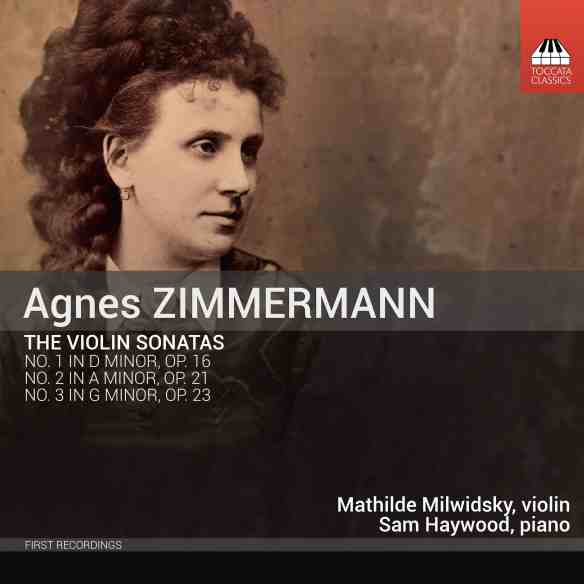
On record – Agnes Zimmermann: The Violin Sonatas (Toccata Classics)

Agnes Zimmermann
Violin Sonata no.1 in D minor Op.16 (1868)
Violin Sonata no.2 in A minor Op.21 (1875)
Violin Sonata no.3 in G minor Op.23 (1879)

Mathilde Milwidsky, violin; Sam Haywood, piano

Toccata Classics TOCC0541 [84’36”]

Producer Michael Ponder
Engineer Adaq Khan

Recorded 6-7 April 2019, 10 November 2019 at Middlesex University, London

Written by Richard Whitehouse

What’s the story?

Toccata Classics continues its not inconsiderable coverage of women composers with this disc of the violin sonatas by Agnes Zimmermann (1947-1925), little recognized as a composer but whose achievements as pianist, teacher and editor were readily acknowledged by her peers.

What’s the music like?

Born in Cologne but largely resident in London, Zimmermann long enjoyed a reputation for her pianism throughout Europe. Her own output is not extensive and mainly from her earlier years, with these three sonatas a notable addition to British music of the mid-Victorian era.

Lasting around 28 minutes, the format of these sonatas is consistent without being predictable. Each begins with a finely proportioned Allegro, the First Sonata being most straightforward in its purposefully contrasted main themes. That of the Second Sonata is more understated, its main themes merging into a seamless continuity whose ominous import is briefly disrupted in the central development. As to the Third Sonata, this commences with greater expansiveness then maintains such deliberation through its intensive development and on to a fatalistic coda.

Each sonata has a Scherzo, placed second in the initial two sonatas. That of the First Sonata brings appealing animation and rhythmic subtlety, not least as regards its warmly ruminative trio. By contrast, that of the Second Sonata has a lively insouciance which is accentuated by some deft syncopation and a notably winsome trio. That of the Third Sonata is placed third (not entirely justifiably) and is itself closer to an intermezzo on account of its halting main theme, to which the trio offers only minimal contrast in its mixture of elegance and pathos.

The slow movements are all designated Andante. That of the First Sonata is an ostensible ‘song without words’ and evinces a distinctly Mendelssohnian poise. Whereas that of the Second Sonata centres on a hymn-like melody that proves capable of no mean fervour as it evolves over the course of music whose direct eloquence never risks becoming cloying. By contrast, that of the Third Sonata (placed third) feels more akin to an intermezzo in its lightness of texture and wistful main theme, not least as it heads towards a subdued close.

As to the Finales, these all tend toward the trenchant and unequivocal. Most notably that of the First Sonata, albeit with a wistful second subject to offset the prevailing impetus. That of the Second Sonata unfolds more stealthily in keeping, with the trajectory of this work taken overall, though the decisiveness of its ending is hardly in doubt. That the Third Sonata needs a finale to balance the weight of its first movement is undoubted and this does not disappoint in its eliding ardency and affection, before an elaborate though not over-wrought apotheosis.

Does it all work?

Yes, in that Zimmermann was essentially a consolidator of the chamber tradition stretching from Beethoven, through Schumann, to Brahms. Her violin sonatas are at least equal to those by such British contemporaries as Parry and Stanford in their conviction and craftsmanship.

Is it recommended?

Indeed. Mathilde Milwidsky is an unfailingly persuasive exponent and astutely partnered by Sam Haywood. Sound is unexceptionally fine, and Peter Fribbins pens a detailed analytical overview. Why the sonatas are featured on CD in reverse order is, however, anyone’s guess.

Listen

Buy

You can discover more about this release at the Toccata Classics website, where you can also purchase the recording.

On record – Joly Braga Santos: Chamber Music Volume One (Toccata Classics)

Joly Braga Santos
String Quartet no.1 Op.4 (1945)
String Quartet no.2 Op.27 (1957)
String Sextet Op.65 (1986)*

Quarteto Lopes-Graça [Luis Pacheco Cunha, Maria-José Laginha (violins), Isabel Pimentel (viola), Catherine Strynckx (cello)] with *Leonor Braga Santos (viola) and Irene Lima (cello)

Toccata Classics TOCC0207 [78’48”]

Producer Brian MacKay
Engineer Romain Zémiri

Recorded 1-3 November 2017, 4-6 April 2018* at Live recording, 26 April 1993 at Centro Cultural de Belém, Lisbon, Portugal

Written by Richard Whitehouse

What’s the story?

Toccata Classics now turns its attention to Joly Braga Santos (1924-88), arguably the leading Portuguese composer from the twentieth century, for what looks certain to be an engrossing traversal of his chamber output and in the company of his native country’s leading musicians.

What’s the music like?

Like the Catalan composers Roberto Gerhard or Argentinian Alberto Ginastera, Braga Santos followed an eventful trajectory from folk-inflected traditionalism to purposeful engagement with mid-century modernism – a trenchant and engaging musical personality emerging in the process.

Cast on a sizeable scale, the First String Quartet opens with a moderately paced Allegro with ample indication of this work’s stylistic indebtedness to Debussy and Ravel, even Koechlin. An eloquent viola solo takes the place of any expected development, besides complementing that for first violin prevalent elsewhere. Next comes a tensile scherzo with much recourse to additive rhythm and contrapuntal agility, then an Andante whose long-limbed melodic lines highlight each of the instruments within a harmonic context of suffused modality. At almost 13 minutes, the finale is a culmination in every sense as it elides between sonata and rondo designs before heading into an expansive coda which brings the work elegiacally full circle.

At little more than half the length of its predecessor, the Second String Quartet enriches its modal tendencies with a harmonic astringency and rhythmic impetus derived from – if not indebted to – Bartók. The latter’s final quartet might be sensed in the opening movement’s soulful introduction then an unhurried course informed by underlying anxiety. The central movement is a scherzo-cum-intermezzo that alternates inwardly speculative passages with more animated episodes, each having recourse to soloistic writing or the deftest polyphony, while the finale pointedly revisits the work’s opening prior to an impulsive Allegro whose dance-like ideas underpin this movement through to its headlong and decisive conclusion.

Among its composer’s last works, the String Sextet finds Braga Santos mining an idiom that now incorporates atonal and even twelve-note elements (though never deployed serially) with considerable finesse. Alternately sombre and desolate, the initial Molto Largo must rank with his most impressive statements as it builds towards a culmination of probing intensity. There follows a trenchant scherzo notable for its textural intricacy and range of playing techniques that open-out rather than inhibit the music’s expressive range, and if the finale feels intent on inhabiting the same emotional terrain as at the beginning, the (overly?) compressed Allegro that ensues leaves no doubt as to the determined resolve confirmed by that concluding chord.

Does it all work?

Yes, in that the stylistic changes between the pieces are determined solely by the composer’s personal and emotional evolution rather than merely wanton desire to follow trends. Certainly, the latter two works are equally well deserving of a place in the post-war chamber repertoire.

Is it recommended?

Indeed. Performances by Quarteto Lopes-Graça (et al) could not be bettered for commitment or insight, despite a rather too resonant and unfocussed sound balance, while the overview by Piedade Braga Santos and notes on each work by Bernardo Mariano are highly informative.

Listen

Buy

You can discover more about this release at the Toccata Classics website, where you can also purchase the recording.

On record – William Wordsworth: Orchestral Music Vol.2 (Toccata Classics)

Kamila Bydlowska (violin), Arta Arnicane (piano), Liepāja Symphony Orchestra / John Gibbons

William Wordsworth
Piano Concerto in D minor Op.28 (1946)
Three Pastoral Sketches Op.10 (1937)
Violin Concerto in A major Op.60 (1955)

Toccata Classics TOCC0526 [79’41”]

Producer Normands Slava
Engineer Jānis Straume

Recorded 21-25 January 2019, Amber Concert Hall, Liepāja, Latvia

Written by Richard Whitehouse

What’s the story?

Toccata Classics issues a further volume of orchestral music by William Wordsworth (1908-88), featuring two highly contrasted concertos alongside the composer’s first acknowledged work for the medium, in persuasive readings by the Liepāja Symphony Orchestra with John Gibbons.

What’s the music like?

Composed in the aftermath of the Second World War, Wordsworth’s Piano Concerto unfolds in five continuous sections. At its centre is an Adagio, its pathos informed by an ominousness that becomes far more confrontational in the two Allegros either side, during which interplay between soloist and orchestra is also at its most combative. Framing these, in turn, is a brief introduction whose understatement belies a motivic resource that is brought full circle in the coda with its mingling of fatalism and defiance. Premiered by John Hunt while dedicated to Clifford Curzon (did he ever actually play it?), this is a compact and effective piece such as ought to have garnered further performances and certainly warrants revival in a live context. Hopefully, this adept as well as committed recording will bring that possibility a little closer.

As should that of the Violin Concerto which, by contrast, ranks among Wordsworth’s most expansive orchestral works. The opening Moderato, alone playing for 15 minutes, is notable for its thematic concentration – its lyrical then contrapuntal ideas being manifestations of the same theme which is duly intensified in the development, though an overly discursive reprise makes the terse coda feel almost too perfunctory. No such doubts over a central Adagio that finds the composer at his most eloquent and builds to a close as affecting as it is inevitable. Following without pause, the final Allegro is essentially a series of variations on its spirited initial theme – replete with imaginative use of percussion and exuding an energy as carries over to the imposing cadenza then a coda whose affirmation Wordsworth seldom equalled.

Placed between these two concertos, the Three Pastoral Sketches might seem lightweight by comparison. In fact, these evocations merge into a purposeful unity with ample indications of the symphonist Wordsworth was soon to become as they proceed from the ruminative poise of Sundown, via the ethereal undulations of Lonely Tarn (Holst and Moeran brought into unlikely accord), then on to the cumulative power of Seascape with its sense of fulfilment just beyond reach. This ranks high among orchestral debuts from Wordsworth’s generation.

Does it all work?

In almost all respects. Special credit to the two soloists, who surely cannot have encountered this music before these sessions but whose dedication and insight can hardly be doubted. Arta Arnicane has all the impetus and incisiveness necessary for the Piano Concerto, while Kamila Bydlowska evinces burnished warmth and a caressing tone ideal for the lyrical expanse of the Violin Concerto. John Gibbons again secures playing of commitment from his Liepāja forces, their lacking the last degree of tension in portions of the concertos being just a minor quibble.

Is it recommended?

Indeed. As with the previous volume, Wordsworth’s music is a ‘slow-burn’ as rewards those who take time to make its acquaintance. Finely recorded and annotated, this can be cordially recommended in anticipation of those numerous works still to be encountered in this series.

Read, listen and Buy

You can read Richard’s review of the first volume in the Wordsworth series on Arcana

You can listen to clips and purchase this disc from the Toccata Classics website

On record – Steve Elcock: Chamber Music Vol.1 (Toccata Classics)

The Veles Ensemble (Hartmut Richter (violin), Ralitsa Naydenova (viola), Evva Mizerska (cello), with Daniel Shao (flute), Peter Cigleris (clarinet), Yuri Kalnits (violin), Leon Bosch (double bass), Catalina Ardelean (piano)

Steve Elcock
Clarinet Sextet Op.11b (2001/14)
String Trio no.1 Op.8b (1998/2016)
The Shed Dances Op.26b (2016)
An Outstretched Hand Op.24 (2015)

Toccata Classics TOCC0506 [79’36”]

Producer & Engineer Michael Ponder

Recorded 21-22 May 2018, St Silas, Chalk Farm, London, 24 May 2018 (Sextet, Trio, The Shed Dances), Henry Wood Hall (An Outstretched Hand)

Written by Richard Whitehouse

What’s the story?

Following an impressive disc of his orchestral music (TOCC0400, reviewed on Arcana here), Steve Elcock (b1957) is given further coverage by Toccata Classics with this release of chamber music, reaffirming him as a force to be reckoned with among those symphonic composers from his generation.

What’s the music like?

Every bit as engrossing as the works on that earlier release – that is, uncompromising without being unyielding and serious without being (unduly) earnest. This is evident from the earliest piece here, Elcock’s First String Trio having been conceived for two violins and viola before reaching its present guise. A tensile single movement pivots constantly between the fractious and consoling, at times encroaching upon a more equable expression that nevertheless fails to sustain itself, and with a conclusion where even the most tenuous poise is summarily denied.

Starting out as a Concertino for clarinet and string orchestra, the Clarinet Sextet is on a larger scale – opening with an Allegro whose clear-cut sonata design opens-out intriguingly with a cadenza-like passage just before the reprise. Similarly, the Romanza is thrown off-balance by a faster central section which duly intensifies the climactic stages, and if the progress of the final Variations and Theme seems more arresting as regards form rather than content, the gentle evanescence after the theme has been elaborated feels as subtle as it is intriguing.

More immediately approachable, The Shed Dances began life as a sequence for violin and piano before being recast for clarinet and string trio. Written at the suggestion of a sufferer from the neurological condition known as ataxia, all six dances are thwarted or undermined by rhythmic imbalances that are only effortfully overcome – the most memorable being the inhibited gait of Petrified minuet, edgy impulsiveness of Boneyard antics and winsome swaying of Marion’s pavane which confirms Elcock as possessing no mean melodic gift.

Finally, to An Outstretched Hand whose inspiration in the stark contrasts of composing as an act of friendship across the centuries and the burgeoning refugee crisis across Europe became fused into this powerfully sustained single movement for flute, clarinet and piano quartet. Its sombre initial Largo is followed by two Allegros (themselves separated by a stark interlude) whose increasingly confrontational manner carries over to a final Largo which recalls earlier material in a mood that, fatalistic rather than merely defeatist, exudes the keenest poignancy.

Does it all work?

Yes, in almost all respects. It helps when these performances are so evidently attuned to this idiom, teasing subtleties out of the charged formal processes and grating expressive contrasts that are recognizable Elcock traits. The overall programme is carried by the Veles Ensemble, whose tonal finesse and tangible commitment to this music is evident throughout – which is hardly to decry the contributions of those other musicians featured here. Hopefully it should prove possible for these pieces to be heard in public performance on some future occasion.

Is it recommended?

Certainly – not least when the sound is unexceptionally fine, and the composer’s annotations are unfailingly to the point. Elcock’s growing admirers will be pleased to hear that a further disc of orchestral music (including the Fifth Symphony) is scheduled for imminent release.

Listen and Buy

You can listen to clips and purchase this disc from the Toccata Classics website

On record – Roger Smalley: Piano, Vocal and Chamber Music (Toccata Classics)

Taryn Fiebig (soprano), Darryl Poulsen (horn), James Cuddeford (violin), Daniel Herscovitch (piano), Scott Davie (piano), Roger Smalley (tam-tams)

Roger Smalley
Albumblatt (1990) Nine Lives (2008)
Capriccio no.1 (1966)
Barcarolle (1986)
Morceau de Concours (2008)
Piano Pieces I-V (1962-5)
Three Studies in Black and White (2002-4)
Lament for the Victims of Natural Disasters (2005)

Toccata Classics TOCC0501 [72’21”]

Producer & Engineer David Kim-Boyle

Recorded 2005, University of Western Australia, Perth (Three Studies in Black and White), 13 February, 28-29 March 2019, University of Sydney Conservatorium of Music

Written by Richard Whitehouse

What’s the story?

Toccata Classics releases this welcome overview of music by Roger Smalley (1943-2015), whose extensive output followed an eventful and unpredictable trajectory from unabashed modernism to post-classicism demonstrably informed and enhanced by a performer’s insight.

What’s the music like?

As varied as this selection might suggest. Earliest here is Piano Pieces I-V, tersely distinctive miniatures whose conspectus of radical tendencies from Schoenberg to Stockhausen is allied to a pianism at once resourceful and pragmatic. An aesthetic heightened in Capriccio no.1, whose often confrontational interplay between violin and piano owes much to Schoenberg’s late Phantasy while not precluding a more personal approach such as Smalley’s subsequent involvement with Stockhausen transmuted into a more progressive but less emotive manner.

By the time of Barcarolle, Smalley had moved away from modernist traits towards an idiom permeated by while never beholden to the Romantic era. Chopin’s famous example may not be evident here, but the ominous undulation of Fauré’s earlier such pieces is unmistakable; as is Liszt in the scintillating dexterity of Morceau de Concours, a test-piece to reckon with not just in terms of its technique. Most impressive, however, is Three Studies in Black and White, a trilogy likely inspired by Alkan’s Op. 76 Études – with the opening Gamelan a visceral yet ultimately eloquent exploration for left hand; by contrast, Moto perpetuo is an edgy and often volatile workout for right hand, then Dialogue reunites both hands in music at once resolute and consoling. Few, if any, piano pieces of such substance have been composed this century.

Which is not to underestimate the effectiveness of Nine Lives. Subtitled A Song-Cycle about Cats, these settings of feline evocation range as widely as that of the authors featured. Of the three extended items – that by Oscar Wilde is stealthy and secretive, that by Christina Rosetti a memorial of deadpan insouciance, while that by Oliver Herford is a luminous and affecting envoi. Framing the programme are a brief Albumblatt later subsumed into the Piano Trio, and Lament for the Victims of Natural Disasters where horn eulogizes against resonant tam-tams.

Does it all work?

Yes. Smalley’s academic career at University of Western Australia at Perth connected him to many significant musicians, several of whom are present here. Taryn Fiebig brings a wealth of nuance to the songs and is ably accompanied by Scott Davis, while James Cuddeford and Darryl Poulsen make salient contributions. Greatest credit, though, to Daniel Herscovitch for piano playing as not only makes light of the considerable technical demands but conveys the unity within diversity of Smalley’s musical language throughout four decades of evolution.

Is it recommended?

Indeed. The Smalley discography is not inconsiderable, and readers should investigate such major works as Accord (Continuum) or Pulses (NMC); while Poles Apart (NMC) focusses on more recent pieces.

A plea, too, for the reissue of the Symphony and First Piano Concerto (Vox Australis), two of his defining works. That said, this latest release makes as inclusive an overview as has been issued. The sound is unexceptionally fine, and booklet notes unfailingly insightful, but for the track-listing the Barcarolle and Morceau have added 10 minutes each.

Listen and Buy

You can listen to clips and purchase this disc from the Toccata Classics website