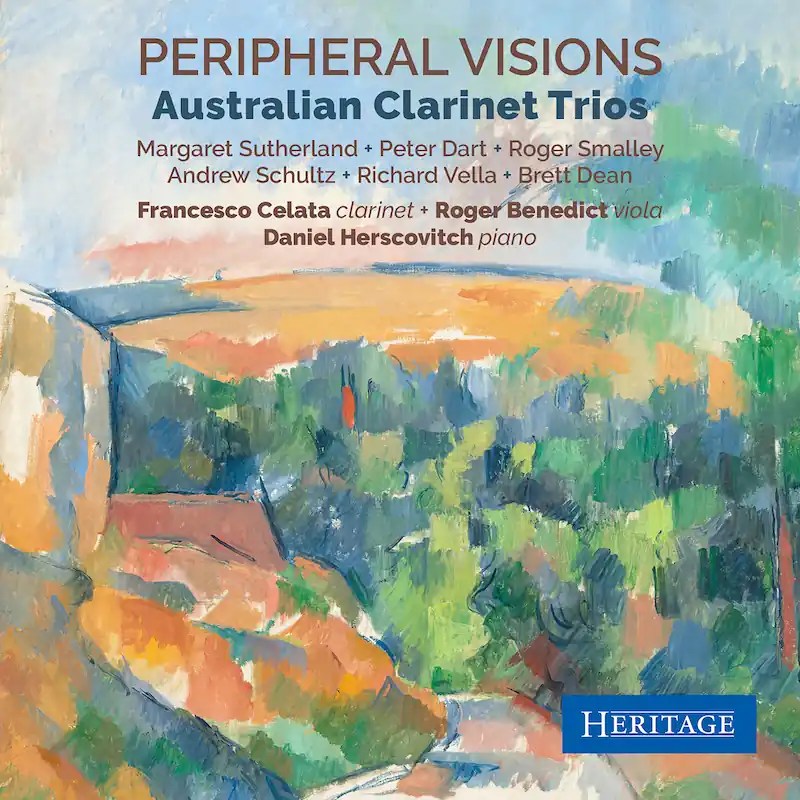
On Record – Francesco Celata, Roger Benedict & Daniel Herscovitch – Peripheral Visions: Australian Clarinet Trios (Heritage Records)

Francesco Celata (clarinet); Roger Benedict (viola); Daniel Herscovitch (piano)

Margaret Sutherland Trio in C major (1935)
Peter Dart Peripheral Visions (2021-22)
Roger Smalley Clarinet Trio (1992-99, rev. 2001)
Andrew Schultz Stick Dance no.2 Op.22b (1989)
Richard Vella Tango (1990)
Brett Dean Night Window (1993)

Heritage Records HTGCD119 [71’25”]English texts included
Producer David Kim-Boyle Engineer David Kinney

Recorded 27 & 29 November 2023, 14 & 15 April 2025 at Verbrugghen Hall, Conservatorium of Music, University of Sydney

Reviewed by Richard Whitehouse

What’s the story?

Heritage releases an enterprising anthology of pieces for clarinet trio from three generations of Australian composers that, in the process, demonstrates a stylistically varied while always imaginative approach at the forefront of these consistently assured and committed recordings.

What’s the music like?

Thanks to recent revivals (not least her tone poem Haunted Hills at last year’s Prom season), the importance of Margaret Sutherland in the context of Australian music is well established. Unheard for eight decades, her Clarinet Trio typifies the unforced Classicism of her maturity – whether in that modal tinge of its restrained opening Allegro, winsome poise of its central Adagio or the amiable impetus of its closing Allegro giocoso. It certainly provides a telling contrast with Stick Dance by Andrew Schultz which, as reworked from his earlier piece for larger ensemble, leaves a distinctive impression through often disjunctive contrasts and an ominously visual quality doubtless emanating from its inspiration in Indonesian puppetry.

At the forefront of new music in the UK and subsequently Australia, Roger Smalley latterly found a productive rapprochement with the musical past as demonstrated by his Piano Trio. Its concise sonata-form design is overlaid with that of variations in what becomes a process of continual development away from then back to that melodic fragment from the finale of Brahms’ Clarinet/Viola Sonata in E flat. From the intrinsically musical to the overtly visual – Peripheral Visions finds Peter Dart referencing poems by W. G. Sebald or drawings by Jan Peter Tripp as it unfolds from stealthy dialogue in ‘Reflections and Shadows’, via contrasts of darkness and light in ‘Above the Somme’, to emotive effects of colour in ‘After Cézanne’. The no less visual (and theatrically derived) immediacy of Richard Vella’s Tango makes for an ideal upbeat to Night Window, Brett Dean’s engagingly oblique take on the piano trio as genre or medium. Here an ‘Introduction’ of cadenzas for bass clarinet and viola leads into a ‘Fast, vigorous’ movement, with piano making its presence felt in music incisive and agile. There follows ‘Variations’, on a chorale-like theme whose otherness is as pervasive on the brief first four of these as on a more extended fifth variation that crystallizes the expressive essence overall. It only remains for ‘Return’ to bring about closure, its capricious progress drawing salient motivic facets from across the work into purposeful and inevitable accord.

Does it all work?

Very much so. What comes across most tellingly throughout this recital is a lack of inhibition, shared by these composers, when it comes to writing for a medium already much favoured by those in France and Germany during the previous century. The highly distinct nature of these three instruments is inevitably exploited; so too their timbral or textural similarities for what can equally become an ensemble unified as to its overall sound and conception. In touching on both premises, these three musicians convey the potential of all six pieces in full measure.

Is it recommended?

It is. Sound could hardly be improved on for clarity or definition, without sacrificing warmth, while the booklet note features succinctly informative commentaries by five of the composers as part of an overview that in itself segues unobtrusively between description and biography.

Listen / Buy

You can explore purchase options at the Heritage Records website

Published post no.2,902 – Saturday 30 May 2026

On Record – Kate Moore: Velvet (Heritage Records)

Ole Böhn (violin) (Heather, Dies Irae, Way of the Dead); Minah Choe (cello) (Velvet), Daniel Herscovitch (piano) (all) with Benjamin Kopp (piano) (The Body is an Ear)

Kate Moore
Zomer (2006)
Velvet (2010)
The Body is an Ear (2011)
Heather (2013)
Dies Irae (2015)
Way of the Dead (2017)
Lucidity: Eyes of Hands (2018)

Heritage HTGCD137 [79’38’’]
Producers Kate Moore, Daniel Herscovitch Engineers David Kim-Boyle, David Kinney Recorded 3 March, 8 August and 9 October 2023 at Verbrugghen Hall, Conservatorium of Music, Sydney

Reviewed by Richard Whitehouse

What’s the story?

Heritage rings the changes on its schedule of welcome reissues with this release of music by Kate Moore (b1979), Australian composer born in the UK who currently resides in the Netherlands, all played by a notable roster of musicians based at Sydney Conservatorium.

What’s the music like?

As the booklet notes make plain, any tendency to Minimalism in Moore’s music is rendered from a distinctly maximalist perspective. Hence an inexorable build-up of tension in the two-piano version of The Body is an Ear (initially for organ and recast for two such instruments), with its inspiration in Sufist legend, or growing plangency of Dies Irae where violin intones elements of that plainchant against some ominously undulating harmonies on piano in what the composer has aptly described as a ‘‘spiritual meditation on forgiveness and redemption’’.

Arguably even more revealing of Moore’s aesthetic is the title-track. Velvet draws cello and piano into a sustained and increasingly intense dialogue whose ostensible depiction of cloth in Renaissance painting yields great textural and colouristic diversity, while building toward an impassioned culmination from which the coda is more affecting for its brevity and pathos. Hardly less absorbing, Way of the Dead takes a not dissimilar formal trajectory – this ‘danse macabre’, as inspired by a Mexican festival, fusing melodic eloquence from the violin with an implacable rhythmic accompaniment on piano such as comes to the fore in those seismic final bars. At the opposite end of the scale in all senses, Zomer takes extracts from a sermon by John Donne for this piano rumination with the simple and profound artlessly combined.

The duo for violin and piano Heather takes its cue from the composer’s Hebridean hike – the incidence of vegetation growing in patterns according to outlines of now-vanished buildings effecting a piece where instrumental coordination becomes ever more exacting, as the music’s emotional velocity gradually while also remorselessly accelerates towards another of Moore’s reticent and poignant apotheoses. Lucidity: Eyes of Hands draws on the legend of St Lucie, as related by Dante, for a solo piano work whose polyrhythmic intricacy is in constant evolution as the music unfolds – though, on this occasion, there is no crystallizing of tension at the end; rather, the accrued impetus spills over into a forceful and even unnerving peroration to leave no doubt as to Moore’s identity with the narrative that made possible this piece’s conception.

Does it all work?

Yes, given that Moore’s is an arresting and appealing idiom, one whose outward consistency is countered by its variety of technical procedures along with its underlying expressive range. It certainly benefits from the advocacy of these musicians, their dedication and commitment coming across at every turn, while the clarity of recording emphasizes its visceral immediacy. Informative notes from the composer and Daniel Herscovitch. Those listening via download have an additional item – a Prelude for piano, whose limpid poise makes for a welcome tonic.

Is it recommended?

Indeed, and hopefully those who have acquired this Heritage project will investigate further releases of Moore’s music – the volume of piano pieces Dances and Canons (ECM) and the collection of vocal items Stories for Ocean Shells (Canteloupe) proving no less worthwhile.

Listen & Buy

You can hear excerpts and look at purchase options on the Presto website. For more information on Kate Moore head to her website – and for more on the artists click on the names Daniel Herscovitch, Ole Böhn, Minah Choe and Benjamin Kopp.

Published post no.2,128 – Monday 25 March 2024

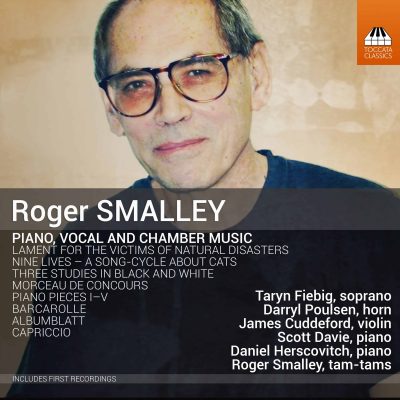
On record – Roger Smalley: Piano, Vocal and Chamber Music (Toccata Classics)

Taryn Fiebig (soprano), Darryl Poulsen (horn), James Cuddeford (violin), Daniel Herscovitch (piano), Scott Davie (piano), Roger Smalley (tam-tams)

Roger Smalley
Albumblatt (1990) Nine Lives (2008)
Capriccio no.1 (1966)
Barcarolle (1986)
Morceau de Concours (2008)
Piano Pieces I-V (1962-5)
Three Studies in Black and White (2002-4)
Lament for the Victims of Natural Disasters (2005)

Toccata Classics TOCC0501 [72’21”]

Producer & Engineer David Kim-Boyle

Recorded 2005, University of Western Australia, Perth (Three Studies in Black and White), 13 February, 28-29 March 2019, University of Sydney Conservatorium of Music

Written by Richard Whitehouse

What’s the story?

Toccata Classics releases this welcome overview of music by Roger Smalley (1943-2015), whose extensive output followed an eventful and unpredictable trajectory from unabashed modernism to post-classicism demonstrably informed and enhanced by a performer’s insight.

What’s the music like?

As varied as this selection might suggest. Earliest here is Piano Pieces I-V, tersely distinctive miniatures whose conspectus of radical tendencies from Schoenberg to Stockhausen is allied to a pianism at once resourceful and pragmatic. An aesthetic heightened in Capriccio no.1, whose often confrontational interplay between violin and piano owes much to Schoenberg’s late Phantasy while not precluding a more personal approach such as Smalley’s subsequent involvement with Stockhausen transmuted into a more progressive but less emotive manner.

By the time of Barcarolle, Smalley had moved away from modernist traits towards an idiom permeated by while never beholden to the Romantic era. Chopin’s famous example may not be evident here, but the ominous undulation of Fauré’s earlier such pieces is unmistakable; as is Liszt in the scintillating dexterity of Morceau de Concours, a test-piece to reckon with not just in terms of its technique. Most impressive, however, is Three Studies in Black and White, a trilogy likely inspired by Alkan’s Op. 76 Études – with the opening Gamelan a visceral yet ultimately eloquent exploration for left hand; by contrast, Moto perpetuo is an edgy and often volatile workout for right hand, then Dialogue reunites both hands in music at once resolute and consoling. Few, if any, piano pieces of such substance have been composed this century.

Which is not to underestimate the effectiveness of Nine Lives. Subtitled A Song-Cycle about Cats, these settings of feline evocation range as widely as that of the authors featured. Of the three extended items – that by Oscar Wilde is stealthy and secretive, that by Christina Rosetti a memorial of deadpan insouciance, while that by Oliver Herford is a luminous and affecting envoi. Framing the programme are a brief Albumblatt later subsumed into the Piano Trio, and Lament for the Victims of Natural Disasters where horn eulogizes against resonant tam-tams.

Does it all work?

Yes. Smalley’s academic career at University of Western Australia at Perth connected him to many significant musicians, several of whom are present here. Taryn Fiebig brings a wealth of nuance to the songs and is ably accompanied by Scott Davis, while James Cuddeford and Darryl Poulsen make salient contributions. Greatest credit, though, to Daniel Herscovitch for piano playing as not only makes light of the considerable technical demands but conveys the unity within diversity of Smalley’s musical language throughout four decades of evolution.

Is it recommended?

Indeed. The Smalley discography is not inconsiderable, and readers should investigate such major works as Accord (Continuum) or Pulses (NMC); while Poles Apart (NMC) focusses on more recent pieces.

A plea, too, for the reissue of the Symphony and First Piano Concerto (Vox Australis), two of his defining works. That said, this latest release makes as inclusive an overview as has been issued. The sound is unexceptionally fine, and booklet notes unfailingly insightful, but for the track-listing the Barcarolle and Morceau have added 10 minutes each.

Listen and Buy

You can listen to clips and purchase this disc from the Toccata Classics website