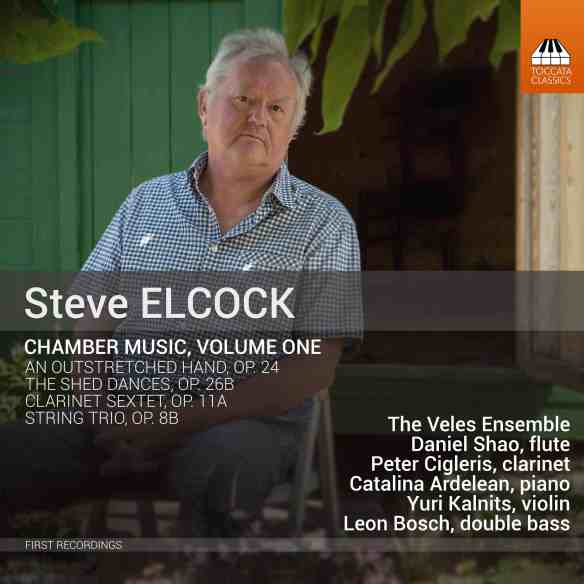
The Veles Ensemble (Hartmut Richter (violin), Ralitsa Naydenova (viola), Evva Mizerska (cello), with Daniel Shao (flute), Peter Cigleris (clarinet), Yuri Kalnits (violin), Leon Bosch (double bass), Catalina Ardelean (piano)
Steve Elcock
Clarinet Sextet Op.11b (2001/14)
String Trio no.1 Op.8b (1998/2016)
The Shed Dances Op.26b (2016)
An Outstretched Hand Op.24 (2015)
Toccata Classics TOCC0506 [79’36”]
Producer & Engineer Michael Ponder
Recorded 21-22 May 2018, St Silas, Chalk Farm, London, 24 May 2018 (Sextet, Trio, The Shed Dances), Henry Wood Hall (An Outstretched Hand)
Written by Richard Whitehouse
What’s the story?
Following an impressive disc of his orchestral music (TOCC0400, reviewed on Arcana here), Steve Elcock (b1957) is given further coverage by Toccata Classics with this release of chamber music, reaffirming him as a force to be reckoned with among those symphonic composers from his generation.
What’s the music like?
Every bit as engrossing as the works on that earlier release – that is, uncompromising without being unyielding and serious without being (unduly) earnest. This is evident from the earliest piece here, Elcock’s First String Trio having been conceived for two violins and viola before reaching its present guise. A tensile single movement pivots constantly between the fractious and consoling, at times encroaching upon a more equable expression that nevertheless fails to sustain itself, and with a conclusion where even the most tenuous poise is summarily denied.
Starting out as a Concertino for clarinet and string orchestra, the Clarinet Sextet is on a larger scale – opening with an Allegro whose clear-cut sonata design opens-out intriguingly with a cadenza-like passage just before the reprise. Similarly, the Romanza is thrown off-balance by a faster central section which duly intensifies the climactic stages, and if the progress of the final Variations and Theme seems more arresting as regards form rather than content, the gentle evanescence after the theme has been elaborated feels as subtle as it is intriguing.
More immediately approachable, The Shed Dances began life as a sequence for violin and piano before being recast for clarinet and string trio. Written at the suggestion of a sufferer from the neurological condition known as ataxia, all six dances are thwarted or undermined by rhythmic imbalances that are only effortfully overcome – the most memorable being the inhibited gait of Petrified minuet, edgy impulsiveness of Boneyard antics and winsome swaying of Marion’s pavane which confirms Elcock as possessing no mean melodic gift.
Finally, to An Outstretched Hand whose inspiration in the stark contrasts of composing as an act of friendship across the centuries and the burgeoning refugee crisis across Europe became fused into this powerfully sustained single movement for flute, clarinet and piano quartet. Its sombre initial Largo is followed by two Allegros (themselves separated by a stark interlude) whose increasingly confrontational manner carries over to a final Largo which recalls earlier material in a mood that, fatalistic rather than merely defeatist, exudes the keenest poignancy.
Does it all work?
Yes, in almost all respects. It helps when these performances are so evidently attuned to this idiom, teasing subtleties out of the charged formal processes and grating expressive contrasts that are recognizable Elcock traits. The overall programme is carried by the Veles Ensemble, whose tonal finesse and tangible commitment to this music is evident throughout – which is hardly to decry the contributions of those other musicians featured here. Hopefully it should prove possible for these pieces to be heard in public performance on some future occasion.
Is it recommended?
Certainly – not least when the sound is unexceptionally fine, and the composer’s annotations are unfailingly to the point. Elcock’s growing admirers will be pleased to hear that a further disc of orchestral music (including the Fifth Symphony) is scheduled for imminent release.
Taryn Fiebig (soprano), Darryl Poulsen (horn), James Cuddeford (violin), Daniel Herscovitch (piano), Scott Davie (piano), Roger Smalley (tam-tams)
Roger Smalley
Albumblatt (1990) Nine Lives (2008)
Capriccio no.1 (1966)
Barcarolle (1986)
Morceau de Concours (2008)
Piano Pieces I-V (1962-5)
Three Studies in Black and White (2002-4)
Lament for the Victims of Natural Disasters (2005)
Toccata Classics TOCC0501 [72’21”]
Producer & Engineer David Kim-Boyle
Recorded 2005, University of Western Australia, Perth (Three Studies in Black and White), 13 February, 28-29 March 2019, University of Sydney Conservatorium of Music
Written by Richard Whitehouse
What’s the story?
Toccata Classics releases this welcome overview of music by Roger Smalley (1943-2015), whose extensive output followed an eventful and unpredictable trajectory from unabashed modernism to post-classicism demonstrably informed and enhanced by a performer’s insight.
What’s the music like?
As varied as this selection might suggest. Earliest here is Piano Pieces I-V, tersely distinctive miniatures whose conspectus of radical tendencies from Schoenberg to Stockhausen is allied to a pianism at once resourceful and pragmatic. An aesthetic heightened in Capriccio no.1, whose often confrontational interplay between violin and piano owes much to Schoenberg’s late Phantasy while not precluding a more personal approach such as Smalley’s subsequent involvement with Stockhausen transmuted into a more progressive but less emotive manner.
By the time of Barcarolle, Smalley had moved away from modernist traits towards an idiom permeated by while never beholden to the Romantic era. Chopin’s famous example may not be evident here, but the ominous undulation of Fauré’s earlier such pieces is unmistakable; as is Liszt in the scintillating dexterity of Morceau de Concours, a test-piece to reckon with not just in terms of its technique. Most impressive, however, is Three Studies in Black and White, a trilogy likely inspired by Alkan’s Op. 76 Études – with the opening Gamelan a visceral yet ultimately eloquent exploration for left hand; by contrast, Moto perpetuo is an edgy and often volatile workout for right hand, then Dialogue reunites both hands in music at once resolute and consoling. Few, if any, piano pieces of such substance have been composed this century.
Which is not to underestimate the effectiveness of Nine Lives. Subtitled A Song-Cycle about Cats, these settings of feline evocation range as widely as that of the authors featured. Of the three extended items – that by Oscar Wilde is stealthy and secretive, that by Christina Rosetti a memorial of deadpan insouciance, while that by Oliver Herford is a luminous and affecting envoi. Framing the programme are a brief Albumblatt later subsumed into the Piano Trio, and Lament for the Victims of Natural Disasters where horn eulogizes against resonant tam-tams.
Does it all work?
Yes. Smalley’s academic career at University of Western Australia at Perth connected him to many significant musicians, several of whom are present here. Taryn Fiebig brings a wealth of nuance to the songs and is ably accompanied by Scott Davis, while James Cuddeford and Darryl Poulsen make salient contributions. Greatest credit, though, to Daniel Herscovitch for piano playing as not only makes light of the considerable technical demands but conveys the unity within diversity of Smalley’s musical language throughout four decades of evolution.
Is it recommended?
Indeed. The Smalley discography is not inconsiderable, and readers should investigate such major works as Accord (Continuum) or Pulses (NMC); while Poles Apart (NMC) focusses on more recent pieces.
A plea, too, for the reissue of the Symphony and First Piano Concerto (Vox Australis), two of his defining works. That said, this latest release makes as inclusive an overview as has been issued. The sound is unexceptionally fine, and booklet notes unfailingly insightful, but for the track-listing the Barcarolle and Morceau have added 10 minutes each.
William Wordsworth
Symphony no.4 in E flat major Op.54 (1953)
Symphony no.8 Op.117 ‘Pax Hominibus’ (1986)
Divertimento in D major Op.58 (1954)
Variations on a Scottish Theme Op.72 (1962)
Toccata Classics TOCC0480 [80’38”]
Producer Normunds Slāva
Engineer Jánis Straume
Recorded 8-12 January 2018 at Great Amber Concert Hall, Liepāja, Latvia
What’s the story?
Toccata Classics embarks on a series devoted to the orchestral output of William Wordsworth (1908-88), his reputation doubtless affected by his music satisfying neither the criteria of post -war modernism nor that easy accommodation with earlier eras as favoured by traditionalists.
What’s the music like?
While he found a measure of success in the decade after the Second World War, Wordsworth had few performances in his later years with only a handful of works recorded. That began to change when Lyrita issued studio accounts of the Second and Third Symphonies (SRCD.207) in 1990, followed by broadcast performances of the First and Fifth in 2016 (REAM.121). The present disc thus fills several more gaps in his discography, not least two further symphonies in what must be hoped will eventually see the complete cycle being commercially available.
Dedicated to Sir John Barbirolli, who had assiduously championed its predecessor, the Fourth Symphony is a tautly conceived single movement – its slow introduction providing the salient material for the sonata design which follows. Although themes are relatively clearly defined, the evolutionary process blurs expected formal divisions so that the piece unfolds seamlessly for all its disjunct contrasts. The developmental episode is made more disquieting through its underlying march-rhythm, then the reprise transforms what had gone before by expressively heightening these themes on the way to a culmination whose decisiveness is permeated with that fatalism which informed so much of this composer’s music. Praised by Neville Cardus among others, it stands as an ideal entry-point into Wordsworth’s symphonic writing overall.
Also featured here are two slighter but not insubstantial pieces. Indeed, the Divertimento has distinct symphonic connotations – witness the purposeful unfolding of its Overture towards a heightened recall of its initial gesture, the wistful Air with its plaintive woodwind writing and crepuscular harmonies, then the lively Gigue whose ideas are kept in perpetual motion up to a rumbustious close. Lighter in tone, Variations on a Scottish Theme finds Wordsworth at his most approachable; the mid-nineteenth century tune The Hundred Pipers (attributed to Carolina Oliphant) made the subject of nine variations whose brevity (only the fifth lasts near two minutes) is complemented by its deftness and charm. Conceived with ‘school’ musicians in mind, this is a piece such as ought to find favour with young and amateur musicians today.
The Eighth Symphony is another matter entirely. Wordsworth’s final work, its subtitle ‘Pax Hominibus’ indicates his lifelong pacifist convictions though any relation to musical content is oblique at best. The first of its two movements proceeds ruminatively, with much recourse to solo lines and spare textures, creating formal and expressive expectations that its successor feels intent on denying. This opens with a strangely dislocated crescendo and continues with an elegiac passage, diaphanously scored, before a literal reprise of what has been heard before then a recall of the first movement’s main theme, prior to a calmly eloquent conclusion. The composer left an alternative ending – rightly included here as a repeat of the movement, for all that its insistence on jarring defiance feels at odds with the mood of this work as a whole.
Does it all work?
Yes. Wordsworth may not be a difficult composer to assimilate, though his music does not reveal its essence easily or without some effort. That said, there is an underlying logic and cohesion to his formal processes which is as tangible as it is satisfying, with the emotional depth that emerges is similarly undeniable. It helps when the playing of the Latvian-based Liepāja Symphony Orchestra sounds so attuned to its reticent idiom, with John Gibbons clearly having thought about this music so that its measure might more fully be conveyed.
Is it recommended?
Indeed. The sound has clarity and focus, while Paul Conway’s annotations are detailed and probing. Hopefully the Sixth and Seventh Symphonies will follow, with major works such as the wartime oratorio Dies Domini – praised by Vaughan Williams and still unperformed.
Peter Sheppard Skaerved (violin), Roderick Chadwick (piano) Kreutzer Quartet (Peter Sheppard Skaerved & Mihailo Trandafilovski (violins), Morgan Goff (viola), Neil Heyde (cello) with Bridget MacRae (cello)
Jeremy Dale Roberts
Capriccio for violin and piano (1965)
Tombeau for piano (1966-69)
String Quintet (2012/14)
Toccata Classics TOCC0487 [78’24’’]
Producer Peter Sheppard Skaerved
Engineer Jonathan Haskell
Recorded 17-18 December 2014 at St Jude-on-the-Hill, Hampstead (String Quintet), 3 July 2014 (Capriccio) and 22 February 2017 (Tombeau) at St Michael’s, Highgate, London
What’s the story?
Toccata Classics further sets the pace by releasing this disc of music by Jeremy Dale Roberts (1934-2017), whose distinguished academic career (for over three decades at Royal College of Music, latterly as Head of Composition) likely obscured his achievements as a composer.
What’s the music like?
Over more than half a century, Dale Roberts created a catalogue whose diversity is out of all proportion to its modesty (some 40 works). The present disc is the third devoted to his music, following releases on the NMC and Lorelt labels; the latter also featuring Capriccio for violin and piano. This 12-minute piece is dedicated to Howard Ferguson, whose technical finesse it emulates for all that its stylistic profile is appreciably wider – evoking Stravinsky and Bartók as it builds to an assaultive climax before subsiding into the subdued while sombre postlude.
As Roderick Chadwick infers in his booklet note, Tombeau was for Dale Roberts his defining work in terms both of encapsulating where his music had reached at that point and in making possible what came after. Unfolding continuously over 30 minutes, its central elegy is framed by a volatile sequence of studies and variations (Chadwick understandably eschews analysis, even if a diagrammatic outline would have helped in elucidating the intricate overall design). Stylistically, too, the piece ranges widely across the pianistic spectrum from Schumann, via Szymanowski, to Messiaen – with the eventual outcome as personal as it is hard-won. A pity dedicatee Stephen Kovacevich never recorded a piece undoubtedly at the forefront of post-war piano music (British or otherwise), but Chadwick’s identification with the score is total.
The largest work here was also its composer’s swansong. Despite its seemingly abstract title, the String Quintet embodies a densely allusive and multi-layered narrative inspired by Marina Tsvetaeva and Edvard Munch while being given focus by Virginia Woolf, though this is not to suggest the piece is other than an intrinsically musical statement. The viola often assumes an almost concertante role during those three movements which make up the first part, then is largely absent from its successor – a lengthy meditation for violins and cellos whose recall of earlier ideas is riven by silence prior to a culmination capped by the viola’s ghostly offstage re-emergence. A singular experience, then, and a singular work which repays intensive study – from a composer who’s not taking the easy path was never vindicated more fully than here.
Does it all work?
Indeed. To say that Dale Roberts is a connoisseur’s composer should not imply his music is hermetic or obscure; rather it assumes the listener’s commitment and goodwill in the process of assessing the piece at hand. Each of these recordings benefited from the composer’s active participation during the recording sessions. Peter Sheppard Skaerved is at his imperious best, whether in partnership with Chadwick or as part of an augmented Kreutzer Quartet; while his and Chadwick’s booklet notes deftly combine musical discussion with personal recollection.
Is it recommended?
Absolutely. This is now the best point of entry into Dale Roberts’s output, and one hopes for more issues from Toccata. In particular, the Cello Concerto Deathwatch (perhaps coupled with the still-unperformed orchestral cycle Arbor Vitae) cries out for commercial release.
Further listening
You can listen to this new release on Spotify:
Further reading
You can read more about this release on the Toccata Classics website, and about the composer Jeremy Dale Roberts at his website
Clare Hammond talks to Arcana about her upcoming world premiere performance in Cardiff’s Hoddinott Hall of Kenneth Hesketh’s new Piano Concerto, and new disc of music by Mysliveček.
Interviewed by Ben Hogwood
The premiere of a piano concerto remains a special event, even in a form that has been in existence for at least three hundred years. Pianist Clare Hammond currently has interest in both ends of that evolutionary spectrum, for in the first quarter of 2019 she gives the premiere of a brand new Piano Concerto, by Kenneth Hesketh – but also releases a new disc of little-known works for keyboard by 18th century Czech composer Josef Myslivecek, including two piano concertos.
Arcana took the opportunity to talk with Clare about these exciting developments, beginning with Kenneth Hesketh’s new work, due to premiere this Friday! His concerto has the intriguing title Uncoiling The River, which perhaps unwittingly is depicted in visual form by the river of paper required for the piece and posted on Twitter by Hammond recently:
Clare has no doubt on which way her latest encounter with Hesketh’s music is likely to head. “It’s going to be absolutely brilliant”, she enthuses. “It’s a mammoth piece from list of… Lots more to do than just play the notes on the piano. New influences, incredibly complex. Rich work on all fronts.” It is the latest in an extremely productive meeting of creative minds. “We met in 2010, and since then we have worked together a lot,” she explains. “Ken has talked about writing a concerto for some time, and pitched it to the BBC and the Royal Liverpool Philharmonic Orchestra. We managed to get things together, and he wrote it once we had the commission.”
It was not the first time Hesketh has written for Hammond, with a complete solo piano disc entitled horae (pro Clara) released on BIS last year. “The horae is a 40-minute solo piece written for me, and it uses extended techniques,” she explains. “Ken’s style of writing is often very complex and dense, and it has a lot of mechanical energy. I feel quite natural with it although it takes ages to learn the notes.”
How long did it take to learn the concerto? “To get up to speed, to the state of working with an orchestra, takes about three weeks”, she says. “I like to blitz things! I’m much quicker than I used to be, and I have methods. I have new ways of marking up scores, in my own different colours, I found it really helps and I have funny ways of managing music, with the page turning especially.”
Uncoiling The River, while dedicated to Clare, has a meaningful dedication to her second daughter, one-year old Emme. “It’s particularly personal as we’ve developed a close collaborative relationship. In the Piano Concerto we use a Kolam for Emme, which is a Hindu tradition passed on from mother to daughter. It is a geometric pattern made with coloured rice, and that is the point in the concerto where I use the bells – I have ten of them on a table next to me, and the Kolam dictates the way they are laid out. It’s a nice thing for Emme, and Ken’s also drawn a picture for her that she has in her room.”
Understandably Emme will not be at the premiere, which will take place in the BBC’s Hoddinott Hall at the Millennium Centre in Cardiff. It will form the centrepiece of a concert marking the hall’s tenth anniversary, and judging from the opening page will feature a sizeable orchestra. “They are quite large forces,” confirms Hammond, “but Ken uses every element in a very imaginative way. It’s a completely unified piece of writing. We don’t rehearse with the orchestra until two days before the concert, but I’ve heard a MIDI version in Sibelius that replicates the sonorities, which is really helpful.”
I ask Clare about the stylistic innovations she mentions in the piece. “It is a very tense and complex piece. I’m assured the orchestral parts aren’t too complicated but sometimes he has a very different sonority in mind. One of the main influences on his sound was the time he spent as a choirboy in Liverpool Cathedral, and how he heard the music from where he was singing. The sonorities he heard in the cathedral mean it wouldn’t necessarily be crystal clear, but he uses that to the advantage of the overall sound and it’s in force here. It has informed a lot of his work over the years, too, to play with the sound in an architectural sense.”
Hesketh is not the only composer with whom Hammond enjoys a strong creative bond. Her recent disc of piano works by Robert Saxton garnered critical acclaim (not least on Arcana). “That was a lovely disc to make, because he is another composer with whom I have a good relationship over a long period of time. Over half the disc is music written for me so it is a really personal piece of work. It finishes with a lullaby for Rose my older daughter. He ‘met’ her when she was 2 months old, and since it was released it’s got an enormous number of hits on Spotify thanks to being included in a number of playlists.”
She is keenly aware of the importance to combine working with living composers and playing much ‘older’ music, and highlights the mutual benefit of working this way. “For me it’s a really fulfilling way of doing things and exploring the repertoire. You’re continually pushing boundaries, both stylistically and personally. I think getting the composer’s feedback in real life is great too. Sometimes we deify the music that has lasted all this time from Mozart and Beethoven, say, and you have to touch it with kid gloves. The composers I’ve worked with are practical and pragmatic and know how to create the sounds that they want, and there’s not that stultifying approach at all.”
From Mozart’s time rather than Beethoven’s, Josef Mysliveček is a very intriguing figure to say the least. “He was friends with Mozart, and was the only composer that Mozart really respected”, says Hammond, “though sadly they became estranged because of his business with Mozart’s father Leopold”. It is tempting to thing Mysliveček would be considered for reappraisal because of his colourful past (he was known as Il Boemo (The Bohemian) but as Hammond explains it is his music that does the talking.
“Mysliveček’s music has a certain freshness and a vitality to it, and although now we are used to complex textures and outlandish harmonies, this was all very exciting in his time. It’s a new thing for me – and if he is completely new to you as a composer I would recommend you start off with his Wind Octets:”
For her new disc of Mysliveček Keyboard Concertos and solo works, due for release on BIS Records in March, Hammond worked with the Swedish Chamber Orchestra. It is another example of a rich and varied career of collaborations, typified by a recent audiovisual project Ghosts And Whispers. It is described on her website as ‘an unbroken sequence of fragments, last thoughts, elegies and absences by Schubert, Mozart, Wagner, Janáček, Stravinsky, Jacquet de la Guerre and Schumann, inter-leaved with movements from John Woolrich’s Pianobook.’
Her enthusiasm for the project matches that for her work Hesketh and Mysliveček. “I want to continue with it, as it’s been really interesting. Initially John Woolrich got in touch with the Quay Brothers, who are stop-motion animators, and had the idea for this project. I don’t have much experience in this area, and working with living artists is really interesting. I only actually saw myself in it recently, and it was the first time I’ve heard it and seen it for the first time. The synchronisation informs the narrative of the film and that’s really exciting.”
This is not the only time Hammond has appeared on film, for she has a piano-playing role as a younger Miss Shepherd in the big screen adaptation of Alan Bennett’s play The Lady in the Van. “If the opportunity comes up again I would do it for sure,” she says. “That film was particularly lovely, and not just because I was working with people who are brilliant at their job but because they are really nice people. It came out the blue, from a friend of the composer assisting George Fenton, who wrote the soundtrack. They needed a young pianist with blue eyes, and they thought of me!”
Clare Hammond and the BBC National Orchestra of Wales, conducted by Martyn Brabbins, will give the world premiere of Kenneth Hesketh’s Piano Concerto, Uncoiling the River, as part of a concert celebrating the 10th birthday of the Hoddinott Hall in Cardiff on Friday 25 January. The concert will be subsequently broadcast on BBC Radio 3.
Details of her new, forthcoming disc of Mysliveček – due for release on BIS in March – can be found on Hammond’s website.



 Arcana.fm