
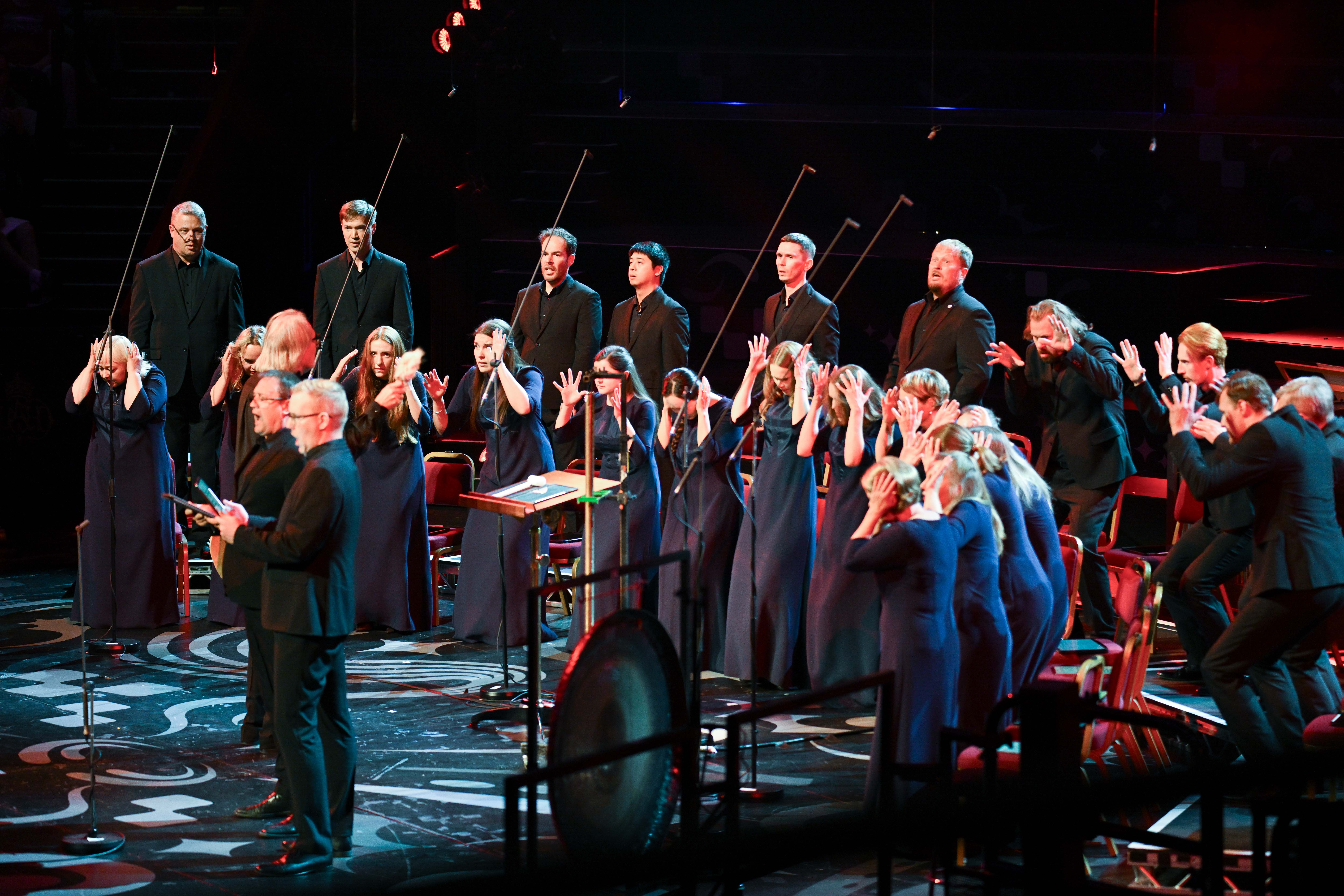
In concert – Estonian Philharmonic Chamber Choir / Tõnu Kaljuste @ BBC Proms: Arvo Pärt at 90

Annika Lõhmus, Yena Choi (sopranos), Toomas Tohert (tenor), Geir Luht (bass), Estonian Philharmonic Chamber Choir, Kadri Toomoja (organ) / Tõnu Kaljuste

Arvo Pärt Da pacem Domine (2004/6); Veni creator (2006); Magnificat (1989); The Deer’s Cry (2007); Für Jan van Eyck (2020) (UK premiere)
Galina Grigorjeva Svyatki – ‘Spring is Coming’ (2004)
Rachmaninov All Night Vigil (Vespers) Op.37 (1915): Slava v vyshnikh Bogu; Bogoroditse Devo
J.S. Bach Motet: Ich lasse dich nicht, BWV Anh.159 (1713)
Arvo Pärt Peace upon you, Jerusalem (2002); De profundis (1980)
Tormis Curse upon Iron (1972, rev. 1991)
Arvo Pärt Vater unser (2005/11); encore: Estonian Lullaby (2002)

Royal Albert Hall, London
Thursday 31 July 2025 (late night)

Reviewed by Ben Hogwood Photos (c) BBC / Chris Christodoulou

The music of Arvo Pärt is ideal for the special atmosphere of a late-night Prom. Yet this was no ordinary concert, being a celebration of the Estonian composer’s forthcoming 90th birthday in September, given by his close friend and collaborator Tõnu Kaljuste, conducting the Estonian Philharmonic Chamber Choir.

This combination of performers have been mainstays of the Pärt discography, forming a celebrated partnership with the ECM label that began with the landmark Tabula Rasa album of 1984, a cornerstone for Pärt’s critical and commercial success.

Pärt is often referred to as a ‘holy minimalist’, to which the response should be that his music is not ‘wholly minimal’. The substantial orchestral works attest to that, though here we heard much slighter but equally meaningful pieces for choir, most given unaccompanied by the 25-strong Estonian ensemble. The Proms audience were commendably quiet, leaning in to appreciate both the delicacy and crystal purity of the voices. The program was well-thought, realising the expressive potential of Pärt’s music alongside that of Bach, Rachmaninov and fellow Estonians, Veljo Tormis and Galina Grigorjeva.

The solemn Da pacem Domine and open-air Veni creator made an ideal opening couplet, the choir projecting with striking clarity rather than volume. For silence, too, plays a critical role in Pärt’s music, and Kaljuste ensured the spaces between the notes were every bit as expressive.

The Magnificat revealed its hidden power, while The Deer’s Cry was perfectly phrased, Pärt’s lilting cadences casting a spell. Für Jan Van Eyck, setting the text of the Agnus Dei, found the ideal balance between the reduced choir and Royal Albert Hall organ, where Kadri Toomoja had the ideal registration. Peace Upon You, Jerusalem, for female voices, contrasted silence with brightly voiced choral statements, while the solemn De profundis, for male voices, began from a small cell, maintaining rapt concentration while punctuated by organ and percussion.

Galina Grigorjeva’s Svyatki was a beautiful meditation, led by the heavenly voice of soprano Yena Choi, her voice with a remarkable bell-like clarity. Bach’s motet, previously attributed to his son Johann Christian, was impeccably voiced and phrased, but while the two excerpts from Rachmaninov’s All-Night Vigil were arguably less successful, they reflected a familiarity with listening to big choirs perform this music, rather than the subtleties of a chamber choir. Purity proved ample compensation for volume here.

This was emphatically not the case in Curse upon Iron, a remarkable setting from Veljo Tormis, of words from the Finnish national epic, the Kalevala, translated into Estonian. Describing the horrors of war, it sends a chill down the spine right from the primal call to arms of the shaman drum, struck by Kaljuste himself, then from the restrained urgency of the choir, like a coiled spring. While listening it was impossible not to think of the current plight of Ukraine and by extension in fear for the Baltic states, especially as Tormis’ writing was brought to a horrific climax. This was realised through the elemental power of tenor Toomas Tohert, bass Geir Luht and the choir, turning from side to side with watchful dread but then erupting in barely concealed anger. It was a remarkable performance, which will live long in the memory.

After this emotionally shattering encounter, the balm of Vater unser, Pärt’s German setting of The Lord’s Prayer for Pope Benedict, was just what was needed, its simplicity all the more affecting for what went before. As an encore, Kaljuste found just the right complement in the choir and piano version of Estonian Lullaby, its pauses near the end the musical equivalent of drooping eyelids. It was a most effective end to a special concert, Arvo Pärt’s musical essence distilled for a most appreciative audience.

You can listen back to this Prom concert on BBC Sounds until Sunday 12 October.

Click to read more about the BBC Proms

Published post no.2,608 – Sunday 27 July 2025

Oxford Lieder Festival – Kai Rüütel and Roger Vignoles: Tallinn to St Petersburg

Kai Rüütel (soprano, above), Roger Vignoles (piano, below)

Härma Ei saa mitte vaiki olla (I cannot stay silent)
Brahms Wie Melodien Op.105/1, Immer leiser wird mein Schlummer Op.105/2, Klage Op.105/3, Auf dem Kirchhofe Op.105/4
Rachmaninov O, dolgo budu ja, v molchan’i nochi tajnoj (In the silence of the secret night) Op.4/3, Poljubila ja (The Soldier’s Wife) Op.8/4, Zdes’ khorosho (How fair is the spot) Op.21/7
Mägi Kolm laulu Betti Alveri luulele (3 songs on poems by Betti Alver) [(Päike paistis, kaste hiilgas (The sun was shining, the dew gleamed), Kui kajab muusika (When music echoes), Uneaknale, uneaknale kevad koputas (On the window of sleep)]
Tormis Nukrad Viivud (Sorrowful Moments) [Kevadpäike, ära looju veel (Spring sun, do not set yet), Sügislaul (Autumn Song), Ei ole roose õitsenud minule (‘No roses have bloomed for me’), Armastus (‘Love’)
Rimsky-Korsakov Plenivshis rozoj, solovey (The Nightingale) Op.2/2, Na kholmakh Gruzii (On Georgia’s Hills) Op.3/4, Serenade Op.4/4, Drobitsya, i pleshchet, i brizzhet volna (The wave breaks) Op.46/1, Kogda volnuyetsya zhelteyushchaya niva (When the ripening wheat fields gently stir) Op.40/1
Mart Saar nnemuiste (In Days of Yore), Kõrs kahiseb (The Straw Murmurs), Kadunud ingel ‘Lost Angel’, Sügismõtted (Autumn Thoughts), Mis see oli? (What was It?), Üks ainus kord (Only Once More)

Holywell Music Room, Oxford
Wednesday 17 October 2018 (evening)

Written by Ben Hogwood

Continuing the Baltic theme of this Wednesday at the Oxford Lieder Festival, Estonian mezzo-soprano Kai Rüütel and pianist Roger Vignoles gave a fascinating concert introducing their audience to Estonian song from the 20th century, helpfully placed in the context of Romantic Russian and German song. Rüütel had very helpfully provided English translations of the Estonian songs, which was particularly useful for those Festival goers who had attended the earlier ‘Language Lab’ in the Ashmolean museum, where we had an introduction to the language from Kerli Liksor.

Rüütel set the tone with the unaccompanied Estonian folk song Ei saa mitte vaiki olla (I cannot stay silent), before four late Brahms songs showed off the rich tones of her mezzo-soprano. Yet there was a feeling these were merely a prelude to the meat of the concert, which really began with a wonderfully evocative account of the first of three Rachmaninov songs, In the silence of the secret night. The value of Vignoles’ scene setting was incalculable both here and in the Brahms, with some complex piano writing handled with apparent ease and an instinctive sense of melody and expression. Rüütel inhabited the character of The Soldier’s Wife with a powerful sorrow, contrasted with a dream-like finish to How Fair Is The Spot.

There followed 3 Songs on poems by Betti Alver from the 96-year old Estonian composer Ester Mägi. These had a very clear sense of location in their folk-inspired melodies, with distinctive inflections that Rüütel was ideally placed to exploit. These were mirrored in the piano part, which provided a particularly dramatic introduction for the second song, Where Music Echoes. The directness of the text was strangely refreshing and was reflected in the economy of the music, slightly redolent of Janáček in its economy but forging a very distinctive path.

The name of Veljo Tormis will be a more familiar name to students of Baltic music. Known primarily for his choral work, he is a fine song composer too – and the 1958 collection Sorrowful Moments left a lasting impression. Its central pair, Autumn Song and No Roses Have Bloomed For Me, were darkly toned, but the final Love offered much greater hope, Rüütel singing from the heart of ‘the stars that light the traveller’s way’.

Photo credit (c) Ben Ealovega

We returned to Russia for the beginning of the second half, with some rarely heard songs from Rimsky-Korsakov. Given the melodic prowess and dramatic scene setting on show in songs like On Georgia’s Hills and The Wave Breaks it remains a mystery that Rimsky’s songs are not heard more in the concert hall. Rüütel sang them with great fullness of tone but also enjoyed the more tender moments of Serenade and When The Ripening Wheat Fields Gently Stir. Vignoles’ tumultuous evocation of The Wave Breaks was a highlight; so too the pair’s account of The Nightingale.

Finally we heard the music of Mart Saar, an Estonian composer from the first half of the 20th century who studied with Rimsky-Korsakov. In one of several helpful introductions Rüütel told of how Saar followed Rimsky’s advice to ‘be himself’ but also to take risks – and those qualities were evident in these deceptive songs. They were deceptive because some of the twists and turns had an individual quirk, Romantic in profile but alighting on unexpected harmonies or melodies. To Rüütel these were second nature, and in Autumn thoughts especially she found a deep, soulful mood. The first song, In days of yore, had more obvious folk music inflections, but perhaps the most dramatic song of all was Lost Angel, where Vignoles’ mastery of the challenging piano part set the way clear for Rüütel’s direct, emotive response.

As an encore Rüütel and Vignoles gave us a timeless account of Richard Strauss’s Morgen which, while brilliantly performed it did not distract from the impact of the Estonian and Russian music we had just heard. Clearly there are many riches to be discovered from the Baltics, and it is to be hoped Rüütel and Vignoles might set these down permanently for a record company such as Hyperion.

This was a memorable concert, and will be broadcast soon on BBC Radio 3. It comes with the strongest possible recommendation!

Further listening

There is relatively little material on streaming services with which to discover Estonian songs – but there is a new series devoted to the songs of Mart Saar that has just begun:

Meanwhile most of the music from the concert can be heard on the below Spotify playlist: