In concert – Quatuor Danel: Shostakovich & Weinberg #8 @ Wigmore Hall

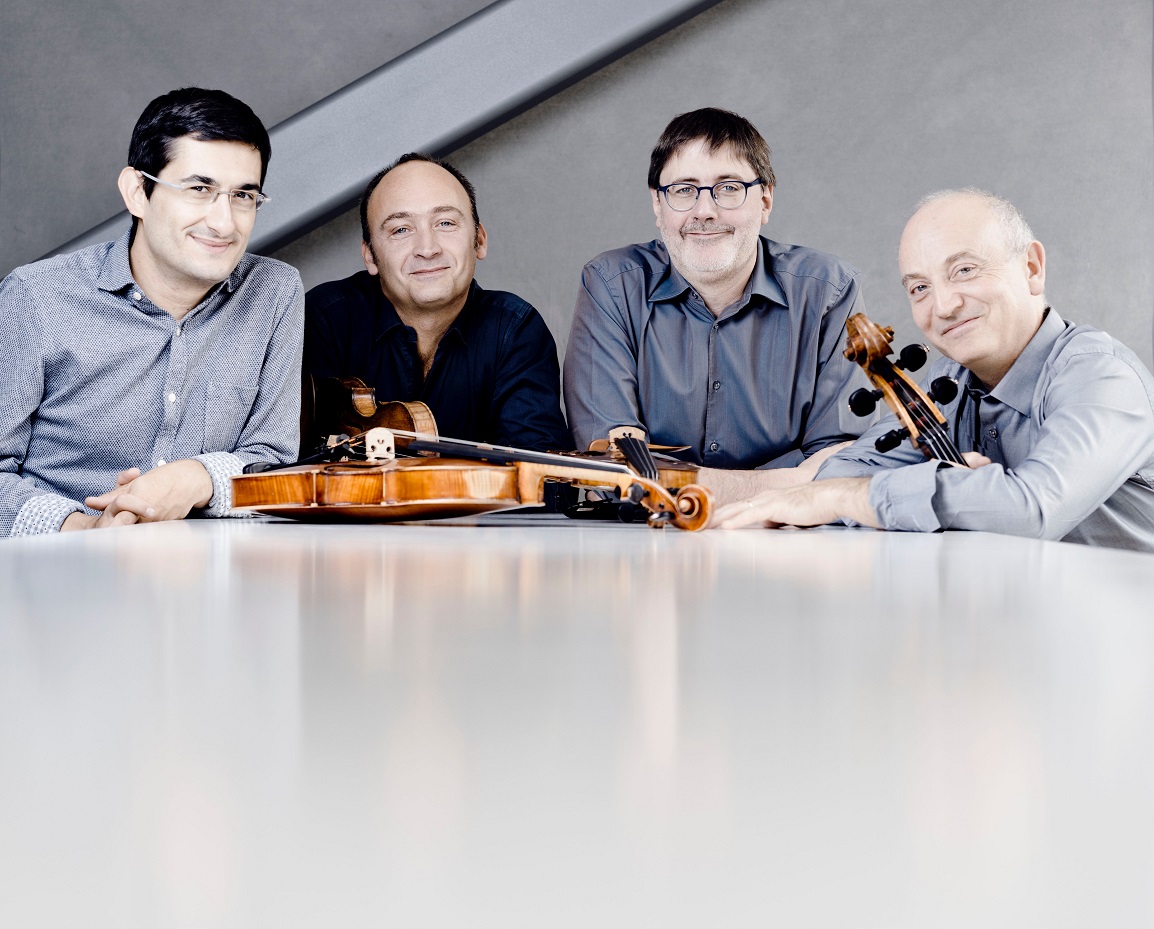
Quatuor Danel [Marc Danel & Gilles Millet (violins), Vlad Bogdanas (viola), Yovan Markovitch (cello)]

Shostakovich String Quartet no.11 in F minor Op.122 (1966)
Shostakovich String Quartet no.12 in D flat major Op.133 (1968)
Weinberg String Quartet No. 12 Op.103 (1969-70)

Wigmore Hall, London
Wednesday 15 January 2025

by Richard Whitehouse Photo (c) Marco Borggreve

This latest instalment in Quatuor Danel’s traversal of the string quartets by Shostakovich and Weinberg comprised the Twelfth Quartets from both composers – masterpieces both, and was prefaced by the teasing brevity and obliqueness of the former’s preceding such composition.

His 60th year marked the onset of Shostakovich’s ‘late period’ – its overt introspection being appropriate for a piece dedicated to the memory of Vasily Shirinsky, former second violinist of the Beethoven Quartet who premiered all but the first and last of the composer’s cycle. In fact, the Eleventh Quartet is appreciably more varied than this memorial aspect may suggest – the Introduction initiating a subdued discourse given an ironic twist in the Scherzo then erupting combatively in the Recitative, prior to the anxiety of the Etude and ruthlessness of the Humoresque. This performance came into its own with the Elegy, a remembrance of enfolding pathos – after which, the Finale assumed that retrospective function found in many of Shostakovich’s later works with due emphasis on its stealthy and quixotic humour.

Just two years on brought Shostakovich’s Twelfth Quartet – if not his greatest then surely in the top two, while arguably uncharacteristic in its self-conscious yet masterly formal design. Although not introductory as such, the Danel was mindful to keep its opening movement on a tight rein such that its interplay of mood and tempo inferred without defining those seismic confrontations to come. This longest and most diverse of its composer’s quartet movements did not disappoint – the Danel having fullest measure of an 18-minute span whose eventual subsiding presages a pizzicato-driven assault the more visceral for being so methodical in its unfolding. Nor was the allusion to initial material at all misconstrued as this work enters its climactic phase, a transformation whose unbridled affirmation was powerfully in evidence.

It might have emerged barely 18 months on, but Weinberg’s Twelfth Quartet feels comparable only in its scope and ambition. A likely response to the creative radicalism this composer had encountered on returning to his native Poland after over a quarter-century, its four movements essentially reinvent the Classical archetype so that the opening Largo outlines a succession of amorphous or disruptive elements with little audible regard for just how they might interact – something that will only come into focus as the work unfolds while opening-out expressively.

This evolution takes in a stealthy if always speculative Allegretto, and a Presto whose violence has become assaultive by its close. It remains for the final Moderato to effect closure through a synthesis almost improvisatory for all its formal rigour. Allied to this comes a dominance of playing techniques that does not intensify the music as drain it of all emotion and so reduce it to merest gestures by the end. A remarkable piece, even so, and a testament to its composer’s tenacity in the face of an unsympathetic, often antagonistic cultural climate at home or abroad.

Tonight’s impressive reading almost had to be abandoned as Gilles Millet’s bridge collapsed just before the end of the third movement, but his last-minute location of a replacement saw it resume to the close – an unexpected hiatus seemingly in accord with this extraordinary work.

You can hear the music from the concert below, in recordings made by Quatuor Danel -including their most recent cycle of the Shostakovich quartets on Accentus:

For more information on the next concert in the series, visit the Wigmore Hall website. You can click on the names for more on composer Mieczysław Weinberg and Quatuor Danel themselves.

Published post no.2,414 – Friday 17 January 2025

In concert – Quatuor Danel: Shostakovich & Weinberg #7 with François-Frédéric Guy @ Wigmore Hall

François-Frédéric Guy (piano), Quatuor Danel [Marc Danel & Gilles Millet (violins), Vlad Bogdanas (viola), Yovan Markovitch (cello)]

Shostakovich String Quartet no.10 in A flat major Op.118 (1964)
Weinberg String Quartet no.11 in F major Op.89 (1965-6)
Weinberg Piano Quintet in F minor Op.18 (1944)

Wigmore Hall, London
Monday 25 November 2024

by Richard Whitehouse Photo (c) Marco Borggreve

This latest instalment in Quatuor Danel’s parallel cycle of string quartets by Shostakovich and Weinberg comprised one of the former composer’s most understated pieces followed with two of the latter’s most characteristic yet, at least in terms of expression, utterly contrasted works.

Written during just 11 days, the Tenth Quartet is something of a standalone in Shostakovich’s cycle – coming as it does between the four innately personal quartets that preceded it and the four related to members of the Beethoven Quartet (who premiered all except the first and last of this cycle) that followed. Yet, as its dedication to Mieczysław Weinberg suggests, this is no less specific in intent – hence the musing ambivalence of its initial Andante and visceral force of its scherzo. The Danel savoured their respective essence, cellist Yovan Markovich coming into his own in the ensuing Adagio with its emotionally restrained variations. The link to the finale was seamlessly effected, then the movement built methodically towards a heightened restatement of the passacaglia theme before tentatively retracing its steps to a wistful close.

Written months later, Weinberg’s Eleventh Quartet is by no means lesser by design or intent. Its fugitive opening Allegro exudes a scurrying motion such as resurfaces at key moments in the overall design, akin to that of the Shostakovich in equivocation, and if the scherzo could hardly be more different in its fleeting delicacy (the original such movement it replaced was likely much more demonstrative), the solemn alternation of ensemble and solo writing in its Adagio conjures up a similarly processional aura. Contrast is again pronounced in the finale where, instead of channelling the musical loose-ends towards a formal and expressive unity, Weinberg leaves matters in abeyance; despite (or because of) the most tentative recollection of that scurrying motion which flits across the already fragmented texture at the very close.

If the Danel had long mastered Weinberg at his most refractory, it proved equally adept with the communicative power of his Piano Quintet. At almost 45 minutes this is also his largest chamber work, its five movements unfolding as a discursive if never random sequence such that the furtive questioning of its opening Moderato finds accord with the unsettled humour of its ensuing Allegretto – an intermezzo next to the scherzo-like energy of its central Presto, in which the interplay between François-Frédéric Guy and the Danel was at its most incisive.

Much the longest movement, the Largo accumulates intensity through juxtaposing passages in rhythmic unison with those during which piano and strings predominate. Its impassioned culmination is exceeded by that of a final Allegro whose impetuous main ideas bring about    a climactic return to the work’s opening theme. Even more remarkable is what follows: the intensity soon subsiding prior to this movement’s initial idea returning, quietly transformed, as though to suggest its composer having been reborn as a sentient being and creative artist.

Hearing this work, performances of which have fortunately become more frequent these past two decades, is an experience like few others in the chamber domain; suffice to add that Guy and the Danel were as one in their realizing the scale and impact of this modern masterpiece.

You can hear the music from the concert below, in recordings made by Quatuor Danel -including their most recent cycle of the Shostakovich quartets on Accentus:

For more information on the next concert in the series, visit the Wigmore Hall website. You can click on the names for more on composer Mieczysław Weinberg, Quatuor Danel and pianist François-Frédéric Guy

Published post no.2,378 – Saturday 30 November 2024

In concert – Steven Isserlis and Friends – Fauré at the Wigmore Hall (5)

Steven Isserlis (cello) – with Joshua Bell, Irène Duval (violins), Blythe Teh Engstroem (viola), Connie Shih, Jeremy Denk (pianos)

Fauré Dolly Suite Op.56 (1894-6)
Enescu Pièce sur le nom de Fauré (1922)
Ravel arr. Garban Berceuse sur le nom de Garbriel Fauré M74 (1922)
Koechlin Hommage à Gabriel Fauré Op.73bis (1922)
Fauré Cello Sonata no.2 in G minor Op.117 (1921)
Fauré String Quartet in E minor Op.121 (1923-4)

Wigmore Hall, London
Tuesday 5 November 2024

Reviewed by Richard Whitehouse Picture (c) Wigmore Hall Trust

So to the final concert of this series, curated by cellist Steven Isserlis and centred on Fauré’s larger chamber works in the centenary of his death. The last of five concerts was rounded out in its coverage by including his most popular work for piano duet, along with miniatures from several pupils of one who was held in equal esteem as a teacher.

It is doubtless as easy to describe the Dolly Suite with patronizing charm as it is to play it so but, with Jeremy Denk and Connie Shih an alert if always sensitive partnership, there was no likelihood of this latter. A limpid take on the evergreen Berceuse was followed by no less a deft rendition of Mi-a-ou; the ineffable charm of Le jardin de Dolly made a telling foil to the skittish evocation (of a dog) that is Kitty-valse, then the searching poise of Tendresse created a delightful contrast with that affectionate send-up of Chabrier in Le pas espagnol.

Quite why the journal Le Revue chose Fauré’s 77th year to publish an edition devoted to his music is unclear, but it did enable seven former students to express their admiration through miniatures that encapsulate his own idiom as surely as theirs. Hence the intricate texture and enfolding harmony of Enescu’s Pièce, the pert elegance of Ravel’s Berceuse arranged (from its violin-and-piano original by Lucien Garbon), then the gently inflected wit of Koechlin’s Hommage to remind one of the latter composer’s service to Fauré as sometime orchestrator.

These three items were engagingly played (and introduced) by Denk, and it seemed a pity the other four (by Aubert, Ladmirault, Roger-Ducasse and Schmitt) could not have been included – perhaps at the start of the second half – given the appositeness of the programme. This first half ended with the Second Cello Sonata which, while it resembles its predecessor in form, is appreciably more forthcoming as to expression. It is evidently a work that Steven Isserlis first played as a teenager, and there could be no mistaking his identity with the close-knit dialogue of its opening Allegro, pathos bordering on the elegiac of its central Andante that started out as music commemorating the centenary of Napoleon’s death, and effervescence of a finale as endows what is otherwise typical late Fauré with a genial humour never less than captivating.

After the interval, this series ended in the only way possible with the String Quartet that was Fauré’s last work. In his initial remarks, Isserlis mentioned how long it had taken for him to ‘get’ this piece and, indeed, its three movements each unfolds in a seamless polyphonic flow which can feel disconcerting even in the context of the composer’s other late chamber works. Whether or not they play it frequently, Joshua Bell, Irène Duval, Blythe Teh Engstroem and Isserlis audibly had its measure – their steady though always flowing tempo for its Allegro moderato ideally complemented by the luminous radiance of its Andante; before its Allegro elides elements of scherzo and finale in music whose dextrous pizzicato writing and gently cumulative intensity conveys an affirmation that speaks of a challenge, and a life, fulfilled.

As a work and as a performance, it set the seal in the only way possible on a series of concerts through which the quality and substance of Fauré’s chamber music could not have been more eloquently confirmed, which is just as should be expected from a retrospective of this nature.

You can watch the concert below, thanks to the Wigmore Hall YouTube channel:

For more information on the Fauré series, visit the Wigmore Hall website – while you can also read Arcana’s interview with Steven Isserlis about the French composer

Published post no.2,355 – Thursday 5 November 2024

In concert – Steven Isserlis and Friends – Fauré at the Wigmore Hall (4)

Steven Isserlis (cello) – with Joshua Bell, Irène Duval (violins), Connie Shih, Jeremy Denk (pianos), Quatuor Agate [Adrien Jurkovic, Thomas Descamps (violins), Raphaël Pagnon (viola), Simon Iachemet (cello)]

Fauré Cello Sonata no.1 in D minor Op.109 (1917)
Enescu Violin Sonata no.2 in F minor Op.6 (1899)
Fauré Piano Trio in D minor Op.120 (1922-3)
Ravel String Quartet in F M35 (1902-03)

Wigmore Hall, London
Monday 4 November 2024

Reviewed by Richard Whitehouse Picture (c) Wigmore Hall Trust

Tonight’s instalment of the Wigmore Hall series focussing on Fauré’s larger chamber works was also the most cohesive in its alternating two of the composer’s late pieces with formative ones by Enescu and Ravel for what was a fascinating programme of echoes and anticipations.

While not necessarily the weakest of those works played in this series, Fauré’s First Cello Sonata is the least remarkable – the melodic content reduced to barest essentials such that its main motifs can verge on the anonymous. That said, its opening Allegro is a model of formal economy and expressive restraint, Steven Isserlis and Connie Shih being no less perceptive in the pensive musing of its central Andante or the urbanity of a final Allegro whose ‘commodo’ aspect was always evident. Less may not always be more, but it is rarely less than appealing.

Less often heard than its successor, Enescu’s Second Violin Sonata is no less significant. Its composer’s first masterpiece, much of the fascination lies in the degree to which its melodic ideas evolve across and between each of the three movements for a potent demonstration of motivic unity. This was something Irène Duval conveyed in ample measure, yet without ever neglecting that reticent or sometimes ominous quality characterizing much of its content – at least until the quixotic finale channels these diverse elements towards a resolution achieved almost despite itself. Throughout, Jeremy Denk’s pianism was a model of lucidity and poise in a performance which went all the way in confirming this work as one of the three greatest masterpieces by a teenager – the other two being written 74 years earlier, then 72 years later. (presumably Mendelssohn’s Octet and a piece to be confirmed! – ed)

Fascinating how much Enescu’s precocity resembles Fauré’s maturity in what was the latter composer’s penultimate work. Compact almost to a fault, the Piano Trio is dominated in all respects by a central Andantino whose melodic eloquence has intensified almost to the point of ecstasy by its close, not least as rendered by Joshua Bell, Isserlis and Denk in what was a near-ideal performance. Succinctness almost gets the better of the outer movements, though it would be churlish not to acknowledge the tensile energy of its opening movement and the exhilaration of a finale whose element of syncopation marks Fauré’s nearest approach to the jazz idiom. Interesting as it is to hear this piece with clarinet as was originally intended, its interplay of violin, cello and piano is no less inevitable than in the parallel work by Brahms.

The well-regarded Quatuor Agate duly took the stage for Ravel’s String Quartet, evidently a work for which Fauré expressed only muted enthusiasm. Superbly played though a little self-regarding interpretively, this account was at its best in its latter stages – the inward rapture of its slow movement in pointed contrast to the volatility and ultimate decisiveness of its finale. The opening movement at times verged on expressive inertia and the scherzo’s deft humour was rather self-conscious, but the overall conviction of this performance still came through. Seemingly the Agate will not be playing Fauré’s String Quartet which forms the culmination of tomorrow’s concert and of this series; one that also includes the Second Cello Sonata and music written in tribute to a composer whose greatness could hardly be doubted now as then.

You can watch the concert below, thanks to the Wigmore Hall YouTube channel:

For more information on the Fauré series, visit the Wigmore Hall website – while you can also read Arcana’s interview with Steven Isserlis about the French composer

Published post no.2,354 – Wednesday 5 November 2024

In concert – Steven Isserlis and Friends – Fauré at the Wigmore Hall (3)

Steven Isserlis (cello) – with Joshua Bell, Irène Duval (violins), Blythe Teh Engstroem (viola), Jeremy Denk, Connie Shih (pianos)

Fauré Violin Sonata no.1 in A major Op.13 (1875-6)
Saint-Saëns Piano Trio no.2 in E minor Op.92 (1892)
Ysaÿe Solo Violin Sonata in D minor Op.27/3 ‘Ballade’ (1923)
Fauré Piano Quintet no.2 in C minor Op.115 (1919-21)

Wigmore Hall, London
Sunday 3 November 2024

Reviewed by Richard Whitehouse Picture (c) Joanna Bergin

This third instalment of the Wigmore Hall’s journey through Fauré’s larger chamber works, as overseen in typically understated fashion by Steven Isserlis, took in works from (almost) either end of this composer’s output alongside pieces by two very different contemporaries.

It was Joshua Bell’s recovering illness that brought a switch in programme such that tonight began with the First Violin Sonata which established Fauré’s reputation and remains among his best-known works (also the only one of these pieces in a major key). The melodic verve of its initial Allegro responded well to Bell’s tonal warmth, despite marginal loss of focus as the development ran its cumulative course, then the Andante lacked little in lyrical intimacy nor the scherzo in nimble dexterity. That the final Allegro felt less than animated (not much evidence of ‘quasi presto’) was understandable in context and, even if it meant rounding off this performance with less than ideal decisiveness, there could be no doubting the sense of epiphany as its main theme returns transformed for an apotheosis of heightened eloquence.

At a time when Fauré was grappling with the implications of what became his Second Piano Quintet, Saint-Saëns was writing his no less substantial Second Piano Trio with relative ease. Its stylistic retrenchment is not hard to discern, witness the opening movement’s prolonged and ultimately doomed struggle to break free of a main theme riven with doubt and anxiety. Tensions relax appreciably in the sequence of middle movements – a lithe and ingratiating Allegretto, an Andante of ‘song without words’ lyricism, then a Grazioso with more than its touch of quixotic humour – during which, interplay between Bell, Isserlis and Jeremy Denk was at its most felicitous. Returning to weightier issues, the finale takes in some intensively contrapuntal passages prior to a conclusion whose headlong impetus came to the fore here.

After the interval came the third of Ysaÿe’s solo sonatas – the Ballade dedicated to Enescu but, as Bell pointed out, premiered by his teacher Josef Gingold who had been the last pupil of its composer; its ‘introduction and allegro’ format incisively delineated on this occasion.

Thence to Fauré for his Second Piano Quintet. Although written relatively quickly compared to its predecessor, it is no less fastidious in content or elusive in character – witness the initial movement whose harmonic subtlety is accentuated by the flexibility of its rhythmic contours, which latter aspect comes to the fore in a scherzo whose angularity betrays more than a touch of malevolence. Is there a more consummate instance of this composer’s art than its Andante? Once characterized as a synthesis between Beethoven and Wagner, it exudes a transcendent calm entirely its own in which the eloquence of Irène Duval and Blythe Teh Engstroem added appreciably to the underlying affect. If the finale is less remarkable, it injects an impetus that propelled the work to a headily affirmative close which was conspicuous by its presence here. An impressive performance of a masterpiece that, while it will never achieve in popularity what it has in respect, could never seem other than communicative when realized with this empathy – something that should be no less evident in the remaining concerts of this series.

You can watch the concert below, thanks to the Wigmore Hall YouTube channel:

For more information on the Fauré series, visit the Wigmore Hall website – while you can also read Arcana’s interview with Steven Isserlis about the French composer

Published post no.2,353 – Tuesday 5 November 2024