Review – James Ehnes and Andrew Armstrong play Bartók at the Wigmore Hall

bela-bartok

Arcana begins its coverage of Béla Bartók (above) for 2016 with Richard Whitehouse reviewing a concert of the composer’s works for violin and piano, part of the Chamber Music series taking place at Wigmore Hall this year.

Wigmore Hall, Sunday 10 January 2016

Bartók: Rhapsody No.2 (1928); Solo Violin Sonata (1944), Sonatina (1925) (arr. Gertler); Violin Sonata No.1 (1921)
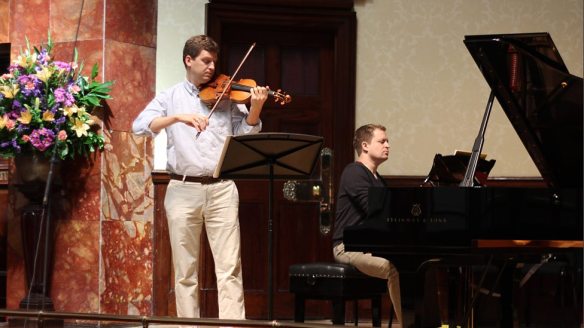
ehnes-armstrongJames Ehnes and Andrew Armstrong © BBC

Bartók’s chamber music with violin fits neatly into two recitals, James Ehnes returning to Wigmore Hall tonight for the second of these. He and pianist Andrew Armstrong began with the Second Rhapsody, in which they found persuasive accommodation between the music’s folk-derived essence; its combative alternation of mood and pacing, or its notably subtle thematic interplay: these aspects being governed by the player, Zoltán Székely, for which it was written and which here complemented each other perfectly in aim and intent.

While it has never been short of advocates since Yehudi Menuhin blazed a trail, the Sonata for Solo Violin is still undervalued in the context of Bartók’s later output. In part this is through its idiosyncratic handling of procedures deriving from the Baroque in general and Bach in particular. This can be observed in the first movement’s interweaving of chaconne and sonata elements, the second movement’s opening-out of its initial fugue to incorporate disparate processes, then the interplay of dynamism and reflection in the closing Presto. Such qualities were brought out in an interpretation audibly acknowledging this work as a harbinger of music to come, though the absence of quarter-tones in the finale underplayed the movement’s astringency.

The second half began with a transcription of the Sonatina by Endre Gertler, resulting in a brief yet perfectly poised piece whose three movements emerge with marginally greater presence than in the piano original, while not any the less characteristic of its composer.

The two violin sonatas (written for Jelly d’Arányi, though neither was in fact premiered by her) are significant in marking off decisive periods within their composer’s output. The First Sonata, its three movements cast on an imposing and even heroic scale, brings to a head those expressionist tendencies of the previous decade yet, for all its leanings towards atonality, is centred on chromatic and whole-tone harmonies. Ehnes had the measure of the fractured design of the opening Allegro appassionato, the stark thematic elements pulled apart rather than being brought together over its course, and found anxious introspection in the Adagio – not least the funereal overtones of its central section. The final Allegro tempered its headlong rush with lyrical asides, re-establishing a sense of tonal ‘destination’ prior to the brutally decisive coda. Armstrong tackled the cruelly exacting piano part with notable lack of inhibition and matched Ehnes’ headlong tempo for the finale through to those coruscating climactic bars.

A fine showing for a work which has only latterly come into its own in terms of performance. Ehnes and Armstrong returned for the Romanian Folk Dances (1926), Székely’s transcription of which stays relatively close to the piano original without sacrificing the slightest degree of virtuosity or panache. That would describe this evening overall, confirming Bartók as master of his craft and a reminder of his stature in the context of earlier twentieth century music: a stature that is happily being accorded its due at the Wigmore this season.

You can listen to the works in this concert on the Spotify playlist below, using versions by Yehudo Menuhin where possible:

Wigmore Mondays – Benjamin Appl & Graham Johnson

benjamin-appl-graham-johnson

Benjamin Appl (baritone) and Graham Johnson (piano) perform settings of the poetry of Joseph von Eichendorff

Wigmore Hall, London

Monday, 4 January 2016

Audio (open in a new window)

http://www.bbc.co.uk/programmes/b06tkp3w

Available until 3 February

What’s the music?

Schumann (1810-1856): Frühlingsfahrt Op.45/2 (1840); Der Einsiedler Op.83/3 (1850; Der frohe Wandersmann Op.77/1 (1840)

Mendelssohn (1809-1847): Pagenlied (1832); Nachtlied Op.71/6 (1847); Wanderlied Op.57/6 (1841)

Brahms (1833-1897): In der Fremde Op.3/5; Mondnacht; Parole Op.7/2; Anklänge Op.7/3 (all 1852-1853)

Pfitzner (1869-1949): In Danzig Op.22/1 (1907); Der Gärtner Op.9/1 (1888-9); Zum Abschied meiner Tochter Op.10/3 (1901)

Wolf (1860-1903): Nachruf (1880); Das Ständchen; Der Musikant; Der Scholar; Der Freund (all 1888)

Spotify

Benjamin Appl has not yet recorded any of this repertoire, but a reproduction of his program using available versions can be accessed below, for listeners who cannot hear the BBC broadcast. Where possible I have used recordings made by Appl’s mentor, Dietrich Fischer-Dieskau:

About the music

Joseph_Eichendorff

Joseph von Eichendorff (picture used courtesy of Wikipedia)

With around 5,000 song settings of Joseph von Eichendorff’s poetry from the 19th century alone – with thanks to BBC Radio 3 announcer Sara Mohr-Pietsch for the info! – Benjamin Appl and Graham Johnson had no trouble making up a concert of 18 ‘lieder’ for the first Wigmore Hall lunchtime concert of the year.

Their choice gives an intriguing insight into different approaches to the poet. Broadly speaking, Schumann ranges from love-laden to thoughtful and a little morose (though his selection comprises three prayers), Mendelssohn is either forthright or reflective in his three songs; the youthful Brahms is surprisingly relaxed, while Pfitzner emerges as an inventive painter. Perhaps the most striking examples here come from Hugo Wolf, who wanted to focus on the ‘comparatively unknown humourously and robustly sensual side’ of von Eichendorff’s poetry.

Performance verdict

A slightly downbeat return for the WIgmore Hall in 2016, but a concert that was beautifully performed. The pairing of an incredibly experienced pair of hands in Graham Johnson and a singer starting out on his artistic voyage in Benjamin Appl was a good match and yielded many rewards.

Several songs left lasting impressions from the program, among them two from Brahms, with Appl’s control throughout Mondnacht and the picture painting from Johnson in Parole especially notable.

It was good to hear some rarely-sung lieder of Hans Pfitzner, whose use of the piano’s lowest end brought a wholly new texture to In Danzig, while the Wolf selection reminded us how original he could be in his song settings, the piano cast in a prominent role of scene setting, one that Johnson relished and used to his great advantage.

What should I listen out for?

Schumann

2:06 – Frühlingsfahrt (A spring journey) – the initial optimism of this march is quite bracing, but it soon subsides as the poet thinks of old age.

5:31 – Der Einsiedler (The hermit) – quite a sad song, solemn and lost in thought. Again old age is a preoccupation, the piano supporting the vocal melody as a walking stick might support the physical frame.

9:02 – Der frohe Wandersmann (The happy wanderer) – a much more positive, open-air march that talks of streams ‘rushing down the mountains’ and larks that ‘soar heavenwards’. More spring than winter!

Mendelssohn

11:03 – Pagenlied (Page’s song) – a tentative detached figure in the piano part adds to the tension of this song, which is relatively subdued and distracted.

13:11 – Nachtlied (Night song) – there is a withdrawn feel to this song also, until the Nightingale is encouraged to sing out at 14:39.

16:12 – Wanderlied (Song of travel) – a typically busy piano part from Mendelssohn gives the impression of rapid movement, the traveller set on his way with the minimum of fuss – and happily so!

Brahms

20:49 – In der Fremde (In a foreign land) – a rather downcast setting in a minor key, the poet in reflective mood. The piano hints at a major key near the end but such thoughts are quickly forgotten.

22:12 – Mondnacht (Moonlight) – dappled piano lines suggest moonlight in the branches, and there is a more romantic mood, with yearning vocal lines.

25:03 – Parole (Password) – again Brahms thinks privately, using vivid picture painting from the piano that depicts the huntsman through distant calls but also the ‘one last shot’ (26:44), where Johnson adds extra emphasis.

28:02 – Anklänge (Echoes) – a short but evocative song of two halves, the first depicting a lonely house in a forest, the second greeting the maiden inside.

Pfitzner

30:07 – In Danzig – the mood changes dramatically in this darkly coloured song exploiting the lower range of both piano and singer. The mysterious and faintly menacing mood is aided by elusive harmonic movements.

34:38 – Der Gärtner (The Gardener)­ – this song is more conventional in its language, looking back to Schumann and Brahms. The mood is positive and quite dreamy, but reaches a very impressive climax at the end with the words ‘Viel schöne, hohe Fraue, Grüss ich dich tausendmal’ (‘I, lovely gracious lady, greet you a thousand times’)

38:08 – Zum Abschied meiner Tochter (Farewell to my daughter) – a positive farewell, and an expansive setting that reaches another impressive climax at 40:07.

Wolf

42:58 – Nachruf (In memoriam) – the piano imitates the lute in this song as Appl sings a gentle lament

47:06 Das Ständchen (The serenade) – a watery piano introduces an adventurous setting that contains the tune of a serenade but some unconventional dissonances between voice and piano. There is a great deal of sadness in this song.

50:27 – Der Musikant (The minstrel) – the choice of music over marriage is made here by the singer! As if to emphasise his decision there is a rather lovely piano introduction that proves to be the bedrock of the song.

52:14 – Der Scholar (The scholar) – there are a number of examples of picture painting in the piano part for this song, depicting the ‘little birds’ and the rain that ‘rattles on the leaves’. Again the singer extols the virtues of making music but occasionally with a few too many wines! (53:40)

54:55 – Der Freund (The friend) – The joy of friendship is celebrated here, though not without travelling through a storm or two (55:30) where the crushing piano and loud voice descend into brief turmoil before emerging triumphant.

Encore (not heard on the broadcast)

Verschwiegene Liebe (Silent Love) The twinkling piano introduction was followed here by a sensitive and grateful rendition from Appl.

Further listening

As a complement to the concert, how about a recital based on poems by Heinrich Heine? Anothre great influence on 19th century vocal music, Heine’s music was set by a number of composers – and here the great tenor Christoph Prégardien and fortepianist Andreas Staier look at songs by Schubert, Schumann and Mendelssohn:

Patricia Petibon and Susan Manoff at the Wigmore Hall – La Belle Excentrique

petibon-manoff

Patricia Petibon (soprano) and Susan Manoff (piano) – La Belle Excentrique, Wigmore Hall, Wednesday 16 December 2015

Review by Ben Hogwood

It isn’t often you see a rubber chicken as part of a song recital, and I would wager one has not been seen on the Wigmore Hall stage for quite some time. If ever! But this wasn’t just any song recital, this was a concert where soprano Patricia Petibon and pianist Susan Manoff asked questions of their audience, expanding the format but making them laugh and cry in the process.

The concert, a memorable Wigmore debut for Petibon, reminded us how regimented and serious some song recitals can be. Not a criticism you understand, for sometimes it is only right and proper to sit and listen to a singer and pianist making music of raw emotion. It can be one of the very best live experiences in classical music. But this was so very different, Petibon and Manoff marrying humourous music with songs of deep emotion, punctuated with well-chosen piano pieces.

La Belle Excentrique was the title given to the recital, which fell neatly into two parts. Part one began with understated beauty, the crystalline music of one of Reynaldo Hahn’s finest songs A Chloris a daring way to start, especially when sung so quietly. Yet gradually it became clear Petibon was here to have some fun, the actions at the end of the third Hahn song Quand je fus pris au pavillon a notice of intent. Soon the soprano was barking (Manuel Rosenthal’s Fido, Fido) and then Manoff donned a trunk for the same composer’s story of L’éléphant du Jardin des Plantes, both brilliantly done. Hats were donned for songs by Satie and Poulenc, while charm and heart-rending emotion took hold in two wonderful songs by Fauré.

The second half also moved between extremes. France, Spain and the Swiss Alps dovetailed beautifully for songs of powerful impact from lesser-known composers such as Henri Collet and Fernando Obradors, as well as underrated song composers Joaquín Turina and Joseph Canteloube, whose Chants d’Auvergne have fallen out of fashion in the last few decades. Petibon’s performance of La delaïssádo (The forsaken girl) proved this to be an oversight, matched by exceptional playing from Manoff who effortlessly deconstructed the orchestral parts. Then we moved back to farce, and an exaggerated performance of Leonard Bernstein’s song cycle La Bonne Cuisine. For this, Petibon and Manoff went the whole hog by dressing up as chefs and using props relating to the food they were describing. It was hilarious! The recital ended with a no holds barred performance of Lara’s popular song Granada, before two encores – the popular French song Parlez-moi d’amour and a short excerpt, The Cat, from Ravel’s opera L’enfant et les sortileges.

These two performers were a breath of fresh air on the Wigmore Hall stage, heightening our appreciation for 20th century song while questioning the conventional format of the song recital. The strongest possible recommendation I can give lies in the fact I have since purchased two of Petibon’s albums on Deutsche Grammophon, La Belle Excentrique and Melancolia (see Spotify below!) – and would wholeheartedly recommend and Susan Banoff as a concert experience to completely blow away the cobwebs.

Wigmore Mondays – Rachel Podger, Marcin Świątkiewicz and David Miller – Biber Mystery Sonatas

Rachel_Podger_photo
Photo (c) Jonas Sacks

Rachel Podger (violin), Marcin Świątkiewicz (harpsichord, organ), David Miller (theorbo) – Wigmore Hall, London, live on BBC Radio 3, 14 December 2015

Listening link (open in a new window):

http://www.bbc.co.uk/programmes/b06rwh78

on the iPlayer until 6 January 2016

Spotify

In case you cannot hear the broadcast, here is a Spotify playlist of some of the music in this concert. Rachel Podger has in fact recorded this music but it is not currently available for streaming – so here is a version led by violinist Andrew Manze:

If you particularly want to hear Rachel in action – along with excerpts from some of her other recordings for Channel Classics – this page on her website provides more audio

What’s the music?

Biber: Mystery Sonatas (c1674):

Sonata No. 1 in D minor ‘The Annunciation’ (6 minutes)

Sonata No. 3 in B minor ‘The Nativity’ (7 minutes)

Sonata No. 9 in A minor ‘Jesus Carries the Cross’ (8 minutes)

Sonata No. 10 in G minor ‘The Crucifixion’ (9 minutes)

Sonata No. 11 in G major ‘The Resurrection’ (9 minutes)

Passacaglia in G minor (8 minutes)

What about the music?

If you don’t know much about the music of Biber yet like what you have heard from the 17th century then you really are in for a treat.

Performance verdict

The programming of the Wigmore Hall’s Monday lunchtime series often gets deserved plaudits, but to have this set of sonatas on the last of the concerts before the Christmas break was an inspired choice. In Rachel Podger the sonatas have their ideal vehicle, for she is a charismatic performer who clearly just loves playing the violin. In Marcin Świątkiewicz and David Miller she had the ideal support, the two very sensitive with the levels of their accompaniment, supplying light and shade but also subtle virtuosity. Świątkiewicz moved effortlessly between a small organ and the harpsichord, mindful of the colour he was making with each, and when he held the long notes on the organ as a descriptive aid (for instance giving an idea of the echo in Jesus’ tomb) the purity of tone was striking. Miller was a very tasteful presence on theorbo, this fascinating instrument always great to watch live but making a lovely mellow sound too.

Yet most eyes were on Podger, who played this music on four different violins with really impressive command not just of the notes and their intonation, but also of the characterisation. We lived the story in a very profound way, the abject despair of the crucifixion and burial only too obvious – but in the same way the portrayal of the resurrection, where minor key darkness gives way to major key light – was a radiant moment, the wide open sound a joy to behold.

From there it was on to the solo Passacaglia, and here it was as though Podger was on her own in the room, completely lost in the four note sequence that obsessively repeats – but finding all the variations in tone colour, attack, vibrato and rhythm that make this music consistently interesting. In this way she capped a very fine concert.

What should I listen out for?

First of all make sure you listen to the Radio 3 announcement from the beginning, and Rachel’s own introduction at 9:57 – they make the ideal preface to the music you hear, and the four instruments she uses to play it. As for Biber’s music:

No.1 The Annunciation (violin normally tuned)

The first of the suites is based on the following bible verse: Luke 1: 26-33 In Nazareth, the angel Gabriel riding on a cloud tells the Virgin Mary she is to have a child.

2:02 – a long low note from the chamber organ starts the Praeludium of this suite, where the violin becomes increasingly animated. Soon this leads into an aria allegro (4:13), where after a quick introduction from the organ the violin takes the lead in a gentle dance. But soon the dance becomes more energetic as the violin spins out variations on the melody. Then the organ holds a long note (6:49) over which the violin ducks and dives – and where the theorbo is more audible. Here it is as though the prophecy is being made.

No.3 The Nativity

Luke 2: 6-20 Surrounded by farm animals, Mary shows Jesus to two shepherds. The angel presides.

14:05 – a solemn though reverent beginning to this sonata, where the harpsichord can be heard elaborating in the background. Then from 15:43 the chamber organ and theorbo can be heard in a mellow accompaniment to the relatively shrill violin. At 17:31 the triple time Courante begins, thought to be set in this way to convey the rocking movements of Jesus’ cradle. At 19:09 the music slows considerably, the organ now an extremely slow accompanist – and another thoughtful, reverent passage brings the Nativity vision to a close.

No 9 Jesus Carries the Cross

Luke 23: 26-32 Jesus falls and Simon the Cyrenian is forced to help by a Roman with a stick while a daughter of Jerusalem ululates.

22:59 – this is a much more obviously grief-stricken piece, a sonata of mourning depicting a woman wailing with grief. The slow introduction depicts this from the outset, and from 24:28 the music becomes twisted. Then the mood softens, the soft strumming of the theorbo again evident against the cool sound of the organ – before Podger again speeds up, dominating the exchanges. Finally an organ improvisation brings in something of a coda 29:30.

No 10 The Crucifixion

Luke 23: 33-46 Jesus dies before three female onlookers.

32:21 – a real tour de force of word painting here, as Biber conjures up visions of Christ’s crucifixion. He does this through the hammering of nails into the coffin (e.g.33:07 in the Praeludium from violin and harpsichord), and then, after a dance based aria and some lively variations, through a violent earthquake, with all three instruments generating stunning power (40:14). The theorbo offers pointed support too, and is especially audible at 36:56.

No 11 The Resurrection

Luke 24: 1-12 Jesus bursts from the sepulchre, the cross now on his flag, surprising the guard and his cowering accomplice.

43:24 – the violin has a very unusual tuning for this sonata, creating a ‘cross’ – wholly appropriate given the subject matter! It is here that the music becomes free of the shackles of the minor key. First there is a slow introduction, where the sonorous octaves on the organ represent the echoes of the tomb. Then there is a quotation of the plainsong hymn Surrexit Christus hodie (46:05) from the organ, and a series of variations on this theme. The closing Adagio (from 50:46) is soft and rather beautiful, with the violin double stopping (playing more than one note at once). The theorbo is also more prominent here.

Passacaglia (violin normally tuned)

A guardian angel guides a child by the hand.

54:13 – the Passacaglia is an extraordinary bit of writing for solo violin, based on a sequence of just four notes the violin plays at the beginning. A sequence of 64 variations on this unfolds, becoming ever more intense as it progresses (from 58:15 for instance) until a rapt finish at 1:02:30.

Further listening

Biber could be regarded as being a slightly earlier example of the Baroque period. Fast forward just a couple of decades and you have quite a lot of music that has either become associated with Christmas or is Christmas-themed – so this disc of seasonal concertos by The English Concert and Trevor Pinnock is a wholly appropriate next port of call:

Wigmore Mondays – Adrian Brendel and Aleksandar Maksar

brendel-madzar

Adrian Brendel (cello), Aleksandar Maksar (piano) – Wigmore Hall, London, live on BBC Radio 3, 7 December 2015

Listening link (open in a new window):

http://www.bbc.co.uk/programmes/b06r5dhh

on the iPlayer until 6 January 2016

Spotify

In case you cannot hear the broadcast, here is a Spotify playlist of some of the music in this concert. The Birtwistle is not on Spotify, and Adrian Brendel has not yet recorded either of the Debussy or Chopin Cello Sonatas, so alternative versions have been chosen:

What’s the music?

Debussy: Cello Sonata in D minor (1915) (11 minutes)

Birtwistle: Variations for cello and piano (2007) (6 minutes)

Chopin: Cello Sonata in G minor (1846) (31 minutes)

Every piece of music that Chopin published features the piano in some way. Most of his output is for piano solo but there are a couple of exceptions – two piano concertos and some works for piano and orchestra, the Polish Songs, the Piano Trio and this, Chopin’s only Cello Sonata.

It is a substantial piece, written late on in its composer’s career, and has a curious structure of four movements where the first is as long as the other three put together. It is a substantial piece of work, deeply felt in the slower music especially, but is also restless, the cello and piano playing closely together in melodies of unusual rhythm and contour. Chopin achieves the difficult task of honing his instincts for the piano to play as a solo instrument, balancing the two forces extremely well.

Debussy’s Cello Sonata is much shorter, a third of the length of the Chopin, but is equally concentrated in feeling. The work was to be the first in a series of six sonatas for different instrumental combinations from the composer, but sadly ill health determined he would not be able to get any further than three (the others are for violin and piano, and flute, viola and harp). The Cello Sonata is a sultry piece, particularly in the second movement Sérénade, which features plucking on the cello.

Bisecting these is one of Sir Harrison Birtwistle’s several pieces for cello and piano. The Variations are very closely linked to the Brendel family, and although they were commissioned by Adrian they take as their theme a piece written by Birtwistle for father Alfred. The theme is taken from another piece for the same combination, the Lied, and Birtwistle complemented that with this piece and several more to make a continuous sequence for cello, baritone and piano lasting just over half an hour.

Performance verdict

Adrian Brendel and Aleksandar Madzar gave highly accomplished performances of these three works, the result an extremely satisfying concert of contrasting musical language. The Debussy is a perennial favourite but sounded very fresh here, Brendel enjoying the almost complete freedom of the improvised second movement.

The Birtwistle, a gritty, concentrated piece, was very well done also, with characterisation of each of the short variations and some really vivid shades of colour from Brendel in particular.

The Chopin exploited the cellist’s singing tone beautifully, especially in the soaring second theme of the second movement. The duo stressed the uncertainty of much of this piece, and in particular the sizeable first movement, which here seemed to have just as many intriguing questions as it had answers. Brendel took everything in his stride technically, and the rapport and ensemble between the two performers – Madzar employing plenty of light and shade with the piano – was a real asset throughout.

What should I listen out for?

Debussy

2:04 – the first movement, a Prologue, begins with an opening statement from the piano, before the cello comes in expansively. The mood evokes to me a late summer evening. Debussy impresses with his economical use of form here, packing a lot of musical incident into a short movement before it finishing thoughtfully.

6:29 – the Sérénade is a nocturnal movement, and sounds like an improvisation, the plucked cello leading the piano in a stuttering series of musical gestures, showing off a more obvious Spanish influence. Gradually Debussy brings both instruments into line, and the cello uses the bow a lot more, building the tension and moving straight into…

9:50… the Finale, which starts with urgent piano and soaring cello before a vivacious theme makes itself known from the cello (10:08). This becomes the main focus of the movement, though the sultry mood of the Sérénade is not entirely forgotten.

Birtwistle

15:27 – the piece begins with a mysterious sound world on show, the cello playing two notes at once and the piano sounding very uncertain. The variations unfold in wildly differing moods, and without following the score it is relatively difficult to say where one ends and the next begins. After a tense beginning the piano stabs out two penetrating notes and then the music becomes faster – though the performers seem much more at odds. The end, when it comes, is slight.

Chopin

23:28 – the very substantial first movement (16 minutes) starts on the piano, with a solemn introduction. It doesn’t take long for Chopin to show off the pianist’s technique, but he is careful not to write a part that impinges on the cello once it appears with the theme. After a slow start the pace picks up a little, the mood intensifying – until Chopin works around to a repeat of the whole first section (from 28:42)

39:54 – a short scherzo that flits about without seeming to settle. The instruments are very closely linked in their musical discussion, both sharing the distinctive rhythm that Chopin gives to the main theme. The second theme () has a soaring quality very unusual to Chopin (in that he wrote so many melodies for the piano) and it has a penetrating beauty in this concert.

45:10 – a soft but warm-hearted slow movement, with a songful melody first aired on the cello but then repeated on piano. This is a surprisingly short movement, profound but giving the sonata a slightly lopsided form.

48:40 – the finale takes us back to the sonata’s ‘home’ key of G minor and finds an impressive urgency, with cello and piano working very closely together. Chopin employs a number of extremely catchy hooks but the form is relatively compressed…and soon the music moves into the major key and a thoroughly affirmative finish at 54:30.

Further listening

The Spotify playlist containing the music for this concert has been enhanced to include Chopin’s other large-scale chamber work, the Piano Trio. After this you can enjoy some music for cello and piano by a composer best known for his piano music, Franz Liszt – and played by the great Hungarian cellist Miklós Perényi: