
Wigmore Mondays – Michael Collins and the Borodin String Quartet play Mozart

borodin-quartet

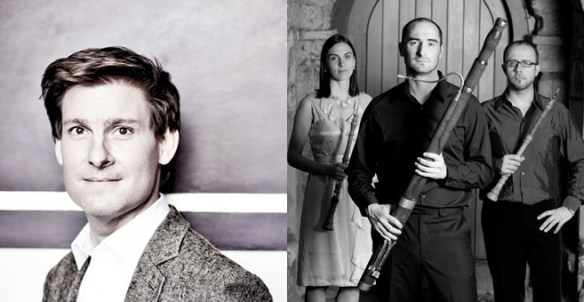
Michael Collins (clarinet) and the Borodin String Quartet (above) (Ruben Aharonian and Sergei Lomovsky (violins), Igor Naidin (viola), Vladimir Balshin (cello)

Wigmore Hall, London, 25 April 2016

written by Ben Hogwood

Audio (open in a new window)

http://www.bbc.co.uk/programmes/b07866f4

Available until 24 May

What’s the music?

Tchaikovsky, arr. Rostislav Dubinsky – Album d’enfants, Op.39 (1878) (29 minutes)

Mozart – Clarinet Quintet in A major, K581 (28 minutes) (1789)

Spotify

In case you cannot hear the broadcast, recordings of the music played can be found on the Spotify playlist below, including a recording of Rostislav Dubinsky’s arrangement:

About the music

Tchaikovsky’s Album d’enfants follows in the footsteps of Schumann’s collection for piano of the same name, yet this set of 24 piano miniatures is designed to be played by children as well. It includes dances, children’s pieces, portraits and flights of fancy, with most pieces little more than a minute and a half in length.

In it the composer allows his inner child to run free, in the same manner it was to do later in life in the ballets The Sleeping Beauty and The Nutcracker. This arrangement for string quartet was made by the Borodin String Quartet’s previous first violinist, Rostislav Dubinsky.

michael-collins

Clarinetist Michael Collins

Mozart’s Clarinet Quintet is probably the best known work for the combination of clarinet and string quartet, and it was written late in his life – 1789 – for the clarinettist Anton Stadler. It is written in A major, the same key the composer was to use for his final orchestral work, the Clarinet Concerto, and is notable for its sunny mood.

Performance verdict

This was a charming concert, though the Borodin String Quartet did take quite a serious approach to even the most infantile of Tchaikovsky’s character pieces. They were effective in their arrangements, and the quartet played with charm, delicacy and poise.

The Clarinet Quintet enjoyed a similar performance – serious but enjoying the work’s abundance of melody, although the decision not to employ the repeats Mozart marks in the first two movements changed its dimensions rather. Michael Collins was a good match, allowing himself a freer rein at times in the solo part, and while the quartet and clarinettist did not exchange much in the way of glances during the performance, theirs was an account notable for its unity. When played as beautifully as it was here, the Clarinet Quintet is as vivid an evocation of spring as you could wish to hear!

What should I listen out for?

Tchaikovsky

1:20 Morning prayer a charming, contented slow piece

2:42 A Winter morning – quite a blustery one by the sounds of it! Quicker interplay between the instruments

3:32 The Hobby-Horse – a quick portrait of a horse that seems to be difficult to capture!

4:17 Little Mother – soft and reassuring music that speaks of safety and warmth

5:55 March of the Wooden Soldiers – the title sounds like something out of The Nutracker, and the tune is similar. A crisp march.

6:49 The Sick Doll – the mutes are on for this fragile, mournful portrait, which sinks despondently into its minor key.

8:20 The Doll’s Funeral – the doll has now died, and this movement marks its passing with plaintive pizzicato.

9:49 The New Doll – the funeral has passed and a relatively quick and brief waltz, the face of the new doll lifts the mood from the doldrums.

10:29 Old French Song – A solemn piece, but with elements of warmth too. A beautifully scored movement, this has a lovely unison between first violin and cello.

11:48 German Song – this cheery dance has a jagged rhythm and opens out into quite a knees-up! The viola (I think) can be heard tapping its strings rhythmically half way through.

13:00 Italian Song – this has a lovely warmth, and the full part writing allows us to hear a lovely, rich quartet sound, with the cello plucking underneath.

14:15 Neapolitan Song – here the peasant is playing a form of concertina – and it sounds a lot of fun from the cello plucking and the sprightly tunes from the quartet!

15:24 Waltz – this has a lovely, simple tune for first violin, with the other instruments mostly off the beat.

16:52 Mazurka – a grand introduction from the cello with multiple stopping (playing more than one string at once), taken over by the violin

18:10 Polka – a charming, brief dance, lively and with some imaginative violin harmonics at the top end.

19:21 Russian Song – a solemn intonation from each instrument in turn, taking on the form of a canon but then settling to a relatively calm finish

20:21 The Peasant Plays His Ziehharmonika­ – the instrument effectively portrayed here is the concertina, the quartet playing as one.

21:05 Popular Song (Kamarainskaya) – this is brilliantly sent up by the violin especially, with squeaky high harmonicas like an old creaking chest of drawers

22:28 Sweet Dreams – a sentimental tune where Tchaikovsky allows some indulgence

24:43 The Old Nurse’s Tale The scratchy strings here give a lovely impression of old age, and the tale itself is lightly humorous.

25:40 The Witch: Baba-Yaga Even more scratchy is the old witch, played with the bows right close to the finger board for a more scary sound.

26:22 Song of the Lark The lark makes a beautiful sound here, thanks to the first violin over warm string accompaniment.

27:52 The Organ-Grinder Sings – over the held chords of the organ the first violin sings in a rather small voice.

29:02 In Church – a solemn finish to the cycle, given by the quartet in very subdued and rather eerie tones.

Mozart

27:07 – the first movement (marked Allegro) begins with the strings, a restful series of chords that are actually the first theme, a support for when the clarinet rises through the texture. Then, a minute later, the clarinet enjoys a tune that rises through the texture, floating gracefully. At 30:06 Mozart develops his ideas, the main theme coming back at 31:18.

34:01 – the second movement is marked Larghetto. In the key of D major, it is notable for its restraint and beautiful, spaced out melody heard on the clarinet at the outset. The melody returns at 37:50 in an even softer guise, peaceful and rather moving.

40:44 – a stately Minuet for the third movement, led by the clarinet but egged on by the strings. Mozart includes two contrasting ‘Trio’ sections – the first in the key of A minor (42:01). The Minuet section is repeated at 43:59 before a second trio at 44:40, another graceful dance led by the clarinet. The Minuet returns for the final time at 47:00.

47:47 – the final movement consists of a perky theme from the strings, embellished by the clarinet – and then five variations on it. The first (48:36) gives the clarinet a free reign, the next (49:30) hands over the baton to the first violin in an energetic section. The third (50:25) moves into the minor key and a brief shadow falls over the music, before 51:36, where the clarinet joyously lets itself go in the fourth variation. Then the music pauses, almost in an operatic sense, with a complete freedom of tempo as the clarinet leads the movement towards a close – where the perky theme reappears (54:36).

Further listening

Having heard the Borodin Quartet in sympathetic versions of Tchaikovsky, it makes perfect sense to expand that to the composer’s three published string quartets, which are relatively rare in concert these days. They are extremely enjoyable works. The First is notable for its slow movement, the Andante cantabile, which Tchaikovsky arranged for string orchestra, while the Third is a particularly poignant piece of work. As a bonus the album below includes the Souvenir de Florence, the composer’s String Sextet:

Howard Shelley & London Mozart Players – Mozart Explored – Piano Concerto no.27

sjssHoward Shelley & London Mozart Players, St John’s Smith Square, 2 March 2016.
Mozart Explored: Piano Concerto no.27

For the latest in their Mozart Explored series at St John’s Smith Square, Howard Shelley and the London Mozart Players turned their attention to the composer’s final work in the form.

It is astonishing when you pause to think that Mozart had already completed 27 piano concertos by the age of 35, quite apart from everything else he did. Even after the composition of this piece, when he was under all sorts of personal and financial pressure, he managed to write such ‘trifles’ as The Magic Flute, the Clarinet Concerto and the Requiem. So although the music here was shown to be wonderfully positive there was a twinge of sadness at a career cut so short.

Howard Shelley was the ideal guide, affable yet knowledgeable, and although his keyboard was positioned so he faced the orchestra rather than the audience this was a good move, for everyone in St John’s could see his hands at the keyboard – and as a result the music physically being made.

St John’s is a lovely venue for this music, a world apart from the incessant clamour of Parliament Square just around the corner – an oasis by the Thames. Shelley’s demeanour only aided this hour of escape, talking through the circumstances around the composition of the concerto and also getting to the nub of the main themes of each of the three movements.

And then the performance itself, which was beautifully and stylishly given. With the orchestra ideally sized, Shelley conducted them through the opening bars of the first movement before his own graceful solo part asserted itself, stressing the vocal nature of much of this music.

There was lovely interplay particularly with the woodwind, who were also a prominent feature of the second movement, which felt like an aria in Shelley’s hands. The finale, written in celebration of the onset of Spring, could have been a little misplaced given the bitterly cold wind outside, but it became a light footed and quite graceful dance, Shelley again taking the lead.

The LMP return on Thursday March 16 to turn their attention to Beethoven’s Emperor Piano concerto – and if you can make it the rewards will surely be many!

Wigmore Mondays – Armida Quartet play Mozart and Beethoven

The Armida Quartet play string quartets by the teenage Mozart and Beethoven – his first quartet for Count Razumovsky of Prussia

armida-quartetPhoto: Felix Broede

Wigmore Hall, London, 25 January 2016

written by Ben Hogwood

Audio (open in a new window) – available until 24 February

http://www.bbc.co.uk/programmes/b06xwtbp

What’s the music?

Mozart – String Quartet in G major, K80 (1770) (10 minutes)

Beethoven – String Quartet in F major, Op.59/1 (Razumovsky) (1806) (39 minutes)

Spotify

If you cannot hear the broadcast then this attached playlist has all the repertoire in the concert. The Armida Quartet have recorded a disc of Mozart but not this particular piece – so the Hagen Quartet version is included here, along with the Tokyo String Quartet in the first Razumovsky:

https://open.spotify.com/user/arcana.fm/playlist/726X8dueQnIBJOflr9jeIt

About the music

What were you doing when you were 14? I daresay you hadn’t completed a String Quartet lasting 20 minutes by then! The teenage Wolfgang Amadeus Mozart had managed that – he had also completed ten symphonies and numerous other works – and was about to witness the premiere of his first opera, Mitridate, in Italy with his father Leopold.

This string quartet was written on the road, between Milan and Parma – an early ‘tour album’, you could say! – and initially sat in three movements to conform with Italian taste. Later the composer added a fourth to suit German audiences. All were completed under the watchful eye of his father.

Beethoven dedicated three of his ‘middle period’ string quartets to Count Razumovsky, the Russian ambassador in Vienna at the time and a musical patron. At his request Beethoven included a Russian theme in each work, and in the first quartet it can be heard at the beginning of the last movement.

With these three quartets Beethoven noticeably expanded the form, no longer the intimate salon experience of Mozart but now a medium for the communication of extremely personal thoughts and big structures. The three works are big, each around 35-40 minutes in length, and they push the boundaries of string quartet writing so that on occasion the four instruments sound at least double the size. This one, Op.59/1 in F major, is the longest of the three and is notable for its profound slow movement (one of only two pieces marked mesto (sad) by the composer) and for the fun and games in its second movement Scherzo.

Performance verdict

The Armida Quartet are BBC Radio 3 New Generation artists, and on the strength of their Beethoven performance in particular they clearly have a very bright future.

This was excellent quartet playing, incredibly well balanced and full of vitality. Their sense of enjoyment in the second movement of the Beethoven was infectious, and throughout their quiet playing in particular was something to treasure, enabling them to reach the very sombre depths of the slow movement but also the dynamic contrasts used by Beethoven elsewhere. The outer movements contrasted nicely with this, being vibrant and humourous on occasion, and always revelling in the composer’s tuneful invention.

The Mozart was very stylish, possibly a little too rich in the first movement as the quartet recaptured the Italian style. The main emotion here was one of surprise at the composer’s sheer prowess – this is a remarkable work for someone the age of 14 to have turned out – but on occasion.

The quartet decided not to employ the repeats marked in each movement, effectively halving the length of the piece with the Beethoven in mind. A shame, perhaps, but not a decision that stopped us from sitting in awe of the adolescent’s genius!

Interestingly the quartet changed their seating arrangements during the concert. For the Mozart the violinists faced each other, with viola and cello in between, while for the Beethoven the cello and second violin swapped for a more conventional arrangement.

What should I listen out for?

Mozart

1:32 – the first of Mozart’s quartets is quite top heavy in structure, and it is the first movement that has a lot of the emotional and musical content, lasting nearly twice as long as any of the others. It starts with such elegance you would never know it was the work of a fledgling composer. There is assured writing for the four instruments, often divided into pairs in the part writing.

5:17 – a lively second movement, the four instruments playing in unison initially then moving apart.

7:33 – Mozart writes a graceful minuet for the third movement, one with a light spring in its step.

9:27 – the finale brings with it more open textured, bright writing for the quartet

Beethoven

13:40 – the piece starts quietly, the cello theme immediately evident before being passed to the violin. At 15:03 we hear the other main theme of the quartet, different in character – the music feeling more ‘established’ by this point. At 16:06 we hear the cello’s theme again, but now Beethoven moves this through a development section, chopping and changing it – before bringing it back for a recap at 19:40. By now the music feels increasingly restless, and continues to pass through a number of different forms and keys, until the quartet state the theme in fall, and the music falls away a little to the end, seemingly content.

23:44 – the ‘Scherzo’, traditionally the movement where composers show their witty side. Beethoven certainly does that here, picking a tune that can be cheeky or quite aggressive by turns. It starts sheepishly, but Beethoven varies the volume a lot in this movement, passing from very quiet to loud, often in a way that might make you jump!

The music then moves into the minor key for a contrasting ‘trio’ section, beginning at 30:00, but by 31:14 is back in the major key and playing with different volume levels again! Snippets of the main tune and other phrases are passed around until the soft finish at 32:16…though even this has a sting in the tail!

32:48 – the slow movement begins – and with it one of Beethoven’s saddest themes, heard on the first violin. While fragile at the start the music gains intensity and sounds rather tortured at times. At 37:48 we hear the sad music again, though it is higher and weightless in its new guise. Then Beethoven takes us through a section developing the tune, with a pensive and very intimate dialogue between the four instruments. This profound passage of play comes out of the doldrums and into…

46:05 – the last movement, based on a Russian folk tune – and immediately positive with the cello’s rendition of it. Beethoven structures this as a Rondo – a form that means the tune comes back repeatedly, with differing sections in between. Then at 51:31 we hear the tune very slowly, setting up a quick drive to the finish from 52:03.

Encore

54:09 – as an encore the quartet play Contrapunctus IV from J.S. Bach’s The Art of Fugue. The violin begins, then the second violin joins, then the viola and then the cello – all in a perfectly calculated example of how a fugue works with four parts. (3 minutes)

Further listening


Vilde Frang, Royal Scottish National Orchestra and Peter Oundjian – Viennese classics in Dundee

rsno
Ben Hogwood visits Dundee’s magnificent Caird Hall for an trio of Viennese works given by violinist Vilde Frang, the Royal Scottish National Orchestra and principal conductor Peter Oundjian
Caird Hall, Dundee, Thursday 12 November

Webern Langsamer Satz (1905), arr for string orchestra by Gerard Schwarz

Brahms Violin Concerto (1878)

Mozart Symphony no.41 in C, ‘Jupiter’ (1788)

What a magnificent setting for a concert. Dundee’s Caird Hall will be well known as an attraction by the locals but it bears repeating that the venue is an excellent acoustic for classical music, as the Royal Scottish National Orchestra conductor Peter Oundjian observed in his brief talk to the audience before the concert.

The high ceiling was perfect for the burnished ardour of Webern’s Langsamer Satz, written while the composer was still in a tonal way of thinking and in thrall to his hero Mahler. Although normally heard through the intimate medium of the string quartet, this arrangement, made by the conductor Gerard Schwarz for string orchestra, worked extremely well, and the RSNO strings made a beautiful and clean sound that left us in no doubt as to the composer’s feelings towards his cousin – who was later to become his wife.

The Norwegian violinist Vilde Frang then joined the enhanced orchestra for another Viennese piece, Brahms’s Violin Concerto­ – and in the process she built on a relationship already established with the erte concerto last year. Frang is not a player prone to exaggerated gestures or one-upmanship on the orchestra and this was the ideal approach for the Brahms, where the two forces work together and where the orchestra often have the better tunes. Oboist Adrian Wilson, acknowledged by Frang at the end, was superb in his slow movement solo, and while this was perhaps a more ‘classical’ reading looking back towards Schubert, Frang took the difficult and extended solo passages, particularly the cadenzas, by the scruff of the neck and refused to let them go.

Completing the Viennese trio was Mozart’s Jupiter symphony, his last – with Oundjian sensibly reducing the forces in the name of clarity. This was an extremely fine performance where the rapport between the RSNO and their conductor was abundantly clear, and where he ensured that Mozart’s deceptively simple themes were beautifully communicated and developed. A graceful minuet was notable for the floated violin delivery, though in the trio the minor key harmonies sowed the seeds of disquiet.

These were emphatically blown away by the finale, one of Mozart’s greatest achievements as a composer in his successful dovetailing of all five themes in a brilliantly worked fugue. Oundjian took this at a daringly fast tempo but we never lost sight of the tunes, the orchestra working incredibly hard to keep their lines clear and crisp. The enjoyment of all – players and audience – was clear, for this was music to banish even the squalliest of November nights.

Wigmore Mondays – Alexei Ogrintchouk and friends play music for oboe and string trio

Picalexei-ogrintchouk

Picture used courtesy of the BBC

Alexei Ogrintchouk (oboe), Boris Brovtsyn (violin), Maxim Rysanov (viola) and Kristina Blaumane (cello) – Wigmore Hall, London, live on BBC Radio 3, 12 October 2015

Listening link (open in a new window):

http://www.bbc.co.uk/programmes/b06hjxlv

on the iPlayer until 18 November

Spotify

In case you cannot hear the broadcast, here is a Spotify playlist of the music in this concert, from available versions on Spotify. Alexei Ogrintchouk has recorded the Mozart, while available versions of the Haydn, Britten and Schubert pieces are also included.

What’s the music?

Attributed to Haydn: Divertissement in B flat, HII:B4 (not known) (10 minutes)

Britten: Phantasy Quartet, Op 2 (1932) (13 minutes)

Schubert: String Trio in B flat, D471 (1816) (8 minutes)

Mozart: Oboe Quartet in F, K370 (1781) (14 minutes)

What about the music?

Often in chamber music the strings get a lot of the glory, so it is good to report on a concert where the oboe is invited to take centre stage. The instrument is on occasion associated with sad music (Midsomer Murders use it a lot!) and it is perfect for autumnal listening, but it should be remembered that the oboe is also responsible for a lot of happy music too, as Mozart’s Oboe Quartet testifies.

This piece is a beauty, seemingly free of any constraints in its outer fast movements, while the inner slow movement is short yet poignant, set in the minor key. Mozart wrote it for the virtuoso Friedrich Ramm, and composed the oboe line to sit above that of the violin, thus using the higher register of the instrument a lot.

Britten uses a wider range of colour in his Phantasy, written as a competition piece when he was at the Royal College of Music. Thanks partly to the advocacy of the legendary oboist Leon Goossens, but also to his musical craft, the piece won its competition in Paris. Set over nearly 15 minutes, it has a dramatic profile, beginning as a march that seems to process in from nothing – started by the cello – until the sweep of lyrical oboe and punchy strings together is striking.

The first piece in the concert is a two movement Divertissement attributed to Haydn but, it is not wholly certain who actually wrote it. To my slightly untrained ears it sounds like it could be earlier than Haydn, but regardless of who the composer is the music is polite and attractive, the four instruments set in close dialogue.

Schubert’s single movement for String Trio is in the same key – B flat major – and has a similar profile, though does make the most of a striking descending motif throughout. Originally Schubert wanted this to be the first movement of a bigger piece, but after sketching some bars of the slow movement he stopped writing.

Performance verdict

Over the last few years Alexei Ogrintchouk has developed from a very promising musician to an oboist right at the top of his game – and that was evident throughout a highly enjoyable concert.

The peak was undoubtedly reached in the Mozart, where he met the virtuosic demands of the piece head on but without losing the airy, lyrical approach that makes the Oboe Quartet such a charmer. The performance of the Britten dug in much more firmly, the strings encouraged to project outwards, and this they did with impressive power when the march took hold. Britten’s genius in working with small forms was evident even at this point, and not a note was wasted in the performance.

Both the Haydn and Schubert performances charmed, the Schubert nicely placed so that the strings had a brief moment in the sun – which they enjoyed, with lightness and dexterity, clearly listening to each other.

What should I listen out for?

Attrib.Haydn

2:01 – this light hearted piece begins with an oboe-led melody, while the cello supplies a chugging pulse. The music is polite and attractive. At 5:13 a central section begins, based on the melody from the start.

7:50 – a slightly slower second movement, a courtly dance – in the form of a rondo, which essentially means the same theme recurs at regular intervals. The violin and viola assume greater importance in this movement. The theme itself makes a final appearance at 11:02.

Britten

14:25 – the beginning is almost imperceptible, a little phrase from the cello which is gradually joined by the other two stringed instruments. When the oboe joins at 15:07 the tone is songful, though the spiky accompaniment continues, leaving some tension until a firm statement of the main tune at 16:12. Then a different section takes over, with heavier string writing.

20:25 – the writing now has a softer, hazy hue, as the strings enjoy a slower and more obviously lyrical section. At 22:30 a higher melody from the oboe floats above the texture.

24:52 – the main march idea makes a reappearance, striding forward purposefully – until the music fades, as though it were walking over the horizon and out of earshot.

You can read more about the Britten Phantasy on a blog entry I made two years ago here

Schubert

29:52 – the Schubert String Trio, set in one movement, begins with an attractive melody led by the violin. There is a distinctive downward sweep that is heard from 30:40, and which becomes an important part of the piece. The three instruments stay closely aligned throughout. After developing his main tune, Schubert restates it at 35:22.

Mozart

40:04 – the oboe is already high in its register when the distinctive tune of the first movement is heard, top of an extremely light texture. The strings are busy in their accompaniment. Mozart then proceeds to manipulate his memorable tune through different methods of presentation, until a slight lull at 43:53 – and the return of the main tune at 44:57.

46:44 – A slight shadow falls over the music for the second movement Adagio, where the strings are softer and the oboe a little mournful if still beautiful in its first melody. At around 48:57 the oboe is left exposed in a kind of cadenza, leading up to the thoughtful end.

49:57 – once again the brightness in this music is evident as a light hearted theme sways between oboe and strings. The oboe enjoys the recurrences of its tune, with Mozart subtly varying the accompaniment each time before finishing on the high ‘F’ of the oboe at 54:00.

Further listening

If you enjoyed the sound of the oboe, then a logical next step is a couple of orchestral pieces, added to the bottom of the playlist, that use the instrument to its fullest capabilities:

First of all is Ravel’s subtle but gorgeous Le tombeau de Couperin, the oboe taking up the first theme in the Prélude and also enjoying prominence in the slow Menuet.

Then we have Vaughan Williams’ beautiful, autumnal Oboe Concerto, heard here in a new recording from the oboist Nicholas Daniel. The wistful quality perhaps gives away the fact this piece was written in the Second World War. Daniel’s disc is reviewed on Arcana here