Summer serenades: Mozart

As part of Arcana’s occasional Sunday look at the serenade, we cannot leave out one of the finest examples in the form. Mozart‘s Gran Partita, composed in 1781, was written for 13 instruments – wind ensemble and double bass – and is in seven movements. It is a special piece of music, not least in the third movement Adagio. Here it is in a 1991 performance from the Bavarian Radio Symphony Orchestra conducted by Sir Colin Davis:

Published post no.2,232 – Sunday 7 July 2024

BBC Proms 2023 – Isabelle Faust, Alexander Melnikov, Les Siècles / François-Xavier Roth – Ligeti & Mozart

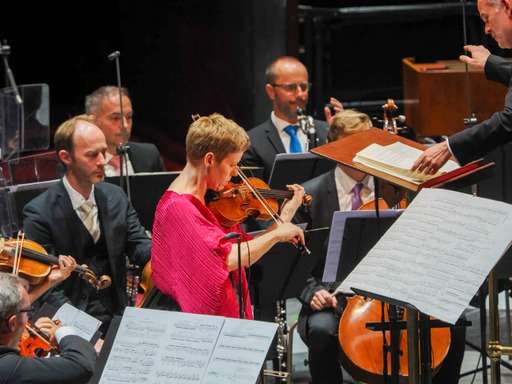
Prom 47 – Isabelle Faust (violin), Alexander Melnikov (fortepiano), Les Siècles / François-Xavier Roth

Ligeti Concert Românesc (1951)
Ligeti Violin Concerto (1989-93)
Mozart Piano Concerto No. 23 in A, K488 (1786)
Mozart Symphony No. 41 in C, K551, ‘Jupiter (1788)

Royal Albert Hall, London
Sunday 20 August 2023

by Richard Whitehouse photos by Sisi Burn / BBC

A major step in the evolution of musical ‘authenticity’ or vanity project of its artistic director? Celebrating its 20th anniversary, the Paris-based Les Siècles and François-Xavier Roth tonight made their third appearance at the Proms in a programme divided between Ligeti and Mozart.

Long in limbo as with most works of Ligeti’s early years, Concert Românesc now ranks as its composer’s primary crowd-pleaser – a ‘concerto for orchestra’ compact yet entertaining. Roth drew winsome charm from its initial Andantino and no mean impetus from its scherzo, before an Adagio whose dialogue of two horns (one high in the gallery) prefigures those intonational experiments three decades on. The finale did not lack verve, but anyone having heard Jonathan Nott give this piece for a Proms encore will recall just how much more scintillating it can be.

It may have had a long gestation, but Ligeti’s Violin Concerto is now established as the most recent such piece to have entered the repertoire. Technically assured but never merely showy, Isabelle Faust is a fine exponent, and it was not her fault if a lengthy platform reset made for a restive audience response in the teasingly understated Praeludium or plangent fervency of Aria, Hoquetus, Chorale which is one of the composer’s most potent inspirations. Diversely yet modestly scored, this work needs to be projected for its emotional impact to be felt and a certain bemusement met its coruscating Intermezzo and anguished Passacaglia, but not its engaging Appassionato in which Faust’s methodical cadenza fitted seamlessly into context. As, also, did the sparse Andante of Erwin Schulhoff’s Solo Violin Sonata given as an encore.

There was a similar sense of ends not always equating with means in Mozart’s Twenty-Third Piano Concerto after the interval. Playing a (Graf?) fortepiano from deep within the orchestra, Alexander Melnikov summoned playing of admirable dynamic subtlety and emotional poise – notably an Adagio whose bittersweet fatalism was consummately rendered. Just how much detail and articulation could be heard in the farther reaches of this acoustic was uncertain, but the rapport between soloist and orchestra in a sparkling final Allegro could hardly be gainsaid.

Playing to period-pitch in the second half (just occasionally offset by vagaries of intonation), Les Siècles came into its collective own with an engrossing account of Mozart’s Forty-First Symphony, its Jupiterian connotations evident from the outset of an opening Allegro whose distinction between (relative) dynamism and stasis was thrown into relief with Roth’s use of pause for expressive punctuation. Best here were an Andante whose muted while often dense textures were precisely articulated, then a Menuetto whose sweeping gait found contrast in a quizzical trio whose closing phrase was pointedly curtailed. Not that Roth had other than the measure of the finale, fully integrating its thematic unity into a powerfully controlled overall structure, but its underlying progress felt just a shade dogged in the light of what preceded it. That said, there was no lack of impetus when, after the longest of those pauses, Roth led his forces through the magisterial coda; duly setting the seal on a programme that played to this orchestra’s strengths if not always having been designed with the Royal Albert Hall in mind.

For more on the 2023 BBC Proms, visit the festival’s website at the BBC. Meanwhile click on the names for more information on artists Les Siècles, conductor François-Xavier Roth, violinist Isabelle Faust and pianist Alexander Melnikov. You can discover more about Ligeti at this dedicated website

BBC Proms 2023 – Felix Klieser, Bournemouth Symphony Orchestra / Kirill Karabits – Karabits, Mozart & Rachmaninoff

Prom 24 – Felix Klieser (horn), Bournemouth Symphony Orchestra / Kirill Karabits

Karabits Concerto for Orchestra no.1 ‘A Musical Gift to Kyiv’ (1980-81) [UK premiere]
Mozart Horn Concerto no.4 in E flat major K495 (1786)
Rachmaninoff Symphony no.2 in E minor Op.27 (1906-08)

Royal Albert Hall, London
Wednesday 2 August 2023

by Richard Whitehouse photos by Mark Allan / BBC

While not exactly a ‘best kept secret’, Kirill Karabits’ tenure at the helm of the Bournemouth Symphony Orchestra (soon to enter its 16th season) might have attracted even greater national attention than has been the case, with this evening’s Prom offering various pointers as to why.

One of Karabits’ concerns has been promotion of music from Eastern Europe in general and in particular Ukraine, where the role played by his father Ivan (1945-2002) was considerable. Written across the 1980s, the latter’s three Concertos for Orchestra follow on from those by his Russian forebear Rodion Shchedrin by homing in on facets of post-war music in a direct and accessible fashion. As its title indicates, his first such piece commemorates the Ukrainian capital – here the 1500th anniversary of its founding – over the course of a single movement whose monumental if never impersonal introduction leads into a series of evocatively scored episodes that culminate in a shimmering climax replete with the pealing of bells. The ending, as atmospheric as it proves unexpected, is just the most striking aspect of this engaging work.

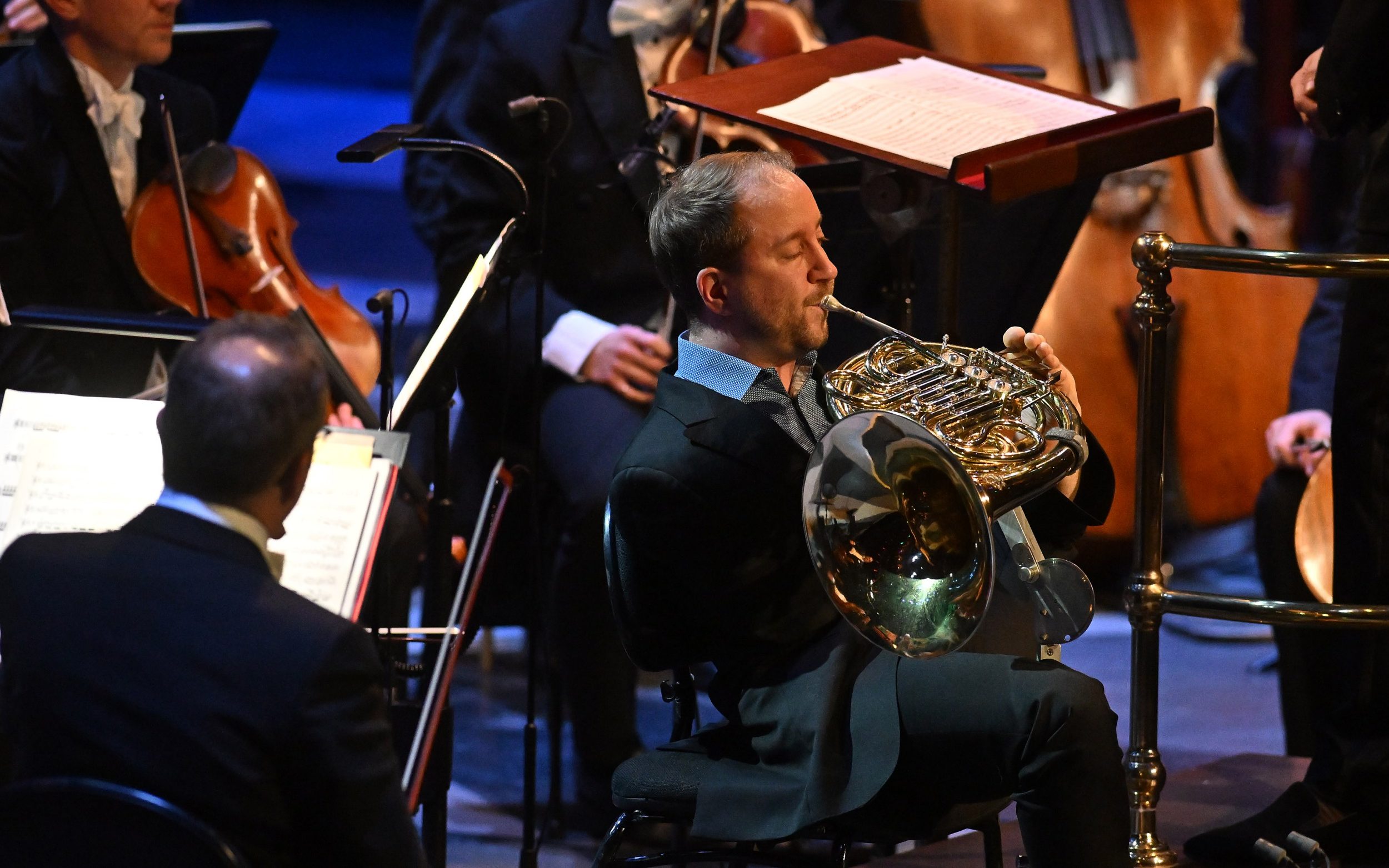
Equally unexpected, for those previously unaware, was the emergence of Felix Klieser on the Albert Hall platform to play Mozart’s Fourth Horn Concerto with his left foot. Not that those listening on the radio would have sensed anything unusual about this performance, Klieser’s warm and rounded tone a throwback to an earlier generation though melding seamlessly into the reduced orchestral forces. Most popular of its composer’s four such pieces (but not heard complete at the Proms for 34 years), its opening Allegro unfolded with an admirable balance between energy and grace; the Romanza exuding a charm that was never cloying and the final Rondo a pert humour. Clearly having enjoyed his appearance on this stage, Klieser returned for the finale of Mozart’s Third Horn Concerto with its even more overt hunting associations.

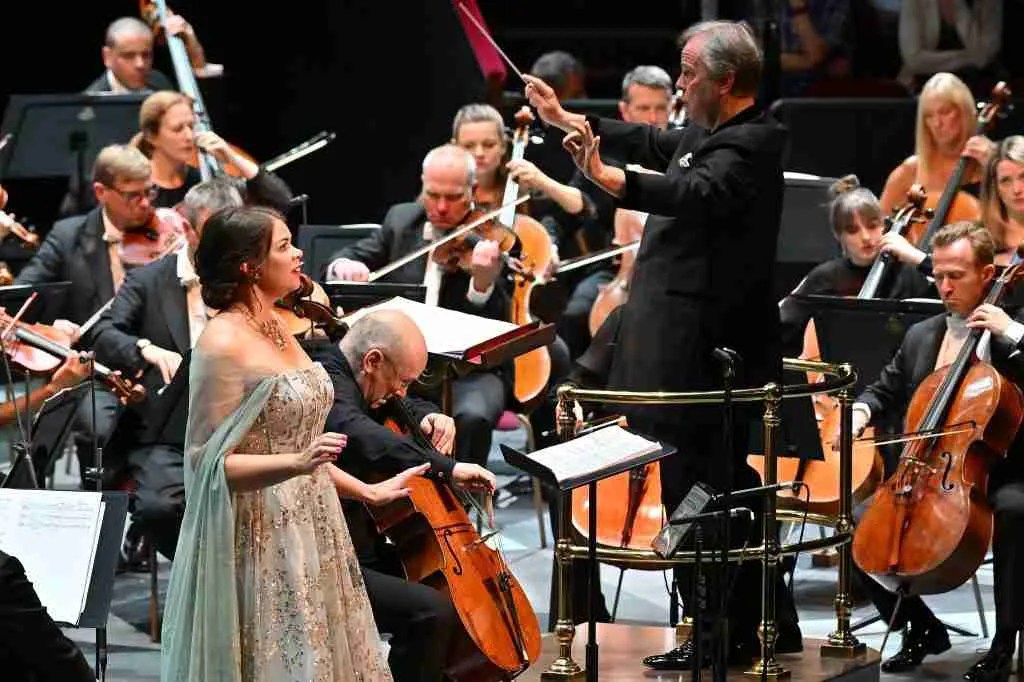
Prom 24 – The Bournemouth Symphony Orchestra conducted by Kiril Karabits (Felix Klieser horn) perform Ivan Karabits: Concerto for Orchestra No. 1, ‘A Musical Gift to Kyiv’ UK premiere, Wolfgang Amadeus Mozart: Horn Concerto No. 4 in E flat major and Sergey Rachmaninov: Symphony No. 2 in E minor at the Royal Albert Hall on Wednesday 2 August 2023 Photo by Mark Allan

Karabits (above) has not yet added Rachmaninoff to his Bournemouth discography, but his account of the Second Symphony suggests he should do so. A sombre yet alert introductory Largo set the course for an opening movement whose eschewal of histrionics did not preclude a powerfully cumulative response to its lengthy development or decisive take on its brief coda. The scherzo then had the requisite incisiveness, and if Karabits slightly over-indulged the ‘big tune’, there was no lack of impetus across its headily contrapuntal trio or glinting irony in its closing bars.

Almost over-familiar now, the slow movement demonstrably gained from a flowing and even lilting tempo such as encompassed its rapturous central section as securely as its serene main melody – with Barry Deacon the eloquent clarinettist on its first appearance. Uncut or not the finale can outstay its welcome, but Karabits duly had the measure of its festive progress – his headlong tempo making for a slightly jarring transition into the secondary theme, but with the gradual subsiding of activity at the centre then its stealthy re-accumulation assuredly handled.

Nor was the focus of his approach to this movement’s culmination in doubt, the return of the work’s ‘motto’ setting the seal on an engrossing and unusually cohesive reading which augurs well for this partnership even after Karabits relinquishes his post at the close of next season.

For more on the 2023 BBC Proms, visit the festival’s website at the BBC. Click on the names for more information on Felix Klieser, Kirill Karabits and the Bournemouth Symphony Orchestra – and composer Ivan Karabits

In appreciation: Coralie Hogwood

by Ben Hogwood, editor

Here is a personal blog for Saturday 22 July – as on this day, my mother Coralie would have been 80 years old.

I owe my mum and dad a huge debt of gratitude, not just for bringing me up in the way they did but for playing music to me when I was young, and encouraging my love of classical music (they didn’t know about the prog rock and techno until a good deal later!)

As a thank you to Mum, who we still miss greatly, I have picked out some of her favourite classical pieces. She loved guitar music, and few pieces made her smile more than Rodrigo’s Concierto de Aranjuez, with its bright first movement:

Another fresh-faced favourite was Mozart’s Clarinet Quintet, a set work that she studied at ‘O’ level but one that stayed with her:

Scotland held a special place in Mum’s heart, and while her favourite places were Oban and Mull, one piece that never failed to move was the wonderful Farewell To Stromness by Sir Peter Maxwell Davies:

Happy birthday Mum – and thank you.

In concert – Benjamin Grosvenor, CBSO / Riccardo Minasi: Schubert, Chopin & Mozart

Benjamin Grosvenor (piano), City of Birmingham Symphony Orchestra / Riccardo Minasi

Schubert Overture in C major ‘In the Italian style’ D591 (1817)
Chopin Piano Concerto no.2 in F minor Op.21 (1830)
Mozart Symphony no.41 in C major K551 ‘Jupiter’ (1788)

Symphony Hall, Birmingham
Thursday 1 June 2023 (2.15pm)

Reviewed by Richard Whitehouse

It is not often these days to have a whole concert of music from the late Classical and early Romantic eras, but that was just what the City of Birmingham Symphony Orchestra provided this afternoon under the disciplined as well as immensely assured direction of Riccardo Minasi.

There was no mistaking the inherent classicism of Chopin’s Second (sic) Piano Concerto – not least the simmering impetus in its opening Maestoso where, after a forthright tutti, Benjamin Grosvenor rendered those main melodies with requisite poise, and the emotional eddying of its development in direct contrast to the terseness of its coda. Most memorable was a Larghetto of melting eloquence but also, in its central episode, a volatility only gradually dispelled. Here, and in the final Allegro, the almost concertante role allotted to bassoon was characterfully taken by Nikolaj Henriques – as were those brass fanfares and col legno writing for strings (was this really Chopin’s idea?) which see the latter movement on its way to a spirited close. A limpid take on Chopin’s Nocturne in C sharp minor from the same year made for an appropriate encore.

Mozart symphonies rarely conclude a programme nowadays, yet the last four are ideal for this purpose and none more than the Forty-First – by some distance the weightiest and the most physical such work prior to Beethoven’s Eroica. This was the highlight of Minasi’s recording of the final triptych (Harmonia Mundi), with the opening Allegro likewise a statement of intent in its rhythmic tensility and general bravura, though its more ambivalent asides were never downplayed. Less distinctive melodically than its two predecessors, the Andante is memorable for its expressive understatement and a subtlety – with wind and strings enfolded into a textural continuity – that accentuates its pathos. Nor was there any lack of suavity in the Menuetto, its outer sections finding ideal contrast with a trio whose pert expectancy was delectably pointed.

The final Allegro crowns this work in every respect and, here again, Minasi did not disappoint. Not that there any sense of merely ‘going through the motions’ with his inclusion of first- and second-half repeats, each of which brought added intensity to what had gone before as well as enabling the wealth of contrapuntal detail to come through as it too rarely does. For its part the CBSO more than rose to the challenge, not least in a coda whose methodical combining of this movement’s themes makes possible an apotheosis such as felt truly visceral in its affirmation.

Schubert evidently had other preoccupations when essaying his two overtures ‘in the Italian style’, both of which have fallen out of the repertoire this past half-century but which make for attractive and appealing curtain-raisers. Especially that in C major with its teasingly portentous introduction, jocular and lilting main themes, then coda which sees it through to an effervescent close. The CBSO players (woodwind in particular) audibly enjoyed making its acquaintance, and it would be a real pity were such pieces relegated to the lower reaches of today’s playlists.

Hopefully a performance such as that by Minasi will make this just a little less likely. One looks forward to his future collaboration with this orchestra, which returns next Wednesday with its chief conductor Kazuki Yamada in a programme featuring Holst, Beethoven and Rachmaninoff.

You can read all about the 2022/23 season and book tickets at the CBSO website. Click on the artist names for more information on Riccardo Minasi and Benjamin Grosvenor